



Vibration pump or rotary pump? What the pump means for espresso
 Benjamin Hohlmann
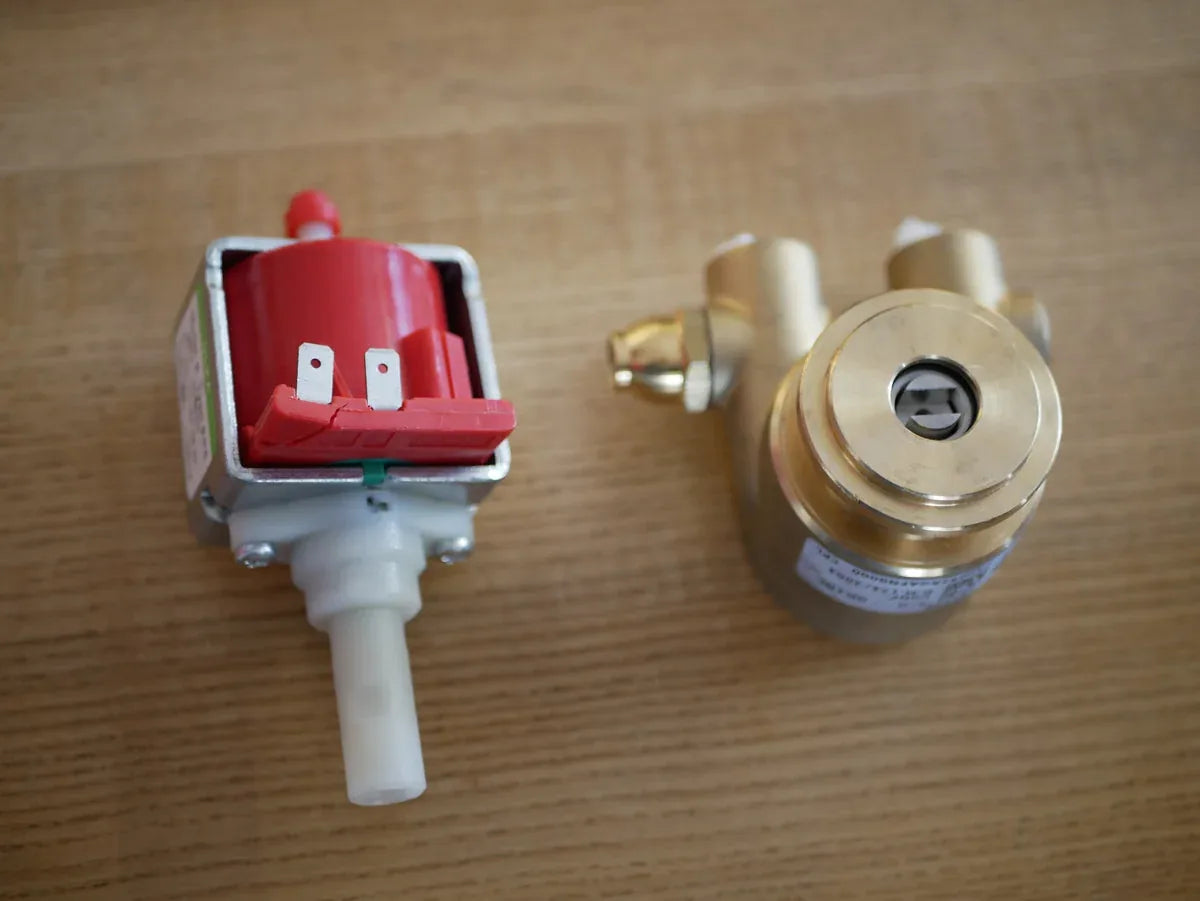
Almost every home espresso machine has one of two pumps inside: a vibration pump or a rotary pump. One costs around 20 to 40 euros and fits in any small housing, the other needs its own motor and quickly makes a machine 200 to 400 euros more expensive. For a few years now, there's been a third type added to the mix, one that used to be found only in commercial machines: the gear pump.
Which pump makes better espresso? We've now tested more than 60 espresso machines according to our protocol and measured the noise level; for some we've also double-checked the pressure at the portafilter. Here's what sets the three pumps apart, what you should watch for when buying, and which tested machine has which pump.
For most households, a vibration pump is sufficient if the machine has an expansion valve. For beginners, we even consider it the better choice, because its gentle pressure buildup prevents channeling. A rotary pump is worth it if you want to connect the machine to mains water, make many drinks in a row, or are looking for a quiet machine. The gear pump is the pump for pressure profiles. Grind size, recipe, and temperature have a much stronger effect on taste than the pump.
How loud the pumps are: 56.4 dB rotation, 62.2 dB vibration
You'll hear the difference immediately. The vibration pump hums, the rotary pump purrs, and the gear pump sounds more scraping, like a door squeaking quietly.
Measured, it looks like this: Across 24 machines with vibration pumps, we average 62.2 dB; across 11 machines with rotary pumps, 56.4 dB. About 6 dB difference, which you can clearly hear. The range is large, though. The quietest vibration pump in our measurements, the Lelit Mara X, sits at 53.0 dB, below almost all rotary pumps. The loudest, the Stone Espresso, reaches 74.0 dB. So how loud a machine is also depends on how well the pump is mounted and how well the housing is damped.
Vibration pump: magnet, piston, and seven seconds of startup
A vibration pump has an electromagnet powered by alternating current. It pulls a hollow piston back against a spring; water flows through the piston as it does. When the magnetic field collapses, the spring pushes the piston forward again and forces a small amount of water through a check valve toward the machine. Standard pumps have a diode built in and therefore only work with one half-wave of the current; at 50 Hz, that's 50 strokes per second. Hence the hum.
The best-known brand is Ulka. Their pumps are found in machines from DeLonghi to Rancilio to Profitec. A typical pump delivers up to 15 bar. More important is how it behaves under load: the more back pressure, the less water it delivers. At closed outlet it delivers its maximum pressure; at open outlet it delivers the most flow.
For espresso, this means: pressure builds slowly. With a brew ratio of 1:2.5, it takes about seven to eight seconds before the first drops come and the machine reaches 9 bar. During this time, the coffee gets wetted and can expand. This works like built-in pre-wetting and forgives one or the other mistake in preparation. What this means for your recipes is in our article on extraction time; more on the topic of pre-wetting in the article on pre-infusion.
A vibration pump is inexpensive and easy to swap out. On average it lasts five to six years, so through the second or third service. You'll notice it's reached the end when the pressure doesn't build up as much as before. Scale shortens the lifespan; soft water lengthens it.
With or without an expansion valve: 9 bar or 13 bar on the puck
With vibration pumps, there are two designs, and the difference is bigger than between vibration and rotary pumps.
Without an expansion valve, full pump pressure goes to the coffee. How much actually applies depends only on the resistance in the portafilter, so grind size and dose. If you grind coarser, you might be at 6 to 8 bar. If you grind very fine for a ristretto, the pressure quickly rises to 12 or 13 bar. This is found mainly in cheap thermoblock machines. The DeLonghi Dedica is such a case.
This has a side effect that leaves many in despair when adjusting their grinder. At 12 or 13 bar, the coffee puck is compressed so much that barely any water gets through. At 8 to 9 bar, the same grind size might have gone through just fine. So the problem stacks: too fine, more pressure, even tighter.
With an expansion valve, there's an overpressure valve behind the pump that's adjusted with a screw. If pressure rises above the set value, usually 9 to 9.5 bar, excess water flows back to the tank or in front of the pump through a hose. The brew pressure can't rise further, no matter how fine you grind. This is true for almost all dual boilers and dual boilers with vibration pumps, but also for single boilers like the Profitec Go 2.0, where you can adjust the valve under the cup tray.
To backflush with the blind basket, your machine needs a three-way valve. After the shot, it releases the pressure from the brew group into the drip tray, and that's exactly where you flush the cleaning agent during backflushing. Without it, the water has nowhere to go: pressure stays in the group, the cleaning agent doesn't rinse out, and hot water sprays at you when you unscrew. With these machines you don't need to backflush anyway, because no coffee water flows back into the machine. Cheap machines without an expansion valve often also don't have a three-way valve; the DeLonghi Dedica, for example, has neither. Whether your machine has one, you can hear: if it hisses briefly into the drip tray after the shot, it's installed. If in doubt, check the user manual.
Rotary pump: motor, four slides, full pressure immediately
A rotary pump consists of two parts: a large electric motor and the pump head. Inside the pump head, a wheel with four slides rotates and moves outward with each revolution, transporting water forward. Technically this is called a vane pump. Each revolution delivers approximately the same amount of water.
Because the motor has a lot of power, the set pressure is there almost immediately. It's adjusted via a screw at the pump outlet, the so-called bypass valve. What's too much flows back inside the pump to the inlet side. Home machines usually have pumps with 50 or 100 liters per hour; commercial machines tend to have 150 to 200 liters.
This has two consequences for espresso. First, the gentle startup phase of the vibration pump is missing. Full pressure hits the coffee puck directly, and if it's not prepared cleanly, the risk of channeling increases. Second, many roastery recipes come from machines with rotary pumps. With a vibration pump, you therefore add a few seconds, as described in our +3-second rule.
The advantages: a rotary pump is quieter, can handle mains pressure, and can therefore be easily connected to mains water. If the mains pressure is too high, install a pressure reducer in front. And it lasts. Technicians we spoke with figure on ten years and more. The downside: the pump itself costs about 200 euros more, weighs significantly more, and needs space.
Multi-group machines: about 0.4 bar less per group
In gastronomy, two or three groups often run on one pump. We measured this on our commercial machines. If you start on group 1 at just under 9 bar on the portafilter and add group 2, the pressure drops about 0.4 bar. With the third group, another 0.4 bar.
This is noticeable. I know of a four-group machine that worked very well with one shot and didn't run consistently with four shots side by side. The solution is multiple pumps. In commercial machines, these are rotary or gear pumps.
Gear pump: precision for pressure profiles
A gear pump has two gears that mesh together and are manufactured to micrometer accuracy. They sit next to each other in a tightly fitting housing. The water travels in the gear gaps along the outside of the housing wall from inlet to outlet; in the middle, the meshing teeth seal. Per revolution it delivers a very precise amount, and because it has many small chambers, it can be controlled more finely than a rotary pump with four chambers or a vibration pump with one. It's driven by a DC motor whose speed the electronics control.
This is what makes the gear pump the pump for pressure profiles. You tell the machine, for example: three to four seconds at 1 to 3 bar, then 9 bar for about 20 seconds, then gradually down to 5 bar at the end. The pump executes that immediately without pulsing. Strictly speaking, it determines the flow, the pressure arises from the resistance of the coffee. For the machine to maintain a pressure value, a sensor continuously measures, and the electronics adjust the speed. With a vibration pump, such a low pressure doesn't work cleanly because you lack the force at low output.
Until now, the gear pump was mainly found in commercial machines like the La Marzocco Strada or the La Cimbali M100, there with one pump per group. Meanwhile it's arriving in home devices, for example in the WPM Primus for around 2,000 euros, which we just tested.
With the Primus, it measures like this: when the pump ramps up to 9 bar and needs to work properly, the machine hits 66 dB. We don't mind the noise while brewing; on the contrary, you can hear what the pump is doing. The Primus's flow mode, on the other hand, we barely used: the strength of this pump is pressure, and that's what it's built for.
Precision has two drawbacks. A gear pump quickly costs 250 euros and more depending on size. And it doesn't like scale. In gastronomy it runs with ion exchangers, water treatment, and fixed maintenance intervals. At home you're responsible for it yourself, and here the rule is: the softer the water, the better. What water you need is in our article on coffee water.
What the pressure gauge shows: 9.8 bar on the machine, 8.9 bar in the portafilter
Many machines have a pressure gauge showing the brew pressure. But that doesn't mean that exact pressure is on the coffee. We double-checked on our commercial machines with a measurement portafilter. Most showed 9 to 10 bar, but the portafilter often saw almost 1 bar less. With a Rancilio Specialty, the gauge showed 9.8 bar and the portafilter showed 8.9 bar.
The reason is physics. The pump creates pressure and flow. On the way to the coffee, the water loses pressure: in every line, at every bend, in every solenoid valve. The coffee puck itself is also such a resistance, and the last and greatest one. The faster the water flows, the greater the losses. The gauge only measures the static pressure at the point where it's connected. If that point is directly behind the pump, it shows more than reaches the puck. That's why pressure gauge values between two machines are barely comparable.
Add to that a component many don't know about. Every E61 brew group has a small nozzle, the gicleur. It's a fixed restriction that slows flow before the water reaches the coffee. More on the group is in our article on the E61 brew group.
Every pump can be regulated: valve, restriction, or output
It used to be said: pressure profiles only work with a gear pump. That's not true. All three pump types can be regulated in output. That you rarely see it in espresso machines is about the effort, not the physics. Basically there are four ways to influence pressure and flow on the coffee:
| Method | How | Examples from our tests |
|---|---|---|
| Limit pressure | Expansion valve or bypass opens above a fixed value | almost all dual boilers and dual boilers |
| Fixed restriction | Nozzle in front of coffee | Gicleur in every E61 group |
| Variable restriction | Needle valve, manually adjusted via a paddle | Lelit Bianca V3 |
| Regulate pump output | Electronics control stroke, speed, or cycle of pump | Decent, Roxy, Lelit Pagaia, Maro Model 1, WPM Primus |
Pumps differ in output control. A vibration pump has the worst control behavior because only the stroke can be influenced. With a phase angle control, the electronics cut off part of each power wave; the piston makes shorter strokes. At low output the pump can get stuck. The Roxy takes a different approach: it switches individual strokes on and off deliberately; each stroke runs at full force, only the number of strokes decreases. This allows even slow flow profiles.
Rotary pumps in espresso machines usually run on AC motors and are only switched on and off. With a DC motor, the pump gets more compact and can be controlled via speed. The Maro does this via pulse-width modulation: the electronics switch the motor voltage very quickly on and off. The motor keeps running, and the on-off ratio determines its speed. A flow sensor behind the pump and a pressure sensor above the brew head report back continuously; the electronics adjust accordingly. Such a closed-loop control system is the difference between a machine that provides a profile and one that actually maintains it.
For beginners, the better choice: less channeling from gentle pressure buildup
It used to be said that the rotary pump was the better pump and the vibration pump a cost-saving solution. We see it differently today. If you're starting with espresso, you're often better served with a vibration pump and expansion valve.
The reason lies in the pressure buildup. The vibration pump ramps up slowly in the first few seconds. Water gradually saturates the coffee puck, the coffee swells, and only then does full pressure apply. A rotary pump, by contrast, smacks the pressure almost immediately onto the dry puck. If there's a loose spot in it, a crack, or a nest of coarse coffee, the water finds its way exactly there. That's channeling: part of the coffee is over-extracted while the rest stays sour and thin.
This is exactly what happens to beginners frequently. Puck preparation isn't down yet, the grinder may not be the best, particles are distributed unevenly. The gentle startup of the vibration pump makes up for some of that. By our experience, there's less channeling this way, and overall you get the better coffee.
With a rotary pump, you can achieve this too, but it needs built-in pre-infusion or clean preparation every time. The caveat from above remains important: without an expansion valve, the advantage reverses because pressure can then reach 12 or 13 bar at the end.
Can you taste the difference?
Between a vibration pump with expansion valve and a rotary pump with the same pressure, the difference in the cup is small. The pump delivers water under pressure; coffee, grind size, recipe, and temperature make the taste. A rotary pump in a machine with fluctuating temperature makes worse espresso than a vibration pump in a well-built machine.
What differs is the behavior during pressure buildup, and that mainly matters with imperfect preparation. That's why each espresso at our place has its own recipe, with one variant each for machines with pressure profile, rotary pump, and vibration pump. You'll find it on the page for each coffee.
Pressure profiles make the biggest difference in the cup. In our basement and in gastronomy, where we work with profiles, espressos almost always taste better than at constant 9 bar. There are exceptions, coffees where the profile barely improves extraction. Usually, though, body, intensity, or the interplay of acidity and sweetness can be deliberately refined with a profile. That's why the pump becomes more important: how well it can be controlled matters.
Vibration pump, rotary pump, and gear pump compared
| Vibration pump | Rotary pump | Gear pump | |
|---|---|---|---|
| Principle | Magnet, piston, spring | Motor, wheel with four slides | Two meshing gears |
| Pump price | approx. 20 to 40 euros | approx. 200 euros more | from approx. 250 euros |
| Pressure buildup | Slow, approx. 7 to 8 s | Immediate | Immediate, controllable |
| Noise level (our measurements) | Ø 62.2 dB | Ø 56.4 dB | 66 dB (WPM Primus) |
| Lifespan | approx. 5 to 6 years | 10 years and more | No experience values yet |
| Mains water | Only with extra effort | Simple | Depending on machine |
| Controllability | Limited | Good with DC motor | Very good |
Which pump is right for you?
You have one to four espressos or cappuccinos a day and don't mind a water tank? Then a vibration pump with expansion valve is enough, and especially if you're new to espresso, it's the more forgiving pump. The money you save goes better toward a good grinder. When buying, check whether the machine has an expansion valve. For beginners, check our comparisons of single-group machines and thermoblock machines.
You want to connect the machine to mains water, make eight cappuccinos in a row when guests come over, or get up earlier than the rest of the family? Then a rotary pump is the right reason for the extra cost. You'll find most machines with rotary pumps in our tests of dual boilers and dual-group machines.
You want to work with pressure or flow profiles? Then what counts isn't just the pump, but the control behind it. That can be a gear pump, but also a well-controlled vibration pump like in the Roxy or a rotary pump with sensors like in the Maro. For an overview of all designs, see our article Which espresso machine is right for you; all tests are on our espresso machine overview page.
All tested espresso machines by pump type
Here are all machines from our test field, sorted by pump. Click on the name for the full test.
With vibration pump
| Model | Type | Noise level* |
|---|---|---|
| ACM Homey | Dual-group | – |
| Arkel Coast | Dual boiler | 57.4 dB |
| Ascaso Steel Duo PID | Thermoblock | – |
| AVX-DB1 Hero X | Combo | 64.8 dB |
| Bezzera BZ10 | Dual-group | – |
| Bezzera Magica S | Dual-group | – |
| Decent Espresso | Thermoblock | – |
| DeLonghi Dedica EC685 | Thermoblock | – |
| ECM Mechanika V Slim | Dual-group | – |
| Gaggia Classic Evo Pro E24 | Single-group | 69.1 dB |
| Gaggia Classic GT | Dual boiler | 63.4 dB |
| Gaggia New Classic | Single-group | – |
| Lelit Elizabeth | Dual boiler | 63.5 dB |
| Lelit Elizabeth 3 | Dual boiler | – |
| Lelit Mara X | Dual-group | 53.0 dB |
| Lelit Mara X3 | Dual-group | 64.2 dB |
| Lelit Victoria PL91T | Single-group | 65.0 dB |
| Ligre Youn | Combo | – |
| Profitec Go 2.0 | Single-group | 60.1 dB |
| Profitec Move | Dual boiler | 57.0 dB |
| Profitec Pro 300 | Dual boiler | 57.0 dB |
| Profitec Pro 600 | Dual boiler | – |
| Quick Mill Carola | Single-group | – |
| Quick Mill Evo 70 | Thermoblock | – |
| Quick Mill Luna | Thermoblock | – |
| Quick Mill Orione 3000 | Single-group | – |
| Quick Mill Rubino | Dual-group | – |
| Rancilio Silvia | Single-group | – |
| Rancilio Silvia Pro X | Dual boiler | – |
| Rocket Appartamento | Dual-group | – |
| Rocket Appartamento TCA | Dual-group | – |
| Roxy Espresso | Thick film heater | 58.4 dB |
| Sage Bambino Plus | Thermoblock | – |
| Sage Barista Express Impress | Thermoblock | 67.0 dB |
| Sage Barista Pro | Thick film heater | – |
| Sage Barista Touch | Thick film heater | – |
| Sage Dual Boiler | Dual boiler | – |
| Sage Oracle Dual Boiler | Dual boiler | 60.0 dB |
| Sage Oracle Jet | Thick film heater | – |
| Satrap Espresso XA | Thermoblock | – |
| Smeg ECF01 | Thermoblock | – |
| Solis Barista Perfetta Plus | Thermoblock | 64.4 dB |
| Stone Espresso | Dual-group | 74.0 dB |
| Xenia | Dual-group | – |
| Zuriga E2 Generation 2 | Thick film heater | – |
With rotary pump
| Model | Type | Noise level* |
|---|---|---|
| Ascaso Baby T Plus | Combo | – |
| Bezzera Duo Top DE | Dual boiler | – |
| Dalla Corte Mina | Dual boiler | 53.0 dB |
| Dalla Corte Studio | Dual boiler | 54.0 dB |
| ECM Estetika | Dual boiler | 57.7 dB |
| ECM Synchronika | Dual boiler | – |
| Faema Faemina | Dual boiler | – |
| La Marzocco GS3 | Dual boiler | 60.6 dB |
| La Marzocco Linea Micra | Dual boiler | 58.3 dB |
| La Marzocco Linea Mini | Dual boiler | – |
| La Marzocco Linea Mini R | Dual boiler | 60.0 dB |
| Lelit Bianca V3 | Dual boiler | – |
| Maro Model 1 | Thick film heater | 48.8 dB |
| Meraki Espresso | Dual boiler | – |
| Rocket Mozzafiato R Fast | Dual-group | 62.2 dB |
| Rocket R Cinquantotto | Dual boiler | – |
| Sanremo Cube R | Dual-group | – |
| Sanremo YOU | Dual boiler | 54.0 dB |
| Victoria Arduino Eagle One Prima | Dual boiler | – |
With gear pump
| Model | Type | Noise level* |
|---|---|---|
| WPM Primus | Boiler with two thermoblocks | 66 dB |
* Noise level according to our current measurement standard. Where a dash appears, we measured the machine using the older method. These values are not comparable and therefore not included in the table.
Frequently asked questions
How long does a rotary pump last?
Ten years and more, if the water is right. A vibration pump usually needs to be replaced after five to six years. That's not a big job; the pump costs 20 to 40 euros.
What's quieter, vibration pump or rotary pump?
On average the rotary pump, by about 6 dB in our measurements. But a well-dampened vibration pump can be quieter than a poorly mounted rotary pump. The Lelit Mara X sits at 53.0 dB, below almost all rotary pumps in our test field.
Can you connect a machine with a vibration pump to mains water?
Usually not. Vibration pumps aren't built for pressure on the inlet side; a few machines have a special solution for this. If you want mains water, buy a machine with a rotary pump.
Can I adjust the pressure on a vibration pump?
Yes, if the machine has an expansion valve. Then you adjust the maximum pressure via a screw on the valve, ideally with a measurement portafilter. Without an expansion valve, only grind size determines how much pressure reaches the coffee.
Is a rotary pump worth it?
For mains water, many drinks in a row, and a quiet kitchen, yes. For better espresso alone, it's not. A better grinder or a machine with pressure profile will help you more.
Conclusion
The question "vibration pump or rotary pump" is usually overstated. A vibration pump with expansion valve makes excellent espresso and is even the better choice for beginners: its gentle pressure buildup prevents channeling and forgives mistakes in grinder and preparation. A rotary pump is quieter, lasts longer, and can be connected to mains water, but costs more. When buying cheap machines, especially check whether an expansion valve is built in. That matters more for espresso than pump type.
What matters more is the control. With pressure and flow profiles, our espressos almost always taste better, and that requires a pump that can be precisely controlled. The gear pump is built for that, but vibration and rotary pumps can do it too if the electronics behind them are right.