



























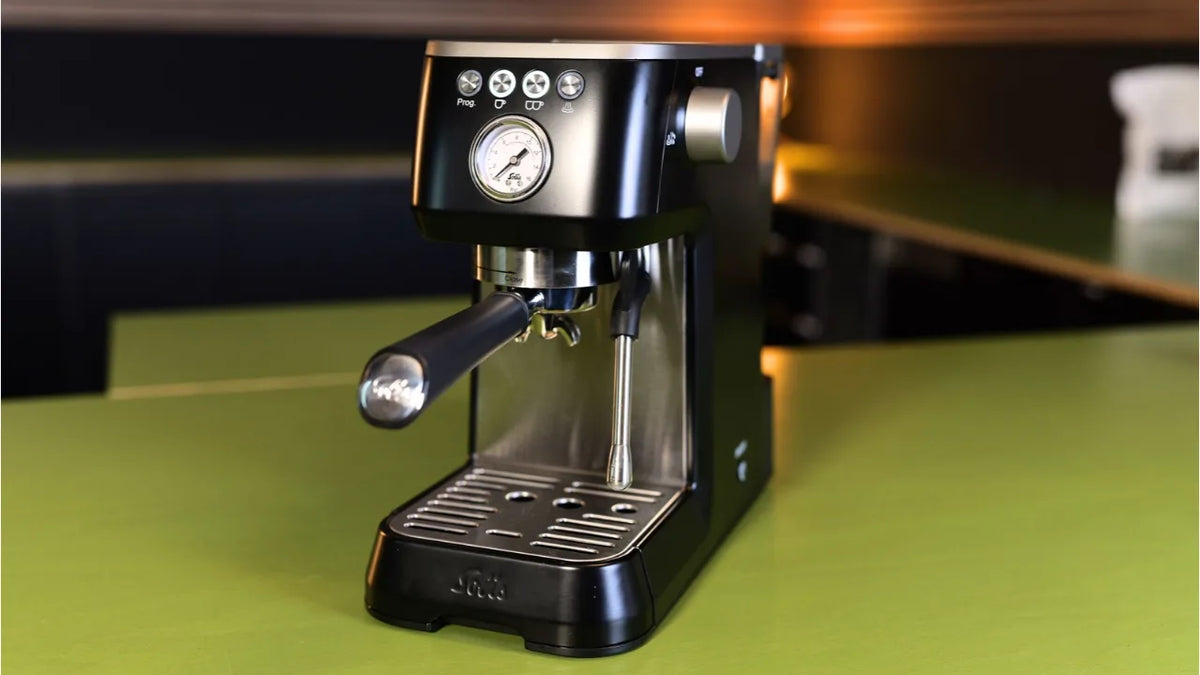

The Solis Barista Perfetta Plus in the test: For around 350 euros, you get a compact thermoblock machine that is ready to brew after 2 minutes, needs hardly any electricity, and froths milk beautifully. With espresso, it struggles, mainly because of the temperature. The small thermoblock machine was already in our test a few years ago. At that time, we tested it according to our standard at the time, using a homemade measuring portafilter. As a community, you asked us to take another look: the milk foam was so good, maybe we weren't precise enough with the temperature.
So we re-measured it according to the latest version of our test protocol. As a coffee school and roastery, we look at three questions for every machine: Is the espresso good? Does the machine deliver consistently, shot after shot? And how good is the milk froth?
A conclusion upfront, and it's the same as before: When it comes to milk froth, the Solis is hard to beat in its price range. The espresso can't quite keep up. You'll find out further down which settings get you the most out of it.
Dimensions, design and workmanship
The Solis is 32.1 cm deep and 37.2 cm tall. The width is 17 cm, with the dial on the side 18.7 cm. With the portafilter inserted, it needs 47 cm depth. The housing is made of stainless steel, the whole machine weighs 5.7 kilos. The water tank holds 1.7 liters and can be removed easily for filling. The drip tray holds 500 ml, with a small float indicating when it's full. For this size, the tank and drip tray are generously dimensioned.
Michel Indelicato, vice barista champion, likes the machine visually. It makes a good impression, and it feels more high-quality to the touch than the price would suggest. The buttons are solid. At barista championships, he's worked on machines that cost twenty times as much and didn't respond when you pressed the button the first time. That doesn't happen here.
The working height is pleasant. The cup platform on top gets warm, but not hot. Your cups warm up there, but you won't burn yourself.
Operation: four buttons and three temperature levels
The operation is as intuitive as a machine with four buttons can be. If you hold down the program button, you get into the settings, for example for the temperature. If you then press the espresso button, the three buttons show you which level is currently set. It's not rocket science.
A pressure gauge on the front shows the pressure during extraction. The temperature is controlled by a PID controller. Despite this, there are no degree markings, just three levels. In the protocol, the Solis thus belongs to class 4 of temperature control: levels only, no degree indication, no offset.

Control panel and pressure gauge of the Solis Barista Perfetta Plus.
You also program the extraction volumes by holding down the button. Pleasant: the brew stops immediately. With a DeLonghi Dedica, it drips for ages after extraction, the Solis is much more precise here. This is due to a relief valve that reduces the pressure after extraction. We'll come back to this valve when talking about pre-infusion, as it's less fun there.
Heat-up time: ready to brew after 2 minutes
After 2 minutes, the Solis has a brewing temperature at which you can brew coffee. At the highest level, the first extraction after 2 minutes averages 92.2 °C (second 15 to 25) and thus meets our heat-up rule. That gives full marks of 10.
Heating longer doesn't help, neither positively nor negatively. We've also tried 40 seconds, 5 and 10 minutes: shorter and it's not warm enough yet, longer and it doesn't get any better. A thermoblock only heats the water currently flowing through it, there's no boiler that slowly heats up.
There is one caveat: after 2 minutes, the portafilter is still cold. Run the first extraction, maybe even a second one, through the empty portafilter to really warm it up.
Temperature: three levels and a roller coaster
We measured with a measuring portafilter that simulates a coffee cake. This way, water only flows as fast as it would with a real espresso. That's fair to the machine: at high flow, i.e., with no resistance, most machines lose temperature, some overheat.
An extraction with the Solis always looks similar. First, there's a short, very hot burst of water for pre-infusion. When it hisses and steam comes out of the group head, that's definitely 95 °C and above. This is actually too hot, but there's little water and it cools down on its way to the coffee. Then there's a pause, then the temperature drops significantly, stabilizes again, and rises toward the end of the extraction. For an espresso, this is unfavorable. A slightly falling temperature can even make sense depending on the coffee, but it should never rise toward the end.
Our philosophy for espresso is a temperature as constant as possible in a range of roughly 91 to 94 °C, targeting 92.5 to 93 °C. The Solis doesn't achieve this at any level.
Highest level: averaging close to 93 °C, but unpredictable
At the highest level, the five extractions average between 91.5 and 98.6 °C. Between the coldest and warmest extraction, there are 7.1 °C. So you never know what espresso you're going to get. Toward the end, it also gets quite hot, which hasn't benefited the coffee in our experiments. Shorter or longer purges don't change that, we tried everything.
Middle level: cooler, but more stable
At the middle level, the Solis delivers about 88 °C. The five extractions average between 85.9 and 89.1 °C, the spread is 3.2 °C. After 5 minutes of heating, it's 86.1 to 88.4 °C, so a spread of 2.3 °C. That's significantly less than at the highest level. As a result, each shot tastes similar.
Temperature · both levels
Middle level steady at 86 to 89 °C, highest jumps to 98.6 °C
Values as table
| Shot | middle level | highest level |
|---|---|---|
| Shot 1 | 85.9 °C | 91.5 °C |
| Shot 2 | 87.6 °C | 94.6 °C |
| Shot 3 | 89.1 °C | 98.6 °C |
| Shot 4 | 88.3 °C | 92.8 °C |
| Shot 5 | 89.0 °C | 97.7 °C |
That's why we recommend the middle level, specifically with dark roasts. 89 °C with a dark roast tastes better than 96 °C. We don't recommend the lowest level.
The protocol score: 2.5
Our protocol calculates according to a fixed rule: for machines with levels, the level that best approaches the target of 93 °C is rated. That's the highest level. For it, we get a temperature score of 2.5. This is the lowest temperature score in the test field, just below the DeLonghi Dedica EC885 with 2.8.
It's not uncommon for a machine in this price range to struggle with temperature. In our old test, we measured without coffee and without resistance in the basket, also at the highest level. Back then, the Solis entered at 98 °C, dropped significantly after a few seconds, and settled around 82 °C. With resistance, water flows more slowly and temperature is higher. Something else surprised us: at high flow, the inconsistency is just as great as with resistance. So our old measurement wasn't off at all.
WBC stress test
In the WBC stress test, we extract 14 espressos in quick succession and froth milk in parallel. At the middle level, the extractions ranged from 89.6 to 97.6 °C. A range of 8 °C is a long way from what we'd want for many drinks in a row.
If you purge right before extraction, you'll brew at around 100 °C. And long purging to cool the thermoblock with cold water doesn't work either. Instead, let water run for about 5 seconds, not just the pre-infusion, then grind and tamp. That can easily take a minute. Then you're in the ranges we measured.
Pre-infusion: too little water, and then it relieves
Pre-wetting the coffee cake isn't inherently bad. Depending on the coffee, it can support more even extraction. With machines in this price range, however, pre-infusion is often very short and with very little water. With the Solis, we're barely scraping 10 ml.
Put that up against the coffee: for the included basket, Michel wouldn't recommend more than 17.5 g, depending on the coffee, not the often-mentioned 18 to 19 g. To wet the whole cake, you need roughly twice as much water, about 35 g. 10 ml isn't nearly enough.
That alone wouldn't be tragic with a vibration pump, which builds pressure slowly anyway. Michel's big but: the machine relieves the pressure during the pre-infusion pause. After that, the pump builds new pressure, and that's on an already softened cake. It's like you'd put the coffee under full pressure briefly, relieve it, and then hit it again with full force. On the softened cake, the risk increases that small holes form and you get channeling.
Do you lose coffee doing this? The water that goes into the drip tray when relieving is slightly discolored. We caught it and looked at it: there's so little that it doesn't matter. It's still a shame. You can't turn off pre-infusion. We suspect that without it, the temperature would be more consistent and the roller coaster smaller.
Espresso: solid with uncomplicated coffees
Can you make good espresso with the Solis? Yes and no. Michel estimates you'll get about 60% of what's possible with a coffee. With uncomplicated coffees, you can make solid espressos.
Choose your coffees for this machine deliberately. This is not a machine that says: take any coffee, I'll make it good. Even stable coffees that usually tolerate a lot have a hard time. Super clean, clear shots weren't possible to achieve. Michel made many extractions with our Apas because we know it best. He never got it to the level where it shows sweetness, nuttiness, and almond. It always remained somewhat dull and hollow. That matches our old test: back then, the espresso tasted bitter and sour at the same time despite fine-tuning the grinder, and somewhat hollow—the typical signs of uneven extraction.
That's why the Solis is less suitable for light, fruity roasts. They need stable temperature in the range of 92–93 degrees to taste balanced and sweet. Darker roasts cope better with the machine.
It went better with a darker Italian espresso. We deliberately used that in the test because it mastered the machine's temperature tightrope reasonably well and because we like it. The best shot was dense and clear, with pleasant bitterness. The cooler it gets and the longer it stays in your mouth, the more it tips toward harshness.
Compared to the cheaper DeLonghi Dedica, the Solis is about on par. The relieved pre-infusion makes it worse, the included accessories make it better.
Volumetrics: about 2 g more than set
The volumetrics can be programmed by holding down the button. In the video extraction, Michel had set 36 g, in the cup there were 35.2 g. For our measurement series, we programmed 43 g, with our Apas espresso at a 1:2.5 ratio. With the measuring portafilter, the five extractions were between 39.0 and 43.4 g, with coffee between 43.7 and 46.3 g. On average, 45.1 g went into the cup with coffee, so about 2 g more than set.
At coarser grind, the amount remained similar (43.6 to 47.9 g), at finer it dropped to 40 to 41 g. The extraction time rose from about 19 to 32 seconds. So the machine doesn't simply stop by time, but it doesn't fully compensate for the slower flow. By Protocol 2.4, that's 4.2 points. For everyday use, that's fine as long as you don't change the grind often. If you want to be more precise, put a scale under the cup.
Milk froth: the strength of the Solis
When it comes to milk frothing, the Solis shows why the community praised it to us again. Already in the first test, Michel's judgment was clear: "That's fantastic!" The machine looks small, but it has lots of steam power. It easily handles a large 0.6-liter pitcher without any problems. With smaller machines, we often recommend only frothing for a cappuccino and using the 0.35-liter pitcher. With the Solis, you don't need to. The steam wand has a good shape, and Michel can froth a double portion with good pressure. The milk quickly enters a nice rolling phase, he doesn't have to hold the pitcher extremely at an angle for that. Drawing phase, rolling phase, and at the end you have creamy milk froth you can pour latte art patterns with.
The machine isn't fast though. In our standard protocol, we heat milk fresh from the fridge to 60 °C. The Solis takes 60 seconds for that. The fastest machines do it in 20 to 25 seconds, many dual boilers and thermoblocks in 40 to 45 seconds. In gastronomy, that would be a disadvantage. For anyone learning to froth milk, the combination of slow heating and lots of rotation is an advantage: you have time to work through the phases step by step from our latte art videos, and you don't have to constantly search for the right angle.
Here's how it works: after the espresso, press the steam button and wait until it stops blinking. Briefly blow out the wand so you have full pressure. Bring the spout of the milk pitcher to the rubber seal, hold it slightly at an angle, turn it on, and slowly move down along the wand. After frothing, blow out the wand and wipe it, then press the coffee button. This releases the remaining pressure from the thermoblock.
Because the Solis only has one thermoblock, you can't brew and froth at the same time. Our protocol deducts a point for that during frothing. How much condensation comes out of the wand before frothing and how much water gets into the milk during frothing, we still need to measure.
In a cappuccino, the Solis reaches about 90% of what's possible. The classic coffee from our test comes through the milk with its main notes: chocolate, nut, the dark notes are all there, and the slight bitterness balances the sweetness of the milk. A very good espresso remains the basis for a very good cappuccino, we don't want to downplay that. But this here is a good, creamy cappuccino. We said that back then too.
Power consumption: 0.032 kWh for heat-up and espresso
The thermoblock only heats when water flows through it. That pays off in electricity. Heat-up and a double espresso together use 0.032 kWh, with a milk extraction it's 0.053 kWh. In standby, the machine draws about 1 watt, keeping it warm costs 0.016 kWh per hour. An espresso thus uses less than a third of what a liter of hot water in the kettle costs. The power score is 9.7.
Power · Measurement
Only heats when water flows through
We measured at the recommended middle level. At results like these, who wants to still heat 1.5 liters of water in a boiler to drink an espresso? Thermoblock machines with clean temperature control will continue to disrupt the market. With the Solis, you can see the advantage in electricity and quick start. Temperature regulation implementation isn't quite there yet.
Accessories: the essentials are included

The included accessories for the Solis Barista Perfetta Plus.
You don't have to buy anything extra and the machine doesn't need to be brought up to a usable standard first, as we'd recommend with even cheaper machines. We really like the tamper: around 350 grams of stainless steel, something like that costs 50 euros when bought separately. A good tamper is an important tool, well made—well done, Solis. The milk pitcher is also solid. It could be a bit larger, but it fits for a cappuccino, and the spout sits cleanly at an angle to the center of the pitcher. With cheap pitchers, that's not a given. In the water tank there's a fixture for a small Brita-Intenza filter.
Overall, five baskets are included. You'll mainly use the double basket, maybe the single basket in rare situations.
Then there's accessories we haven't seen in a long time. A coffee dosing spoon, for example. With a spoon, you dose a consistent volume, but not a consistent amount in grams, and that's very imprecise. That's why every espresso machine should come with a scale, regardless of price range.
Then there's an ESE basket for coffee pods and two double-walled pressure baskets. With these, the espresso first flows through the normal holes and then through a single small hole where high pressure builds up. Pressure baskets are designed for pre-ground coffee. Older coffee has no CO2 left and doesn't create crema, the extra resistance of the pressure basket still creates some crema. The eye thinks: delicious. The mouth says: that doesn't taste good. So work with the regular baskets, only with them can you really dial in the espresso. The biggest step in your coffee life comes from a solid hand grinder for espresso, there are many on the market.
As upgrades, you can buy a shower head and a basket from IMS. The shower head should distribute water more cleanly, the basket should build more even resistance in the cake. Neither helps with temperature. The basket with two closed eyes might be worth an upgrade, but the included one is more than sufficient. You can't change the temperature yourself. We wish Solis would address this, because the machine actually has more potential.
KM Rating by Protocol 2.4
Temperature, heat-up time, volumetrics, and power have been rated by 2.4 so far. We're still collecting data for the remaining categories, including noise, pre-infusion, and water retention during frothing. Until everything is available, we won't provide an overall score.
0 – 100
Where to buy the Solis Barista Perfetta Plus
You can get the Solis Barista Perfetta Plus, for example, at Amazon*.
*As an Amazon partner, we earn on qualifying purchases. It doesn't cost you more, and we reinvest the commission in new test equipment.
You can find the instruction manual for the Solis Barista Perfetta Plus here as a PDF.
Conclusion
The Solis Barista Perfetta Plus is like a winger who sets up the chance with a beautiful pass and then misses the goal wide open. The pass is the milk froth, the missed chance the espresso. Nothing has changed in this regard since our first test.
That makes it a machine for milk drinkers. If you regularly drink cappuccino, prefer dark, uncomplicated coffees, and are buying a portafilter machine for the first time, you're in good hands with this one. It's ready after 2 minutes, uses hardly any electricity, feels more high-quality than the price suggests, and the steam wand forgives a lot.
With espresso, you get a maximum of 60% out. The temperature takes a roller coaster ride with every shot, at the highest level the shots jump by 7 °C, and you can't turn off pre-infusion. So set the middle level, choose a dark roast, and don't purge right before extraction.
Together with a hand grinder or electric grinder, that's still a big step for many, compared to a super-automatic or what you've been drinking so far. If you mainly drink straight espresso and prefer light roasts, you should take another look at our overview of all tested espresso machines.
All measurement graphics
Here you'll find the remaining graphics from our test. Swipe or scroll sideways.
As always, we bought this machine ourselves. This test was not commissioned by Solis.

