



























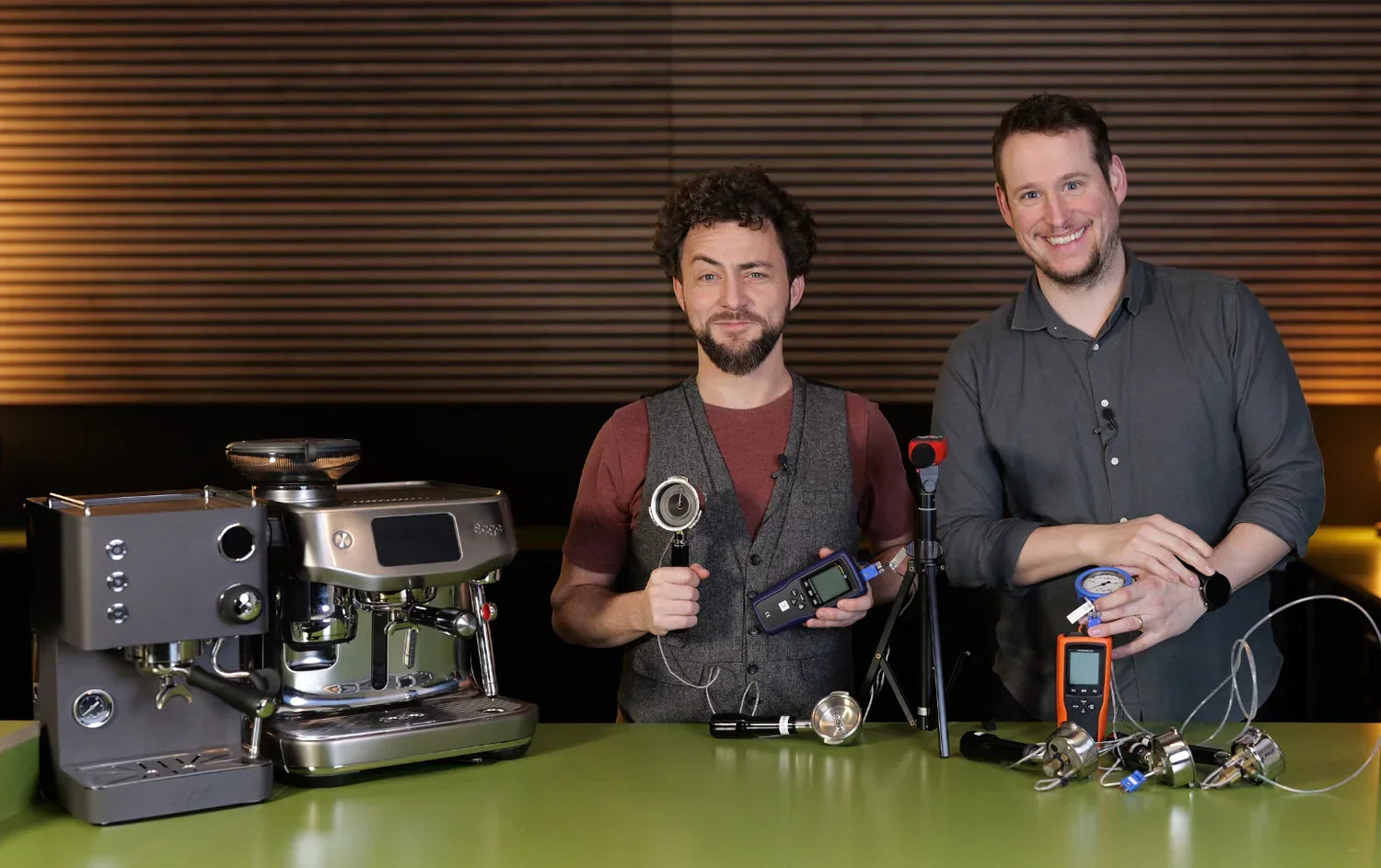

A thermoblock machine for 400 euros and a dual boiler for 4,000 euros sit on the same shelf. How do you compare them? We measure. Every machine goes through the same protocol, receives a grade from 0 to 10 in eleven categories, and from that gets an overall score from 0 to 100.
With Version 2.4, we've rebuilt the protocol in several places. The reason: When we rechecked our own tests, we saw that averages hide too much. A machine that hits 93 °C on the first shot and delivers 96 °C on the second looked better in the old protocol than it really is.
What's new in Version 2.4
Temperature: We count how many seconds of a shot stay in the target range. The first shot after heating up counts the most.
Heat-up time: A machine is only considered heated up once the first espresso reaches the target temperature.
Volumetrics: Every single shot counts. An outlier no longer disappears into the average.
Steaming: We weigh the milk before and after steaming and see how much water the steam introduces.
Power: Both espresso and cappuccino flow into the rating, in a 2 to 1 ratio.
Overall score: The catering module no longer counts. You can enable it if you make many drinks in a row.
The graphics show how we'll display measurements in future tests. They're based on sample data from a fictional machine and are labeled as such.
Three principles
Time on target instead of average. An average of 93 °C can consist of 25 calm seconds or a progression from 88 to 98 °C. For espresso, that's a big difference. That's why every second and every shot counts for us individually.
The first shot counts the most. Most of you make a double espresso at home and maybe another one later. When you turn on the machine in the morning, you want to know what the first shot can do.
Measure and disclose. Every threshold in this protocol is here in the text. If we change one, it goes in the change log.
How to read the overall score
The overall score is a weighted average. A machine with 70 might have a 9 in steaming and a 4 in heat-up time. So always look at the individual grades and ask yourself what matters to you: Do you only drink espresso? Do you make cappuccino daily? Should the machine be ready in five minutes?
The weighting
| Category | Factor |
|---|---|
| Espresso potential | 3 |
| Temperature management | 2 |
| Volumetrics | 2 |
| Steaming quality | 2 |
| Build quality | 2 |
| Usability | 2 |
| Heat-up time | 2 |
| Power consumption | 2 |
| Noise level | 1 |
| Accessories | 1 |
| Value for money | 1 |
The factors add up to 20. The overall score is the sum of grade times factor, divided by 20. We then scale this result to 0 to 100: a 7.0 becomes 70.
Quality classes
| Score | Class | Meaning |
|---|---|---|
| 93 and above | World class | Reference device with no significant weaknesses |
| 80 and above | Excellent | Outstanding, with minor compromises |
| 65 and above | Very good | Strong performance, recommended for most |
| 50 and above | Good / Standard | Solid, meets basic requirements |
| 30 and above | Compromise | Significant weaknesses |
| Below that | Inadequate | Not recommended |
Espresso potential (Factor 3)
How good can the espresso be that you get out of the machine? This is our most important category. It consists of four building blocks.
Temperature (up to 3 points). The machine's temperature rating multiplied by 0.3. An 8.0 in the temperature chapter gives 2.4 points here.
Profiling (up to 3 points). What brew control does the machine allow?
| The machine can | Points |
|---|---|
| Freely control flow, pressure, and stages | 3 |
| Program pressure profiles | 2.5 |
| Adjust pre-infusion | 1.5 |
| Fixed pre-infusion that saturates the puck | 1 |
| Profiling by hand via paddle or lever | 1 |
| None of these | 0 |
Fixed pre-infusion only counts if it really saturates the puck. We double-check by weighing: During pre-infusion time, at least 1.5 times the amount of coffee in water must flow through – for 18 g of coffee, that's 27 g. Machines that monitor flow during the shot and adjust themselves get an additional half point, up to a maximum of 3.
Hardware (up to 2 points). How evenly does the shower distribute the water? Is the portafilter fully heated through, and does the pressure build up stably?
Sensory (up to 2 points). In the end, we taste with reference coffees. The panel is led by Q-Grader Benjamin Hohlmann. We evaluate based on WBC criteria: sweetness, acidity and bitterness, plus body, texture, and finish. The question is: Does what the technology promises arrive in the cup?
Temperature management (Factor 2)
We measure with the Scace 2 or equivalent calibrated measurement portafilters for each basket size in the portafilter, one measurement per second. The water in the tank is 20 °C, the target is 93 °C at the puck.
The KM protocol. After heating up, we pull five double espressos at one-minute intervals: 27 seconds pouring, 15 seconds sitting in the basket, 45 seconds pause, 2 seconds purging.
Temperature · Measurement · Sample data
Here's how it looks in the test: the first shot on target, the following ones slightly cooler
Seconds 10 through 25 of each shot are rated. The first nine seconds are ramp-up.
| Building block | Points | What we check |
|---|---|---|
| First shot | up to 3 | How many seconds does the first shot stay on target? ±1 °C counts full, ±2 °C counts half |
| Subsequent shots | up to 2 | Same for shots 2 through 5 |
| Repeatability | up to 3 | How far apart are the five curves? 0.3 °C spread gives full points, 4 °C gives none |
| Stability during shot | up to 2 | Is the curve flat, steady, or erratic? |
Temperature · Classification · Sample data
These seconds make up the grade
What about the offset? Many machines show 93 °C but deliver 92 or 94.5 °C. Previously, we'd adjust the offset before measuring until it matched. Now we calculate where the machine actually sits from the measurements and write it in the test: "displays 94 °C, delivers 93.5 °C". Points only cost if the display is off by more than 2 °C. Then we deduct half a point.
We divide machines into four categories: hits out of the box · offset adjustable in menu · temperature display without offset menu · only stages or not adjustable at all. For the last category, we use 93 °C as a fixed target.
The WBC stress test. 14 shots in quick succession, plus steaming, after one hour of running. We discuss it in every test. Points only count in the catering module.
Heat-up time (Factor 2)
When is a machine heated up? When the first espresso is correct. The machine's ready light has never counted for us, not even in earlier versions. What's new is the standard: previously we compared the first shot to the average of the fully heated machine; now we compare it to the target temperature. The former exception for light portafilters (1.5 °C tolerance) is gone.
We measure several series with different heat-up times. The heat-up time is the shortest time at which the first shot's average in seconds 15 through 25 is at most 1 °C below target.
Heat-up time · Measurement · Sample data
Too cold after 6 minutes, ready after 9 minutes
| Heat-up time | Grade |
|---|---|
| under 2:30 minutes | 10 |
| under 4:30 | 9 |
| under 7 | 8 |
| under 10 | 7 |
| under 14 | 6 |
| under 18 | 5 |
| under 24 | 4 |
| up to 30 | 3 |
| up to 40 | 2 |
| beyond | 1 |
Volumetrics (Factor 2)
You program 45 g and want to get 45 g, even if the grind isn't quite right. We test this in five stages with our Apas Espresso, a Mahlkönig E64 GbW, and a 1:2.5 brew ratio.
Before stages 1 and 2, we pull three adjustment shots. Their average is the reference value. Each rated shot that deviates by no more than 1 g counts full; up to 2 g counts half; beyond that, not at all.
| Building block | Points |
|---|---|
| Repeatability accuracy at Scace | up to 3 |
| Repeatability accuracy with coffee | up to 2 |
| Robustness under stress | up to 3 |
| Input in grams or milliliters | 1 |
| Built-in scale | 1 |
A pure time-based control gets a flat 3 points, a machine without volumetrics gets 0. If a machine reliably delivers 46.5 g instead of the set 45 g, that goes in the test. It costs no points because you adjust once and then you're set.
If a machine can be paired with a scale, we test twice: with and without the scale.
Steaming quality (Factor 2)
Tested with 300 ml cold milk in the 0.6-liter pitcher. In Version 2.3 this still said "in testing phase". Now the points are set.
| Building block | Points | What we check |
|---|---|---|
| Steam power | up to 3 | Does the steam get the milk spinning if the pitcher is held vertically? The more we have to tilt it, the fewer points |
| Speed | up to 3 | Time to heat 300 ml from 8 to 60 °C. Under 25 seconds gives full points |
| Workflow | up to 1.5 | Wand you can't burn yourself on (1), ball joint (0.5) |
| Condensation water | up to 1 | How much water comes out of the wand before steam appears? |
| Water retention | up to 1.5 | How much heavier is the milk after steaming? |
Why we weigh the milk. Steam heats milk by condensing in it. Without water, it doesn't work: mathematically, even with completely dry steam, about 8.5% is added. Wet steam brings more water and dilutes the milk. Up to 12% increase gets full 1.5 points; up to 18% gets one point; beyond that, none.
Single boiler. With a single-circuit machine, you can't brew and steam simultaneously and must switch. For this, we deduct one point in steaming.
Power consumption (Factor 2)
We measure with a Christ CLM1000 Professional at one-second intervals, after at least six hours of rest, with 20 to 24 °C warm water in the tank, from cold: heat-up, five espressos, five hot water pours, five steam pulls, 20 minutes of standby.
Power · Measurement · Sample data
The power curve shows when the machine really heats
Two values go into the grade:
Espresso: Heat-up plus one double espresso. If the steam boiler can be switched off, we rate the economical mode.
Cappuccino: Heat-up plus one espresso plus one steam pull.
The espresso value counts double, the cappuccino value counts once. The ratio is based on our survey of 2,700 participants.
| Consumption | Grade |
|---|---|
| under 0.05 kWh | 10 |
| under 0.08 | 9 |
| under 0.11 | 8 |
| under 0.14 | 7 |
| under 0.18 | 6 |
| under 0.22 | 5 |
| under 0.30 | 4 |
| under 0.40 | 3 |
| under 0.55 | 2 |
| 0.55 and above | 1 |
Power · Classification · Sample data
What does that mean compared to other devices in the kitchen?
We mention the standby consumption in every test, but it doesn't earn points.
Build quality (Factor 2)
| Building block | Points |
|---|---|
| Surface quality: gap width, edges, fit and finish | up to 3 |
| Materials and haptics, plus 0.5 for high-quality controls | up to 3.5 |
| Construction and stability | up to 3 |
| Interior: How neatly are cables and hoses routed? | up to 1 |
No more than 10 points are given. We can't test durability in a few days of testing. We rely on reports from users.
Usability, workflow, and cleaning (Factor 2)
| Building block | Points |
|---|---|
| Interface and controls, plus 0.5 for programmable shortcuts | up to 3.5 |
| Daily routine: tank, water level, drip tray, portafilter, water filter, layout | up to 3 |
| Cleaning and maintenance | up to 3 |
| Documentation | up to 1 |
For every annoying factor that really bothers you in daily use, we deduct one point and note which one.
Noise level (Factor 1)
We measure at 20 cm distance at the height of the brew group, in the film studio, taking the highest value during a shot under load, at 9 bar with blind basket or puck.
| Measurement dB(A) | Grade |
|---|---|
| under 54 | 10 |
| under 55.5 | 9 |
| under 57 | 8 |
| under 58.5 | 7 |
| under 60 | 6 |
| under 63 | 5 |
| under 64.5 | 4 |
| under 66 | 3 |
| under 70 | 2 |
| 70 and above | 1 |
If a machine sounds especially annoying or especially pleasant, we adjust by up to one point and explain why.
Accessories (Factor 1)
Points go for the basics (portafilter with two spouts, at least two baskets, tamper, blind basket), for the quality of tamper, baskets, and portafilter, and for extras like a bottomless portafilter or a good milk pitcher. A tamper with more than 2 mm play costs one point.
Value for money (Factor 1)
We set the quality in relation to the square root of the price. This way, an expensive machine isn't penalized for the last few percent of quality costing disproportionately much.
An example: Machine A has a quality base of 80 and costs €1,600, raw value 20.0, grade 6.7. Machine B has 70 and costs €900, raw value 23.3, grade 7.8. Machine B offers better value for money.
For reference: Over 8 is a great deal, between 5 and 6.5 is a fair price, under 5 means you're paying a premium for enthusiasts.
Optional: What doesn't go into the overall score
Volume potential and catering. For anyone making many drinks in a row. We evaluate temperature over the 14 shots of the WBC test (up to 4 points), five times 300 ml milk at 90-second intervals (up to 3 points), and features like plumbed-in connection, drip tray with drain, and large cup platform with pre-warming (up to 3 points).
Espresso only. If you never steam milk, look at the power consumption espresso rating alone.
Dark roasts. Pre-infusion helps with classic dark roasts; elaborate profiles offer little beyond that. In this view, profiling counts only up to 1.5 points.
How we place each machine in the test field
At the end of each test, we show in four comparisons where the machine stands. Swipe or scroll through.
What we don't yet differentiate in our data
Very economical machines: Everything under 0.05 kWh gets a 10 for power. We don't differentiate between 0.02 and 0.047 kWh.
Measurement variation: Two test days on the same machine can differ by a few tenths in temperature. Differences under half a point shouldn't be overweighted.
Interval between subsequent shots: We measure at one-minute intervals. If you wait five minutes between two espressos, you'll experience many machines as being more stable.
Our promise
Every machine goes through the same protocol. We buy the machines ourselves; we rent the very expensive ones. And we spend several days on each one. This protocol remains a living document.
Change log
Version 2.4, November 2026
Temperature: Time in target range instead of average, first shot weighted most heavily, offset is displayed instead of adjusted.
Heat-up time: Standard is target temperature in first shot instead of average of fully heated machine. No more exception for light portafilters.
Volumetrics: Evaluation per shot, adjustment shots as reference.
Espresso potential: Temperature continuous, adjustable pre-infusion 1.5 points, fixed pre-infusion only with saturation (1.5 times coffee amount).
Steaming: Point distribution set, milk weight gain new, fixed deduction for single boiler.
Power: Espresso and cappuccino in 2 to 1 ratio.
Overall score: Catering as optional module, sum of factors 20 instead of 21.
Version 2.3, January 2026
Full points for temperature stability even if absolute value is wrong out of the box.
Point distribution for steaming quality and build quality still open.
Version 2.4 | As of: November 2026
Authors: Andrea Perin, Michel Indelicato, Benjamin Hohlmann, Alexandra Frantzikinaki

