




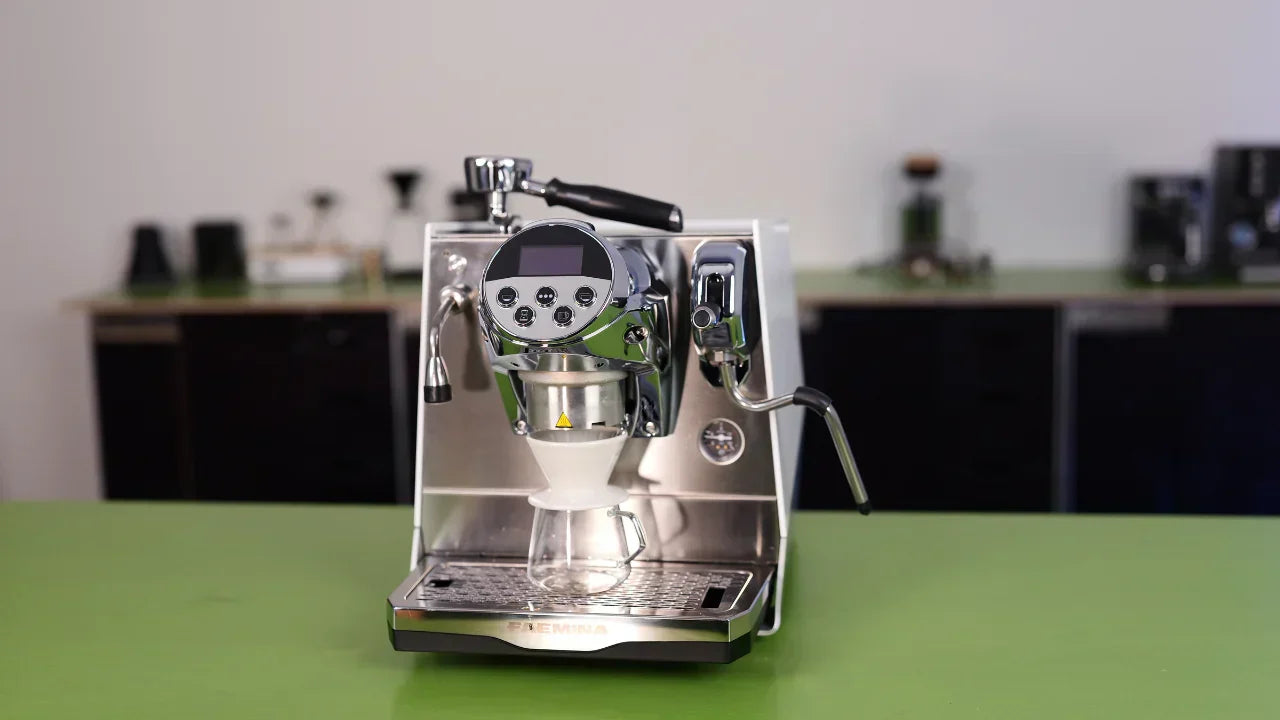

With the Faemina, the company Faema becomes active in the field of domestic espresso machines. Faema has recently been popular in the kitchens and homes of home baristas, especially because of the cult brewing group, the Faema E61. The company's focus, meanwhile, has been on gastro espresso machines with the E71.
With the Faemina, Faema wants to build on the success story of the brewing group and places a single-group portafilter machine in the upper-end segment. The hefty espresso machine costs more than 6000 euros or 7000 francs. The name, with its diminutive form "-ina," fits neither the price nor the dimensions of the machine. The Faemina weighs a hefty 37 kg, is 41.5 cm high, 51.7 cm deep, and has a width of 37.5 cm. With the portafilter locked in, we reach a depth of 62.5 cm. The diminutive is therefore not very fitting here, but it does match the machine's range of functions. Because the Faemina has one main strength: it brews good and consistent coffee. A flow rate control or pressure profiling is nowhere to be found on this elegant block. At least the machine features a smart pre-brew function, which sets it apart positively from, for example, La Marzocco's similarly priced GS3. And the Faemina can brew filter coffee, in principle anyway. Let's dive in and take a detailed look at the machine.
Buy Faema Faemina Dual Boiler
The following specialty stores sell the Faema Faemina Dual Boiler and we can recommend purchasing a machine from these businesses. They all offer to adjust the machine's offset.
Germany:
*We search for specialty partners on your behalf, who we know provide good work and good service. We are in close contact with the dealers. These are affiliate links. If you order through this link, it doesn't cost you any more, but we receive a small commission, which we invest in new test equipment. We are committed to this and are looking for competent partners for you in the DACH region.
Strengths and Weaknesses of the Faemina
Pros of the Espresso Machine
- Fast heat-up time of the espresso boiler of just 7 minutes
- Excellent temperature consistency
- Quiet machine at only 51 decibels
- Easy to control via the brewing group controls
- Powerful steaming
- Relatively low power consumption, especially with the steam boiler turned off
- Interesting machine for small gastronomy
Cons of the Espresso Machine
- Drip tray finish quality
- Limitation of flow and pressure adjustment options
- App lags
Positioning and Classification
Yes, the Faemina is a single-group espresso machine. Yes, Faema wants to be more present in the home segment with it. Nevertheless, it will be worth discussing whether the Faemina is not, in fact, a single-group gastro espresso machine. The components used, at any rate, are. Except for the pump, the Faemina relies on the internals that we also know from President and Co. This ensures excellent performance and makes the Faemina a very consistent and high-quality espresso machine.
From brewing to steam performance, what Faema delivers is excellent and can hold its own in any gastro operation. I would now say: perfect for small cafés or bakeries. If only the Faemina itself weren't so bulky. Because first, a place has to be found for it.
Of course, the Faemina also does magnificent work on a home barista bar. And one of the strongest arguments for the espresso machine is the incredibly fast heat-up time for a boiler. The 0.6-liter brewing boiler sits directly above the portafilter and ensures that the portafilter also heats up quickly. In addition, the Faemina directs energy to the brewing boiler first, making it ready for use after just 7 minutes. The machine itself signals that heat-up is complete after 5 minutes. If you want to brew cappuccino, you'll need to wait a few more minutes.
This fast heat-up time can be compared to many thermoblocks. I admit, after testing many espresso machines with a Faema E61 brewing group that need a good 25 minutes to heat up, I still need to get used to a 7-minute warm-up time for a Faema.
Great Espresso Thanks to Temperature and Pre-brewing
A consistent brewing temperature and a cleverly implemented pre-brew function help the Faemina produce excellent espresso. The Faemina is a reliable machine, which has been repeatedly confirmed in all our measurements. Both the coffee maker protocol and the much more detailed WBC protocol with high frequency between shots showed the espresso machine's high temperature consistency.

In the WBC Protocol, the consistency of espresso machine output from second 4 to 25 is compared. The Faemina showed strong consistency and only a standard deviation of 0.49 across all shots. The PID temperature control can be operated via the app and directly via the controls on the brewing group.
What's impressive is that the Faemina was able to brew at temperature after just 7 minutes. This is clearly visible in the following KM temperature protocol. All measurements were taken using the Scace 2.

Pre-brewing via Water Bypass
The Faemina features pre-brewing with reduced flow rate. This is accomplished via a branch that directs water through a hose reduced to 0.6 cm to the brewing group when the function is activated. This allows the coffee puck to be saturated with water first before the brewing water is applied to the coffee at full pump power via the larger inlet tube. It's somewhat unfortunate that while the reduction in flow rate is achieved, almost 3 ml per second are still delivered under back pressure to the coffee. This could be less to make better use of this function.
The control of the water bypass, as well as the ability to completely pause water supply, are also important functions to use the Faemina's filter coffee option.
A requirement for this is also a precise flow meter, which in the Faemina allows programming of 5 buttons. While this may sound obvious, it's not possible on many espresso machines in the dual boiler and two-circuit segment with Faema E61 brewing group. Properly functioning volume control is a prerequisite for the gastronomy field, however. And here, the Faemina's flow meter marks another plus point.
Steam Performance with Power
The 2.6-liter steam boiler delivers powerful milk frothing. 300 ml are frothed to temperature in 20 seconds. For comparison: the Quick Mill Essence needs more than 40 seconds for that.
Accordingly, milk froths smoothly. Here too, we note: with this performance, the Faemina once again proves that it can make a good impression in gastronomy.
Accessories and Build Quality
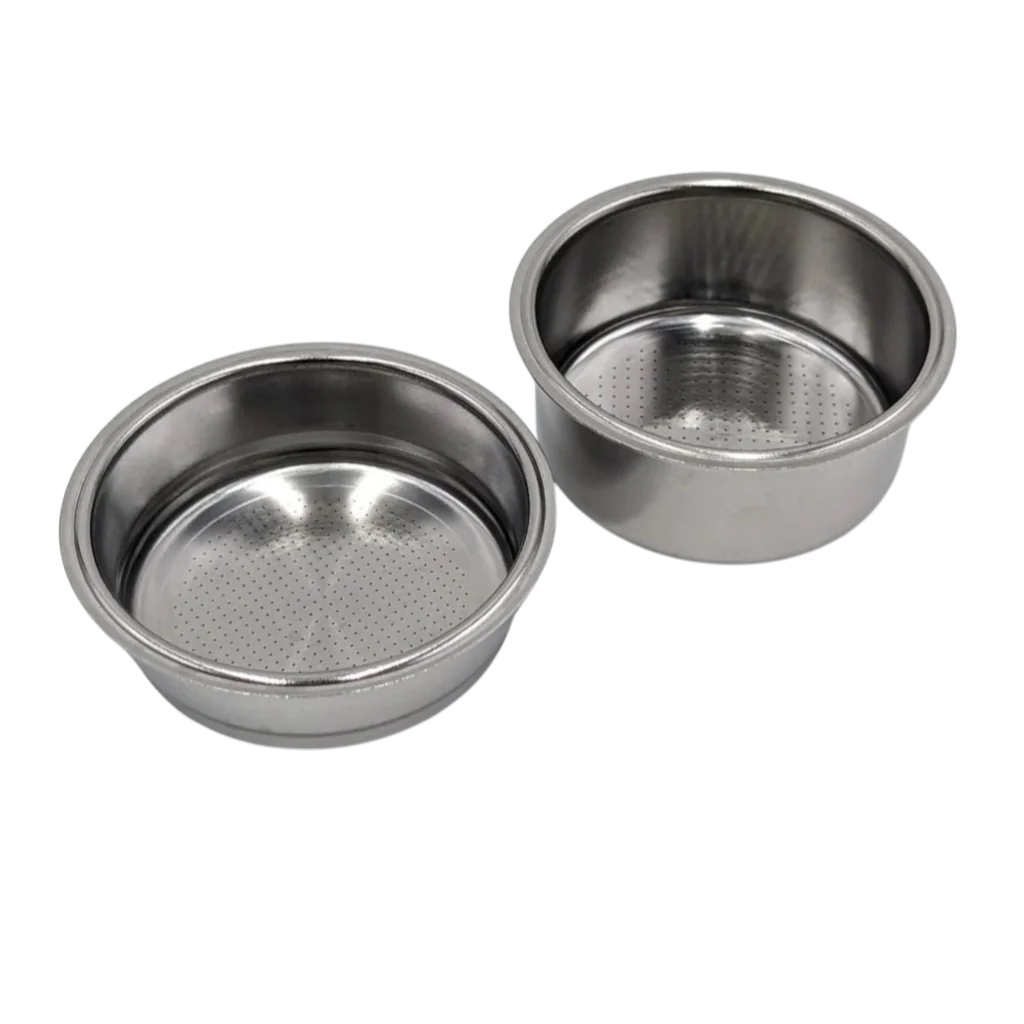
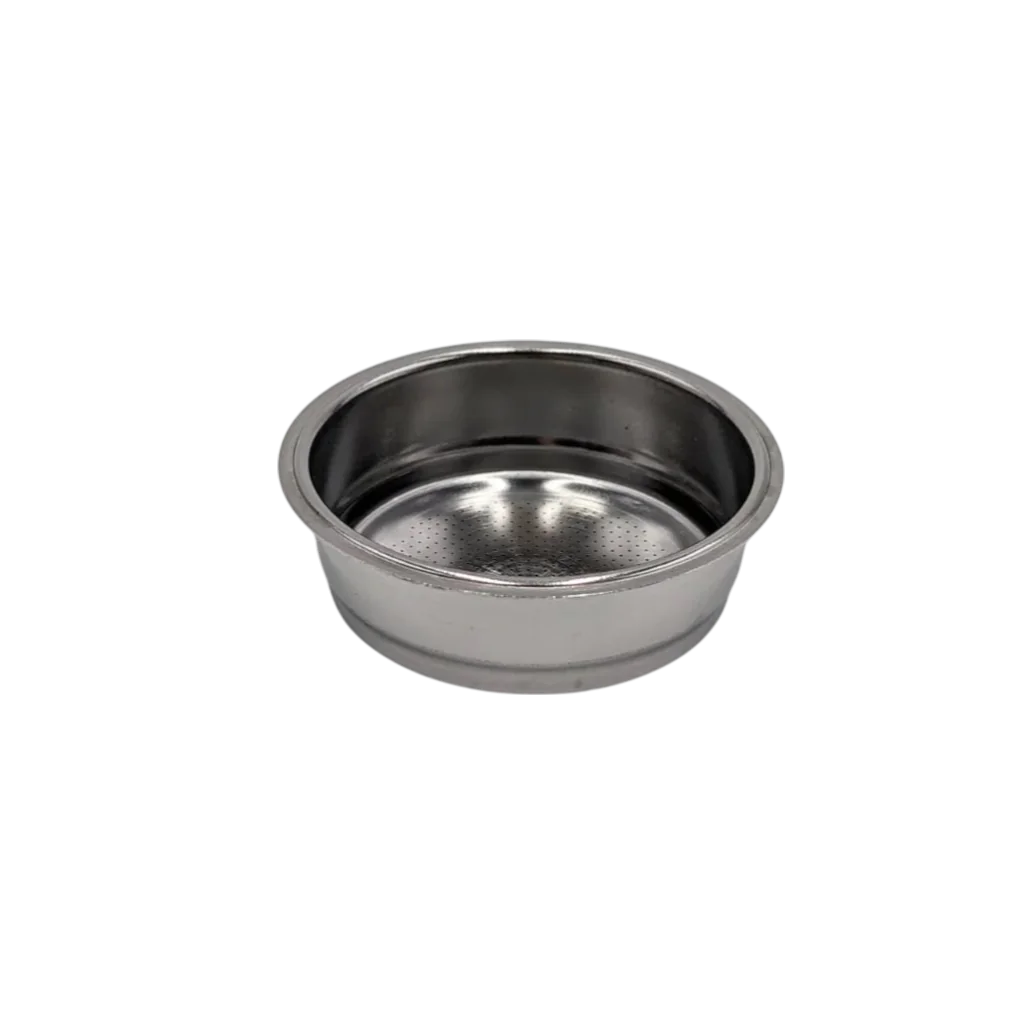
The scope of delivery includes 1 and 2 portafilters, which are equipped with classic Faema baskets. The baskets are of sufficient quality but could be improved with precision baskets.
The 58mm tamper is high-quality but does not sit flush with the supplied baskets. We measure a rim gap of 0.85 mm. Also included are fixed water connections and drain hose, as the rotary pump can be connected to fixed water.
Speaking of rotary pump: It purrs quietly and reaches only 51 decibels. That's extraordinarily quiet. The button tones of the machine were louder but could fortunately be turned off.
Overall, the machine's build quality is good, with a few exceptions. Even with the large espresso machines from Faema, I'm amazed at how poor the feel of some plastic parts is. The steam activation lever, for example, shows obvious seams. That's just not nice. In stark contrast to the machine, however, is the plastic drip tray. It just doesn't fit together! The plastic is thin and feels like a foreign object on the heavy machine.
For the plastic grille on the machine, one could at least argue that it protects the machine from scratches. However, what looks good is something else. In addition, the screw covers located directly under the grille are not secure and quickly slide down when the grille is moved.
However, these small flaws cannot overshadow the overall good build quality and presence of the machine.
Filter Coffee Performance of the Faemina
The Faemina has brewing programming for filter coffee. The integrated flow meter allows, in conjunction with a controller, for pre-brewing and a number of pulses to be programmed.
While you can set how long the pre-brew occurs and how much water it uses, for the main brew you can only program the number of pulses and the final pulse. To calculate the total brew time, you also need to account for the drain time. With 300 ml total volume, for example, a final pulse could be delivered after 1:40 min.
Brew performance is significantly influenced by the shower's distribution capability and the control of pulse programming. In our case, the shower delivers water slightly unevenly, so the coffee on the corresponding side of the filter was more agitated.
It's also practical that the drip tray can be raised and lowered with a simple motion so that at least a filter with pitcher that matches the machine fits under the brewing group.
Faema itself sells a filter set to match the machine, which proved too wide in our test, however. A more cylindrical format, like the filter basket designed by Scott Rao that clamps in (which we'll discuss in one of our upcoming videos), seems to have significantly better properties for brewing espresso with an espresso machine. The recommended filter is not wetted with water in the outer areas and the coffee located there is not sufficiently extracted, resulting in uneven coffee extraction.
The ability to adjust the pulses certainly allows for good filter coffee to be brewed with some optimization. At home, however, I would always prefer to reach for the hand filter and carafe and brew the coffee well through clean agitation and targeted pouring. However, if a gastronomy establishment has multiple groups (multiple Faeminas?) or an underutilized espresso machine, the filter function is certainly an interesting option.
Energy Consumption
One might think that such a large espresso machine must consume a lot of electricity. And indeed, it does under full power and with the steam boiler switched on. If you leave it off, however, the Faemina achieves low consumption of just 0.144 kWh for 5 shots according to the KM protocol, thanks to the short heat-up time. In this scenario, an espresso uses 0.1 kWh including heat-up.

If we turn on the steam boiler, we reach a value of 0.35 kWh, which is remarkably low given the large steam boiler. If we turn on the steam boiler, we consume 0.29 kWh for pulling an espresso shot. A cappuccino, on the other hand, comes to 0.31 kWh.
Conclusion on the Faemina by Faema
The Faemina is an interesting espresso machine. Much indicates that it is suitable for use in small gastronomy, catering, or even in larger offices with coffee-enthusiastic employees. The latter will appreciate the fast heat-up time, although the machine's start can also be programmed via the app. For gastronomy, the fast heat-up time is less necessary but still a nice addition. Good overall performance in terms of temperature and steam quality are important prerequisites for brewing many coffees in a short time.
For private use, the size and especially the price could be arguments against it, although the fast heat-up time and espresso quality are certainly arguments in favor. What is certain is that there are other machines on the market with greater flexibility and adjustment options in terms of flow rate control for significantly less money. However, if you don't value these aspects and are looking for a very solid machine with its own aesthetic and good performance, you will find the Faemina to be a very good espresso machine.