



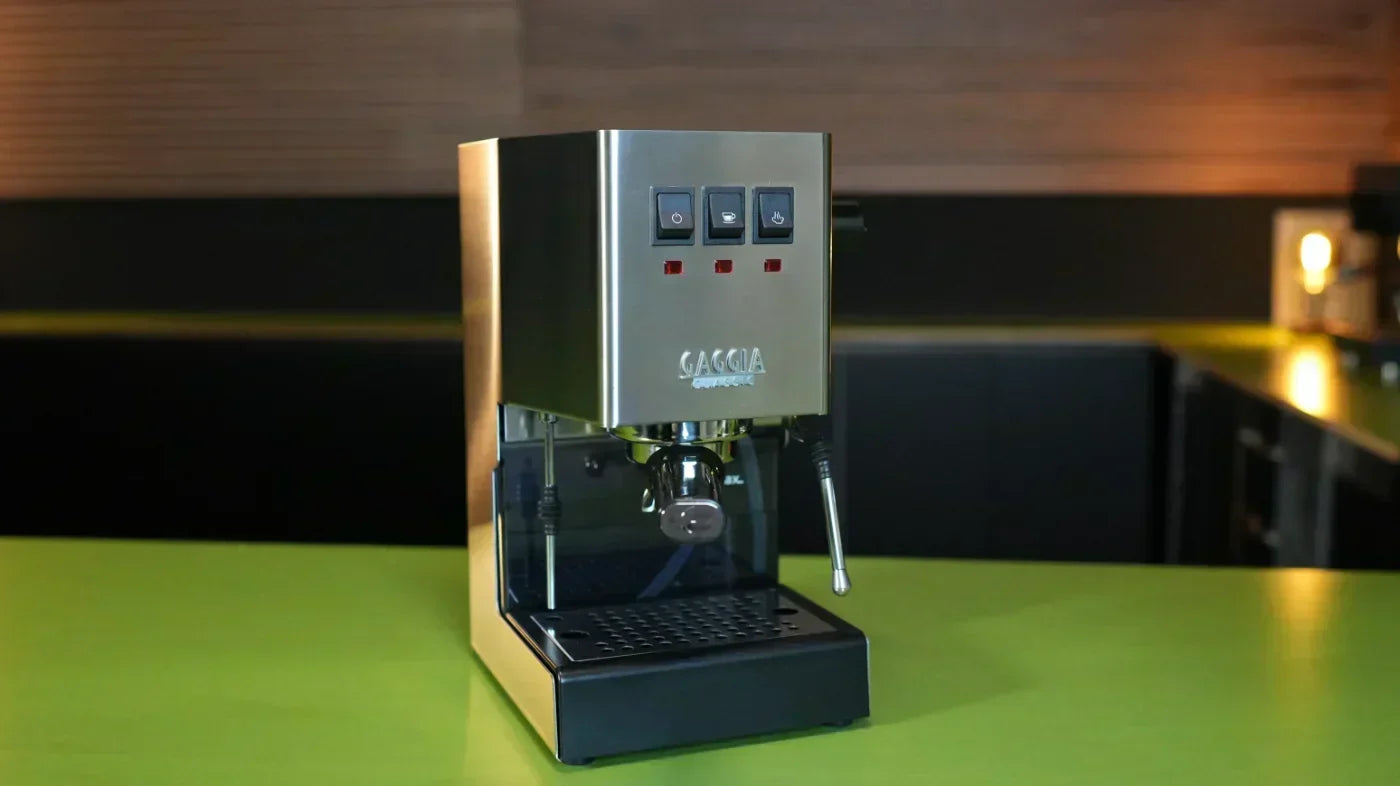

The Gaggia Classic Evo Pro E24 is one of the best-selling single-boiler espresso machines of all time – and has been for years. At 480 euros (Germany) or 419 CHF (Switzerland), you get a compact, solid machine with a metal portafilter, over two liters of water tank capacity, and a community that has developed countless mods and upgrades. The problem: out of the box, the machine doesn't deliver convincing temperature values. The good news: we'll not only show you where the issues are – but also how you can get significantly more out of the Gaggia Classic with just a few simple adjustments.
As always, we purchased the machine ourselves and tested it according to our standardized test protocol v2.3. Especially with "budget" espresso machines, we also aim to provide you with methods that improve your machine. We did that with the Gaggia Classic Evo Pro E24, building on our temperature tips that we developed for this machine years ago.
Design & Build Quality
Score: 6.5/10
The Gaggia Classic Evo E24 is small. 21 centimeters wide, 36 centimeters tall, 26 centimeters deep – with the plug nearly 28.5 cm, with the portafilter around 36 centimeters. It fits on any countertop. It weighs 8.1 kilos. That's enough for stable standing and light enough to move around.
In terms of materials, we see a mix: metal housing with curved sheet metal, sharp edges in some places – especially on the drip tray, where we actually cut ourselves. The gap tolerances show some variation: three millimeters at the bottom knob, half a centimeter at the top. Everything is built with some play. But overall, the build quality is solid. The buttons have real click points, not dummy switches. It holds up.
Pleasantly surprised: the drip tray holds 600 milliliters despite this compact size. Many machines that are significantly larger and more expensive could take notes. And the water tank holds over two liters. That lasts for quite a while.
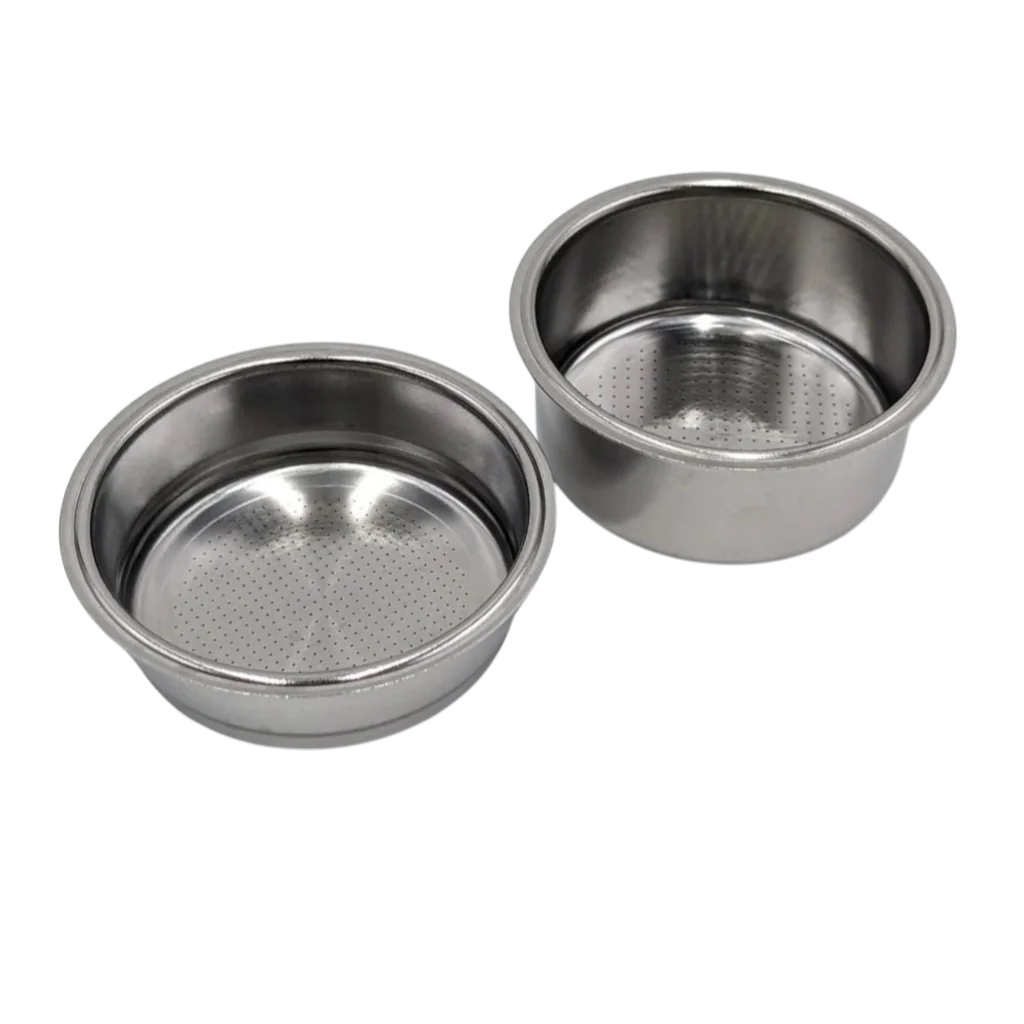
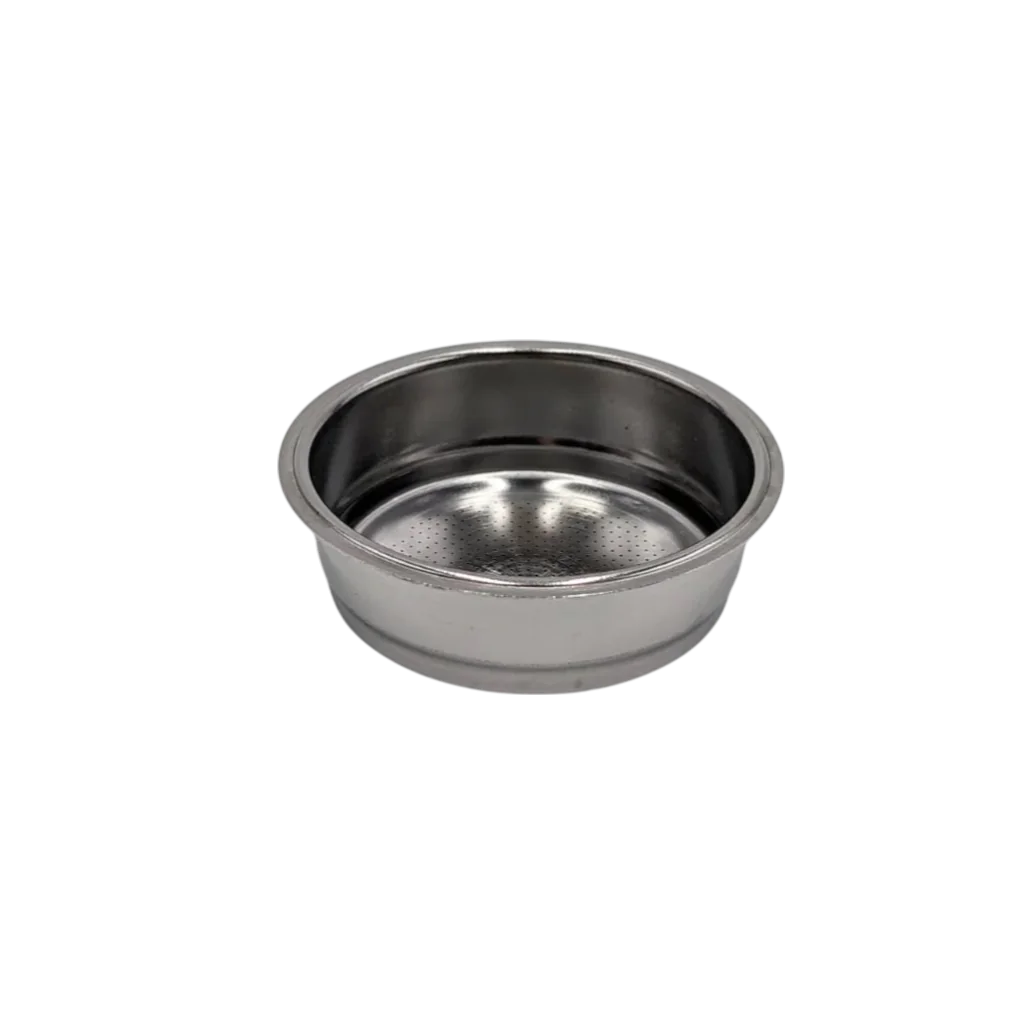
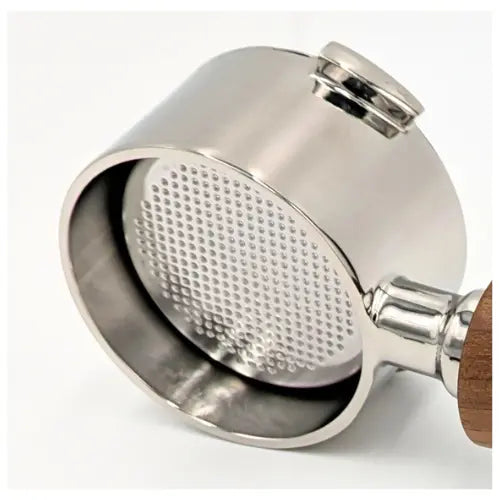
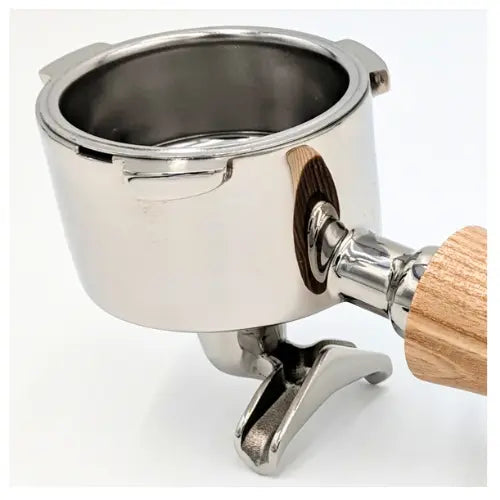
Important: The Gaggia Classic Evo Pro E24 doesn't work with a standard 58mm portafilter because the bayonet is thicker and slightly offset. But you can, for example, insert our KM professional sieves into the portafilter.

Temperature Management: And How You Control It
Standard Score: 2.0/10 | Score with Flush Routine: 5.4/10
Temperature is the central topic with this machine. The Gaggia Classic E24 is a single boiler with brass boiler and pressurestat. No PID, no temperature adjustment, no offset. The machine heats up and you have to take what you get.
And what you get, we measured directly in the portafilter with the Scace 2.
Test 1: Standard Protocol – Simply Turn On and Start Brewing
Five double espressos at one-minute intervals, after 15 minutes and 40 seconds of heat-up time. The way many people probably use the machine in everyday life.
| Pull | Average Temperature |
|---|---|
| 1 | 95.8°C |
| 2 | 91.7°C |
| 3 | 90.6°C |
| 4 | 89.7°C |
| 5 | 88.2°C |
The first shot is at 95.8°C. That's way too hot. At this temperature, the coffee gets burned and extremely bitter. The brew group has built up so much heat during the heat-up time that the first water reaches nearly boiling levels.
Then it flips to the opposite. From shot to shot, the temperature drops. At the fifth pull, we're at 88.2°C – well below the target range of 93°C. This means underextraction: sour, thin, bodyless espressos. The difference between the first and settled shots is 6.2°C – that's the worst category in the protocol.
In the WBC stress test (14 pulls in quick succession), it becomes even more dramatic: a temperature window of 8.5°C. For comparison: professional machines achieve under 1°C. This is clearly not the operating range for this machine.
| Cluster | Score | Max |
|---|---|---|
| A1 Cold Start | 0.0 | 3.3 |
| A2 Consistency | 0.0 | 2.0 |
| B Intra-Shot | 2.0 | 2.7 |
| C WBC Stress | 0.0 | 2.0 |
| Total | 2.0 | 10.0 |
The only bright spot: within a single pull, the temperature curve is relatively stable (2.0 out of 2.7 points). The problem isn't what the machine does during the shot – but that it starts at the wrong level and drops from shot to shot.

Test 2: Improved Flush Routine – How to Get More Out of It
Now it gets exciting. Because with two simple adjustments, the picture changes dramatically:
- Before the first pull: flush for 7–8 seconds (instead of not at all or just 2 seconds)
- Between pulls: wait 1.5–2 minutes (instead of 60 seconds)
Why does this work? In a single boiler without temperature control, heat builds up in the brew group during heat-up time. When you flush for 5–10 seconds, you release this overheated water. You can see it too: at first it hisses, with water that's boiling or nearly boiling coming out as steam from the group. That's way too hot. When it flows smoothly, you're in the good range. The longer wait time between shots gives the small boiler the recovery time it desperately needs. In the standard protocol, 60 seconds isn't enough – the boiler can't keep up.
| Pull | Standard | Improved | Difference |
|---|---|---|---|
| 1 | 95.8°C | 91.5°C | −4.3°C |
| 2 | 91.7°C | 92.3°C | +0.6°C |
| 3 | 90.6°C | 90.1°C | −0.5°C |
| 4 | 89.7°C | 90.5°C | +0.8°C |
| 5 | 88.2°C | 91.6°C | +3.4°C |
Here's the direct comparison with optimized first shot: we manage to bring 95.8°C down to 91.5°C. As a result, the pull works and the machine is no longer overheated. The difference from the mean is only 0.8°C instead of 6.2°C. This is how you manage to jump from "Insufficient" to nearly "Excellent" in the cold start category.
The fifth shot: from 88.2°C to 91.6°C. Instead of a too-cool, underextracted laggard, you achieve a pull at nearly the same level as the first shots. A 3.4°C improvement from just 30 seconds more patience.
Particularly impressive: the intra-shot curve at the fifth pull with wait time shows only 0.44°C variation over 25 seconds of extraction. That's a nearly perfect straight line in the pull. That's technical ideal and achieves full points.
The Gaggia Classic can deliver stable temperatures – if you give it enough time.
| Cluster | Standard | Improved | Change |
|---|---|---|---|
| A1 Cold Start | 0.0 | 2.7 | +2.7 |
| A2 Consistency | 0.0 | 0.0 | ±0.0 |
| B Intra-Shot | 2.0 | 2.7 | +0.7 |
| C WBC Stress | 0.0 | 0.0 | — |
| Total | 2.0 | 5.4 | +3.4 |
From 2.0 to 5.4 points – that's a +3.4 point improvement through pure technique adjustment, without spending a cent.
What Remains as a Weakness?
The consistency between pulls (A2) stays at 0 points – shots 3–5 vary by 1.5°C because shot 5 with the longer wait time is significantly higher. That's not a drama in everyday use, but it shows that the machine relies on your timing management.
The temperature level is around 91°C instead of 93°C. Without a PID, you can't change that. With a PID kit like the Gaggimate, you could correct that. We'll also publish modding guides for this in the future.

15 Minutes Heat-Up Time?
Yes, unfortunately we can't get around this long wait. We were surprised too, but the machine needs this time. If you start the process earlier, you'll be below the target temperature we're aiming for at around 93 degrees.
Espresso Quality
Score: 3.0/10
Espresso potential is directly tied to temperature management – and that brings down the grade. Technically, there are no profiling options: no flow control, no pre-infusion, no pressure profiling. The machine brews with whatever the pressurestat delivers and with 8 to 9 bar.
But: when the espresso works – and with the right routine it definitely does – then it's indistinguishable blind from what a 10,000-euro machine puts in the cup. That sounds provocative, but it's true. With the Gaggia Classic you'll probably nail 4 or 5 out of 10 shots perfectly. A more expensive machine nails 9 out of 10. But the good shots are qualitatively equivalent.
What sets the Gaggia Classic apart from a 3,500-euro machine then? Not the basic capability, but the consistency. More expensive machines stay focused in the target range and don't swing up and down. Parallel steaming is possible with much more power. And with ten pulls in a row, the more expensive machine hits the target nine times.
Our recommendation for coffee choice: stronger roast profiles. The machine sits at around 91°C when you flush. That puts you in a good target range for espresso with darker roasts. Light specialty espressos, which often demand precise temperatures and frequently need temperatures around 93°C, aren't the machine's strength. We brewed with the Compadre in the test – a powerful profile that works very well with this machine.

Power Consumption
Score: 9/10
The Gaggia Classic really excels here. For heating up plus one double espresso, it only draws 0.067 kWh – of which 0.058 kWh is for heating and just 0.009 kWh for the pull itself. Typical for a small single boiler that only has to heat a tiny boiler. 9 out of 10 points, well deserved.
Interesting: you wait 15 minutes for the machine, but barely consume power in the process. The heat-up time is long for the small boiler, but the energy requirement is negligible.
Milk Froth & Steam
Score: 4.8/10
Steaming is definitely doable, but it takes practice and rhythm. As a single boiler, the boiler has to heat up to steam temperature after the espresso pull, which takes about 60 seconds. Then you have another 60 seconds for the actual steaming.
First hurdle: condensation water. About 8 milliliters come out in the first one to two seconds. That's why purging the steam wand beforehand is mandatory. Then you have solid power initially, which you absolutely need to use. The pitcher must be tilted steeply so the draw phase and roll phase happen simultaneously. After 15 to 20 seconds, the power drops off. It does increase slightly again, but with larger pitchers you won't get deep whirlpool action.
The result: creamy, pleasant milk foam. Very important: after steaming, purge well and wait one to two minutes before brewing again.
Workflow & Operation
Score: 7.0/10
The Gaggia Classic scores here with simplicity. One button for espresso, one button for steam, two indicator lights. That's it. No menus, no settings, no display: turn on, wait, brew.
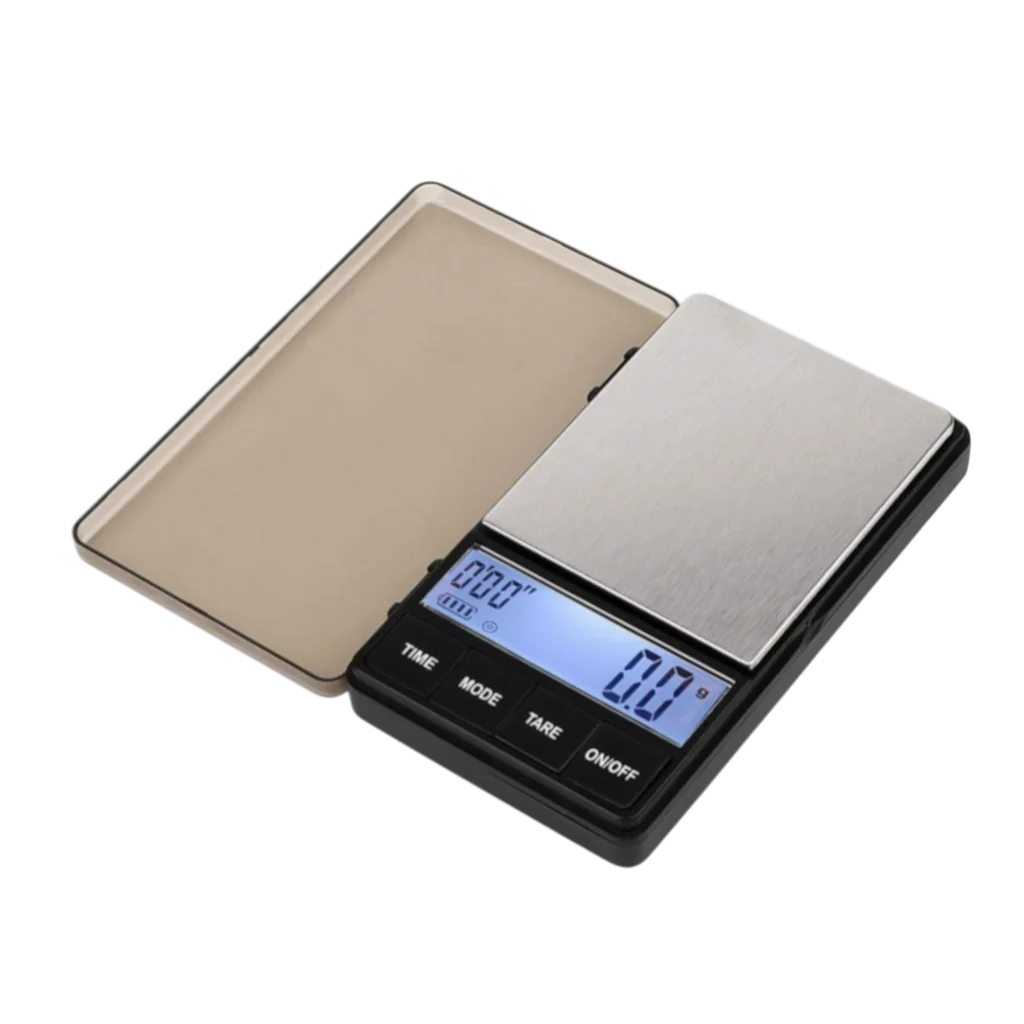
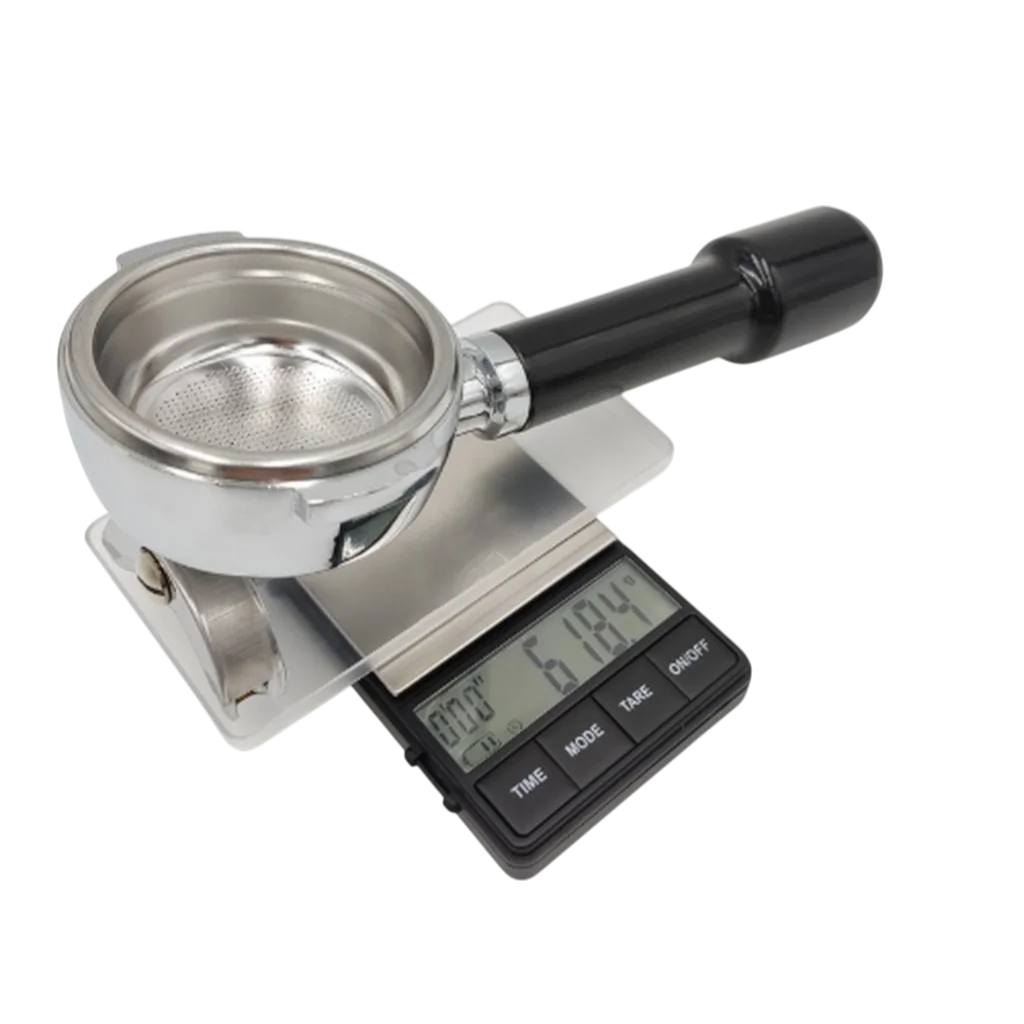
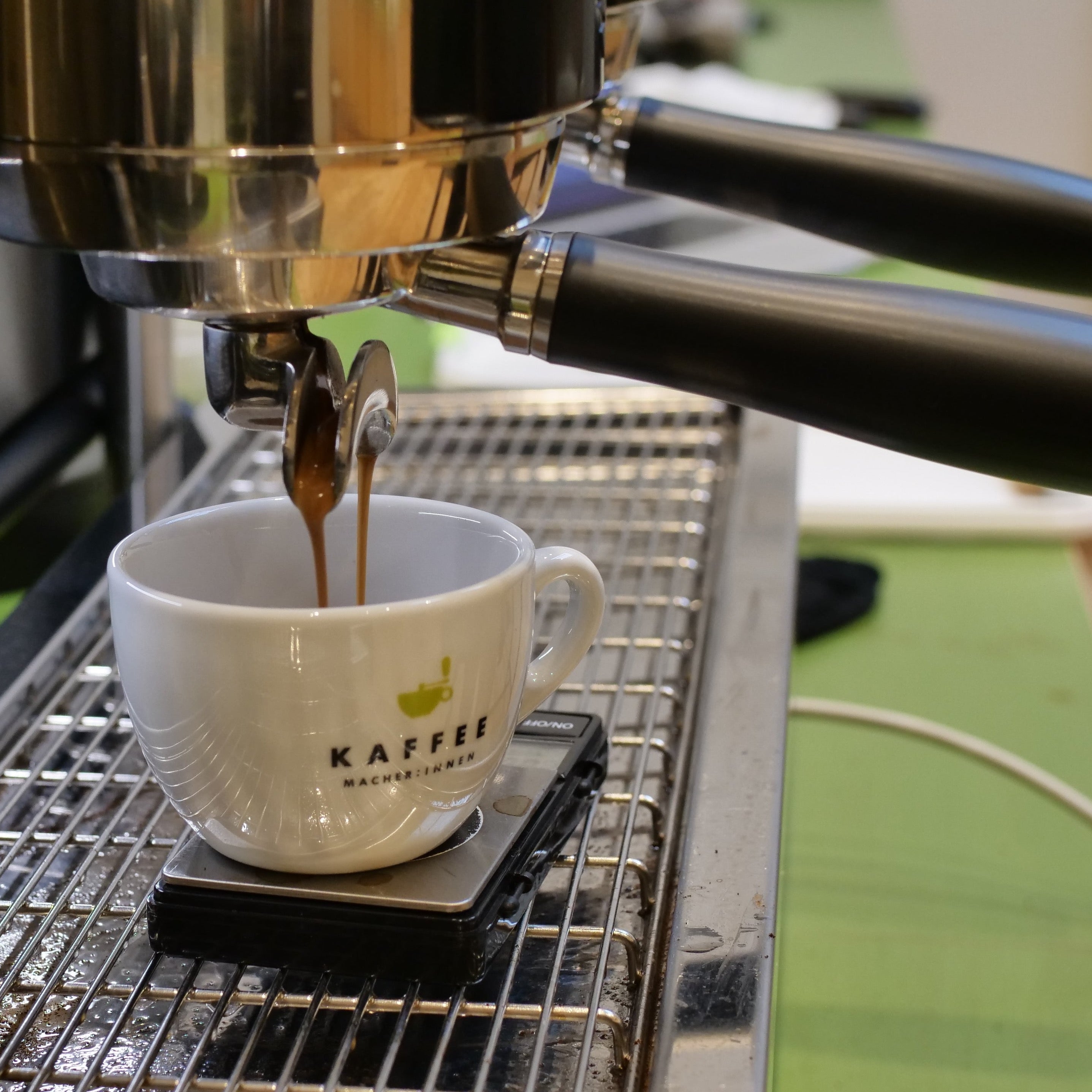
The water tank holds over two liters and is easy to remove. The drip tray is generous at 600 milliliters. The portafilter locks in cleanly. There's no volumetric or timer control. You press the button, the machine brews, you press again. If you want to work precisely, you need a scale under your cup.
What's missing: there's no cleaning program, no shot timer, no dosing option. Expected for this price range.

Accessories
Score: 4.0/10
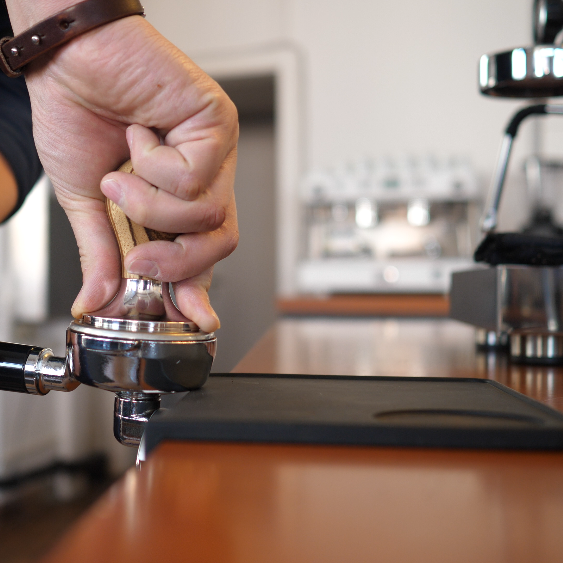
Included: portafilter with double spout, double basket, single basket, and a tamper. The basket is cheap. We recommend an early upgrade with a properly drilled professional basket. The tamper does fit flush in the portafilter, but otherwise it's better suited for hanging up your coat. It's one of those cheap plastic tampers that already dampen your joy of preparing espresso. But: it's included, so you can get started right away.
Noise Level
Score: 2/10
69 decibels and thus rather loud. A typical vibration pump, plain and simple. It does what it does. If you want to brew quietly in the morning while the rest of the family sleeps, you're out of luck.
Volume Potential / Catering
Score: 0.5/10
The Gaggia Classic can't do the WBC protocol. 14 pulls in quick succession doesn't make sense with this single boiler. A fixed water connection isn't provided, and steam retention for continuous use is lacking. That's not its use case.
Practical Tips for Everyday Use
Based on all our measurements, here's the optimal workflow:
Heat-up: 15 minutes. After 15 minutes the portafilter is at 65–70°C.
Before the first shot: Flush for 7–8 seconds until it stops hissing. This removes the overheated water. When it flows smoothly, lock in and brew.
Between shots: Don't rush. Wait at least 1.5–2 minutes. Unlock, briefly flush for 1–2 seconds, then go to your grinder, prepare coffee, tamp – the 45–90 seconds pass almost on their own.
Coffee choice: Stronger roast profiles. The machine sits at around 91°C – that's perfect for darker roasts. Light specialty roasts aren't its strength.
Steaming: After steaming, purge well and let the temperature stabilize, then wait one to two minutes before the next espresso. The boiler needs to recover from steam mode.
Don't forget the grinder: This machine needs a solid grinder. If everything varies – temperature, grind size, dose – it's hard to reproduce good results. Something needs to anchor the setup. In the single-dosing range, there are very good options for 250–300 euros.
Conclusion: Honest, Compact – and Good with Method
Overall Score: 4.8/10 – Compromise | Value for Money: 7.0/10
The Gaggia Classic E24 achieves 4.8 out of 10 points in our test and lands in the quality category "Compromise". Without the right method, this machine simply doesn't deliver convincing results.
But that's exactly where the opportunity lies: with the improved flush routine, the temperature score alone jumps from 2.0 to 5.4 points, without spending a cent. The machine is extremely economical (9/10 for power consumption), as compact as few others, solidly built for its price, and the operation couldn't be simpler.
Most important: the basic technology of the machine has potential and can be improved or optimized. And that's what opens many doors into the world of espresso with the Gaggia Classic Evo Pro E24.
Who is this machine for? For beginners willing to engage with the topic. Who want to find their rhythm with the machine. Who understand that flushing isn't optional but mandatory, and who will add a solid grinder.
The espresso you get from this machine with the right technique can be impressive. Not every shot will be perfect, but the good shots are qualitatively equivalent to what a machine costing ten times as much delivers.
And for those who want more: PID kits like the Gaggimate extract significantly more from this base. We'll also publish modding guides in the future, because the Gaggia Classic is one of the best platforms for gradually upgrading.
You need to get to know each other, find your rhythm. And maybe that's the exciting part.
Technical Specifications Overview
| Feature | Value |
|---|---|
| Price | 480 EUR (DE) / 419 CHF (CH) |
| Boiler Type | Single Boiler (Brass) |
| Heat-Up Time | 15:40 Minutes |
| Power Consumption | 0.067 kWh (Espresso Mode) |
| Brew Temperature | ~91°C (measured, with flush routine) |
| Power | 1,100 W |
| Weight | 8.1 kg |
| Water Tank | 2.1 Liters |
| Drip Tray | 600 ml |
| Pump | Vibration Pump |
| Dimensions (W×D×H) | 21 × 26 × 36 cm |
| Noise Level | 69 dB(A) |
| Highlights | Pressurestat, no PID, no offset, no profiling |
Gaggia Classic Evo Pro E24
Test Report Summary, Protocol 2.3 (January 2026)🛠️ Recommended Specialist Partner for the Gaggia Classic E24
Germany: Stoll Espresso
We recommend you partner with specialists we know do good work and provide reliable service. When you order through our affiliate links, you don't pay more, but we receive a small commission – which we invest directly in new test equipment.

All measurements conducted according to Kaffeemacher test protocol v2.3. Temperature measurement with Scace 2, power measurement with Christ CLM1000 Professional. Rating based on the 3-cluster scoring model.