




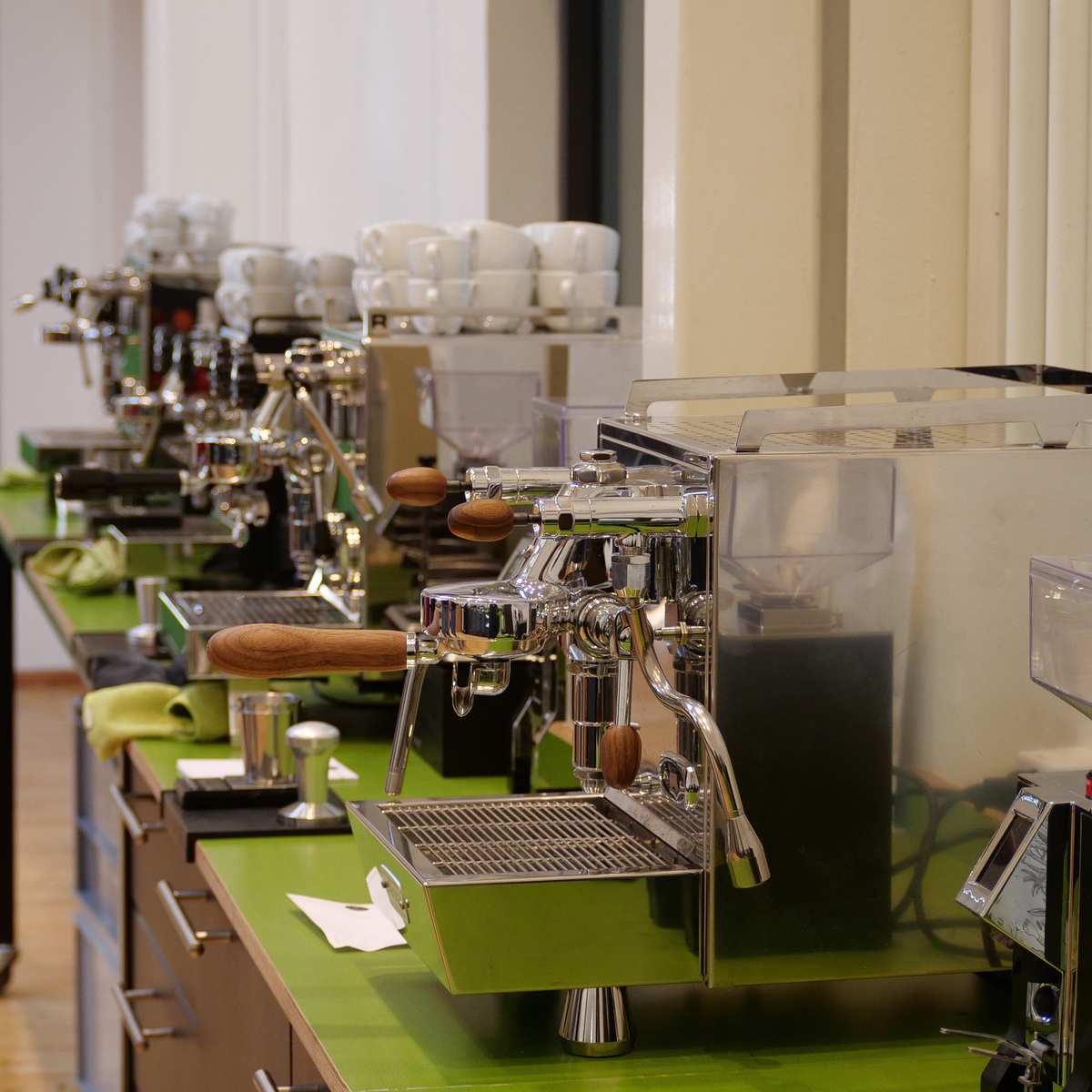
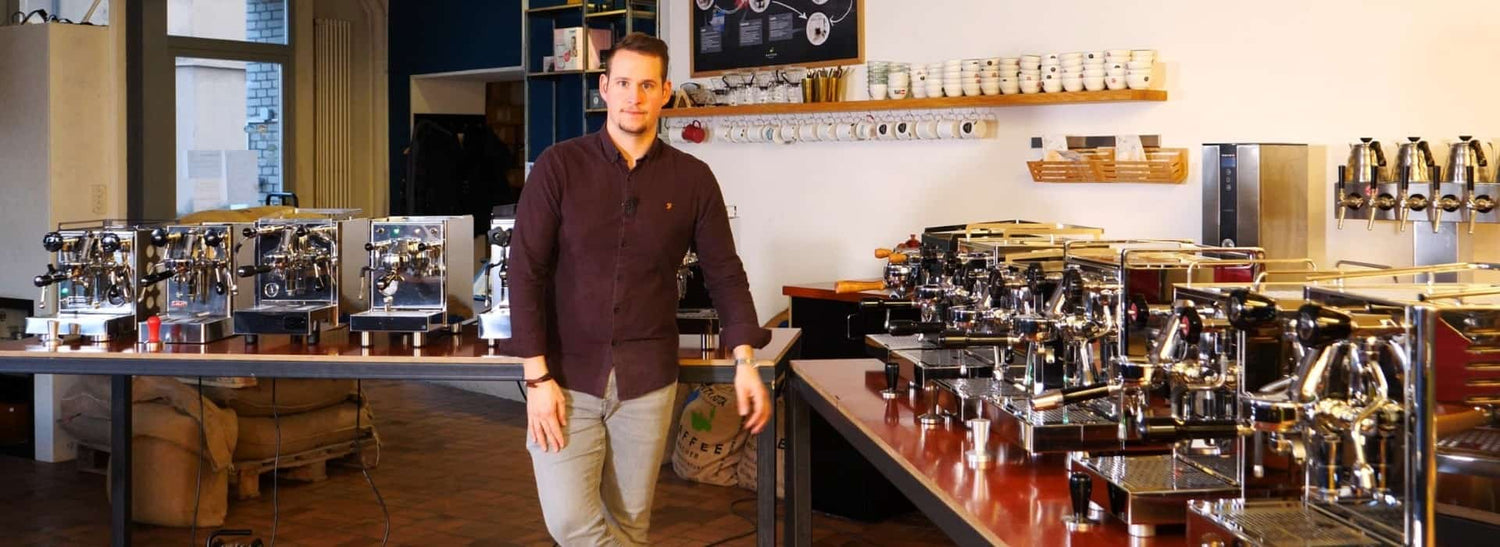

We tested 12 dual-boiler espresso machines side by side over the past weeks and months. This test series was the most comprehensive we've ever done. Each machine was discussed in its own video. We addressed the most important characteristics, worked out differences, strengths and weaknesses.
The present text is a comparison of all machines. It appeared in parallel with our detailed test and comparison video of all dual-boiler espresso machines.
The following machines we tested: Rocket Appartamento, Lelit Mara X, ECM Manufacture Mechanika V Slim, Profitec Pro 500, Bezzera BZ10, Rocket Mozzafiato Cronometro R, Quick Mill Rubino, ACM Homey, Quick Mill Andreja Premium PID, Elba 1 969.coffee, Bezzera Magica, Xenia Espresso
After testing the 12 dual-boilers, we tested additional dual-boiler machines. You'll find a complete list of all tested dual-boilers at the very bottom of this page.
The linked video is intended as a supplement to the article. It provides illustrative material for individual topics in particular. We've added chapter markers to make it easier to find certain information.
As a coffee maker, we see ourselves as a coffee school that supports knowledge transfer and exchange in the coffee market. We operate a coffee farm in Nicaragua, a roastery in Basel, and two cafés, and share the knowledge we apply in our courses, articles and videos.

13 Machines: Michel Aeschbacher with Rocket Appartamento, Lelit Mara X, ECM Manufacture Mechanika V Slim, Profitec Pro 500, Bezzera BZ10, Rocket Mozzafiato Cronometro R, Quick Mill Rubino, ACM Homey, Quick Mill Andreja Premium PID, Elba 1 969.coffee, Bezzera Magica, Xenia Espresso
What did we test in the espresso machines?
With this test report, we go even further. In addition to the external workmanship and build quality, we tested the milk frothing capability of each machine. The espresso machine test provides information about the power consumption of the dual-boilers and shows the temperature consistency during espresso extraction. We show the temperature for each machine from the start of espresso extraction to the end point. The temperature and consistency during brewing is crucial for coffee quality. Depending on the intended use, an espresso machine should be consistent over multiple shots, that is, with the first, second and third espresso. This is especially important if the machine is to be used in a larger household, a shared apartment or at a party. We call this attribute "catering" or "shared apartment" capability.
The heat-up time of the dual-boilers is important not only for early risers. Here we have bad news upfront. The heat-up time of all machines doesn't differ so significantly that we have a clear test winner. We recommend starting the machine 25 minutes before the first shot for all 12 espresso machines. Only then are the machines really well preheated, and some machines even need a bit longer.

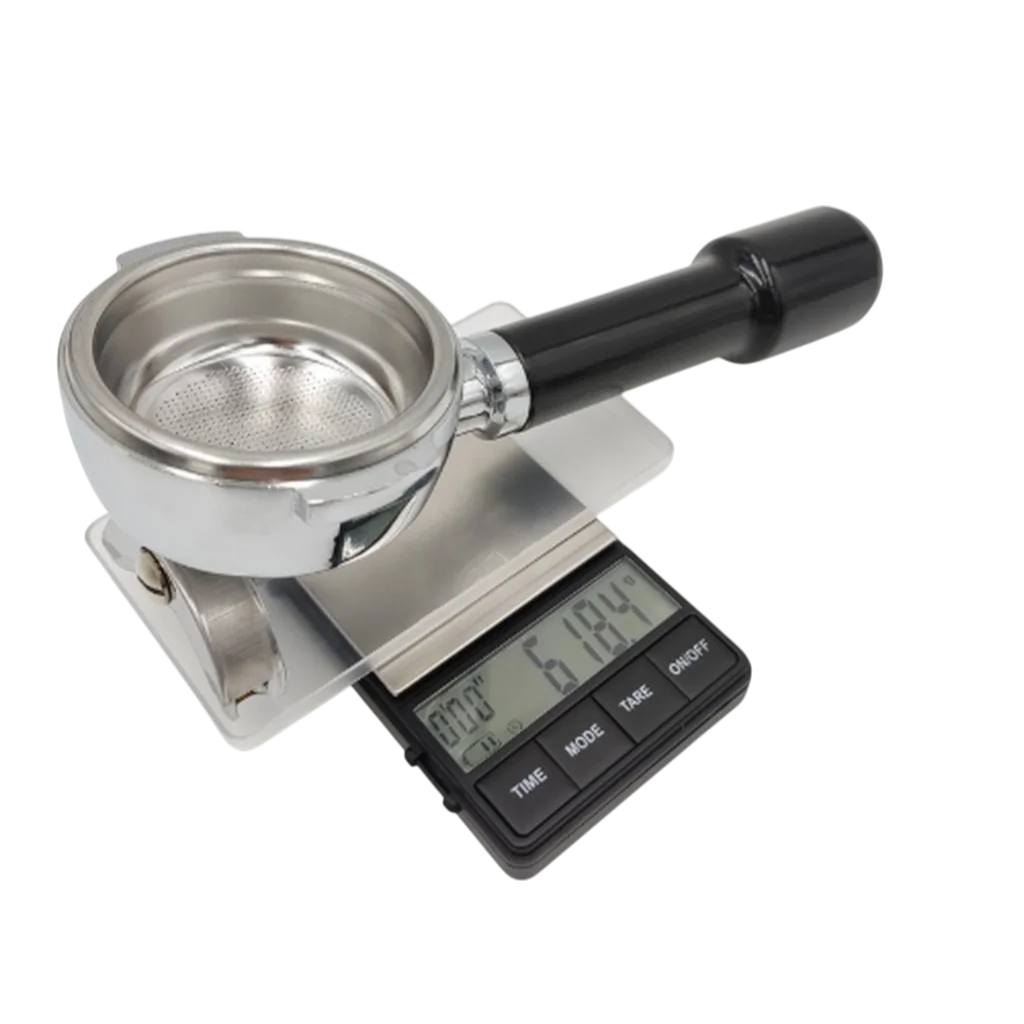
With this temperature probe we measured the brew temperature in the portafilter. A small valve at the bottom releases water so that the resistance corresponds to an espresso shot.
Why is there no clear dual-boiler test winner?
In testing, experimenting and getting to know the twelve espresso machines in depth, it became clear to us that it wouldn't be right to declare a ranking or test winner. The qualities of the machines are too different, the strengths too varied, and the possible intended uses differ as well. The tests were conducted mainly by Michel Aeschbacher and me, Benjamin Hohlmann. And even we couldn't finally agree on which machine would be the test winner for each of us.
Michel values a lot of power when steaming milk, and the external build quality of the machine as well as high-quality materials play a major role. For Benjamin, temperature consistency over 5 shots is central so the espresso machine can also be used well at meetings. And we haven't even talked about price-to-performance yet.
In short, we decided against an absolute ranking and against adding up ratings or points per category. Instead, we work out which espresso machines perform best in which category. Based on your own needs, you can then decide which machine is best for you. Sorry we can't make the decision for you.
If there were an espresso machine that really rocked in all categories, we wouldn't hesitate to declare it. Unfortunately, there isn't one. Instead, there are only sub-category test winners (and losers), Michel's favorites, Benjamin's favorites, and the best value for money. Enjoy reading.
Workmanship and external build quality
Aesthetics and external build quality are subjective. Four machines, however, really stand out in our test. A bright spot – also because of beautiful design with wooden handles and in black, is the Xenia. The Xenia espresso machine can be put together modularly and thus takes on not only the desired look but also the desired configuration. You can choose the Xenia with one or two portafilters, in wood or classic, or even bottomless. Each modular option costs separately – but you also don't get overwhelmed with unnecessary tools and gadgets. If you're looking for sharp edges on the Xenia, you'll look in vain.

Xenia Espresso in side view
The Rocket Mozzafiato Cronometro R breaks the cost structure with +2000 euros/2400 CHF out of our ranking. Accordingly, it shows off with material. The side panels made of solid aluminum are 8 mm thick and contribute to the premium look of the Mozzafiato. The workmanship is overall good and there are only a few sharp edges. The sturdy feet provide support and the cold-touch steam wand rounds out the machine. A built-in clock is a nice additional touch. The Quick Mill Andreja Premium PID is also among the better-finished machines. You can tell with it, as with the aforementioned ones, that some of the higher purchase price goes into clean edges and thoughtful finishing.
The Lelit Mara X is one of the cheapest machines in the entire test. All the more pleasing that it doesn't skimp on external build quality. The machine is just 22 cm wide with a depth of 41 cm. If you're looking for a powerful-looking espresso machine, you'd favor, for example, the Bezzera Magica or Rocket Mozzafiato. The Lelit Mara X is different. It has rounded corners where other machines are angular. It's as quiet as a purring kitten, while the Rocket Appartamento next to it sounds like a tractor starting. But in terms of external workmanship, the Mara plays right at the top. The side walls of the Mara are noticeably thinner than, for example, the walls of a Quick Mill Rubino – they feel a bit tinny when tapped. But this doesn't detract from the positive external appearance.
Recommended retailers for the Lelit Mara X*.

The Lelit Mara X in side view.
Solid exterior is provided by the Profitec Pro 500, the Quick Mill Rubino, Bezzera Magica, Rocket Appartamento (embarrassing plastic railing – that's outrageous!), Elba, and ECM Mechanika Slim.
The two more affordable machines, the ACM Homey and BZ10, show their price point in look and feel. Here, corners were simply cut at many points and not all metal was cleanly finished. You can get annoyed about it, or you can let it go. What remains to be noted: there are sharp spots, but both machines are suitable for brewing good espresso. We say: better this way than the other way around.
Water tank – a clear leader
We probably would have skipped this chapter if there weren't such a clear leader. The Xenia espresso machine leaves all other dual-boilers far behind in terms of water tank flexibility. You could also say that the developers of the machine, Holger Dreißig, are the only ones who took the water tank seriously and sought smart solutions.
Freestanding espresso machines have no problem with filling. But there are setups where a water tank can't be removed from the top and can only be filled with difficulty from a pitcher. And pitcher filling is problematic anyway because it always carries the risk of submerging the espresso machine.

The water tank can be removed from the side on the Xenia. Very practical.
The Xenia offers – as an optional configuration variant – a side drawer. The water tank can be removed to the left or right from the machine and filled that way. This is very practical in a tight kitchen or narrow usage situation like a camper van.
By the way, the drawer variant is also practical because cups standing on the machine don't get in the way. Good solutions for enabling filling or removal from the top are provided by the Bezzera Magica, Profitec Pro 500 and the ECM Mechanika Slim. The lid with cups can be removed on the railing. Many other machines offer reduced counter space for cups and have a lid attached.
The most unpleasant water tank removal is offered by the ACM Homey (Video 11:25). Since there's no handle and the slot next to the water tank is too small to grip, removing the tank is a hassle. Also the water tank removal of the Elba 969 is among the poorly thought-out variants. First you have to remove all cups, then a plastic grid and finally a lid. The handles of the water tank are flimsy and so the finger-water-canister struggle follows here too.

Supplied tampers
A portafilter is good when it flushes with the edge of the basket and the metal base sinks so deep that you can feel the edge of the basket with the flush base using your fingers. The tamper of the Lelit Mara X does this best. The tamper resembles some professional tampers and is at an ideal size with a circumference of 58.5 mm. The clever part is that only the lowest ring has exactly this diameter. This allows the tamper to close cleanly on the pressure surface with the basket wall. At the same time, the tamper doesn't sit so tightly that a vacuum forms when you pull it out. Many flush tampers suck the perfectly tamped grounds back up and thus create potential channeling spots.
Also with the two Quick Mill models is a wooden tamper included. The standard size of 58mm leaves too much space to the edge here. A shame, the base itself has good thickness and helps with even tamping.
The tamper of the ECM Mechanika Slim as well as Profitec Pro 500 pleases with workmanship and fits almost perfectly in the portafilter. It fits more flush than the Rocket and Quick Mill tampers. The thickness of the tamper's base, on the other hand, is somewhat lower, which is why the tamper sinks into the portafilter when tamping. This makes it more difficult to guide the tamper straight.
The two Rocket models come with an aluminum tamper. The distance to the basket edge is too large. Handling and aesthetics are certainly a matter of taste. For larger hands, the tamper is too small. The upper pressure point has a straight edge in contrast to the other tampers. Less pleasant – but certainly not a deal-breaker. The tamper next to the Rocket Appartamento feels appropriate. With the Rocket Mozzafiato in the top price segment of portafilters, a higher-quality tamper would have made a good impression.
The other espresso machines are delivered without a tamper or without anything that deserves such a name. Many machines have a plastic alibi tamper in the package. This, however, next to a high-quality dual-boiler machine, is a bad joke. With the Xenia, purchasing a tamper is optional. We think that makes sense.
A portafilter manufacturer doesn't have to be a tamper manufacturer. But if they supply a tamper, then please a proper one. Tampers are often collector's items and are usually bought separately anyway. There are many great tampers from small manufacturers, for example from Tidaka, Hauck, Prorista.
Portafilters of the espresso machines
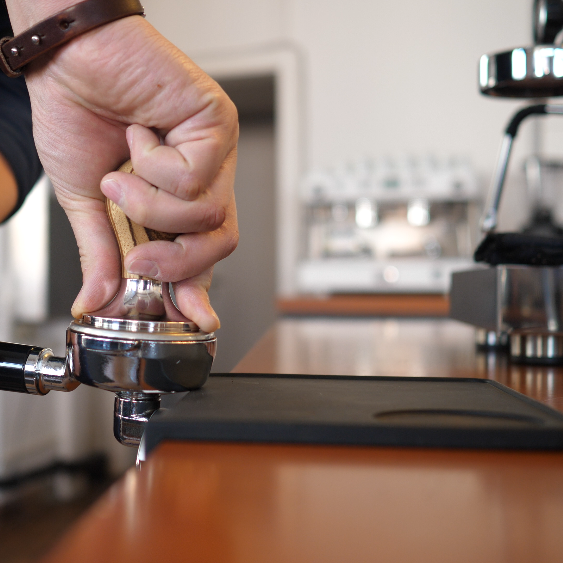
Portafilters and baskets are important tools for the brewing process. They differ in handling, tamping capability and also in the quality of the baskets. In many videos we've discussed that a good portafilter positions the spouts away from the espresso machine. The main reason is that this is the only way to tamp at the edge of the table, which is the best option in everyday use. Quick, clean, and the portafilter doesn't have to be awkwardly threaded into a tamper station and potentially loosen the grounds in the process.

With the variant on the left you quickly slip when tamping and destroy the cake.
Our perspective is "gastronomic." We've installed tamper stations in coffee bars, but ultimately the barista always tamped at the edge of the bar on a tamping mat. This is always possible with gastro machines because the spouts are positioned accordingly.
The spouts of the portafilters of the following machines facilitate tamping.
- ECM Mechanika Slim. What's unfortunate, however, is that the spout is very wide and the espresso flickers as it flows, going from left to right. This has no taste impact, but sometimes it looks like channeling and doesn't produce such nice photos. 😊
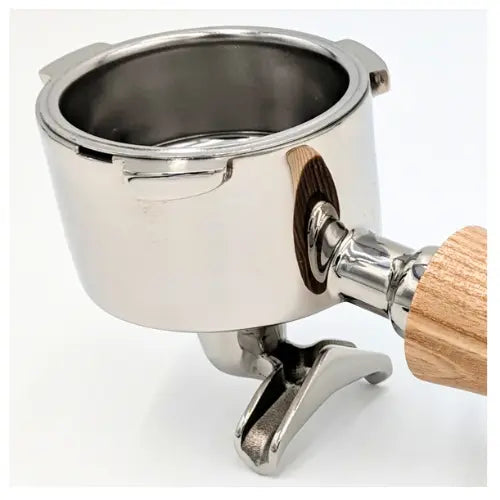
- The Xenia Espresso tamper is chic – we got a great wooden design. You pay extra for it, but it looks impressive. The spouts are positioned in our desired direction, but unfortunately just as wide as the ECM Mechanika Slim, which can lead to the described fluttering effect.
- One of the most beautiful tampers in the field comes with the Profitec Pro 500. "Correctly installed," pointed spouts and it feels good in your hand.
- Similarly pleasing is the portafilter of the Elba.969 as well as the ACM Homey. Both have matte portafilters that feel good in the hand.

"Too futuristic" says Michel. "Clever" says Benjamin. The portafilter of the Lelit Mara X
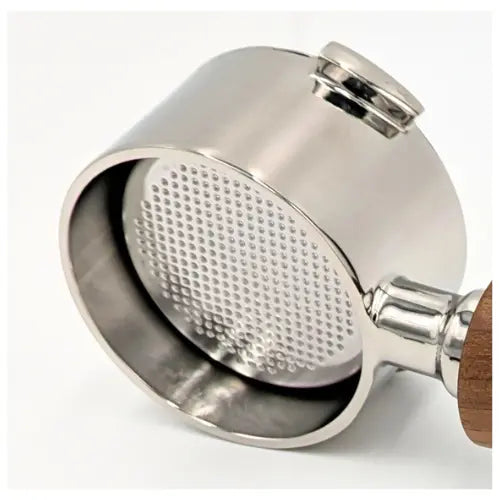
The portafilter of the Lelit Mara X breaks out of the mold of classic portafilters. The espresso is released towards the back and then flows forward and is visible. Michel and I have different opinions on this. Michel thinks the portafilter is "too futuristic." I like that Lelit was more creative and offers new solutions. It looks good how the espresso flows forward and becomes visible. You can't tamp the Lelit portafilter at the edge of the table either. But since the spouts don't rest on the ground, they don't get dirty and carry coffee particles along that would later end up in the espresso. This is one of our main arguments against tamping with a standing tamper. Plus, classic portafilters tilt in the process and it's difficult to tamp straight. The Lelit portafilter, however, stands straight – so this problem doesn't exist.
The portafilter spouts of the other machines are twisted and make tamping more difficult. They are otherwise "classic," with the Bezzera Magica's portafilter still deviating in shape.

The twisted portafilter spouts are directly related to the size of the drip tray. The further a drip tray extends from the espresso machine, or the closer the brew group sits to the machine's body, the less risk there is of water dripping in front of the machine during flushing and shots. Besides the BZ10, the Rocket Appartamento and the Bezzera Magica drip onto the table surface when flushing.
Noise level of the espresso machines
Does the noise level of an espresso machine play a major role? Not for the quality of the espresso. But if you've already skipped your morning espresso because the rest of the house is still sleeping, you know how interesting a quiet espresso machine can be. That said, it's worth noting: almost every espresso grinder is louder. So the noise level of the espresso machine may be less relevant. For some, the Rocket Appartamento, which leads the noise field at 83 decibels, might sound good. Free to say: even if I'm revving like a motorcycle, I want the rest of the village to know.
The other values:
- Quick Mill Andreja: 75 – 78
- Quick Mill Rubino: 79 – 80
- ECM Manufacture Mechanika V Slim: 79 – 81
- Rocket Mozzafiatto Cronometro R: 68 – 70
- Profitec Pro 500: 78 – 80
- Xenia Espresso: 75 – 77
- Bezzera Magica: 78 – 80
- Elba 1, 969.coffee: 78
- Bezzera BZ 10: 75 – 77
- ACM Homey: 79 – 80
- Lelit Mara X: 71
For the record: we measured the noise level pretty amateurly with a phone, keeping the same distance. Don't hold us to the decibel readings. The values still give you a sense of it. For all sound-sensitive folks: here's the file to listen to yourself.
Power consumption and energy efficiency
As with all electrical devices, the actual power consumption of espresso machines is hardly readable from the power consumption specification. For the Lelit Mara X, for example, it's 1400 W and for the Rocket Appartamento 1200 W. However, these values indicate consumption at full power. We were interested in how this looked over several operating hours and what fluctuations occurred with which machine.
For the measurement, we used power meters from mystrom. With the appropriate app, we arrived at the following values.
| Model | 25 Min + 5 Espressos | Espresso after 2 h | – | Espresso + Cleaning after 4 h |
|---|---|---|---|---|
| Lelit Mara X | 0.310 | 0.500 | 0.68 | |
| Bezzera BZ10 | 0.250 | 0.480 | 0.72 | |
| Xenia | 0.240 | 0.470 | 0.72 | |
| Quickmill Rubino | 0.300 | 0.570 | 0.83 | |
| ACM Homey | 0.260 | 0.570 | 0.83 | |
| Profitec Pro500 | 0.300 | 0.580 | 0.86 | |
| Quickmill Andreja | 0.320 | 0.600 | 0.88 | |
| Elba 1 696 Coffee | 0.260 | 0.580 | 0.90 | |
| ECM Mechanika V Slim | 0.340 | 0.640 | 0.92 | |
| Rocket Mozzafiato | 0.320 | 0.640 | 0.97 | |
| Rocket Appartamento | 0.330 | 0.660 | 1.00 | |
| Bezzera Magica S | 0.360 | 0.720 | 1.06 |
How do you read the power consumption table of espresso machines? The machine is heated for 25 minutes. Subsequently, according to the test instructions for temperature measurement (see below), 5 double espresso shots are simulated at roughly 1-minute intervals. After completing this simulation, the power consumption is recorded. Then, 2 hours later, a double espresso is simulated (5 s flush / 30 seconds water extraction) and the power consumption is recorded. After another 2 hours, a double espresso is similarly simulated and the machine is cleaned. For this, it's backflushed 5 times for 4 seconds each. Then the machine is turned off and the power consumption is recorded.
The Lelit Mara X is the only machine in the test with an ECO mode. More and more machines are being built with eco mode. The Lelit Mara X's ECO mode activates after 30 minutes and stops active boiler heating. In everyday life, this can be annoying if you just miss the 30-minute window. One reason why we can't imagine the Lelit Mara X as a training machine in our Home Barista courses.
Interestingly, despite repeated heating cycles, the machine doesn't consume more power than other machines. The insulated boiler contributes greatly to the fact that there's no significant temperature drop and so after two hours there's still plenty of temperature in the boiler. In fact, the machine was already usable again after 5 minutes (normally it heats for 25 minutes). Over the length of the test, the power efficiency of the Lelit Mara X keeps improving.
In addition, the Xenia Espresso and the BZ10 score well, which are the two machines that do NOT have a classic Faema E61 brew group with circulating thermosiphon principle. With both machines, the brew head is electrically heated. From an energy perspective, this shows the potential of this principle. The Xenia Espresso also shows that such a brew head in no way harms temperature consistency. Particularly poor performers are machines with large boilers and those without insulation.

Milk foam and steaming capability and cappuccino power
Dual-boiler espresso machines are distinguished from single-boilers in that espresso can be extracted and milk can be steamed in parallel. How quickly the milk heats up, how much power each machine brings to the 0.6L pitcher when steaming, and how steaming feels overall – we compared these.
Michel Aeschbacher locked in each espresso and started the extraction. After 10 seconds of run time, he briefly released the condensation water from the steam wand. After about 17 seconds, we started steaming.
In the direct comparison of the machines, we also gathered new insights for ourselves. The displayed boiler pressure is not a 1:1 indicator of force on the steam wand. Some machines had rather weak steaming despite showing +1 bar, while other espresso machines delivered decent pressure at 0.8 bar.
Independent of pressure, some machines heated the milk faster than others. Basically, faster heating allows longer steaming before the milk gets too hot. This extends the stretching and rolling phases and that tends to – especially for latte art beginners – be an advantage, namely more time. The ideal performance is: powerful pressure with simultaneous slow heating.
Steaming capability in direct comparison
The Rocket Appartamento steams with lots of power. It's fun to steam, easily spins the whole pitcher and yet doesn't heat the milk too quickly. Great for beginners and pros.
The Lelit Mara X has less power than the Appartamento. The built-up pressure is, however, absolutely suitable for steaming. At the same time, the milk heats up relatively slowly. Pretty good for beginners.
With the ACM Homey, real power comes from the steam wand. It steams up hot quickly. Requires a bit of practice.
The Bezzera BZ10 also has lots of power and easily gets the milk spinning, even if the perfect spot in the pitcher isn't found. Very suitable for steaming for ambitious beginners and pros.
The Elba 1 by 969.coffee also delivers solid performance. Michel's statement on this: «It may get hot a bit faster and at the same time has less pressure. But that's more of a felt statement.» Overall good and we have nothing to complain about.
The Bezzera Magica also puts on a good performance. Lots of power and a nice rolling phase are guaranteed. Heats up quite quickly too.

Simultaneous milk steaming during extraction isn't quite straightforward with the Xenia.
We studied the Xenia Espresso the most in terms of milk foam. It already had difficulties with our first test, allowing simultaneous brewing and steaming. The Xenia has two modes: a classic espresso mode that delivers very consistent temperature and accordingly good espressos, and a heat-up mode. If you press the start button to the right during extraction, the espresso mode runs. With one button press to the left, the Xenia heats up during espresso extraction and stabilizes the pressure in the boiler.
In espresso mode, the boiler pressure drops to below 0.5 bar. Difficult to almost impossible to steam milk this way. The milk can't really be set in motion and so many large bubbles remain on the milk.
In heat-up mode, the pressure is more stable and no longer drops below 0.5 bar. It's then easier to steam. Compared to the other tested machines, the steaming performance is still at the lower end of the table. The manufacturer, however, constantly works on workarounds and is very close to the user community. If steaming milk is more important to you than espresso performance, you can improve the setting with a firmware switch. But it makes more sense to us to wait longer after the espresso extraction so the boiler pressure stabilizes. The milk foam performance becomes much better this way, though not great.
The Profitec Pro 500 has markedly less power than the other Faema E61 brew groups. Michel compares the steaming behavior to the Xenia button combination on the left (heat-up mode). Interestingly, the displayed boiler pressure remains high. But we feel little of that in the pitcher.
Michel had steaming fun with the Quick Mill Rubino. Nice rolling phase, lots of circulation. So you can make good milk foam.
At the top of the range, the Rocket Mozzafiato Cronometro R gives it gas. Steaming is powerful, but also heats up fairly quickly. Definitely interesting for ambitious users.
The ECM Manufacture Mechaninka V Slim delivers solid steaming performance. "Not much and not little," Michel sums up the steaming.
The Quick Mill Andreja Premium PID lines up at the table end with Xenia and Profitec Pro. The pressure is too low to get the milk fully rotating. Since we're already at the upper limit with brew temperature, we can't increase the boiler pressure further.
How is milk steamed?
In the first phase of steaming, we bring temperature and volume into the milk. Air is incorporated and bubbles form. This part of steaming is called the stretching phase.
In the second and subsequent rolling phase, the formed bubbles are broken down and the milk foam becomes creamy-silky and shiny. This consistency is very well suited for pouring latte art on a cappuccino.
Temperature consistency in extraction and from shot to shot
To brew very good espresso, temperature consistency during the brewing phase is the be-all and end-all. In an article and video, Phillipp Schallberger and Michel Aeschbacher worked this out. In their comparison test, they recommend an average brew temperature of 93 degrees. At temperatures of 88 degrees, the tasted coffees had an unpleasant sour, bitter and astringent aftertaste. There was also increased channeling. At temperatures of 96 degrees, bitterness was excessive and acidity was no longer balanced. The texture declined, although the concentration of dissolved coffee solids (TDS, strength) increased.

As part of our test series, we investigated two things.
- Consistency in extraction. We noted how much the temperature deviated during a shot from the 1st to the last second. As a reference shot, we examined the second of five shots.
- Family, shared apartment and catering suitability. If you only want to drink one espresso, you're less dependent on the third and fourth espresso still being at target temperature. But if several espressos are pulled in quick succession through a larger household in the morning, temperature consistency over multiple shots matters. It's also important to give users confidence. If the temperature constantly fluctuates, it's unsettling when brewing.
How consistent does temperature stay over 25 seconds?
To measure consistency along brewing time, we compared the temperature at three temperature points and looked at the difference after 5 seconds, after 13 seconds, and after 22 seconds.
In the first few seconds, the coffee grounds are being saturated and the actual brew temperature at the sensor must first be reached.

Overall, it can be said that almost all machines deliver surprisingly good temperature consistency during the brewing time. Particularly noteworthy are the Rocket Appartamento with a variance of only 0.17 degrees between second 5 and 22. The Bezzera Magica ranks in with a difference of -0.18 degrees. Furthermore, the Xenia (switch right), the Rocket Mozzafiato, the Elba 1, the Quick Mill Rubino and also the ACM Homey deliver good results with less than 0.5 degree fluctuations in the shot. That's sensational and far better than we expected just a few months ago.
The Quick Mill Andreja (0.53), the ECM Manufacture Mechanika V Slim (0.87) and the Lelit Mara X (0.89) also deliver good results. The Bezzera BZ10 comes in at 1.02 and the Profitec Pro 500 at -1.44 – that's all perfectly fine. With the Profitec Pro 500, it should be noted that this drop occurs quite at the end of the extraction, where not much essential is being extracted from the coffee grounds anyway. It's possible that with one or another coffee, this temperature drop towards the end could even have positive effects.
Important notes: for the measurement, we based each reading on the second espresso. We recommend using the first shot for heating the portafilter and flushing the shower to remove any residue from cleaning powder.
The measurements were taken after the machines' temperature adjustments. A real criticism is that some espresso machines were not supplied with sufficient brew temperature. While a PID controller can be adjusted relatively easily on your own, though you don't know exactly what temperature you'll end up with at home, we had to adjust pressure and thus temperature on the Bezzera BZ 10, Bezzera Magica and ACM Homey via the pressostat. We'd advise you to buy these machines exclusively from your local dealer and have them guarantee that the temperature was checked on site!
Consistency over 5 shots
"Who needs 5 shots anyway," you might rightly say. That's 10 espressos after all. Yes, but…
Do you know what temperature you're at if it keeps rising and falling?! The Rocket Appartamento is a good example. The second shot was almost perfect in terms of consistency and temperature. While the first shot had an average temperature of 93.98 degrees, shot 5 was only at an average of 90.32 degrees. So the Rocket performed in the midfield of dual-boilers. More a machine for two to three shots and one that needs to be learned and understood.

By contrast, the Xenia with the right button press is like a straight line, increasing only 0.88 degrees in temperature over 5 shots.

Even more consistent is the Rocket Mozzafiato, with a temperature loss of 0.47 degrees. However, we have a different, significant criticism of the Rocket Mozzafiato. At the highest boiler temperature, namely 124 degrees on the PID controller, the machine only delivered 90.48 degrees to us in the 1st shot. That's definitely too cold. Since there's no thermostat – but a PID controller with sensor – we couldn't set the temperature higher ourselves, which hurt espresso quality. Lots of sourness – not tasty!

In terms of consistency over multiple shots, these three machines are at the top. With just over two degrees of fluctuation following are the BZ10, the Bezzera Magica -2.12, and the ECM Mechanika V Slim with -2.21 degrees.

The ACM Homey (3.28), the Andreja (-2.33), the Appartamento (-3.65) play in the midfield. Performing worst at both switch positions (steam and brew mode) is the Lelit Mara X.

Also not scoring well are the Profitec Pro 500, the Quick Mill Rubino and the Elba 1.


In particular, the performance of the Lelit Mara X is of course problematic, especially since it shows such good performance in many other categories. It's worth it with this machine, and with the other machines that lose temperature, to know them very well to get the most out of them.
Whoever buys one of the consistent machines like the Xenia, the Mozzafiato or also Bezzera Magica, knows where they stand and can find the right temperature with less trial and error.
Heat-up time of the espresso machine
The heat-up time of the espresso machine sometimes determines whether you're still sleeping or awake in the morning. So it's important! Bad news: if you're waiting next to the espresso machine for the first shot, you shouldn't buy a dual-boiler. Unfortunately, we don't have any good news for you. No machine is significantly faster to temperature than the magical 25-minute threshold. Sorry!
The Xenia Espresso reaches usable brew temperature fastest after 18 minutes. However, we also measure only 88 degrees at that point and that's not really tasty. If you're serious about your first espresso, wait your 25 minutes. Our Xenia model has a heating element built into the brew group. There's also the option to install a second element and then the whole thing should go faster.
If we can test that at some point, we'll add it here.
Otherwise, our conclusion on heat-up time is: Wait 25 minutes, set a timer or buy a thermoblock. With dual-boilers, it takes time for the boiler and brew group to really reach temperature. If that stresses you, then this isn't the right machine for you to enjoy.

All dual-boilers tested over the years
Meaning of symbols:
✓ tested and published
⏱ tested, will be published shortly
📦 ordered, not yet tested
We will cover various dual-boiler machines from entry-level to high-end models. At the end of this article, we collect suggestions for testing dual-boiler espresso machines.
Here you can read what else we've tested.
| Manufacturer | Machine | Technology | Status | Video |
|---|---|---|---|---|
| 969.coffee | Elba 1 | Dual-boiler | To video | |
| ACM | Homey | Dual-boiler | To video | |
| Bezzera | BZ10 | Dual-boiler | To video | |
| Bezzera | Magica | Dual-boiler | To video | |
| ECM | Mechanika V Slim | Dual-boiler | To video | |
| Kaffeemaschinen AG | La Basilea Pro | Dual-boiler | To video | |
| Lelit | Mara X V2 | Dual-boiler | To video | |
| Profitec | Jump | Dual-boiler | To video | |
| Profitec | Pro 400 | Dual-boiler | To video | |
| Profitec | Pro 500 | Dual-boiler | To video | |
| Quick Mill | Andreja Premium PID | Dual-boiler | To video | |
| Quick Mill | Rubino | Dual-boiler | To video | |
| Rocket | Appartamento | Dual-boiler | To video | |
| Rocket | Appartamento TCA | Dual-boiler | To video | |
| Rocket | Giotto Cronometro | Dual-boiler | To video | |
| Rocket | Mozzafiato R Fast | Dual-boiler | To video | |
| Rocket | Mozzafiato Cronometro R PID | Dual-boiler | To video | |
| Sanremo | Cube | Dual-boiler | To video | |
| Stone | Stone | Dual-boiler | To video | |
| Xenia | Xenia | Dual-boiler | To video |
Especially with the dual-boiler, the flushing process determines brew temperature. What the entire process looks like is described in Preparing espresso.
*We search for specialist partners for you, from whom we know they do good work and provide good service. We're in close contact with the retailers. These are commission links. If you order through this link, it doesn't cost you more, but we get a small commission that we invest in new test equipment.