



























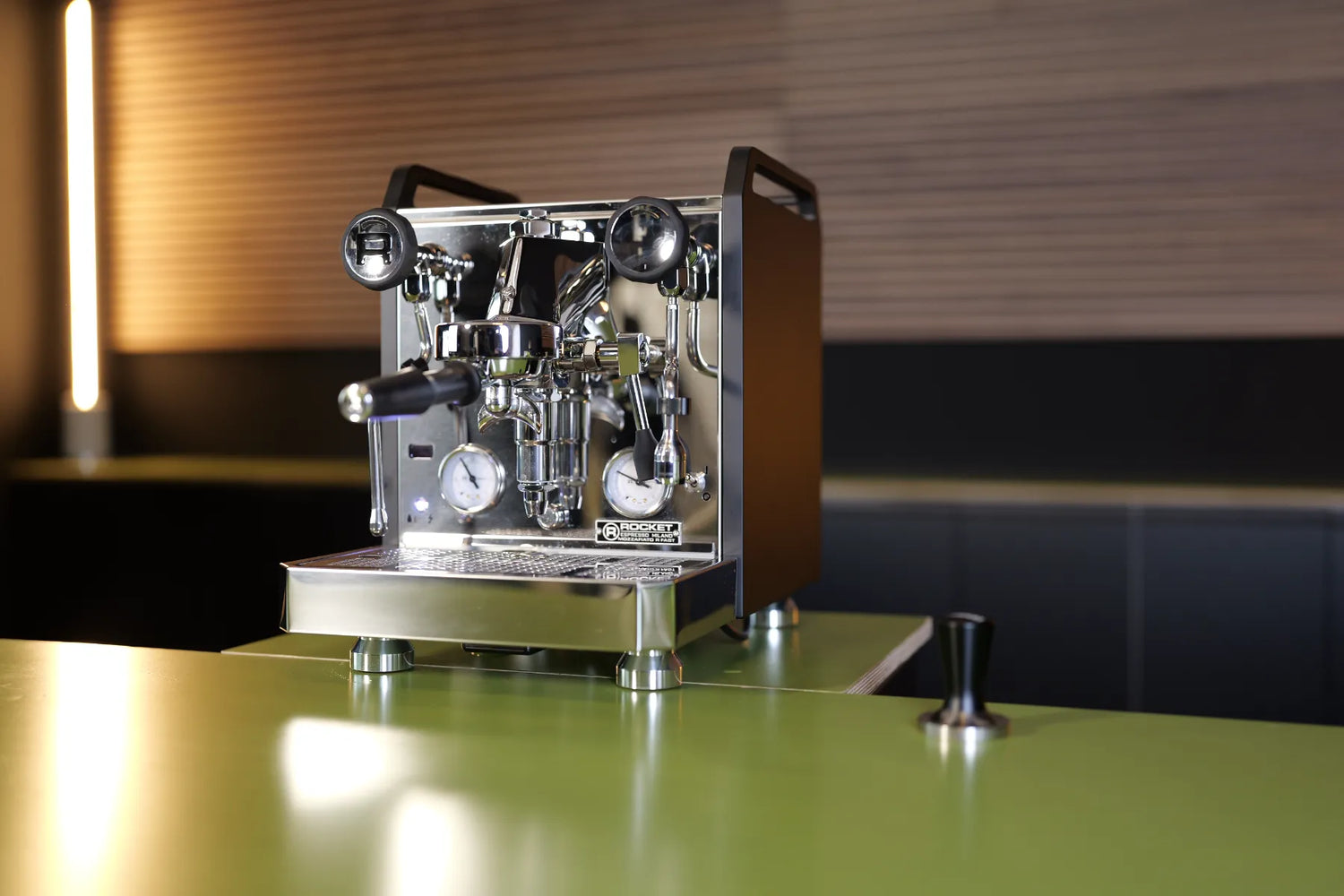

We tested this machine twice. In the first test, it didn't completely convince us. Then Andrea from our team discovered something that shifted the results so dramatically that we ran the entire test again under updated conditions. We're showing you both side by side here because we believe you should know both realities.
The Rocket Mozzafiato R Fast costs €2,190 and is a dual boiler in the classic Rocket design: a heat exchanger boiler, a rotary pump, the E61 group head. No volumetrics, no flow control, no profiling. We purchased the machine ourselves.
Design and Build Quality
Score: 8.25/10
If you know Rocket, you know what to expect: those characteristic thick side panels, the large lettering on the back, a tactile feel that seems out of time and is appealing precisely because of that. The black finish we tested looks convincingly solid—30 kilograms on the scale, 41 cm tall, 45.7 cm deep, and 31.4 cm wide. With the portafilter extended, you need at least 57.5 cm of depth on your work surface. If you don't measure this in advance, you'll regret it later.
What has genuinely improved compared to earlier Rocket generations: the build quality. Older models were notorious for sharp edges on the drip tray and housing that would regularly cut your fingers during cleaning. That's over now. All edges are properly deburred, the new display sits flush in the housing, and the machine feels more refined overall. The portafilter feels good in your hand, and the buttons have genuine tactile feedback.
Water tank with 1.8 liters, drip tray with 1,100 ml capacity, direct water connection available. What mildly annoys us in daily use: it's hard to read the water level from outside. With a 30-kilo machine, that's not a luxury problem—you're not going to tip it over.
Operation: Intentionally Simple
Usability Score: 5.5/10
You set the machine to 122 degrees and brew. That roughly sums up the scope of operation. The display shows boiler temperature, which is explicitly not the brew temperature but rather the steam boiler temperature, from which brew water emerges through the heat exchanger circuit. There is an offset—it's set to 3—but what actually reaches the portafilter depends on several other variables: flush time, wait time between shots, boiler temperature setting. This machine expects you to understand the game.
Behind the drip tray hides a menu with three buttons: Eco mode, temperature units, and, as Andrea discovered, another submenu for group head temperature that isn't documented in any manual. More on that shortly.
Profiling, flow control, volumetrics, preinfusion: none of it present. For anyone who wants to tinker with pressure curves daily, this is the wrong machine. If you value reliability over adjustability and want a machine that will run the same in 15 years as it does today, you're in good hands. A rotary pump, proven electronics, E61 group head. It holds up.
Temperature: What We Measured in the First Test
Temperature Management Original: 6.7/10 | Heating Time Original: 3/10 (25 Minutes)
In our KM protocol, we measure five shots of 27 seconds each at one-minute intervals, each time with the Scace measurement device directly in the portafilter. After 25 minutes of heating time, with the boiler set to 122 degrees, the brew temperatures look like this:
| Shot | Average Temperature | Deviation from 93°C Target |
|---|---|---|
| 1 | 91.6°C | −1.4°C |
| 2 | 92.0°C | −1.0°C |
| 3 | 91.5°C | −1.5°C |
| 4 | 90.9°C | −2.1°C |
| 5 | 90.4°C | −2.6°C |
That's typical dual boiler behavior: a falling curve. Shot 1 is 1.4°C below target, and from there it only goes down. The range across all five shots is 1.6°C. Within a single shot, the curve is stable—a flat line from second 5 onward at around 91.5°C. That earns full 2.7 points for Cluster B in our protocol. The problem isn't what the machine does during the shot, but where it lands.
25 minutes of heating time is long in 2025. Modern dual boilers, thin-film heaters, and thermoblock machines are ready to operate in under 10 minutes. If you get impatient and brew after 15 minutes in this configuration, you're still at 89°C average temperature, which is simply too cold for most coffees. In the WBC stress test with 14 rapid consecutive shots, the temperature window opens to 11.6°C, from 83.1 to 94.7°C. That's not an operating range for this machine.

The Andrea Hack: What a Hidden Menu Changes
Temperature Management with Hack: 7.3/10 | Heating Time with Hack: 5/10 (15 Minutes)
After our first test, Rocket contacted us and asked if we could recheck the results to test whether the group head temperature would be set to 91°C. There's a hidden setting for exactly that group head temperature. Rocket recommends 91°C in their internal communications. We were stuck there. Then Andrea systematically went higher, tested various values, and landed at 96°C. The temperature curves afterward look like this:
| Shot | Original (25 Min. Heating Time) | Andrea Hack (15 Min. Heating Time) | Difference |
|---|---|---|---|
| 1 | 91.6°C | 92.8°C | +1.2°C |
| 2 | 92.0°C | 92.3°C | +0.3°C |
| 3 | 91.5°C | 92.8°C | +1.3°C |
| 4 | 90.9°C | 93.0°C | +2.1°C |
| 5 | 90.4°C | 93.3°C | +2.9°C |
Shot 1 is now only 0.17°C below the 93°C target, which earns full points for cold-start accuracy. The range across all five shots drops to 1.03°C. The machine no longer shows a falling curve, but a slightly rising one, meaning it's ready after 15 minutes and settles slightly more with each shot. Standard deviation across the entire sequence: 0.4°C. That's extraordinarily good for a dual boiler—you can easily compare it to significantly more expensive dual boiler machines.
Remove the drip tray. Behind it you'll find three buttons. Press the right button once, then the left button once, then hold the middle button until the submenu appears. There, increase the group head temperature from 91°C to 96°C and confirm by holding the middle button for a long time. That's it.

Scoring Overview: Original vs. Andrea Hack
Rocket Mozzafiato R Fast
Test Protocol v2.3 — Original Setting (Group Head 91°C)
Espresso Quality
Score: 7.0/10
With the Andrea Hack, the machine brews at stable 92.5 to 93°C. You notice that in the cup. We brewed with Komal from our purple line: sweet, round, soft. The E61 group head ensures even pressure buildup, and the thermal mass gives the shot stability.
What you don't get: flexibility. No pressure profiling, no adjustable preinfusion, no flow control. The rotary pump starts at full pressure. For classic, fuller-bodied espresso roasts, that's not a problem. With light, delicate specialty roasts that need precise pressure curves, you hit limits. That's a technology-based limit, not a weakness in construction.
Espresso Quality
Score: 7.0/10
With the Andrea Hack, the machine pulls shots at stable 92.5 to 93°C. We brewed with Komal from our purple line and got very sweet, round espressos with a texture that has the full body of a well-made dual boiler shot. The E61 group head builds pressure evenly and its thermal mass ensures that a single shot stays internally very stable. What the machine can't offer is flexibility. It starts with full rotary pump pressure, without preinfusion, without profiling flow. For classically roasted coffees, that's not a problem. With light, complex specialty roasts that react sensitively to uncontrolled pressure buildup, you hit limits.
Milk Steaming: The Real Strength of This Technology
Steaming Quality Score: 6.5/10
300 ml of milk from 8 to 60°C in 28 seconds. That's fast, and anyone serving many guests will appreciate that. The pitcher angle we need when steaming is around 15 degrees, which suggests good steam power without needing to hold the pitcher extremely tilted. Because the steam comes from its own circuit, you can brew and steam simultaneously without either interfering with the other. That's a real strength of this technology.
Two things that annoy you in daily use: First, about 8 ml of condensation water comes out of the steam wand when you open it—you always have to blow it briefly into a cloth before introducing the milk. Second, the wand has no cool-touch. After steaming it's hot enough to burn your fingers and stays that way for a while.
Noise Level
Score: 5.0/10
62.2 dB when brewing, measured at 20 cm distance. That's unremarkable average for a rotary pump machine—audible but not disturbing, no characteristic whining or unpleasant humming.
Energy Consumption
Score: 4.0/10
We measure with the Christ CLM1000 Professional. For heating plus one espresso, the machine consumes 0.264 kWh—that's our score-relevant value following the espresso-first principle. A complete cappuccino scenario with heating, shot, and steaming comes to 0.283 kWh. Keeping warm costs 0.147 kWh per hour, which adds up during extended use.
That's the system-based weakness of the dual boiler: because the boiler is maintained at temperature constantly, even if you only drink one espresso a day, the machine continuously draws power in standby. If you turn on the machine in the evening and brew in the morning, you're not doing it any favors—or the environment.
Accessories
Score: 7.5/10
Rocket now includes a tamper that actually fits: less than 1 mm play—that's not standard in this price range and earns full points in this category. The baskets are acceptable, not outstanding. A blind basket and cleaning brush are included. You won't find a single-spout outlet, a naked portafilter, or a milk pitcher in the package.
Volume Potential
Score: 5/10
The WBC stress test with 14 rapid consecutive shots isn't a realistic operating range for this machine—the temperature window opens to 11.6°C. What counts positively: direct water connection available, drip tray with drain. When steaming five pitchers of 300 ml each, you notice the steam power drop from the fifth pitcher onward, indicating good but not unlimited reserve capacity. For a home with occasional guests, that's completely adequate; it's not designed for catering use.
All measurements according to Kaffeemacher Test Protocol v2.3. Temperature measurement with Scace 2, power measurement with Christ CLM1000 Professional.
Specialist partner link Rocket Mozzafiato R Fast: [Partner Link] Stoll Espresso.
Conclusion
In the first test, the Mozzafiato R Fast landed exactly where we expected: a solid dual boiler with 25 minutes heating time and a temperature level that stayed just below the 93°C target mark. Better than its predecessors, but nothing that really grabbed attention in the 2025 market. Then Andrea found the submenu.
With the Andrea Hack, the machine is ready to brew in 15 minutes and delivers temperature stability that's extraordinary even by dual boiler standards. 0.4°C standard deviation, shots between 92.8 and 93.3°C, a flat line within the shot. This isn't the machine we wrote about in the first test anymore. We expressly recommend you do the hack if you own or buy the Mozzafiato R Fast.
What this machine won't become: a machine for everyone. If you want to brew in the morning with just a few minutes of lead time, a thin-film heater serves you better. If you want to extract light specialty roasts with precise pressure profiling, you need flow control. And if you care about energy consumption, you need to know that a dual boiler runs in retention mode as long as it's switched on.
For everyone else—and that's a respectable group—you get a machine for €2,190 that's reliable, durable, and with the right hack temperature-stable, with steam power that makes many significantly more expensive machines look dated, and with build quality you didn't see in earlier Rocket generations. That has substance.
Technical Specifications
| Property | Value |
|---|---|
| Price | €2,190 |
| Boiler Type | Heat Exchanger (Dual Boiler) |
| Pump Type | Rotary Pump |
| PID | Yes (Boiler Temperature, Not Brew Temperature) |
| Profiling | None |
| Heating Time Original | 25 Minutes |
| Heating Time Andrea Hack | 15 Minutes |
| Brew Temperature Original | 91.6°C to 90.4°C (Declining Over 5 Shots) |
| Brew Temperature Andrea Hack | 92.8°C to 93.3°C (Stable) |
| Noise Level | 62.2 dB(A) |
| Energy Consumption Espresso | 0.264 kWh (Heating + 1 Shot) |
| Energy Consumption Cappuccino | 0.283 kWh (Heating + Shot + Steam) |
| Warmkeeping Per Hour | 0.147 kWh |
| Milk Steaming 300ml | 28 Seconds (8°C to 60°C) |
| Water Tank | 1.8 Liters |
| Drip Tray | 1,100 ml |
| Direct Water Connection | Yes |
| Dimensions (W × D × H) | 31.4 × 45.7 × 40.9 cm |
| Depth with Portafilter | 57.5 cm |
| Weight | 30 kg |
| Portafilter Diameter | 58 mm |
Power measurement with Christ CLM1000 Professional, cold start after 6 hours rest.

As always, we purchased this machine ourselves. This test was not commissioned by Rocket. The rating is based on our test protocol v2.3.

