





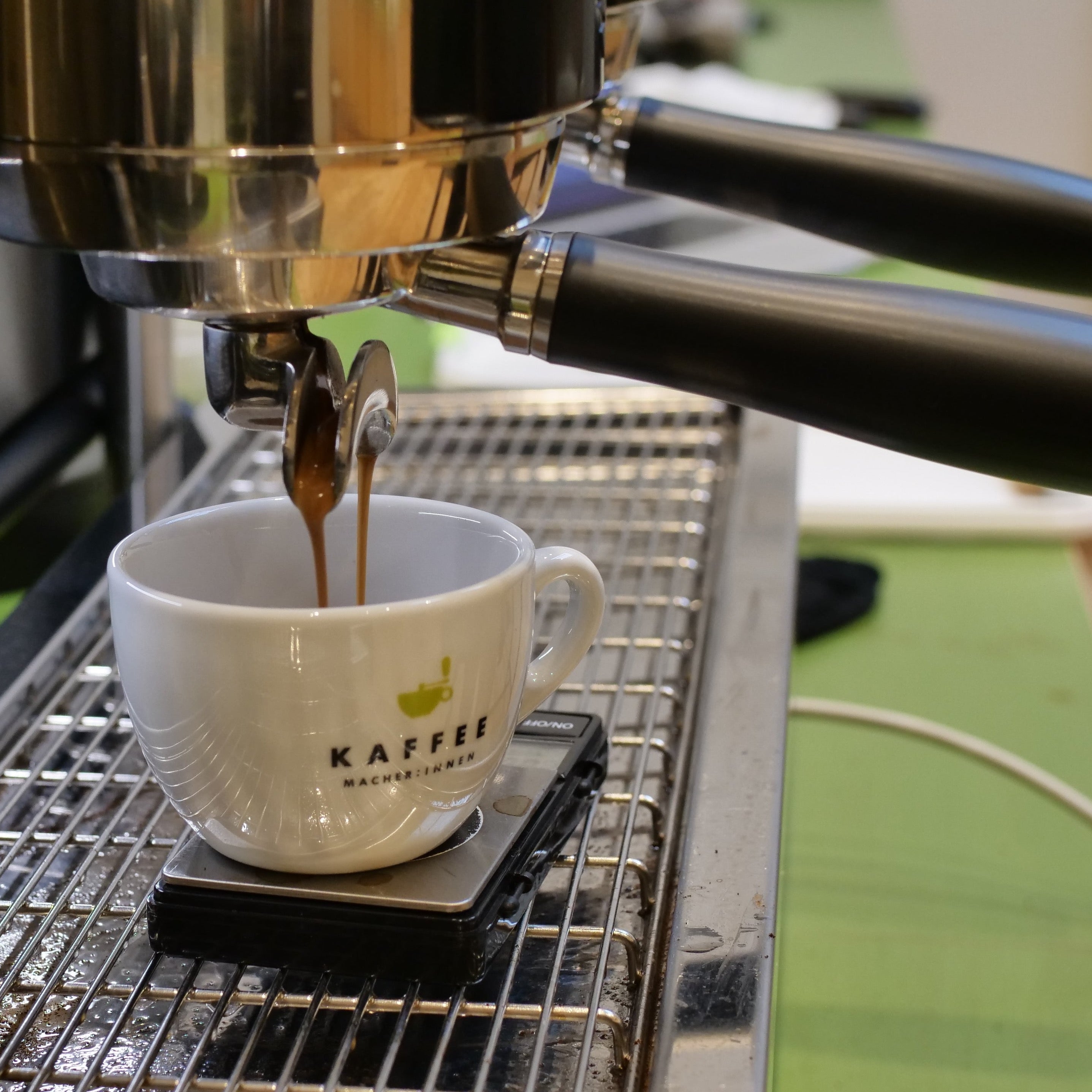
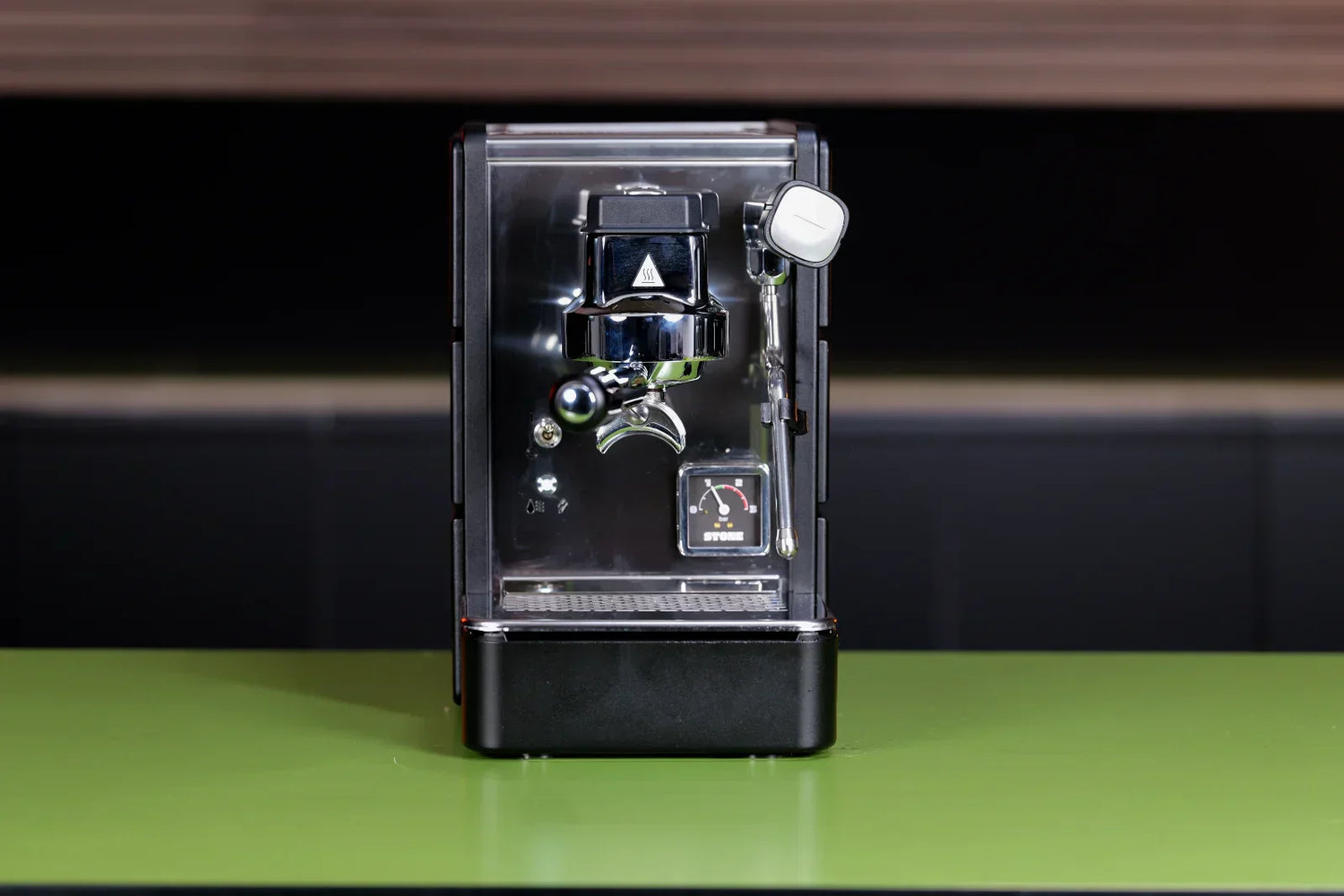

We tested the Stone Espresso machine. The dual boiler is slim, one of the most affordable, and impressed us in our test. You'll find out everything else in the video. Temperature curves and further information about the Stone Espresso can be found below.
Design and First Impression
When unboxing the Stone Espresso, the appearance immediately catches the eye. Our Stone variant has black metal panels that are removable and can be swapped out with other design elements to customize the machine. There are stone panels as well as wood slats. Everyone can make the machine their own.
The machine is extremely compact and fits well on any work surface with just 22 cm width, a depth of 43.5 cm (without portafilter; with it, it's 55 cm) and a height of 41 cm. The machine weighs 20.5 kilograms.
The Stone Espresso makes an overall quality impression, even though some things that shine on the outside aren't entirely convincing on the inside.
One such example is the drip tray. It only holds 400 ml. That's really small and disappointing, because from the outside, the front of the machine actually looks relatively spacious. Unfortunately, the interior part led our testers to describe it as more reminiscent of a pigeon drinking bowl.

The start and stop operation of the machine is unique. Stone Espresso showcases a characteristic in-house development of the group head. It has an extraction actuator above the group. The plastic square is turned to start and turned again to stop. There is no volumetrics or programming, just a manual extraction like with Faema E61 group heads. It feels good and works flawlessly. The only drawback: the square on our machine is twisted slightly beyond the flush edge of the group head when ending the extraction, which doesn't look nice and could trigger the "urge to turn it back" in tidy-minded users.
Stone Espresso's Own Group Head
The Stone Espresso's group head is equipped with a 200w heater that guarantees a fast heat-up time. We measured a heat-up time of 9.30 minutes, which is very fast compared to many dual boiler espresso machines. The temperature stability in the coffee maker temperature protocol is then good to satisfactory, with a tendency to rise toward the end of extraction. We measure a standard deviation of 1.22 degrees across 5 extractions. The machine thus stays in line with machines like the Lelit Elizabeth, Lelit Victoria, or Profitec Pro 300.
However, the Stone Espresso's performance completely breaks down with the WBC protocol, and we drop to a standard deviation of 2.89 degrees across 14 extractions. Here we can clearly say:
- Few extractions: that works after 9.5 minutes and then the Stone Espresso's temperature is solid.
- Many extractions: then the temperature cannot stabilize and fluctuates and continues to rise. Not good at all!
In the price range and for home espresso, the WBC protocol isn't really applicable. Nevertheless, some affordable machines also perform well here, which is why we run the test. If you make a few espresso extractions per day at home with the Stone Espresso, you won't have any problems at all!


Good Espresso with the Stone Espresso
Our espressos tasted very good. Especially more classic coffee blends and espresso with an Italian character deliver very satisfactory results on the Stone Espresso.
Neither with temperature, nor with flow rate or pressure did we notice any peculiarities. With a good espresso grinder that's easy to adjust and an espresso that suits the home barista, the Stone Espresso is a good choice for preparing espresso!
Cappuccino and More with the Stone Espresso
Steaming milk with the Stone Espresso dual boiler espresso machine is a process that requires a little practice, but delivers quite satisfactory results. Thanks to the dual boiler system, the machine can extract espresso and steam milk simultaneously, which is a major plus point especially for cappuccino and latte macchiato fans.
The machine is not a steaming wonder. It could handle a bit more pressure. It takes 40 seconds in our benchmark test to heat water in the milk jug. That's normal dual boiler behavior.
With the right practice and a learning period, both beginners and experienced home baristas will get the hang of it.
We steamed creamy milk foam that's perfect for cappuccinos and other milk coffee variations. The Stone Espresso thus proves that it also delivers solid performance for its price when it comes to milk foam.

Energy Consumption of the Stone Espresso
Despite the fast heat-up time, the Stone Espresso's energy consumption is in the lower-to-mid range, or rather the classic range of energy consumption for dual boiler espresso machines. This is mainly because we always heat up the 1.7 liter steam boiler as well. That's how it works with dual boiler espresso machines, as the brewing water is heated by flowing through the steam boiler. And since the steam boiler has its size, and heating the group head also requires electricity, we come to 0.24 kWh for heat-up time and 5 double extractions. For comparison: with many thermoblocks we land in the range of under 0.15 kWh.
Conclusion on the Stone Espresso
The Stone Espresso is, especially for its price, a very good espresso machine in the dual boiler segment. It would have also performed very well in our large dual boiler test as one of the most affordable and best espresso machines in this segment.
More on performance measurement and energy consumption.