








What we can extract from coffee, what we should extract, and how that affects the strength of the coffee beverage.
"A bit over-extracted and bitter," the barista mutters and adjusts the espresso grinder. Moments later, a few grind settings coarser, and the coffee flows smoothly with the extraction just right. The result is a perfect cup that brings everything the coffee bean's flavor potential holds. A potential that is developed by coffee producers in the growing regions and by processing roasters.
Brewing coffee is nothing more than unlocking this potential or making it soluble. "Making it soluble" is the key phrase. By grinding, the cell structure of the coffee beans is broken, the coffee's surface is enlarged, and thus becomes accessible to water. The solids become gaseous and liquid and form, as flavor components, what we perceive sensorially in the coffee beverage: taste, aroma, body, and brown-red hue. What we taste are chemical compounds whose solubility differs and which, depending on extraction and intensity, lead to very different results in the cup.
Two perspectives simplify the understanding of the brewing process. What we dissolve from the coffee bean we call "extraction." The dissolved particles in the cup we call the "strength" of our beverage, meaning the concentration of dissolved coffee.
Strength and Concentration of Dissolved Coffee Particles
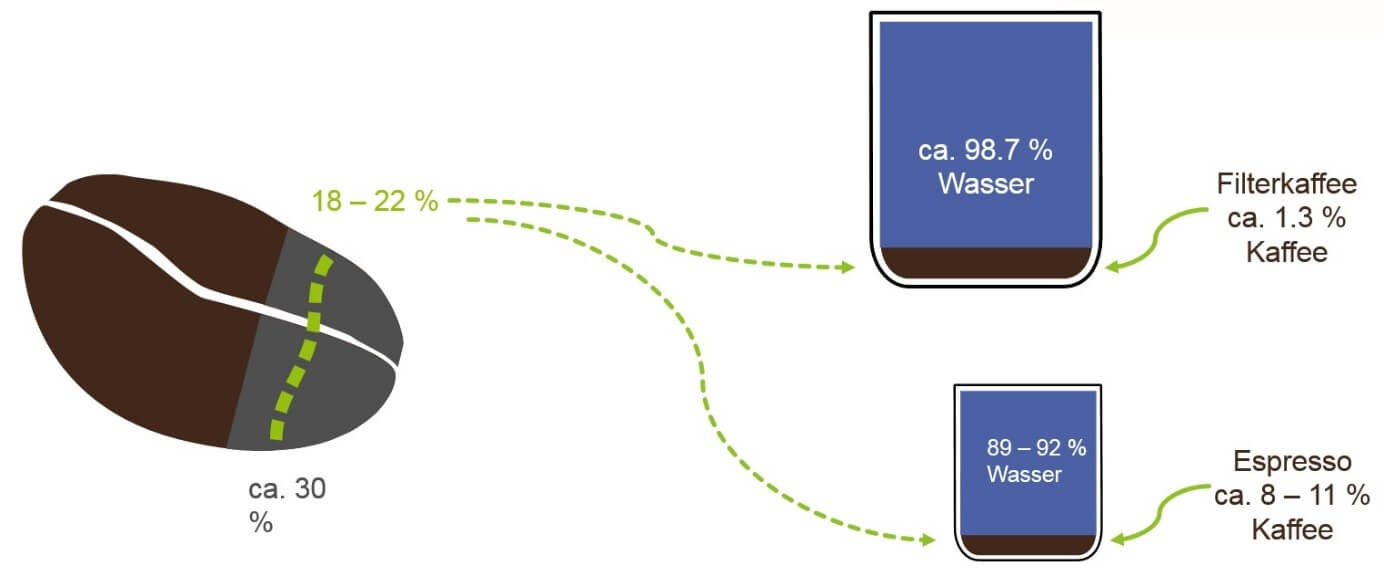
Every coffee beverage is ultimately water in relation to a certain amount of coffee particles, that is, strength. A filter coffee, for example, consists of around 98.5% water and 1.5% dissolved coffee particles. An espresso, which is also perceived as much "stronger" and more intense in flavor, consists of around 90–92% water and correspondingly 8–10% dissolved coffee particles. When we speak of strength, we mean the concentration of coffee in relation to water. The dissolved coffee particles are called Total Dissolved Solids in English and are abbreviated as TDS. The concentration of TDS can be measured with a refractometer.
Coffee Extraction – What We Take from the Bean
Approximately 30% can be extracted from each coffee bean. Everything else is cell material, oil, protein, and not soluble with normal and easily accessible means. However, not everything we can extract from a coffee bean tastes good. There is a fine line between too much and too little extraction, which we perceive sensorially in every cup of coffee.
Over-extraction – Too Much Extracted
If a coffee tastes more bitter than we know it to be, we have probably over-extracted. The typical reason for this is too fine a grind. A fine grind offers water more resistance and forces it to extract more on its way into the cup. In the case of over-extraction, more than is actually good. The result is a coffee that tastes bitter, astringent, and unbalanced. Sensorially, this sensation occurs when we dissolve more than an average of 22% from a coffee bean.
Under-extraction – Too Little Extracted
On the other side of the line, under-extraction threatens. If we dissolve less from a coffee bean than what is inherent in it, we not only fail to unlock the bean's potential, we also get a sour, grassy, and depending on strength, aggressive cup. We then dissolve only the most soluble particles and have probably extracted less than 18% from the coffee bean.
The Sweet Spot and the Perfect Coffee
The art of brewing a perfect coffee lies in navigating this fine line between over- and under-extraction while bringing the dissolved particles into the desired strength ratio to water. A successful extraction unlocks the potential in the bean. The strength defines what type of beverage we have brewed.
Strength of Coffee Beverages
The concentration of dissolved coffee particles is determined for each coffee beverage:
Filter coffee: 1.2–1.5% TDS
Café crème: 1.8–3% TDS
Americano: 3–4.5% TDS
Espresso: 6–10% TDS
These are approximate values that provide good guidance for the strength of coffee beverages. It is important to note that the rest of the cup's contents is water. In filter coffee, for example, more than 98% water.