







Refractometers are scientific instruments that measure the refractive index of a liquid – in simple terms, how strongly light is bent (refracted) in a medium. In the coffee world, the refractive index is directly related to the concentration of dissolved substances in the coffee beverage, known as Total Dissolved Solids (TDS). The TDS value indicates what percentage of the beverage consists of dissolved coffee components and is thus a measure of coffee strength. A stronger coffee has a higher TDS percentage, a weaker one a correspondingly lower value. By measuring TDS, baristas can objectively assess and reproduce extraction during the brewing process. With the help of light and a bit of math, otherwise subjective sensory impressions can be translated into tangible numbers – a dream for coffee-loving nerds, and a practical tool for anyone aiming for consistent quality.
However, not every refractometer from laboratory supplies or wine-making is suitable for coffee. Why? Because coffee is a complex solution of countless compounds, whereas, for example, a simple Brix refractometer is usually calibrated only for sugar solutions. A standard Brix meter shows sugar content in °Bx (1°Bx = 1 g sucrose in 100 g solution). For coffee, however, you would need a conversion factor. In fact, 10 °Bx corresponds to approximately 8.5% TDS in coffee, which can be expressed by a simple factor (~0.85). Moreover, many inexpensive hand-held Brix meters only have coarse scales (resolution often 0.2 °Bx, corresponding to about 0.1% TDS) and require bright backlighting and manual reading. For the fine differences in filter coffee (typically ~1.3% TDS), they are too imprecise and cumbersome. Specialized coffee refractometers, on the other hand, are precisely calibrated for coffee solutions and provide digital displays with two decimal places in seconds. In the following, we take a critical but humorous look at common models, how they work, how to use them to calculate strength and extraction yield, what pitfalls exist, and what science is discovering new about coffee extraction.
TDS says nothing about quality – In a nutshell
The TDS value alone provides no information about the actual sensory quality of an extraction. Tasting is essential for quality assessment. Nevertheless, a refractometer helps in many ways:
- The strength or concentration of dissolved coffee particles can be measured.
- TDS is the prerequisite for calculating extraction. This gives us an indication of whether a coffee is over- or under-extracted. See also the video on this topic further below.
- The values signal changes in material (e.g., grinders with dull grinding discs), water (soft or harder water dissolves more or less coffee compounds), pressure (e.g., pressure drop in the espresso machine due to scale buildup, etc.), coffee aging, or channeling.
- Different espresso machine types and baskets can be compared with their extraction evaluations, as well as tamping techniques, dose amounts in portafilters, etc.
- Different coffees (origin, altitude, variety) can be discovered anew when confronted with consistent external brewing parameters and very different extraction values are measured.

VST Refractometer
Overview of common coffee refractometers
In specialty coffee, some digital refractometers have become established, which vary in precision, features, and price. Here's an overview of the three best-known models:
VST LAB Coffee III
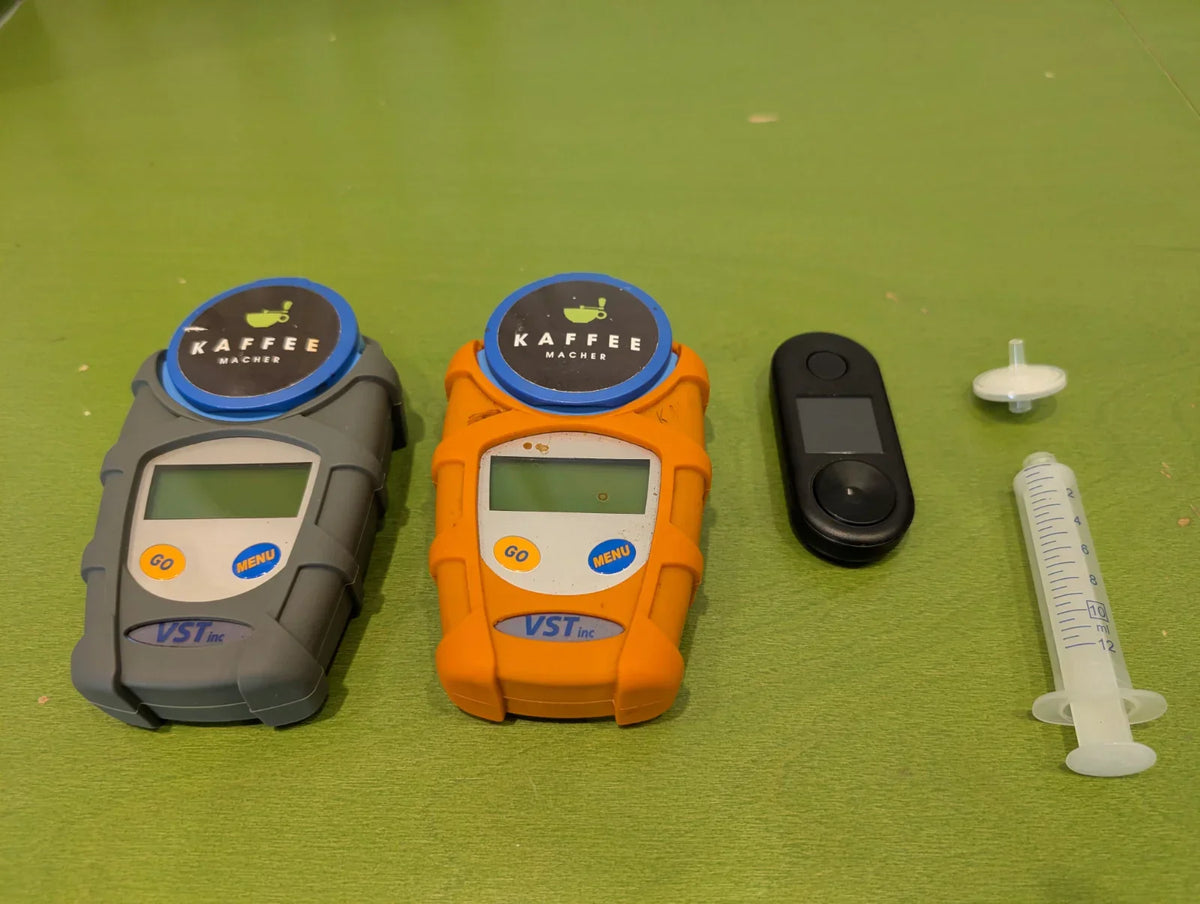
The Lab Coffee Refractometer from Voice Systems Technology (VST) is considered the gold standard in the industry. We have three of these refractometers and they have served us faithfully day after day for over 10 years now.
The VST Refractometer measures coffee strengths from 0.00% to approximately 20% TDS and achieves outstanding accuracy of ±0.02% (typical). For espresso samples (with higher concentration), the accuracy is slightly lower at about ±0.05% – still very precise. The device offers automatic temperature compensation in the range of 15–40 °C, which is practical when the sample hasn't fully cooled yet. High-quality sapphire optics and a 1024-pixel sensor array ensure reliable measurements. VST provides CoffeeTools software for PC/Mac directly with the device, which enables extraction calculation and data analysis. No wonder VST refractometers have served as official instruments at world championships (Brewers Cup, Barista Championship) for years. The only drawback is the price – professional quality comes at a professional price (in the four-figure range including software and filter).
Atago PAL-COFFEE
The PAL-COFFEE from Japanese manufacturer Atago is a handy pocket refractometer and a popular all-rounder. It can display both the Brix value and TDS directly (dual-scale versions are available). We've had a PAL-Coffee Refractometer since 2018 and use it in brewing courses and at championships.
With a measurement time of only ~3 seconds and automatic temperature compensation up to 100 °C, it's even suitable for hot samples right after brewing. The accuracy is ±0.15% TDS. Perhaps a bit coarse for filter coffee, but sufficient for espresso. Many appreciate its robust, water-resistant design (ideal for the hectic café environment) and simple operation with just two drops of sample. Practical: Thanks to the Brix scale, you can also misuse it to measure sugar solutions or fruit juices – but when testing coffee, you should switch to the TDS display to directly get percent coffee extract. Price-wise, the PAL-COFFEE is below the VST, but still in the upper three-figure range.
DiFluid R2 Extract
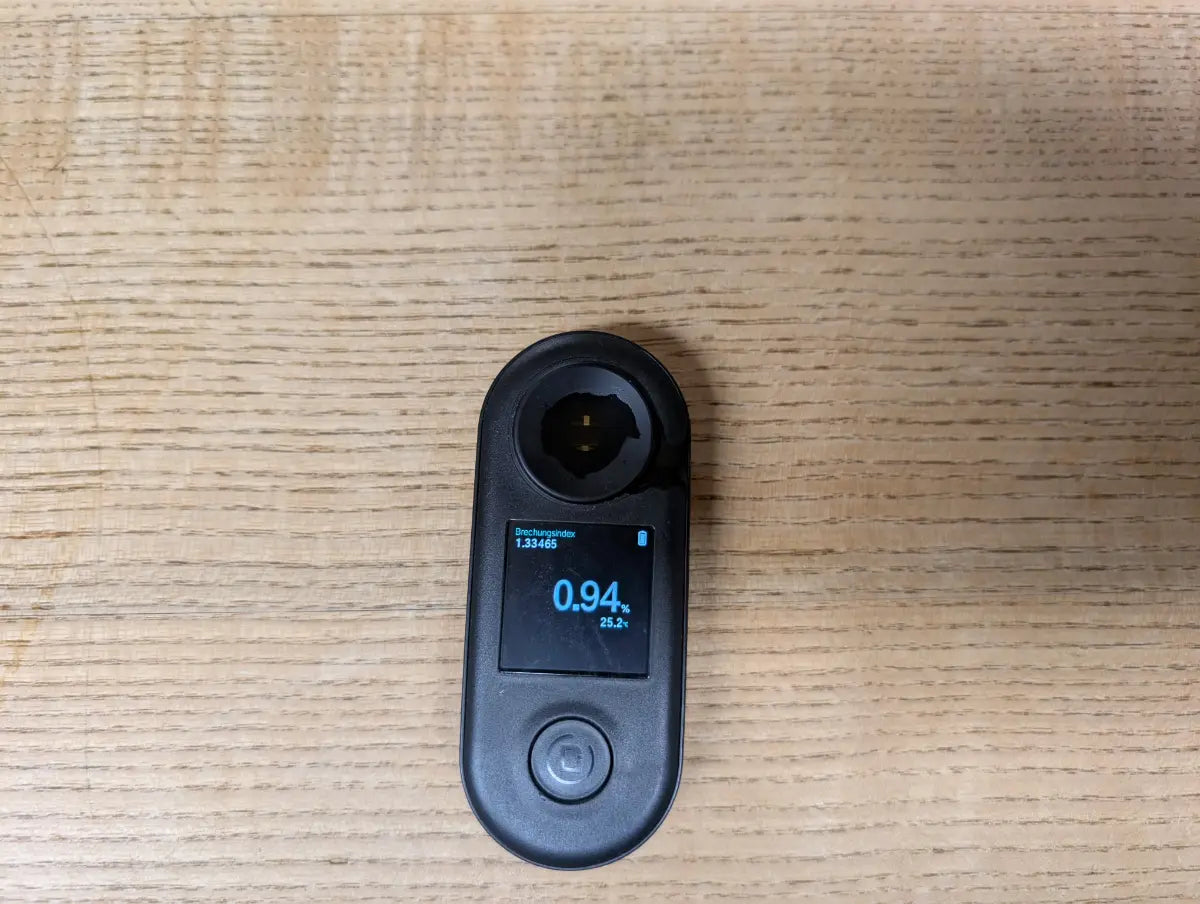
The newcomer DiFluid R2 Extract from China has been making waves since 2022 as an affordable alternative. Despite a significantly lower price, it offers impressive accuracy of ±0.02% TDS and a wide measurement range from 0 to approximately 25% (up to 30% TDS according to the manufacturer). The device is compact, USB-rechargeable, and IP67 water-resistant. So if an espresso spills on it, it won't immediately give up the ghost.
Particularly innovative is the app integration: The R2 connects via Bluetooth to the DiFluid Café smartphone app, which stores measurements, creates statistics, and even provides updates for the device. The large display on the device itself already shows all important data (including temperature) and makes operation easier with just one button. An aluminum sample tray is included, which provides rapid temperature stabilization. In short: The R2 delivers many features of high-end devices at a bargain price. An ideal compact tool for ambitious home baristas or as a second refractometer to take along.

Note: Simple analog refractometers for wine or honey, for example, are usually unsuitable for coffee. They are often only designed for high Brix values and too imprecise in the low TDS range, or they require manual reading, which is subjective and error-prone. So if you want to work seriously with coffee measurement, it's better to choose the coffee-suitable devices mentioned above.
Operating principle and correct application
How does a coffee refractometer work? In simplified terms, the device sends a light beam through the sample onto a prism and measures the angle at which light exits the sample. The denser or more concentrated the solution, the more strongly the light is bent (refracted). Beyond a certain angle of incidence, total reflection even occurs. The light is then completely reflected back in the medium. This critical angle is directly dependent on the refractive index (RI) of the liquid. Digital refractometers use this principle: they scan various angles and detect when no more light passes through. From the critical angle, the device calculates the refractive index of the sample.
For coffee, the refractive index is now a function of dissolved substances (TDS), but not a simple linear one. The relationship between RI and coffee concentration is quite complex and not strictly linear because coffee consists of hundreds of chemical compounds. To develop their algorithms, VST, for example, had thousands of samples of different coffees, roasts, and brewing methods analyzed by determining TDS both refractometrically and by drying. From such datasets, a conversion formula can be derived so that the refractometer display can directly show % TDS without the user having to calculate themselves. Modern coffee refractometers thus essentially contain the empirical results of many laboratory experiments as smart curve formulas in their chip, so that light refraction reliably becomes percentages.
In addition to calibration for coffee solutions, temperature compensation plays a crucial role. Heat changes the density of a liquid and thus the refractive index noticeably. A hot sample would produce an incorrect result without correction. That's why all high-quality devices have automatic temperature compensation (ATC) within a certain range (typically about 10–40 °C or more). The electronics measure the sample temperature and recalculate the RI value as if the sample had been measured at, say, 20 °C. Nevertheless: For highest accuracy, it is recommended to allow the coffee sample to cool to room temperature, especially for espresso. This reduces measurement errors and is also gentler on the device. After all, nobody wants to shock the expensive prism assembly with boiling water.
Equally important is sample preparation. Coffee solutions – especially espresso or immersion coffee – always contain tiny, insoluble particles (microparticles, fines from the ground coffee) and emulsified oils. These turbidities distort the refractive index and must be removed for precise measurement. In practice, filter paper or special syringe filters are used for this (e.g., 0.5 μm pore size for espresso). When you filter an espresso sample, the measured TDS usually drops slightly because the suspended solids no longer contribute to the apparent solids content. At the same time, however, the precision and reproducibility of the measurement increase significantly.
How to use the refractometer
Step-by-step, the following procedure is used for reliable measurement:
- Calibrate: Before measuring, it's best to check with brewing water that the refractometer correctly sets to 0.00% (zero adjustment). This eliminates measurement drift or residue on the prism.
- Stir sample and take it: For espresso, you typically take a few ml from the middle of the shot (not the crema). I use the pipette or syringe to stir. I draw up coffee and spray it back into the container. By stirring, we ensure that we take a well-mixed sample.
- Filter: If necessary, clarify the sample through a paper or syringe filter to remove any visible suspended solids. This is especially advisable for French press, Moka pot, or espresso to avoid distorting the result with particles or oil layers.
- Cool down: Allow the sample to cool to approximately 20 °C if possible. Hot samples can be measured directly with the Atago or DiFluid (they compensate up to 100 °C), but experience shows: as samples cool, TDS values climb slightly because density increases – or simply some water evaporates. So it's better to wait a bit or cool to room temperature.
- Measure: Place one or two drops of the prepared sample on the prism, close the cover (if available), and read the value. Modern devices complete the measurement in seconds and display the TDS value directly as a percentage.
- Clean: After each measurement, clean the prism with water and a lint-free cloth. Coffee residue could otherwise dry on and affect the next measurement.
Sounds like effort? Admittedly, some lab atmosphere comes up. But soon the refractometer becomes part of barista craft like a thermometer is to a chocolatier. With a bit of practice, the above steps take hardly more than a minute. And the reward is exact data about our coffee.
Coffee strength (TDS) and extraction yield (E) explained
Once you've determined the TDS value of your coffee, the question arises: Is that good or bad now?
Here, in addition to strength, another important parameter comes into play: the extraction yield (often abbreviated as EY). The extraction yield indicates what percentage of the original ground coffee has dissolved into the solution. More simply: If you brew 20 g of ground coffee and end up with 4 g of it dissolved in the cup, the extraction was 20%. This value is a central indicator of the brewing level: too low extraction results in sour, thin-tasting coffee; too high extraction leads to bitterness and astringency. We find balance and optimum traditionally at around 18–22% extraction. In this range, coffee tastes balanced, with good sweetness and without dominant acidity or bitterness.
The extraction yield can be calculated from the TDS and brewing values. The classic formula is:

In words: You multiply the weight of the brewed coffee (in grams) by the measured TDS percentage value and divide by the amount of dry coffee used. The result is a percentage of the original coffee mass. An example: 20 g coffee, brewed to 300 g beverage, with TDS 1.35% gives:


Besides extraction, however, strength (TDS) itself also affects the sensory experience. An espresso with 10% TDS and 20% extraction tastes completely different from a filter coffee with 1.3% TDS at 20% extraction – despite identical extraction rates. The former is simply ten times more concentrated (hence a small, intense shot), while the filter coffee is approximately 98.7% water and feels noticeably "thinner" on the tongue. For different brewing methods, therefore, typical TDS ranges have become established:
- Filter coffee (V60, Chemex, filter machine): approx. 1.2–1.5% TDS, at ~18–22% extraction. Mild to medium strength, with clear flavors.
- Espresso: approx. 8–12% TDS, likewise ~18–22% extraction. Very strong and concentrated, syrupy.
- Moka pot (Bialetti): approx. 3–5% TDS, extraction ~18–22%. More robust than filter, but not quite espresso strength – a "small black" with pronounced body.
- French Press: approx. 1.2–1.7% TDS, extraction ~18–22%. Similar to filter coffee in strength, but fuller-bodied because no filter paper retains oils and fines.
- Cold Brew: typically as concentrate 1.4–1.6% TDS at ~18–22% extraction. Tastes mild because brewed cold, although TDS can be high. Often diluted with water/ice when serving.
- Cupping (coffee tasting in the cup): approx. 1.2–1.4% TDS at ~20% extraction.
(Of course, these values can vary depending on the recipe, bean, and taste preference – they are guidelines, not dogmas.) The exciting insight is: Many very different preparations ultimately aim for a similar extraction percentage. The brewing strength (TDS), on the other hand, varies widely depending on the beverage type. In the so-called Brewing Control Chart of the Specialty Coffee Association, this is exactly visualized: a coordinate system with extraction on one axis and strength on the other. Within it, an "ideal" rectangle (around 18–22% E and 1.15–1.45% TDS for filter coffee) serves as a target area for balanced flavor. With a refractometer, you can precisely place your brewed coffee in this diagram – and with targeted recipe changes (e.g., grind size, dose, water amount), control where the point moves.
Apps and software as helpers
No barista today has to manually use calculators and brewing charts to determine extraction from TDS. There are a number of apps and programs designed exactly for this purpose and often work seamlessly with the refractometers:
- VST CoffeeTools: The software developed by VST (for PC/Mac, partly as mobile app) takes TDS value, coffee dose, and beverage amount and outputs extraction percentage and even graphical evaluations. It comes included with the purchase of the VST refractometer and has essentially become the de facto standard tool in the coffee community for documenting and optimizing recipes.
- MoJo To Go: A mobile app originally by VST that allows you to enter and save measurements on the go. "MoJo" became famous as the first barista-oriented tool of its kind – it made a splash in 2010–2012 because it ran on the iPod Touch and suddenly baristas had an "extraction toy" in their pocket. Today the app is part of the CoffeeTools family and continues to serve as a practical notebook for coffee parameters. I got an iPhone back then just because of this app.
- DiFluid Café App: Matching the R2 refractometer, DiFluid offers an app that receives data via Bluetooth. It displays TDS live, calculates the extraction rate after entering dose/output, and can store results in the cloud. Particularly nice is the visualization: You see your brew ratio, TDS, and extraction on graphs – e.g., as a point in the brewing chart (SCA standard). This way you quickly learn where your own brew was (strong/weak, under-/over-extracted).
- SmartRef Coffee Meister: Behind this cumbersome name is an app from Anton Paar for their SmartRef digital laboratory refractometer. Although the device is a jack-of-all-trades (for industry, beverages, etc.), there's a dedicated coffee mode with app support. The app calculates TDS, extraction, and allows you to manage results. Anton Paar, otherwise known for highly precise laboratory instruments, is obviously targeting roasters and labs that want to measure coffee quality as well.
These digital helpers are not just gimmickry. They make working with the refractometer significantly easier and take the calculation off your hands, sometimes perform corrections (such as when you had to dilute espresso to measure it), and present results clearly. Some allow data export, which is useful for roasters or coffee shop chains to monitor brewing standards. In short: Apps + refractometer = data-driven coffee enjoyment!
Critical reflection: accuracy, sources of error, and utility
With all the enthusiasm about precise measurements, one shouldn't forget: A refractometer is a tool, not an oracle of taste. There are a few points to examine critically:
- Absolute accuracy vs. practice: Manufacturers advertise accuracies of ±0.02% TDS – that's impressive (2 hundredths of 1%). In practice, the actual deviation can sometimes be higher, depending on calibration and clean handling. The Atago, for example, has ±0.15%, which means a true TDS of 1.30% could be displayed as 1.15% or 1.45% - a noticeable range. VST and DiFluid are much finer, but they too have tolerances (VST ±0.1% in the espresso range according to spec). What matters: For comparative measurements (e.g., recipe A vs. B), all devices are sufficiently accurate; you can clearly recognize trends. But you should be cautious about perfecting the last decimal place. In any case, no palate in the world can taste the difference between 1.37% and 1.40% TDS.
- Sources of error & pitfalls: The biggest enemy of accurate measurements is careless technique. Residue from the last coffee on the prism? -> distorted value. Sample not properly mixed? -> unrepresentative measurement (e.g., weaker on top than bottom). Not filtered? -> suspended solids artificially raise apparent TDS. Measured too hot? -> device may not fully compensate, or water evaporates during measurement. Tip: Always stir samples thoroughly (especially for immersion), pipette cleanly, zero the device, and measure within seconds (possibly cover with the included cap; some refractometers have evaporation protection). Then you get very consistent results (repeat measurements should differ by no more than ±0.03%, otherwise there's user error). There are also curious quirks: some baristas swear by skimming crema off espresso before measuring because it's lighter and floats on top – essentially irrelevant as long as you stir the sample, but it shows: the devil is in the details.
- Oils in espresso: A point often discussed is coffee oils. They are hydrophobic and don't really dissolve in water, but can circulate as finely dispersed droplets in espresso (emulsion). A refractometer actually only measures dissolved substances, but if enough oil droplets are present, they scatter light similar to solid particles. This could minimally affect the RI. If you filter espresso through fine-pore paper, many oils remain behind. The measured TDS drops slightly afterward. Does this mean unfiltered measurements are "wrong"? Not necessarily – after all, we drink espresso unfiltered, including the oils, and sensorically they contribute to body. But for comparison purposes, it makes sense to always proceed the same way (either always filter or never filter). In competitions or labs, filtering is standard practice to achieve maximum comparability and minimize measurement noise.
- "TDS is not taste": Perhaps the most important critical point: A refractometer can measure quantity, not quality. It tells us how much dissolved was extracted, but nothing about what was dissolved. Two coffees can have identical TDS and extraction percentage yet taste completely different – because the dissolved substances are different. One recipe might extract more acids and less sugar, the other vice versa. Numbers don't lie, but they don't tell the whole story either. An experienced barista will therefore always consider measurement values in context with sensory feedback. Instrumental measurement supplements sensory, but doesn't replace it. Misunderstandings often arise here: A high extraction value (e.g., 24%) might suggest over-extraction – but doesn't have to if the coffee still tastes good. Conversely, a coffee with only 17% extraction can be unexpectedly balanced, especially if the bean was very light roasted and benefits from less extraction. Numbers provide objectivity, yet coffee is ultimately a beverage of pleasure, not a purity competition.
- Furrowed brows in the community: There have actually been heated debates in the coffee scene about refractometer use. Some traditionalists felt refractometers were tech gimmickry, others as a threat to their sensory expertise. Statements like: "If you don't know TDS and extraction%, you're not a competent barista" were made. Understandably, such statements caused resentment. Fortunately, the discussion today is on more objective ground. Most have realized the refractometer is a tool – it can highlight errors, ensure consistency, and support training. It demystifies some aspects of brewing (no more voodoo about why it tastes different today than yesterday). But it doesn't take away creativity or sensory fine-tuning. Quite the opposite; many top baristas deliberately use the device to calibrate their taste impressions. For example, if the coffee tastes watery and the refractometer confirms a TDS of 1.0% (instead of the intended ~1.3%), you know objectively: too thin – next time use slightly more dose or grind finer. This way you learn faster to link cause and effect in the brewing process.
Why then a refractometric approach despite all limitations? Because it's another building block on the path to consistently great coffee. As an experienced Q-Grader put it: "The refractometer doesn't replace tongue and nose – but it lets them grope in the dark less often."
With data, you can test hypotheses (does a finer grind really increase extraction? Does pre-brewing help increase strength? etc.) and ensure quality. In times when specialty coffee is seen as a craft on equal footing with wine or culinary arts, measurement instruments are in standard use. What matters is using them sensibly: A coffee is not a math puzzle to be solved, but a beverage of pleasure that can be elevated to a new level through knowledge and technique – if you want.
Scientific context and new discoveries
Coffee science is booming, and refractometers often play a key role in quantifying experiments. Here are some current studies (2021–2024) that are exciting for pro baristas and coffee nerds:
Full immersion, fixed extraction
In 2021, a study in Scientific Reports by Liang et al. showed that in immersion brews (e.g., cupping), the extraction rate is fixed within a narrow range – essentially a thermodynamic equilibrium. Interestingly, the TDS could be easily controlled via the brew ratio (coffee/water), but not the extraction (E), which always turned out similar at a given temperature. In other words: More water dilutes the coffee (TDS drops), but doesn't extract substantially more from the grounds once saturation is reached. Practical implication? During cuppings between 80 °C and 99 °C, equilibrium extraction was always around ~20% – regardless of water amount. So whoever brews very "weak" cupping coffee (lots of water, little coffee) ends up with simply weak coffee at ~20% extraction; whoever brews strong gets a robust one at ~20%. The extraction plateau can be influenced by temperature (higher temperatures extract somewhat more, lower ones somewhat less). This finding somewhat overturns the classical brewing chart in that immersion extraction is less variable than thought – strength, however, is quite variable depending on dilution.
TDS vs. taste – Cold brew vs. hot brew
In 2022, a research team (Batali et al.) examined the sensory difference between cold brew coffee vs. hot brewed coffee, with both subsequently adjusted to the same TDS (diluted to 2% TDS). This made it possible to isolate how brew temperature affects the flavor profile, independent of strength. Result: Even at identical TDS (~2%) and same extraction, sensory differences were clear. Hot brewed coffee consistently tasted more bitter and sour, cold brewed tasted sweeter and more floral, across all tested roasts and beans. Attributes like "rubber" (an off-flavor) were higher in hot brew, "floral" higher in cold brew. This disproves the assumption of some skeptics that cold brew is just "watered down" - no, temperature apparently influences which compounds are extracted and how polymers, acids, etc. dissolve, even if the total amount is the same. For baristas, this means: TDS and extraction percentages alone don't explain taste. The manner of extraction (here: temperature) plays a major role in the aroma profile.

Grinding, fines, and extraction dynamics
A fascinating 2024 work (Smrke et al., Scientific Reports) addressed the influence of coffee particle size distribution – specifically the proportion of fines (ultra-fine particles <100 µm) – on espresso extraction (for better understanding, I recommend our article on "particle distribution"). Researchers deliberately varied the amount of fines in the coffee puck and measured effects. More fines led to significantly lower puck permeability, espresso flowed more slowly, and extraction time increased. Extraction yield increased somewhat, but interestingly they found that aroma doesn't increase linearly with extraction, but rather plateaus or even shows losses beyond a point. They suspect that while higher extraction dissolves more aroma, longer contact time also allows more volatile aromas to escape, even during extraction. In other words: An espresso with 25% extraction could have less aroma in the cup than one with 22% because the longer extraction time provides opportunity for aroma volatilization. Furthermore, the study sensorically confirmed that too many fines tend to disrupt balance – probably through over-extraction of bitter compounds in areas where water lingers longer. Practical learning: A uniform grind with moderate fines content promotes both flow and flavor balance. The refractometer helps track overall extraction here, but the fine analysis (aroma via PTR-MS) shows that more extraction doesn't blindly mean better.
In summary, these studies show how important precise measurement is for coffee understanding. Without refractometers (and other measurement methods), many of these insights wouldn't have been possible. In turn, science provides exciting hints that pro users can test in practice ("Science-fueled coffee"!). It's a cycle: baristas use scientific methods, and scientists investigate barista questions. In the end, all coffee drinkers benefit from better coffee.
Conclusion: Strength and extraction yield
Refractometers have evolved from laboratory instruments to secret weapons of modern coffee brewing. They allow strength and extraction – two key factors for taste – to be quantified and thus controlled more deliberately. In my daily brewing practice, I rarely use the refractometer.
But for me personally, especially when preparing for national Brewers Cup championships, as well as the World Brewers Cup in Rimini 2024, it was an important tool. The refractometer helped me understand brewing filter coffee and espresso much better. It also helped me improve my own sensory abilities and challenge myself sensorically. Twelve years after buying my first refractometer, I still love the game of tasting against the device. I brew a coffee and try to guess the correct TDS. Even when I'm off, I learn something about the brew.
Models like the VST, Atago, or DiFluid offer the right tool for various demands: from high-end device with maximum precision to affordable pocket solution for home use. Combined with apps like VST CoffeeTools or DiFluid Café, monitoring and dialing in recipes becomes a data-driven pleasure. Nevertheless: Numbers serve taste, not the other way around. A refractometer tells us what happened, but whether the result is good is still decided by tongue and nose. However, if you combine both – sensory expertise and measurement data – you can work almost alchemistically on coffee perfection.
Ultimately, refractometers are despite some limitations a valuable tool for ensuring consistency, supporting learning processes, and further illuminating the mysteries of the cup. They have contributed to transforming coffee from a "feeling beverage" into a "knowledge beverage" as well. And honestly: A bit of nerdiness suits us baristas well, as long as the end result in the cup is delicious. In that sense: May your coffee be delicious and your TDS on point! ☕️📈