



























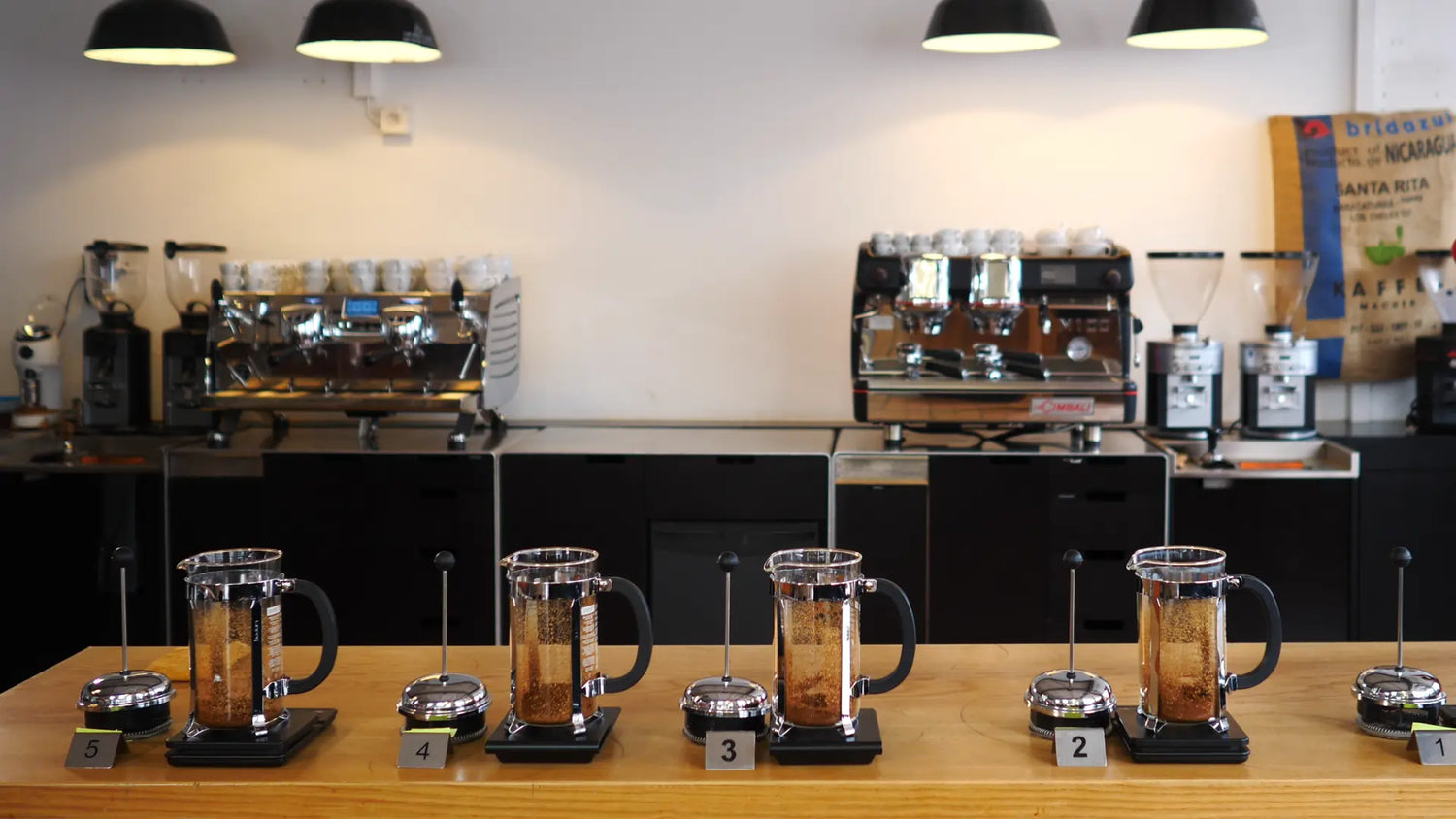

The French press, or plunger pot, delivers good coffee like no other brewing method – and plenty of it. In this article, Swiss specialty coffee champion and 2017 German coffee taster Benjamin Hohlmann summarizes his two favorite French press recipes. This guide takes you step by step through the preparation. We answer the most important questions, explain how much coffee grounds are needed for each water quantity, and show you how to find the right brewing temperature.
French Press, Plunger Pot, or Coffee Press
What matters more than the name of the coffee maker is how it works. First, coffee grounds go into a round glass or metal vessel. Hot water is poured in at a ratio of 1:15 to 1:16. That works out to about 60 to 70 grams of coffee per liter of water, depending on your taste. The water should be about 95 degrees Celsius. After a brewing time of 3 to 5 minutes, a central rod pushes down a metal mesh, nylon screen, or paper filter. The plunger separates most of the coffee particles from the brewing water. The plunger ends the brewing and gives the French press its name.
It's simple and practical – this is the French press. The straightforward principle is one reason why the plunger pot is so popular. Anyone can make good coffee at home with a French press. The two recipes below are easy and highlight two different flavor profiles.

French Press Instructions: Recipe No. 1 – Classic, Strong, Good
The process already described in the introduction is the classic French press basic recipe. Here it is step by step once more.
Since there's still water mixed with coffee in the plunger pot, extraction technically continues. After pressing down, there's little movement, which greatly limits extraction. For the best results, I serve the coffee right after the four minutes or pour it into another pot.
French Press Recipe No. 2: Elegant, Nuanced, and Championship-Worthy
For even better results with a French press, try a recipe based on professional coffee tasting. This brewing method is called cupping. Cupping or cup tasting is used in quality control at green coffee traders and roasteries.
With this method, coffee grounds go directly into a cup and are covered with about 94-degree hot water. After four minutes, you break and skim off the crust. After another four minutes, tasting begins with a spoon from the top. This avoids stirring up the coffee particles that have settled to the bottom.
Sensorially, the coffee tastes "clearer" and "cleaner" this way than the results from plunger pot recipe 1. The mouthfeel is also "softer" and more "elegant."
You can achieve this flavor profile with a plunger pot too. Follow steps 1 through 4 from recipe 1.

The Ratio of Coffee to Water in a Plunger Pot
Using 60 to 70 grams of coffee produces the best flavor result, which suits most Central European palates well. The exact amount can be adjusted to your taste.
Generally speaking, using more coffee grounds – for example, 7 grams of coffee per 100 ml, or 70 grams per liter – makes for a "stronger" coffee. When more grounds are used, the water has more extraction potential available. It's often overlooked that the beverage also becomes "more acidic" this way.
Using more coffee makes the drink stronger. However, the same amount of water can't extract substances from the coffee as effectively. This tends to result in under-extraction, which tastes more acidic.
If you want a stronger coffee without increased acidity, a finer grind often produces better results. Keep in mind that a finer grind causes more extraction of the coffee grounds. This tends to taste more bitter.
When the ratio of coffee grounds to water settles around 60 to 70 grams of coffee per liter, the brew is usually balanced and delicious.

What Temperature for a French Press?
The right brewing temperature is simple: pour at about 95 degrees. If you have a kettle with temperature control, set it to 95 to 96 degrees. Everyone else can boil the water and then wait about two minutes – it will be in roughly the right range.
It shouldn't be much hotter, or the brew will quickly highlight bitter notes. If the water is too cool, the coffee will taste thin and flat. With very light roasts, you can go toward the higher end; with darker roasts, drop it a degree or two. Unlike pour-over coffee, the French press is forgiving here: a few degrees off is no problem.
Which Coffee Works Best with a French Press?
The French press or plunger pot belongs to alternative brewing methods and is part of the "immersion brewer" family. Immersion means water and coffee stay in contact throughout most of the brewing – the coffee is submerged in water. This contrasts with percolator systems like traditional drip coffee, where water flows through the grounds.
Another immersion method is the AeroPress, which uses shorter contact time and some pressure. If you're looking for a difference from traditional pour-over: with a French press, coffee sits in water the whole time; with a filter, water flows through it. This makes the plunger pot stronger and more forgiving, while the filter delivers a clearer cup.
"The French press is a very honest brewing tool. It shows the coffee as it is. Without filtering anything out. I like that."
Benjamin Hohlmann, German Cup Tasting Master and Swiss Brewers Cup MasterCoffee choice depends significantly on the strength of the final beverage. This is roughly the same for both immersion and percolator systems. Strength is the concentration of dissolved coffee particles relative to water. The best flavor results come when coffee brewed in a plunger pot contains about 1.2 to 1.5% dissolved coffee particles. In technical terms, we call this "Total Dissolved Solids" or TDS as a percentage.
To put it in perspective: the remaining 98.5 to 98.2% of the coffee beverage is water! That says something about how important the water you use really is.
So Which Coffee Goes Best in a Plunger Pot?
Filter coffees are best suited for brewing in a plunger pot. The lighter roast preserves flavor nuances and the coffee's natural acidity, which balances beautifully with the water content (98%+).
You'll find our filter coffees here.
Espresso uses darker roasted coffee. This is partly because of the water ratio. Since only 90 to 93% water is in the final espresso drink to provide balance, darker roasting reduces the intensity of acidity.
Important note: the acidity we're talking about here is primarily about taste. Like in wine, it helps the coffee stay balanced. In good coffees, acidity, sweetness, and bitterness should be in equilibrium.

What Water Should You Use for a French Press?
As with all coffee beverages, coffee tastes best in a French press when you use "soft" water that's also free of off-flavors. Soft indicates lower hardness – meaning fewer minerals like magnesium or calcium in the water.
"Hard" water buffers the coffee's acidity, removing an important factor for taste. Without acidity, coffee becomes "flat," one-dimensional, and flavor notes can't develop well.
For brewing methods like the plunger pot or traditional filter, water with a hardness of 2 to 5 German degrees of total hardness and appropriate carbonate hardness works best. A table filter from BWT or Brita can reduce water hardness. Mineral waters like Lauretana, Black Forest, or Volvic are also very soft.
Who Should Use a French Press?
The plunger pot is the simplest brewing method for making good coffee easily. It forgives more mistakes than pour-over, the Moka pot, or espresso. Even if the grind isn't quite right, the French press delivers good results. A good, everyday pot for getting started is the Timemore U French Press from our shop, for example.
We always recommend grinding coffee fresh. If the coffee isn't freshly ground and you can't adjust the grind, the plunger pot still delivers the best results. It's a forgiving brewing method. That's mainly because the coffee sits in water. No movement – or the wrong movement – affects the outcome. With pour-over coffee, if the water doesn't flow because the grind is too fine, the result is always poor. Not so with a coffee press or plunger pot.
The plunger pot also brews larger quantities of coffee without issues. The 1-liter version of the Bodum Chambord plunger pot, for example, can brew up to 800 ml of coffee. Results don't get worse with larger quantities – they stay consistently good. This makes the plunger pot excellent for brewing coffee for groups. It also requires little "maintenance." Even if step 5 of either recipe isn't done on the dot, the plunger pot forgives it flavor-wise.

The Bestargot titanium coffee press* is one of the most interesting coffee brewing methods for outdoor use. That's why the plunger pot, weighing just 216 g, earned a top spot in our article about coffee methods on the go.
How Much Coffee Grounds per Cup for How Many People?
An average coffee cup holds 150 ml. To brew a full cup of coffee for four people, you should brew at least 600 ml.
If you pour 600 ml of water over 36 grams of coffee, you won't have enough coffee (reminder: about 6 to 7 grams of coffee per 100 ml of water, see above). Additionally, 2 to 2.5 grams of water per gram of coffee stays in the grounds – in our example, at least 72 grams. From 600 ml, we'll only get about 530 ml of coffee, or a bit less if we consistently don't pour everything. That results in better flavor.
That's why it makes sense with a plunger pot to always brew a bit more than 150 ml per cup. This brewing method conveniently makes it easy to brew larger volumes well. We've published a separate article on the perfect amount of coffee grounds per cup.

Freshly Ground is Half Brewed!
For the coffee press too, freshly ground coffee tastes best. Grinding breaks the coffee's natural protective shell. After that, it starts reacting with oxygen in the air and light. Volatile aromatic compounds escape and the coffee's oils begin to oxidize. The coffee loses complexity and becomes rancid.
We tested 14 hand grinders under 100 euros, and almost all work well for grinding coffee for filter coffee and plunger pots. We've included higher-priced, excellent models from Comandante in our shop. We also now offer the Timemore C5 ESP PRO hand grinder in our shop – one of the test winners from that series in its latest version.

What Grind Size for a French Press?
The grind is only slightly coarser than for filter coffee. The company Kruve has developed a helpful reference guide. While we don't agree with all the particle sizes they recommend for different methods, their grind reference is useful.
A particle size of 700 to 1000 is perfect for brewing the French press recipes we've shown here.
Cleaning Your French Press
After coffee, wet grounds remain in the pot. Knock them into compost or the green waste – not down the drain, or pipes will clog over time. Then rinse the glass and plunger with warm water, and add a bit of dish soap if needed.
Once a week, take a closer look at the plunger. The metal screen comes apart on most models. Coffee oils build up there over time, and when they turn rancid, you'll taste it in your next cup. So separate and thoroughly clean the discs occasionally. Most plunger pots are also dishwasher-safe, though a quick check of the manufacturer's instructions doesn't hurt.

