



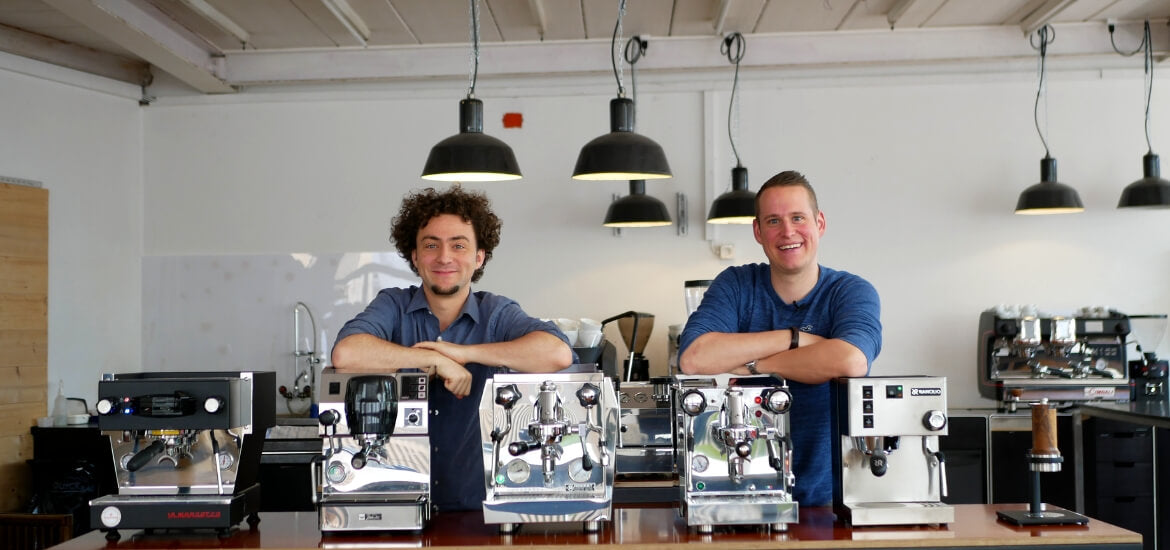

The espresso machine that meets your needs is the best fit for you. That sounds trivial, but it's actually crucial for determining which espresso machine is the right one for you.
Are you an espresso purist? Then a single boiler espresso machine might be right for you.
Are cappuccino and latte macchiato high on your list? Then a dual boiler espresso machine quickly makes sense.
If you're looking for the highest consistency and performance, you'll be happy with a dual boiler espresso machine.
In this article, we break down the differences between the various espresso machine systems: single boiler, dual boiler, and dual boiler. Based on the strengths and weaknesses of each machine, you'll quickly see which espresso machine is right for you and which one is the correct choice.
If you want to learn how to prepare espresso step by step, this tutorial with video will help.
How the single boiler espresso machine works
One water circuit runs through a single boiler in the single boiler espresso machine. The boiler's job is to heat the water to the required temperature. For espresso preparation, the ideal temperature ranges from 90 to 96 °C depending on the coffee and roast.
Temperature is also needed to steam milk. To generate sufficient steam, the boiler temperature is heated to 120 – 130 degrees. With single boilers, this must be done with the same boiler that heats the brewing water.
After brewing an espresso, the single boiler system increases heating. This can be started manually with the press of a button. The small, usually powerful boiler then heats up from the brewing temperature to approximately 125 °C. When the target temperature is reached, you can begin steaming.
Before brewing more espressos, the boiler temperature must first be brought back down to the brewing temperature of 92 – 96 °C degrees. We've explained this principle in detail using the example of the Rancilio Silvia.
 Illustration of single boiler espresso machine
Temperature surfing – prerequisite for delicious coffee
Mastering temperatures is the prerequisite for good coffee on a single boiler espresso machine. Brewing temperatures that are too high, over 100 °C degrees, lead to very unpleasant coffee taste. The coffee becomes very bitter and sour – both at an intensity level you won't want to drink.
If you can't reach sufficiently high temperatures with steam pressure, you won't be happy steaming. At low boiler temperatures, large amounts of water instead of steam are blown into the milk. This makes it impossible to froth the milk and dilutes it increasingly with water.
With single boilers, it's absolutely necessary to get to know your espresso machine well in order to estimate the timing between heating and cooling.
Does the single boiler make good espresso?
Absolutely! The espresso tastes just as good on a single boiler espresso machine as espresso from a small car-priced commercial espresso machine. The prerequisite for this is that the temperature is right. And in the single boiler price segment, this usually can't be read from the outside. You must learn to master the temperature. Or you can do without the milk frothing function. Then the boiler doesn't need to function for both brewing and steaming and is often better adjusted to the target brewing temperature.
Pros: What speaks for the single boiler
- Makes very good espresso when the temperature is right
- Affordable machines on the market
- Relatively small models also available
- Can be heated up for milk steaming depending on the model
- The small boiler can heat up and cool down relatively quickly
Cons: What speaks against the single boiler
- It's not automatic. It requires a certain amount of engagement with the machine to master it.
- Temperature management required to achieve good drink results.
- While you can learn to operate the machine, since there's already so much to learn for "espresso beginners," such as properly adjusting the grinder and steaming milk, this machine type is in our view not the perfect beginner machine.
- Due to the small boiler, there's a lack of temperature consistency.
Who is the single boiler suitable for? For espresso drinkers and milk steamers with strong nerves
Pro tip: If you like to tinker, you can retrofit many single boilers with a PID controller. This promises high temperature stability and turns the single boiler into a machine with high precision – unbeatable in terms of value for money. We'll explain how this works in a later article.
Examples of single boiler espresso machines
Lelit Victoria PL91T, Gaggia New Classic, Bezzera Hobby, Lelit Grace PL81T, Lelit Anna PL41 LEM, ECM Classica PID, Bezzera Unica PID, Quick Mill Carola, Rancilio Silvia
How the thermoblock espresso machine works
The thermoblock is an alternative to the boiler principle. Instead of a heated water reservoir, a spiral-shaped tube is drawn through an aluminum block. A heating element runs along the tube. The water is heated by the tube. This process is similar to a flow heater.
The big advantage over boiler espresso machines is the relatively short heat-up time. The heating element heats up quickly. The "block" can be brought up to temperature relatively quickly through several shots without inserted coffee.
The temperature stability of the thermoblock depends on how the tube is installed, its length, the flow rate of the water, and the heating power. With well-tuned machines, this is relatively or even very precise in standard operation. Positive examples include machines from Ascaso or the Decent espresso machine.
It becomes problematic when a lot or very little coffee is brewed. When pulling many espressos or long drinks (lungo, café crème-like), the surroundings cool down due to the large amount of cold water passing through, and the water is no longer heated to a sufficient brewing temperature.
If the water flow is slow, for example due to very finely ground coffee, the water heats up beyond the target temperature.
The larger the thermoblock, the better
With most smaller thermoblock espresso machines, the thermoblock is relatively small. To reach the desired target temperature during the short flow time, the block must therefore be heated significantly higher than the actual target temperature. This further intensifies the problem described above.
The larger the thermoblock, the closer the block's temperature is to the actual target temperature and can thus provide the desired temperature more consistently even at higher or lower power levels.
For steaming milk, thermoblock machines are generally not well suited. The pressure built up is relatively low. Additionally, the foam generated has relatively high residual moisture, which means the milk becomes heavily diluted. The pump sprays small amounts of water into the thermoblock to generate pressure, which then evaporates and creates pressure. Due to these bursts, steam also exits the steam wand in bursts, which makes homogeneous steaming difficult. However, there are positive counterexamples here, such as the Sage Bambino Plus.
Pros: What speaks for thermoblock espresso machines
- Quick heat-up
- Depending on installation and tuning, precise temperature and correspondingly good espresso
- Hardly any scale buildup
- Relatively inexpensive
Cons: What speaks against thermoblock espresso machines
- Temperature fluctuations depending on flow rate and water volume
- Dependent on the size of the thermoblock
- Not well suited for steaming milk
Examples of thermoblock espresso machines
Sage Barista Express, Sage Barista Pro, Lelit Glenda PL41, Quick Mill Peagso, ECM Casa V, Lelit Kate PL82T, Ascaso Steel Duo PID, Ascaso Dream PID, Sage Bambino Plus
Suitable for: Budget-conscious buyers willing to compromise on quality
How the dual boiler espresso machine works
Two water circuits after the pump characterize the dual boiler espresso machine system. A boiler is the central element. It is heated to a temperature of 120 – 130 °C. Steam pressure for milk steaming is taken directly from this boiler. Additionally, a tube runs through the boiler that transports the brewing water toward espresso preparation.
The tube functions as a heat exchanger. While flowing through the tube, which is surrounded by hot water, the fresh water heats up. The hot water in the boiler is analogous to the thermoblock in this case.
The material thickness of the tube and the "retention" time of the brewing water through the boiler is crucial for how much the brewing water heats up.
 Illustration of dual boiler espresso machine
With the dual boiler system, milk steaming is a pleasure
Dual boiler espresso machines are the favorites of all cappuccino drinkers. The hot boiler generates strong steam and allows you to steam milk and pull espresso simultaneously. This is really a huge difference from the single boiler espresso machine, where you have time to meditate between brewing espresso and steaming milk. Temperature surfing is thus a thing of the past compared to the single boiler.
The dual boiler also has enough power to brew several espressos in succession. Depending on the boiler size, you'll notice a slight performance drop after 2 to 6 steamed milk pitchers. But this is quickly overcome when you give the machine time to heat up again.
Dual boiler and temperature consistency
When comparing the temperature fluctuations of the dual boiler with those of the single boiler espresso machine, the difference is striking. But the dual boiler also has its "little problems." The brewing water is heated by the time it spends in the heat-exchanging tube. If you don't brew an espresso for a long time, the temperature of the brewing water corresponds to the ambient temperature. In other words, it's more than boiling hot. That's why flushing, i.e., a blank shot, is very important with heat exchangers. This removes the heated water from the tube and the incoming water is already at temperature.
If you're brewing one espresso after another at a family gathering, there's a risk that the brewing temperature will fall below the 90 °C threshold. This results in espresso that tastes sour and has reduced extraction capability.
Pros: What speaks for dual boiler espresso machines
- Good espresso and steaming capability
- Simultaneous steaming and brewing is possible (large boiler)
- Good temperature consistency
Cons: What speaks against dual boiler espresso machines
- Home machines are not suitable for large events or commercial use. Neither the steam pressure nor the brewing water temperature can handle it.
- More expensive than single boiler and thermoblock
Suitable for: Espresso lovers and cappuccino drinkers.
Options for dual boiler espresso machines
Espresso machines with dual boiler systems are available in many variations from numerous retailers. Of course, each machine has certain advantages and disadvantages and different designs, such as slightly larger or smaller boilers and different aesthetics.
Two improvements to the dual boiler are particularly noteworthy and change both quality and price.
PID control
The option of PID control regulates the brewing water temperature. You can read a good explanation of how this works exactly here. PID stands for Proportional Integral Differential.
PID control helps the espresso machine heat precisely in its target range. The target range can be adjusted with a regulator, though with dual boilers it should be noted that you always change the boiler temperature, which affects both the brewing temperature and the steam pressure. So if the steam pressure isn't sufficient, the boiler temperature can be increased. However, this also raises the temperature heating the heat exchanger, which may make longer blank shots or flushes advisable.
Rotary pump vs. vibration pump
Another upgrade for the dual boiler is the rotary pump. The rotary pump is more powerful and heavier. The rotary pump is quieter than the vibration pump, which may be beneficial depending on where you place the espresso machine.
Due to robustness and power, rotary pumps are standard equipment in multi-group commercial machines.
Examples of dual boiler espresso machines
Bezzera BZ10, Quickmill Rubino 0981, Bezzera Magica SMN, Bezzera Strega R AL, Profitec Pro 500, ECM Mechanika V, Elba 1 and 2, Rocket Appartamento, Lelit Mara X, Rocket Cronometro Mozzafiatto, Sanremo Cube
To get a really good overview of the most important dual boiler models, check out our comparison of 12 dual boiler espresso machines.
Dual boiler espresso machine – Function and application
No question about it, if you invest in a dual boiler, you're buying temperature precision that shows with every espresso preparation. Two separate boilers deliver the temperature that is needed. The steam boiler heats to the desired 120 – 130 °C and the brewing boiler serves us the precisely set brewing temperature between 90 and 96 °C.
The juggling act with temperatures comes to an end. The typically larger steam boiler is controlled via a pressure switch to the appropriate pressure. In the brewing boiler, a PID controller monitors the temperature for brewing with precision to a tenth of a degree.
Many dual boilers also come standard with a rotary pump, which contributes to durability in terms of power and robustness. Durability and consistency in brewing – that's what characterizes dual boiler systems. Even with higher drink frequency, these machines rarely buckle.

Illustration of dual boiler espresso machine
Consistency from shot to shot and during extraction
The quality of espresso from shot to shot is primarily demonstrated through reliability in the system. The crucial factors are temperature and pressure with every shot and within a brewing session. The consistency during the brewing time is a factor we haven't explored further with the other machine types.
The challenges there were already in starting the brewing with the same brewing temperature. Within a shot, the temperature often also fluctuates. This is because, for example, cooler water flows through the heat exchanger, which encounters less back pressure in the coffee puck in the second part of an espresso shot than in the first part of the brew.
The dual boiler achieves consistency here because it is supplied from a perfectly tempered water retention.
Steam milk until the stadium is served
Even if the Kelly Family is visiting, the milk foam flows. And the best part: should we ever overdo it and empty the steam boiler to exhaustion, the espresso is unaffected. That's the advantage of the independent boiler for both areas.
The steam pressure can be increased by raising the temperature in the steam boiler and thus also the steaming speed. If you prefer to steam more slowly, you can reduce the pressure a bit. Again, the brewing temperature is unaffected.
Semi-professional use
A single-group dual boiler is suitable for small catering, larger family gatherings, and depending on the type, for continuous operation. Many machines of this type can also be connected to a water line, which is another advantage.
We regularly use both our La Marzocco Linea, a Dalla Corte Mini, and of course a La Marzocco GS 3 for catering operations. What we like about them: unlike commercial machines, machines built for household or office contexts run on standard household current of 220/230 volts. Depending on the location, this is a major advantage.
Of course, there are also large quality differences between dual boilers, which we'll explore further in our tests of individual machines. For machines in the La Marzocco GS 3 quality class, we can say that these also look good in a small café to start with. If business picks up, another machine of the same type can be added and you already have a two-group setup. If business is slow sometimes, one of the two machines can already be cleaned and "shut down" (catering jargon).
Turn off the steam boiler and save energy
Wisely, the steam boiler can be manually deactivated. This makes sense when only espresso drinkers are present. This saves energy and is kind to both climate and wallet. For us, this is a decisive quality criterion for a dual boiler.
The size of the brewing boiler is repeatedly the subject of discussion. If it's too large, the brewing water unnecessarily spends a long time in the boiler and is repeatedly heated and slowly replaced. Also, a larger boiler takes longer to reach temperature. A larger boiler mainly makes sense if, for example, half the office floor pulls an espresso during the lunch break.
Pros: What speaks for dual boiler espresso machines
- Precise brewing temperature
- Brewing temperature and steam pressure independent of each other
- Consistency from shot to shot
- Consistency within a shot
- Suitable for semi-professional use (larger guest volume)
- Some models with commercial components extremely robust and precise
Cons: What speaks against dual boiler espresso machines
- High-priced
- Dual boiler doesn't always mean PID and rotary pump. Be sure to read carefully what else is installed in the machine.
Examples of dual boiler espresso machines
Profitec Pro 300 Duablboiler, La Spaziale Dream, Bezzera Duo Top MN, Quick Mill New Vetrano 2B, Rocket R58/Cinquantotto, Bezzera Matrix, ECM Synchonika Dualboiler, Dalla Corte Mini, La Marzocco GS/3, La Marzocco Linea Mini
Espresso grinder as a basic requirement
This article focuses on the various espresso machine types. However, the note about a quality grinder should still be mentioned in passing. As coffee makers, we observe in both commercial and private households that the choice of coffee grinder is not sufficiently considered. We've already seen such absurd combinations as a €7000 CHF/6500 espresso machine next to a €360 CHF/290 espresso grinder.
That's just a shame. The grinder severely limits the quality of the espresso machine in such a setup. When budgeting for the purchase of an espresso machine, we recommend reserving at least ¼, preferably 1/3, of your budget for the grinder. Unevenly ground coffee extracts inhomogeneously and ensures that the quality of your espresso is limited.
Conclusion – Which espresso machine is right for you?
| Thermoblock | Single boiler | Dual boiler | Dual boiler | |
| I only drink espresso! | xx | xx | xxx | xxxx |
| Cappuccino is nice to have. | x | xx | xxxx | |
| Cappuccino is a regular topic. | xx | xxxx | ||
| I don't want to invest more than €500/600 CHF. | xxxx | |||
| I don't want to invest more than €1000/1200 CHF. | xxxx | |||
| The machine should also make coffee at the school summer festival. | x | xxxx |
Related topics:
- Cleaning the espresso machine
- My grind size is not your grind size