




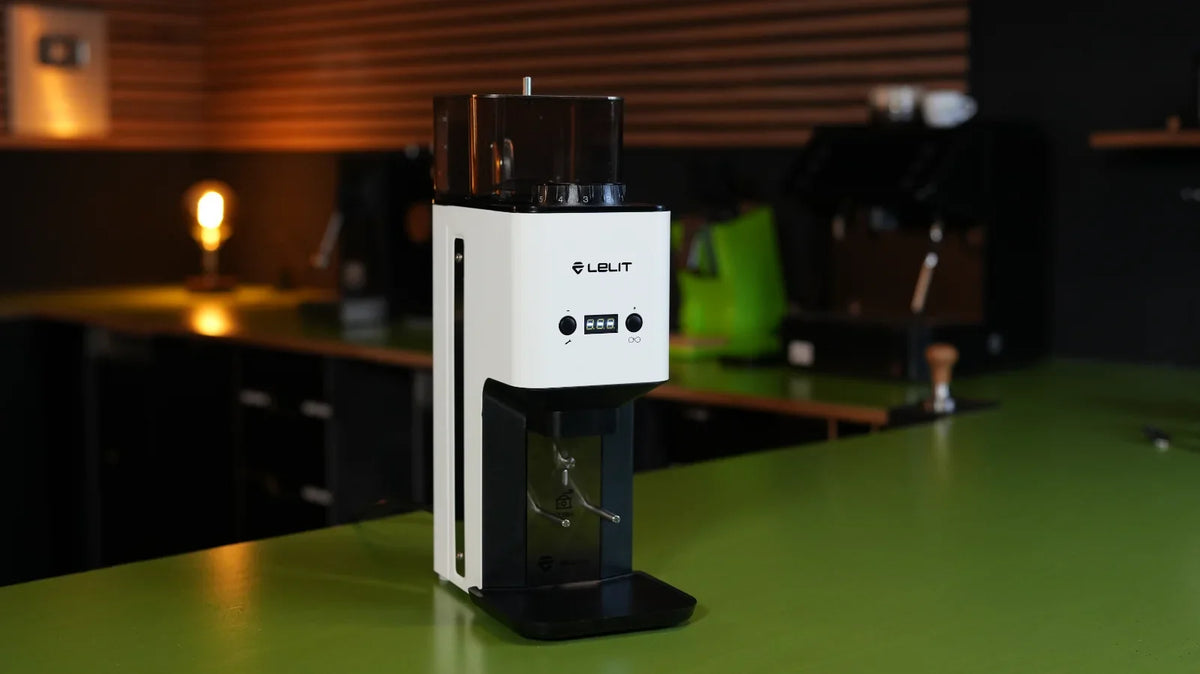

Lelit doesn't just build espresso machines, but also grinders. The Steve is one such grinder with 64 mm flat burrs, bean hopper, time-based dosing, from 499 francs at specialty retailers (as of September 2026). And it's explicitly an espresso grinder, not intended for filter coffee.
It's the further development of the old Lelit William, which we already had on the table in our first grinder set. That's exactly what makes this test interesting: between the two grinders and tests lie roughly five years. Has Lelit caught up with the state of the art in that time, or does the Steve remain a William with a new display? As grinder number 99 in our test field, it has a lot of comparisons alongside it.
As always, we also purchased the Lelit Steve ourselves to guarantee independent testing.
The short version in a few minutes. The detailed test video with all measurements can be found at the end of the article.
Build quality: distinctive in appearance, portafilter holder from yesterday

6.5 kilos, 14 cm wide, 23 cm deep, 39 cm high. The Steve stands narrow and tall on the work surface and has its own character: "distinctive" probably fits best as a characterization, and so the appeal lies in the eye of the beholder. In appearance, it fits well in white or black color versions with the color variants of the Lelit Elisabeth or a Mara. Lelit supplies it in brushed and polished stainless steel as well as in black, white and gold, always with a band of polished stainless steel on the side.
The portafilter holder, on the other hand, is a flashback to old times. Michel, our assistant barista master, speaks of a flashback to the time when we started testing grinders: two side bars hold the portafilter and by pressing we release the grinding. The height adjustment can be easily adjusted and every portafilter we have in the house fits in it. We tested among others ECM, Rocket, Ascaso, Lelit Mara, La Marzocco. Proven, I would say, pragmatic and still functional.
The bean hopper holds 350 grams and is screwed on. You can't remove it, and there's no slider to close the shaft. If you want to change the bean, you tilt the grinder and pour out what's still inside, including fragments.
Display and dosing: the Lelit Steve doses by time

The new display is the most visible advancement. A seven-digit LED display, two programmable dosages, a continuous mode, plus a button to grind further or cancel. Programming is simple: press once, adjust the time with plus and minus, wait briefly, done. You decide which of the two dosages runs via the portafilter switch with single or double pressing.
The Steve doses by time, not by weight. So you tell the grinder six seconds and find out yourself how much coffee comes out. It's not very precise. With unchanged grind, we measure 18.5, 18.3, 18.4, 18.5 and 19.0 grams. That gives a standard deviation of 0.27 grams, and from 0.2 grams it becomes disruptive for precise recipes. Michel remembers his early instructor years when he put scales, cups and spoons in front of all participants to grind into the cup, weigh, and remove the excess. That's exactly how we work with the Lelit Steve.
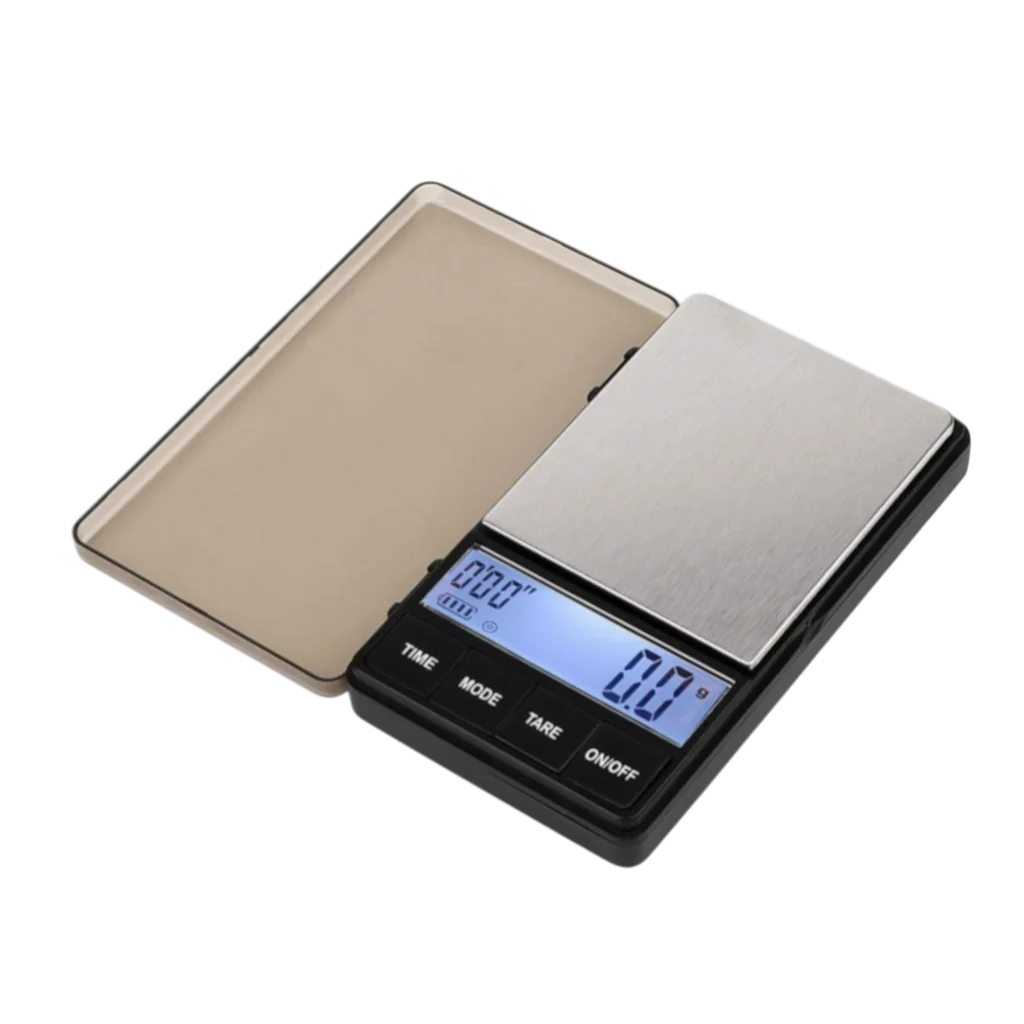
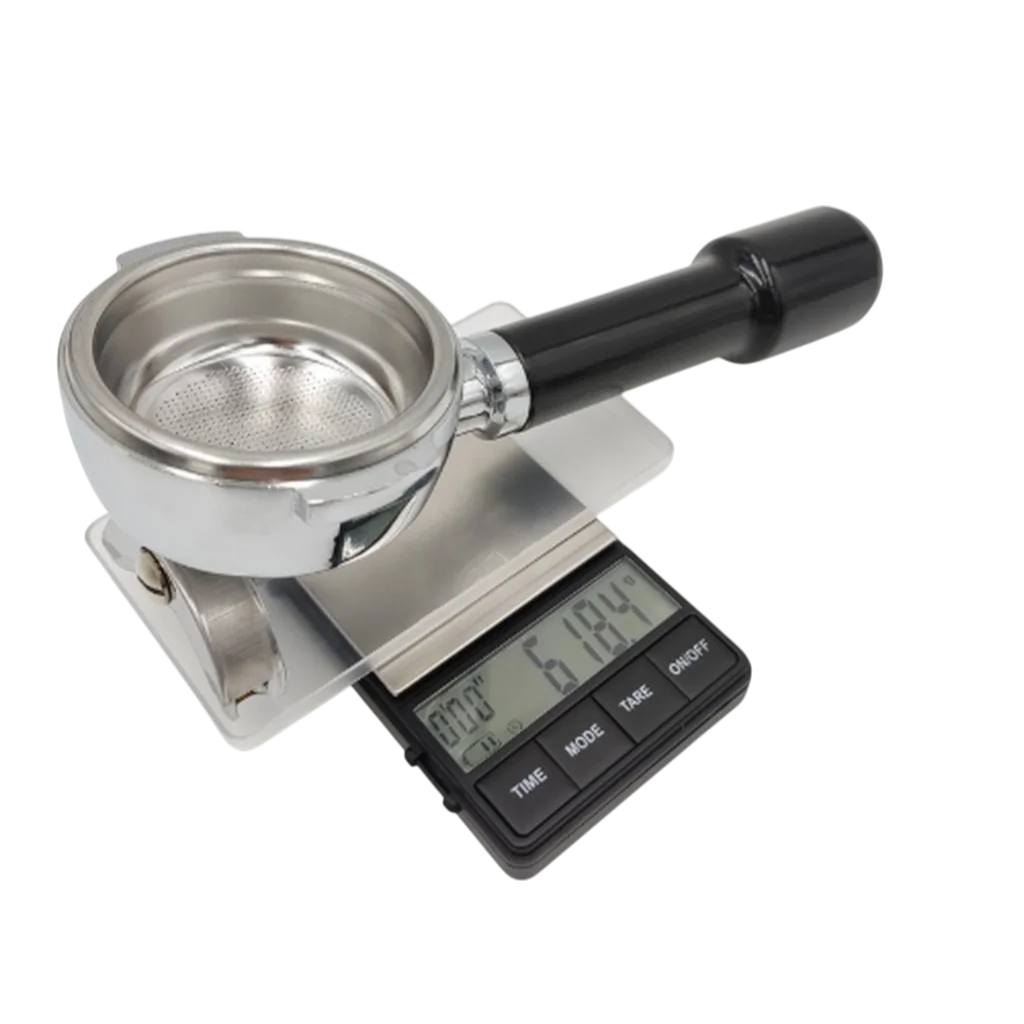
Because the Steve doses by time and scatters in the process, it's better to weigh afterwards. We grind into the KM stainless steel measuring cup, which fits on the 58 mm portafilter, and place it on the Timemore Black Mirror Mini. What's too much, you take back out with the spoon, what's missing, you grind briefly more. Two moves and the dose is right.
Volume and speed: the Lelit Steve grinds fast and sounds full
Here the Steve is strong. With a full bean hopper, 30.3 grams come out in 10 seconds, 18 grams it achieves in 6.1 seconds. That's brisk, and in everyday use speed brings joy, especially when you have to grind again anyway after a grind adjustment.
In terms of volume, we measure 81.8 decibels, measured 20 cm in front of the grinder. That's in the mid-range of our scale. But volume isn't just about volume but also about "quality": the Lelit Steve sounds pleasant, without shrill whirring, and instead produces a full grinding sound. Compared to the original model, we're six to seven decibels quieter. Some of that might also be due to the fact that we measured less accurately back then and provided less shielding.
Thermally, the grinder remains inconspicuous. The beans go in at 22.2 °C, the first sample is at 26.1 °C, after five consecutive grindings with 20 seconds pause we're at 31.0 °C, on average at 28.8 °C. This slight warming has no negative effect on taste. You'd have to make a lot of shots in a row to notice the effect. So no worries.
Retention of the Lelit Steve: 5.5 grams and no single dosing
The retention is 5.5 grams absolute, of which 5.2 grams temporary and 0.3 grams permanent. So hardly anything sticks permanently in the grinding chamber itself, which reduces cleaning needs. That's pleasant, because for a deep clean you always need a screwdriver. The 5.2 grams temporary are what shape everyday life: with 18 grams of shot, just under a third of coffee lands in the sieve that's one grinding older. If you make the next espresso the next morning, you start with coffee from yesterday that has already oxidized because it's no longer in whole bean form.
Compared to single-dosing grinders, these 5.2 grams are enormous. In the range of grinders with bean hoppers, that's a mid-range value.
The real step backward is elsewhere. The old William also had lots of retention but could be ground empty: one portion in, everything came back out. That doesn't work with the Steve anymore. In the single-dosing test, 5.2 grams remain in the grinder, and even if you patiently grind empty, you can't get below two to two and a half grams. Single dosing is thus not an option, not even as a workaround. On the positive side, what comes out is noteworthy: the ground coffee is very fluffy even in the fine range, Lelit has done work there.
If you change grind or bean, you first have to grind out these five grams before the new setting becomes visible at all. And because the bean hopper is screwed on, changing beans is already a task in itself.
Setting the grind: one click shifts the espresso by five seconds

Lelit has reworked the grind adjustment ratio, the steps have become smaller. But they remain stepped, and one step makes about five seconds of extraction time difference in the espresso. Previously it was five to ten. A quality step that makes adjustment better, but still makes precise grinder setting difficult. If you land at 30 seconds extraction time with 18 grams but want 27.5, you won't get there with the coarse grind adjustment. The next step would be around 25 seconds. Michel had shots where one click went from 27 to 18 or 19 seconds.
Just setting it is tedious. On grind setting 6 we measure 26 and 29 seconds with identical recipe, on grind setting 6.5 twice 22 seconds. So you're not just looking for the right step, you're also getting partially different results on the same step.
Behind this is play in the mechanics. The upper burr sits in a fine thread, the adjustment runs through it via a gear. On one side fine thread, on the other side play, and with espresso, hundredths of a millimeter of burr distance decide the result.
We see this in numbers in the adjustment test. We start on grind setting 6 with our espresso recipe, go to grind setting 3 for the ristretto, to grind setting 7 for the lungo and click back to the 6. The x50 is then at 267.5 instead of 222.0 micrometers, the fine peak drops from 39.4 to 34.7 percent, the main peak grows from 243 to 268 micrometers. And in the cup it shows itself likewise: the same recipe that previously needed 25 seconds runs through in 14 to 15 seconds after the return. We start wanting to fine-tune but end up with a different coffee and not the one we wanted.
You can handle this if you run one bean and refill that same bean repeatedly. Whoever regularly switches between coffee A, B and C gets into a tedious battle and for that doesn't really have the right grinder in front of them. And adjusting the amount instead of the grind doesn't help either, that changes brewing ratio, taste and recipe with it.
Particle distribution of the Lelit Steve: lots of body, widely applicable
We measure the particle distribution together with the Coffee Excellence Center at ZHAW on a Retsch Camsizer X2. We measured at our espresso setting with 18 grams in, 45 grams out and around 25 seconds.

The fine peak is pronounced. That gives you body and weight in the cup and a bit less clarity. The main peak remains at 243 micrometers well below the limit at which espressos appear scattered, so the ground coffee is quite homogeneous. Together, that gives you a distribution with which you can do a lot. The Lelit Steve is suitable for dark roasts, the mid-range and also lighter coffees. The last complexity of a very light specialty can't quite make it into the cup with the Lelit Steve, but quite a lot of espresso with good quality. For many home baristas, this particle distribution picture is a really good range.
For comparison the other two points from the adjustment test: on ristretto the x50 is at 155.3 micrometers with 44.5 percent fine peak, on lungo at 304.1 micrometers with 31.6 percent. The grinder covers a wide range, it just doesn't hit it reliably again.
Espresso from the Lelit Steve: solid and with body

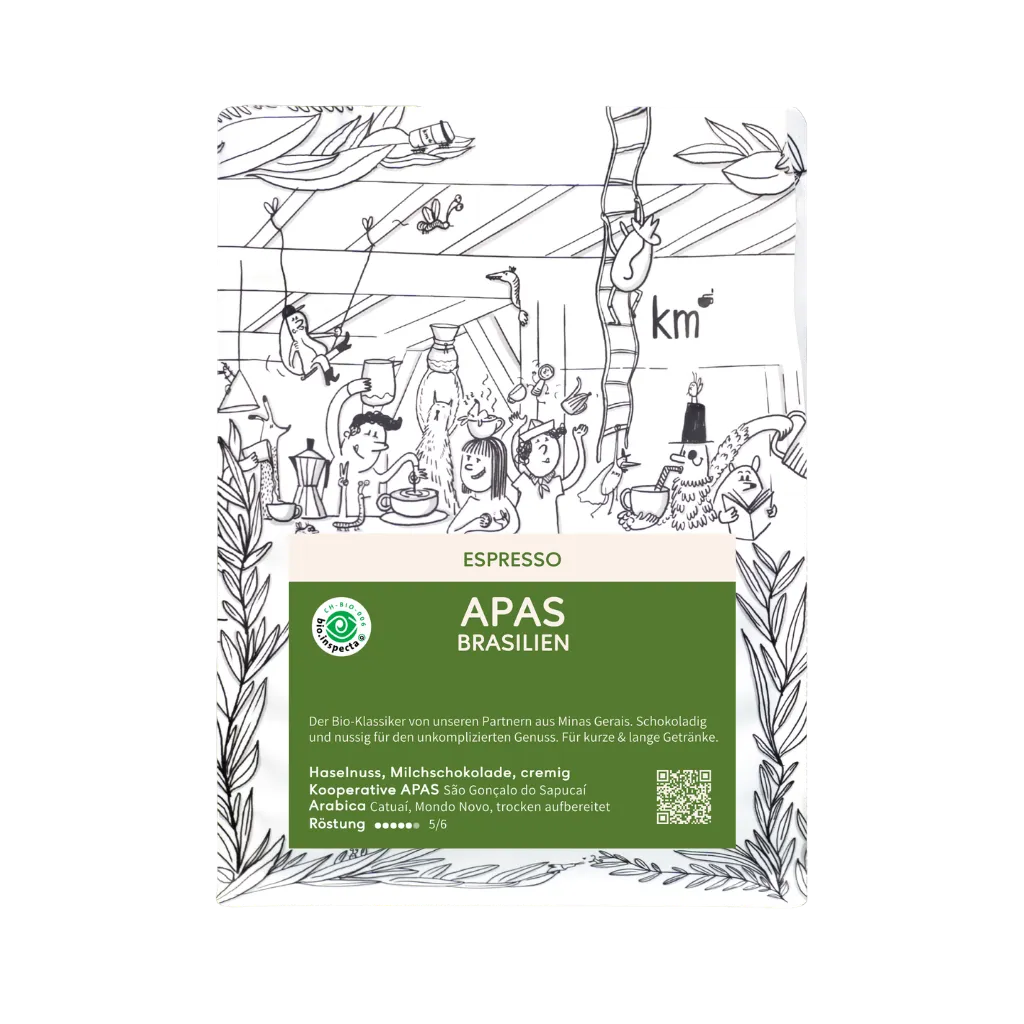
We tasted with our reference coffee, the Apas Espresso, a dry-processed coffee from Brazil from the APAS cooperative. Michel selected it because a grinder that looks like a grinder from our early days deserves the coffee from our early days too. In the meantime, the Apas is organic and much sweeter than it was then: nutty, marzipan-like, sweet. What's exciting about it is that the coffee farmers of the cooperative who switched to organic had already achieved the higher specialty grades before that. That shows in the cup too.
The espresso from the Steve was solid, with around 25 seconds extraction and decent body. Properly adjusted and with ground-out retention, you get a good result here. That's the good news of this test: the grinder can do espresso. The path to get there is the problem.
Cleaning the Lelit Steve: seven screws and plastic thread
For regular grinder cleaning the grinding chamber needs to be opened so the fat particles that stick there come out. With the Steve that's a procedure. First the beans have to be poured out because there's no closure. Then four screws for the lid, then three more for the gear. The screws tighten in plastic threads, one already stripped on us. Care is required! Whoever tightens it again, does so better very carefully.
Plus: in theory the design is well solved because the adjustment runs through the gear and opening the screws shouldn't change the grind. In practice, after the gear you're not yet in the grinding chamber but have to turn the upper burr out of its fine thread. You can mark the position but afterwards you don't know how deep it was in the thread. Whoever cleans regularly, calibrates regularly. A good grinder cleaner is sufficient though with the Lelit Steve to solve the low permanent retention.
Conclusion: who the Lelit Steve suits
The Lelit Steve is a fast, pleasantly running espresso grinder that delivers good espresso as soon as it's properly adjusted. It's precisely this adjustment that is its weakness.
Strengths: It's very brisk at 30.3 grams in 10 seconds and 18 grams in 6.1 seconds. At 81.8 decibels with pleasant grinding sound it's clearly quieter than the previous model. Thermally it remains uncritical, 26.1 °C on the first and 31.0 °C on the fifth sample. The particle distribution provides lots of body and is widely applicable from dark to mid roasts. And a bean hopper with time dosing is rare in this price class. The ground coffee falls fluffy into the sieve.
Weaknesses: The stepped grind adjustment shifts extraction per click by around five seconds, and results vary on the same step. Due to play in the gear and thread, the same recipe runs through in 14 to 15 instead of 25 seconds after returning to the starting grind. 5.5 grams retention, of which 5.2 grams temporary, and single dosing no longer works. The bean hopper is screwed on and has no closure, bean changing is inconvenient. For cleaning you loosen seven screws in plastic threads, then the grind is gone. And the time dosing scatters by 0.27 grams.
For whom? For you if you run one bean, refill that bean repeatedly and want a bean hopper with two dosages. If you set it once and then make espresso in peace, you get along well with the Steve and have a fast grinder on your counter.
For whom not? For anyone who frequently changes beans, works with multiple coffees in parallel or wants to adjust their recipe to the second. And for anyone considering single dosing.
Value for money: At around 499 francs, the Steve is not without competition. In this price class you'll find in our grinder test field grinders with less retention and similar particle distribution, many of them single-dosing grinders where you can additionally choose the direction of the distribution. What the Steve sets against that is the combination of bean hopper, time dosing and speed. That's truly rare in this class. For five years of development time since the William, that's too little for us: the new display and smaller grind steps are advances, the screwed-on bean hopper was already a shortcoming five years ago.
Lelit has recently made a big step with espresso machines and clearly profited from the knowledge of new parent Sage Breville. We don't see much of that grinder know-how in the same family here. Michel's and my half-serious rule remains: with Lelit look at the name. Elisabeth, Mara, Bianca have convinced us. Fred, William and Steve haven't so far. The women rock it at Lelit and the men are a bit yesterday.
Technical data at a glance
| Property | Value |
|---|---|
| Price | from 499 francs at specialty retailers (as of September 2026) |
| Burrs | 64 mm, flat (manufacturer specification) |
| Operating mode | Bean hopper, time dosing |
| Dosing | two programmable times, continuous mode, 7-digit LED display |
| Grind adjustment | stepped, micro adjustment via gear and fine thread, factory setting grind 3 |
| Grinding speed | 30.3 g / 10 sec; 18 g in 6.1 sec |
| Volume | 81.8 dB(A) |
| Grinding temperature | 26.1–31.0 °C (first to fifth sample), average 28.8 °C |
| Absolute retention | 5.5 g (5.2 g temporary, 0.3 g permanent) |
| Single-dosing deviation | 5.2 g |
| Consistency (std dev) | 0.27 g over 5 × 18 g |
| x50 (espresso, T4) | 222.0 µm |
| Fine peak (T4) | 39.4 % |
| Main peak (T4) | 243 µm |
| x50 after reset (T7) | 267.5 µm |
| RPM control | no |
| Bean hopper | 350 g, screwed on, without closure slider |
| Dimensions (W × D × H) | 14 × 23 × 39 cm |
| Weight | 6.5 kg |
| Mains voltage | 220–240 V, 50/60 Hz |
| Finishes | Stainless steel brushed, stainless steel polished, black, white, gold |
All measured values according to the KM test protocol for espresso grinders measured by us, particle distribution in cooperation with the Coffee Excellence Center at ZHAW.
The detailed test video for the Lelit Steve
The complete test with Michel: retention, grind adjustment, particle distribution and tasting.
As always, we purchased this grinder ourselves. This test was not requested by Lelit.