







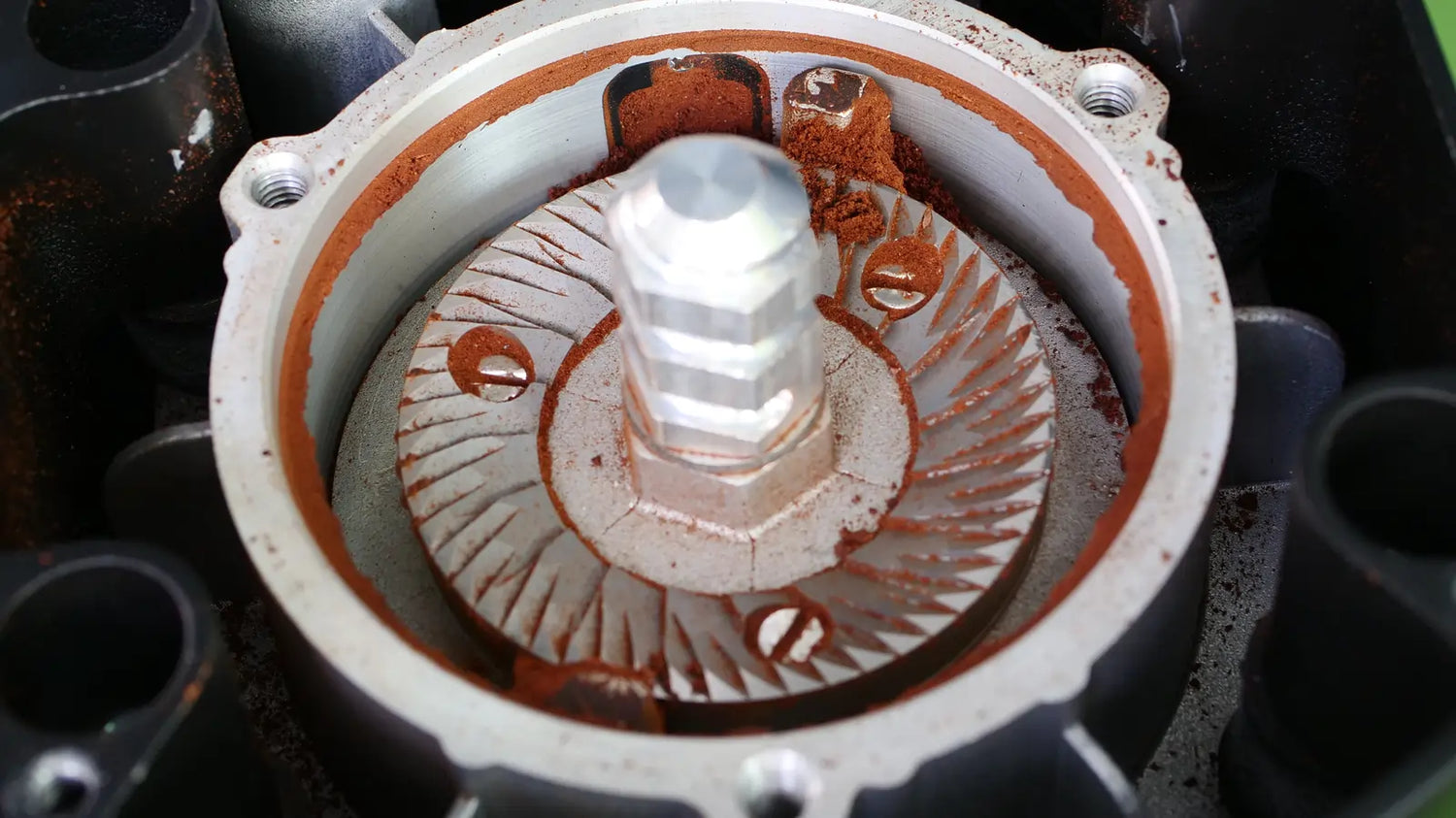

Retention is the term used to describe the empty space in a coffee grinder where already ground coffee accumulates that is not part of the current grinding output. Good grinders have low retention and expel the majority of the ground coffee.
Retention is created by free spaces around the grinding discs. Long and complex discharge paths that the ground coffee must travel after grinding on its way to the output increase retention. In English, the term retention is used, referring to the remaining ground coffee. We distinguish between permanent, temporary, and absolute retention.
In permanent retention, coffee powder sticks permanently. Temporary retention is emptied and refilled with each grinding. Absolute retention is the sum of permanent and temporary retention.

What are the flavor impacts of retention?
The larger the retention, the greater the flavor impact on the coffee taste. In retention, there is ground coffee. As long as coffee is in whole bean form in the bean hopper, the aging speed is low. During grinding, the coffee is broken down into many small particles. This causes it to lose its own protective layer that it previously formed. The specific surface area increases many times over. Before grinding, oxygen and light only reacted with the whole bean, but now they easily reach every particle.
As a result, the chemical components contained in the coffee react with external factors such as oxygen and light. The oils inherent in the coffee oxidize at an accelerated rate. Aroma components evaporate. Already 15 minutes after grinding, a significant portion of volatile components have escaped.
The oxidation of particles is strongly perceptible in taste. Already 30 minutes after grinding, a sensory difference can be noticed in darker coffees, which increases significantly. If much old coffee sits in the grinder, the coffee tastes unpleasantly sharp, rancid and pungent. In the aftertaste, a drying sensation that contracts the tongue remains.
Additionally, old coffee becomes bland and loses complexity through the loss of volatile aroma components. With large retention, this sometimes makes up half of the new espresso. The flavor consequences are correspondingly significant.

Retention's Impact on Extraction
Old coffee in the retention also affects the extraction and flow behavior of the coffee. This is particularly significant in espresso preparation. Old coffee creates a different resistance in the portafilter than freshly ground coffee. At high humidity, older coffee sometimes builds up higher resistance because it clumps and sticks. At the same time, this coffee also doesn't fall well into the portafilter, which can lead to channeling.
Large retention makes it difficult to adjust the grinder. For example, if an espresso runs too fast, we make the grinder finer. When the next espresso is pulled and the retention is 9 grams, however, there are still 9 grams of "old" coffee and thus also coffee with the previous grind setting in the grinder. These must first be ground out to see the effects of the grinder adjustment. If the 9 grams are not first ground out, the subsequent grind setting adjustment is made based on a false foundation. As a result, the inexperienced home barista quickly loses track and despairs adjusting the espresso. Therefore, the important rule: with grinders with large retention, always grind out the retention between adjustments when setting the grind size!
Permanent Retention
In permanent retention, coffee powder sticks permanently to the grinder. It is not replaced with every grinding once the permanent retention is filled. Typical places that create permanent retention are the crevices in screw heads. Also around the grinding discs, a permanent layer of coffee powder forms in some grinders. In the area before or behind the flapper, a small amount of coffee powder also tends to build up, which sticks permanently and rarely detaches.
When it does detach, it causes significant fluctuations in coffee powder amounts from one extraction to the next.
Theoretically, permanent retention should be viewed as relatively neutral. It has no direct impact on the dispensed grinding and does not become part of the next extraction. However, this coffee slowly ages and creates a rancid atmosphere in the grinder. Since coffee itself normally doesn't get moldy, this is relatively unproblematic from a food hygiene perspective. Sensorially, the debris of old coffee does have an impact on taste. The impact is pronounced when the coffee in a larger temporary retention is in contact with the coffee in permanent retention for a long time. If much coffee is pulled regularly and the permanent retention is less than 2 grams, the impact is minimal.

Temporary Retention
Temporary retention empties and refills with each grinding. The coffee remains as residue from one grinding in the grinder. Instead, the old coffee powder, which is in the grinder from the last grinding in the retention, is expelled.
Depending on the grinder, retention is between 0 and over 10 grams. As part of our espresso grinder test series, we checked over 24 espresso grinders for their retention. The extent of retention is sometimes surprisingly large. The larger the grinding discs, the more susceptible a grinder is to temporary retention. This is due to the circumference of the grinding discs, but also the path to discharge. If the grinding discs are above the discharge or if a grinder is built from top to bottom, the retention is usually lower.
Depending on its size, temporary retention has considerable influence on the taste, extraction, and adjustability of the grinder. The coffee powder in the retention becomes part of the espresso if it is not first ground out. So it affects the taste, but also the extraction. If the coffee powder is only briefly in the retention, the influence is less. If the last pull was the day before, the coffee tastes unbalanced due to the pre-ground coffee powder and has a rancid tendency. Additionally, the extraction runs poorly because the powder cannot build up resistance.
Grinders with Low Absolute Retention
In the largest espresso grinder comparison in the German-speaking world, we placed special emphasis on measuring absolute retention. Absolute retention is the sum of temporary and permanent retention. It refers to the area in the grinder where ground coffee is located, either permanently or temporarily.
Grinders with the lowest absolute retention are the G-Iota (1.5 g), the Niche Zero (1.1 g), the Rommelsbacher EKM300 (1.5 g), and the Delonghi KG521 (1.4 g). Grinders from the Eureka Mignon series achieve good values with the Magnifico (2.1 g) and the Specialità (2.7 g). The Baratza Sette 270 (2.7 g) and the Rocket Faustino (2.8 g) also remain under 3 g retention. Not all of the grinders mentioned above are also good espresso grinders. The extent of retention is just one important parameter.
Additional grinders with low absolute retention:
- Zuriga G2 1.5 g
- Ceado Life 1.9 g
- La Marzocco Pico 2.2 g
- Macap Leo 55 Essential 2.4 g

Retention's Significance for Single Dosing and Timing Programs
Many of the tested grinders performed significantly better as "single dosing" grinders than in their intended mode. In particular, they had less retention.
Single dosing is a principle of espresso preparation that emerged from the barista world championships. Instead of putting the entire amount of coffee in the bean hopper, only the desired amount of coffee is weighed and ground. The process initially developed with the Mahlkönig EK43, which has no dosing program. For example, 18 grams of coffee are put in the bean hopper and ground out. A good single dosing grinder now completely expels these 18 grams. Many grinders achieve this goal more or less well when they grind for 30 seconds. In our test, we tried exactly that. We had the grinders grind for 30 seconds.
Here, for example, a Lelit PL72 surprised, which normally has 5 grams of retention. When grinding for 30 seconds, however, it expelled the complete amount of coffee that was input and thus had no retention.
This approach differs significantly from working with a bean hopper. In that case, the grinding is interrupted after a defined time when the output target amount is reached. However, a large amount of coffee powder remains in the retention on the way.
Particularly for grinders with large retention, it is worthwhile to check whether they perform well as single dosing grinders. This has the nice side effect of making the grind setting easier and using less coffee. Switching from one coffee to another is also easier with the single dosing approach.

Conclusions about Retention
If you know your grinder, you can work against your own retention and improve coffee quality with a simple trick. At the same time, the grinder becomes easier and simpler to adjust.
Before every pull, the coffee powder in the temporary retention should be ground out. This applies especially if no coffee has been pulled for a long time. We recommend grinding out after an inactive period of one hour. Regular thorough cleaning of the espresso grinder is also important.
When adjusting the grinder, the old coffee powder should also definitely be ground out after each grind setting adjustment. Only this way is the result of the grind setting adjustment visible in the pull. Especially in espresso preparation, it is crucial for a successful search for the perfect grind size.
If a grinder has very large absolute retention but performs well as a single dosing grinder (see our espresso grinder test for more), the grinder should be used accordingly. This increases quality, simplifies grinder adjustment, and quickly becomes routine. This type of use also allows easy switching from one coffee variety to the next. That's a joy!
Retention is an important topic when it comes to the quality of coffee grinders. With this blog, you now know everything that matters about it.
Or did we forget something? Please feel free to add with your comments, questions, and assessments. Thank you!