




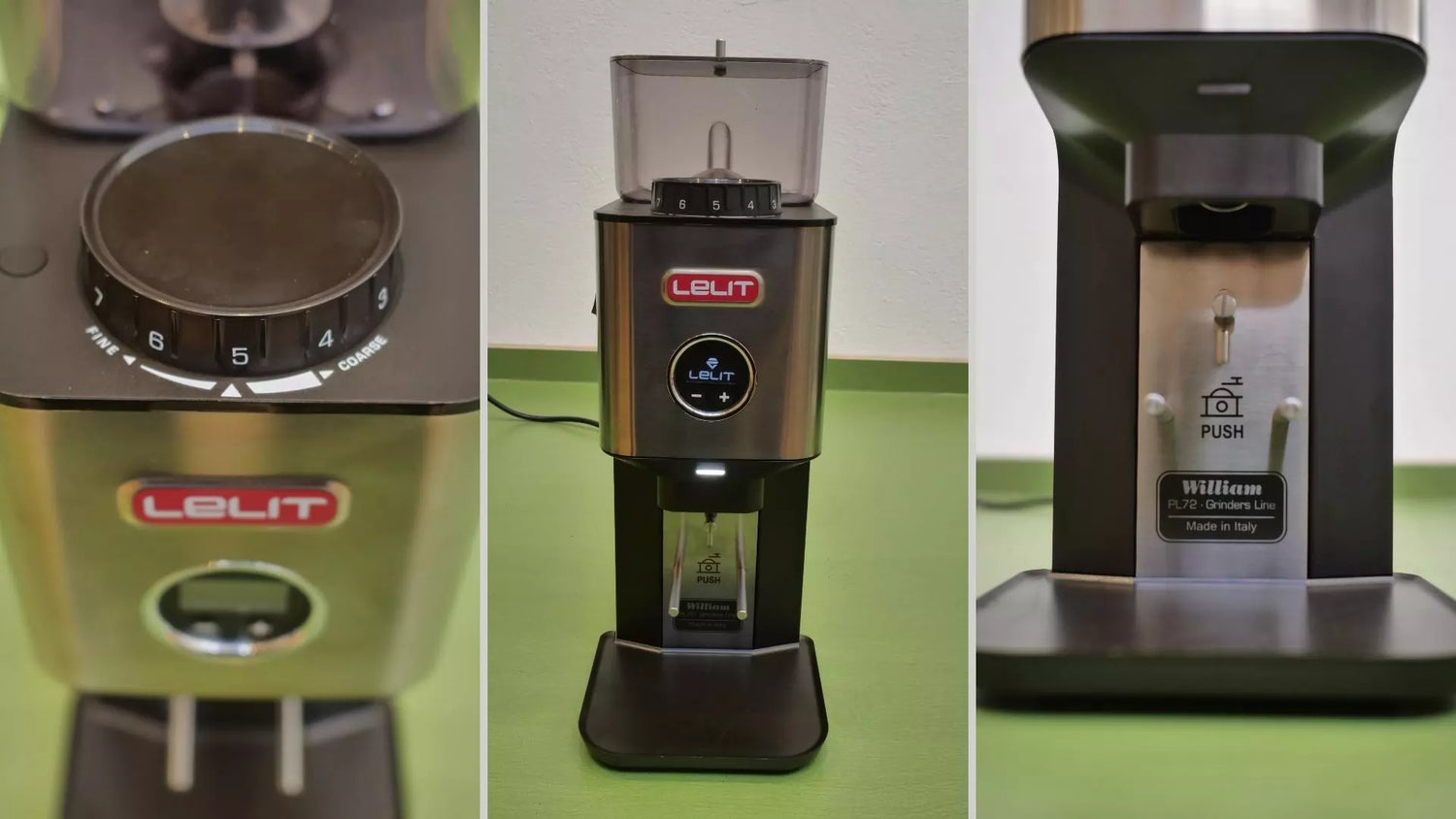

At the time of testing, the Lelit William PL72 cost around €417 and fell into our comparison group for grinders between €400 and €500. We purchased it ourselves, as always. It's loud and can only be adjusted in steps. Michel Aeschbacher, Swiss Vice Barista Champion and instructor with us, kept it brief in the test: "I think it looks visually mega ugly." And yet this grinder does one thing better than any other grinder that has come through our lab.
We tested the PL72 in the first set of our large espresso grinder test series, in which we directly compared 24 grinders. Since then, over 100 grinders have come through our lab, all tested using the same protocol. You can find details of this protocol in Espresso Grinder Test Protocol. We consolidate all our tests for the manufacturer on the page Lelit at a Glance.
Design and First Impressions
The PL72 weighs 6.6 kilograms on the scale, at 14 centimeters wide, 38.5 centimeters tall, and 22.5 centimeters deep. A good portion of the weight is in the lid. Much of the housing is simply constructed: bent sheet metal, like you'd see from espresso machine manufacturers who bend their stainless steel themselves and then use it for grinders too.
One detail we like: The drop blade at the outlet sits magnetically and feels solid. What we like less: The drive transmission uses plastic gears. We can't say how long that will last based on our testing period. If you own the grinder longer, please let us know in the comments.
The bean hopper is not removable. You can unscrew it, but that's not removal in the everyday sense. For us, this means: this grinder is not built for switching bean varieties multiple times a day. At least not in the way the manufacturer intended. We'll come back to that shortly.

Noise Level, Speed, Temperature
86.4 decibels. In our comparison group, there were two rather quiet and two rather loud grinders, and the PL72 belongs to the loud ones. It also audibly needs time to get up to speed.
What it then achieves is impressive: 31.8 grams in 10 seconds. This makes the PL72 one of the fastest grinders in the entire test field. If you're grinding 18 grams, you won't wait even six seconds.
The temperature sits at 38.6 degrees on the warmer side, with an increase of 1.1 degrees over the measurement series. That's a minor increase, though the initial value is already high. In our measurement series so far, higher ground coffee temperatures showed no clearly detectable sensory effect.
The retention, and why it's not the problem here
5.1 grams of retention. That's a lot. There are grinders in this field that sit at 3 grams or less, and every gram of old powder in the burrs has to be ground through eventually.
Only: With the PL72, this doesn't matter if you use it correctly. We ground the grinder empty, filled in 18 grams at the top, and got 18 grams out the bottom. Completely. Zero loss. We repeated this several times because we didn't believe it, and in our measurement table, Single Dosing Performance still shows a zero.
Weigh the coffee beforehand, add the beans at the top, and let the grinder run for 30 seconds after grinding. After that, it's empty, and you have your ground coffee completely in the container. This solves two problems at once: no retention and the ability to drink multiple coffees one after another, even though the bean hopper is not removable.
For anyone who wants an Ethiopian espresso in the morning and a Brazilian cappuccino at noon, this is the only sensible operating mode for this grinder. And it works surprisingly well. If you have a PL72: try it out.
The Dosing Function Is the Opposite
The PL72 has a timed dosing function with single and double portions. Press once for single dose, twice for double. Adjustment is via the minus button, then the value is saved directly. So far, so convenient.
However, dosing accuracy is not great. We measured a standard deviation of 0.61 grams, and at the extremes, there's a 1.2 gram difference between two doses with the same setting, that's 18 versus 19.2 grams. This makes the dosing function simply not usable for espresso. If you have to weigh it anyway afterward, weigh it beforehand. This is the point where the grinder works against its own concept.

Grind setting adjustment and stop button of the Lelit William PL72
Grind Setting: The Actual Weak Point
The PL72 is adjusted in steps, not continuously. The jumps between two steps are noticeable. Normally we need three shots to dial in an espresso properly, but here it was four and a half because one step was regularly too far and we had to go back.
Worse is the repeatability. We switched the grinder back and forth between ristretto and café crème and then back to the same espresso grind. Same step, same recipe four times, and four particle distribution curves that clearly diverge. The X50 values are at 328, 341, 305, and 366 micrometers. Those are worlds apart, and we suspect the plastic transmission as the cause.
What this means for you: You can't dial in recipes with this grinder and recall them later. If you change the grind setting in between, you're practically starting over when you set it back.

Particle distribution curves of the Lelit William PL72 at four espresso pulls (T2, T3, T4, T7)
What the Grinder Produces Is Good
Despite all criticism of its adjustability: the ground coffee itself is solid to very good. The coarse peak in our espresso base measurement is at 227 micrometers, clearly on the narrow side. A narrow main peak means many particles are in the size range we need for even extraction. For comparison: The Eureka XL came in at 239 micrometers with the same espresso recipe, measured in our comparison series for the Lelit Fred grinders.
Add to that a fines content of 22.7 percent. That's a decent amount in comparison, but with espresso, this fines content is exactly what builds the resistance you need.
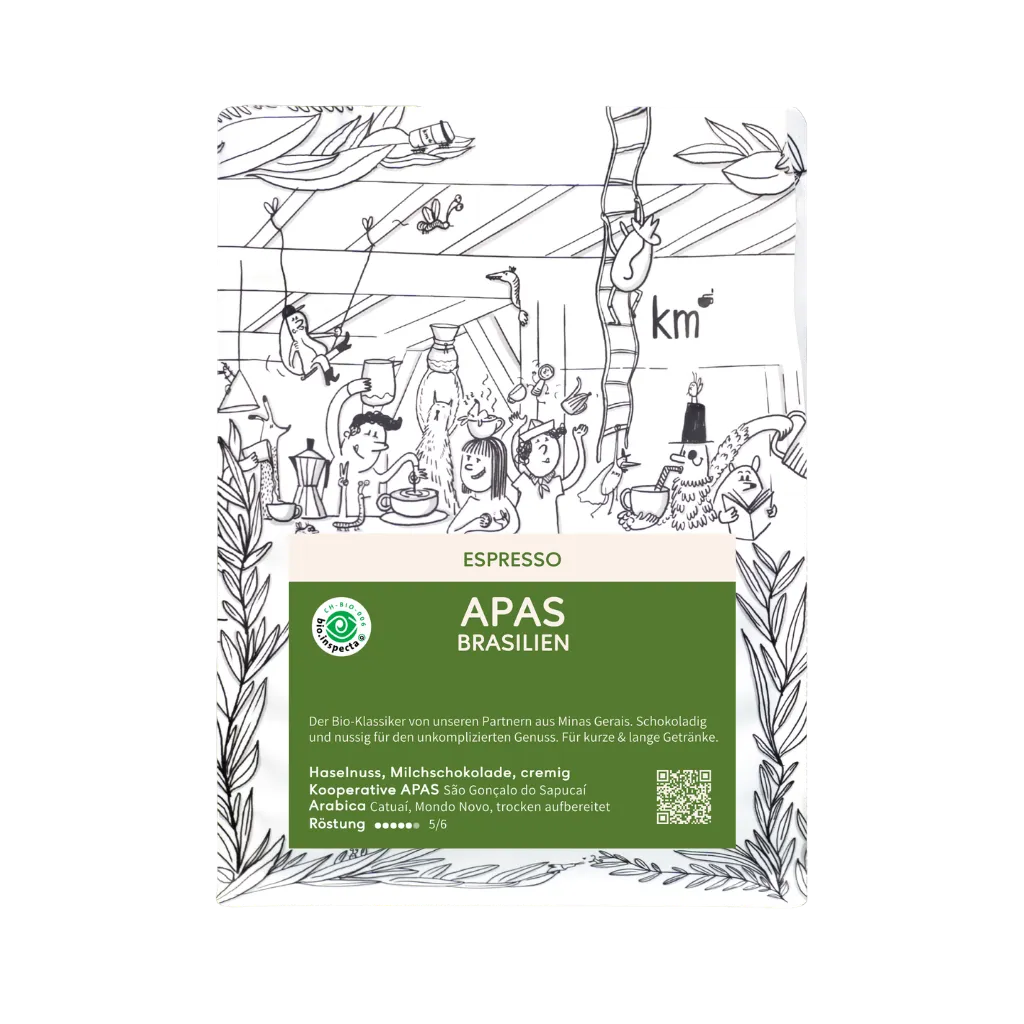
In the cup, this shows up as a decent, balanced espresso. Our training espresso Apas came out almond-like, with a slightly sharper acidity and a more juicy than creamy texture. Not the densest interpretation of this coffee we know, but clean. When we had a pull in the range, it was good. We just needed more attempts than usual to get there.
Measurement Values at a Glance
| Criterion | Measured Value | Classification |
|---|---|---|
| Noise Level | 86.4 dB | Loud for the group |
| Retention | 5.1 g | High |
| Speed | 31.8 g / 10 s | One of the fastest in the test |
| Temperature | 38.6 °C, Increase 1.1 ° | Warm, but stable |
| Dosing Consistency | Standard Deviation 0.61 g | Poor |
| Grind Setting Repeatability | X50 from 305 to 366 µm | Poor |
| Coarse Peak (Espresso, T4) | 227 µm | Narrow, very good |
| Fines Content (Espresso, T4) | 22.7 % | Low for today's standards |
| Single Dosing Performance | 0 g Loss | Best result in entire test field |
| Bean Hopper Removable | No | Only screwable |

Conclusion on the Lelit William PL72
The PL72 is a grinder with two faces. If you use it the way Lelit intended, with beans in the hopper and timed dosing, then it's mediocre: high retention, unreliable dosing, and no bean switching possible. If you use it in single dosing, with pre-weighed beans and 30 seconds of running after grinding, then you get a fast grinder with very good particle distribution and zero loss.
The catch remains the grind setting adjustment. The steps jump too far, and the same point cannot be relocated after adjustment. If you only drink espresso and set the grind once, you'll live with it. If you switch between preparation methods, you'll hate it.
Our recommendation: If you already have the PL72, keep it and switch to single dosing. It's really worth it. If you're buying new, there are grinders in this price range that demand fewer compromises from you. Which ones, you'll find in our overview of the best espresso grinders for home use, which now includes over 100 tested grinders. The PL72 didn't make it to the finals of our grinder test.
To see how the PL72 ranks against the other Lelit grinders and the manufacturer's espresso machines, check out our overview page Lelit: all tests and models. And if you want to work on the recipe instead of the grinder: Preparing espresso.
As always, we purchased this grinder ourselves. This test was not requested by Lelit.