






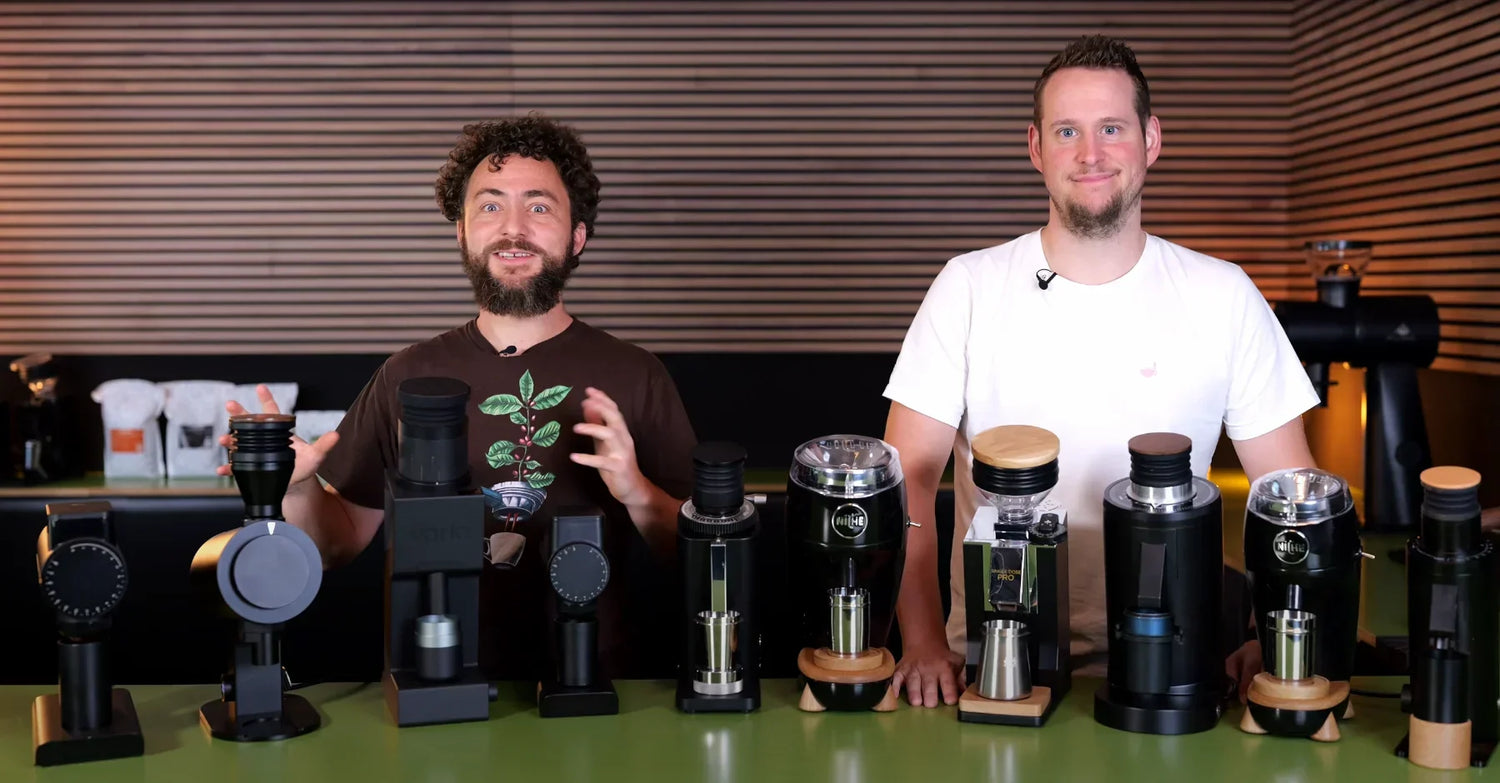

Over the past few years, we've tested over 90 espresso grinders – from entry-level models at €150 to professional single-dosing grinders above €1,000. What we've developed is not a gut feeling, but a structured measurement and testing protocol that we've refined with every test.
This article explains how we work, why we collect exactly these measurements, and what's behind our rating thresholds. It also serves as a reference for all our individual grinder reports – we link to the relevant sections here.

The test protocol at a glance
Our test is divided into four blocks, conducted at different times. This ensures we capture both the cold start of a grinder and its behavior after break-in and under load.
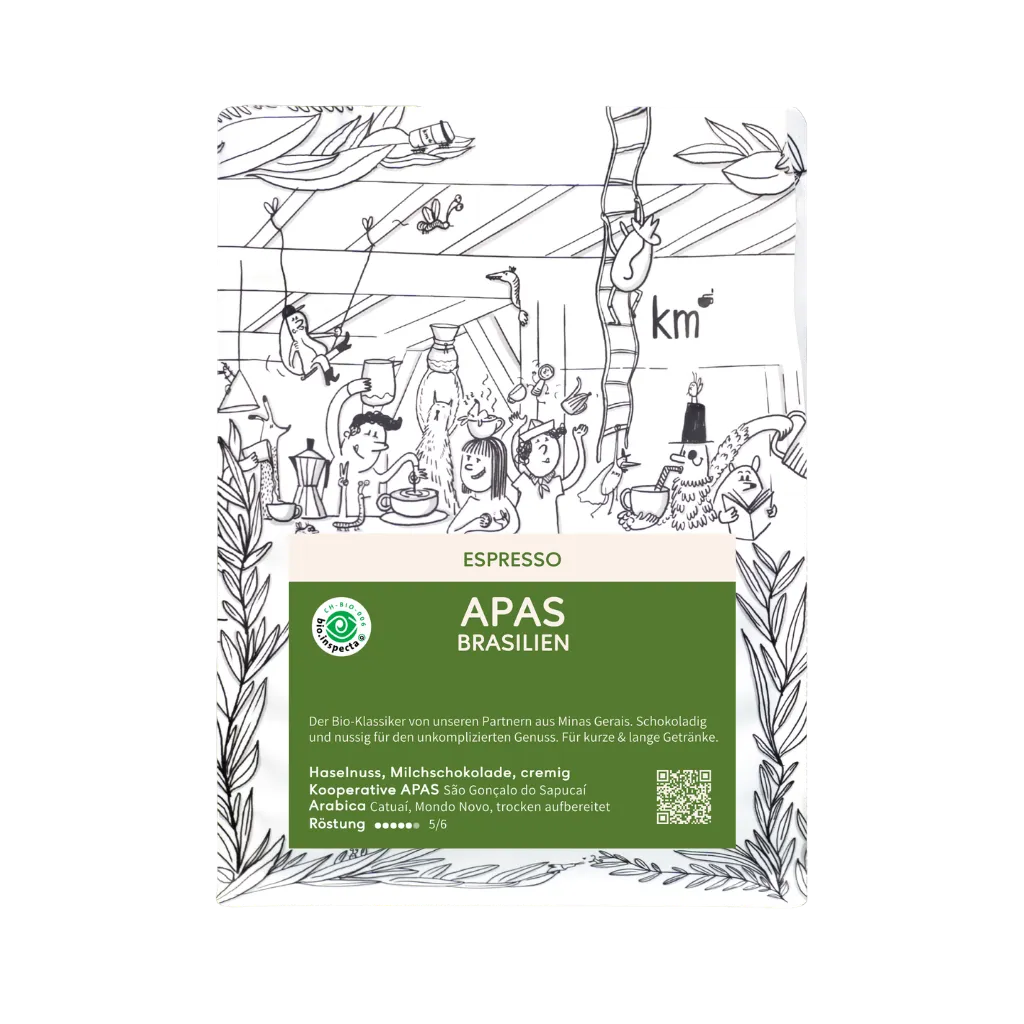
All grinders are tested with the same coffee: Apas Espresso, a naturally processed Brazilian from our partner cooperative APAS. Same coffee, same bean batch – this ensures comparability across all grinders.
Block 1 – Initial grinding and baseline check: Accessory check, grind 1 kg of coffee, first recipe setting, first particle distribution samples.
Block 2 – Main measurements: Temperature, noise level, grinding speed, consistency check, additional particle samples with and without RDT (Ross Droplet Technique).
Block 3 – Adjustment check: Ristretto, Lungo, reset to Espresso – how does the grinder behave with significant grind size changes?
Block 4 – retention: Absolute, temporary and permanent retention are measured precisely.
Tastings take place in parallel with each block.

Starting material and grinding
Before we take a single measurement, we grind 1 kg of coffee through the grinder. This simulates realistic use and ensures that flour and oils have been run in. A freshly unboxed grinder behaves differently than one that's behind 100 shots – and we test the latter.
Then we check the included accessories: dosing cup, hopper, brush, key. We note what's included and what's missing.
For the In-Out Test, we grind 18 g of coffee three times for 30 seconds each and measure the output quantity. This gives us an initial assessment of retention and consistency – before all other measurements.
Noise level
We measure noise level with a calibrated sound level meter, positioned 20 cm from the grinder. Measurement is taken during continuous grinding of 250 g of coffee – not at cold start, but during steady-state operation.
| Rating | Decibels |
|---|---|
| Top / quiet | below 80 dB |
| Mid / fairly loud | 80–90 dB |
| Negative / loud | above 90 dB |
Why these thresholds? 80 dB corresponds to roughly the noise of a vacuum cleaner at normal distance – that's the point at which a grinder becomes noticeable in a quiet kitchen. Above 90 dB, roughly lawn mower level, is simply too loud for home use. Below 80 dB, however – like the Mazzer Philos at 78.1 dB – a grinder is acceptable even early in the morning or in an open kitchen.
Important:
The grinding sound has two dimensions. The pure decibel number says little about the quality of the sound. A penetrating, droning hum at 73 dB (like the Varia VS3) can subjectively be more annoying than an even rumble at 78 dB. We note such qualitative impressions in the comments.
Grinding temperature
Heat is the invisible enemy of good extraction. Coffee ground too hot loses volatile aromatic compounds before extraction even begins – and fats start to oxidize. We measure the temperature of the ground coffee immediately after grinding, five times in a row with 18 g each and 20 seconds between measurements to show the heating effect.
| Rating | Ground coffee temperature |
|---|---|
| Top | below 30 °C |
| Good | 30.1–35 °C |
| Mid / warm | 35.1–39 °C |
| Negative / very warm | above 39 °C |
Why these thresholds? Below 30 °C, the ground coffee is still close to room temperature – no measurable thermal stress. From 35 °C, we occasionally taste differences in cupping, especially with light, aromically delicate roasts. Above 39 °C, as we measured with the Zuriga G2 at 40.2 °C, is a real limitation: it disqualifies the grinder for higher throughputs because temperature continues to rise with multiple consecutive pulls.
We're aware this measurement is only an approximation of the temperature in the grinding chamber. Heat during grinding is transferred to the surrounding material, and the ejected coffee is always cooler than the coffee in the grinding chamber. However, this type of measurement is the most precise available to us with our resources.

Grinding speed
Speed is measured in two different ways, which measure different things and are not directly proportionally comparable.
Measurement A – Grams in 10 seconds (full hopper): The grinder runs with a full bean hopper. We measure how many grams are ejected in 10 seconds. This measurement is particularly relevant for grinders designed for hopper use – it shows peak performance potential and helps assess whether a grinder might be suitable for commercial use.
| Rating | Grams in 10 seconds |
|---|---|
| Top | above 40 g |
| Good | 30.1–40 g |
| Mid | 20.1–30 g |
| Slow | 10–20 g |
| Very slow | below 10 g |
Measurement B – Time for 18 g: For hopper grinders, this measurement is also performed with a full hopper – the value is therefore in direct proportion to the 10-second measurement. For single-dosing grinders, measurement is with an empty hopper. This also includes the time for additional puffs with the bellows needed to completely eject the coffee. Total duration is thus typically longer and not directly comparable to hopper values.
| Rating | Time for 18 g |
|---|---|
| Top | 1–6 seconds |
| Good | 6.1–10 seconds |
| Mid | 10.1–15 seconds |
| Slow | 15.1–20 seconds |
| Very slow | above 20 seconds |
Why is speed relevant? Very fast grinders grind at high power, which increases grinding temperature. Very slow grinders lengthen the contact time of coffee with the grinding mechanism – this doesn't have to be a weakness, but it noticeably changes workflow. Our investigations of rotation speed show that grinders with lower RPM tend to have a narrower main peak; this means they grind more uniformly.
Grinding speed is an important criterion for commercial or catering use. A speed below 10 seconds for 18 grams is desirable for high frequency use.

retention
retention is the area in a grinder where already-ground coffee remains. This coffee is not ejected immediately, but only during the next grinding – so it's always one portion older than the freshly ground coffee. The larger the retention, the stronger the taste consequences: rancid, sharp, unbalanced. We describe this in detail in our article on retention.
We distinguish three types: Temporary retention empties and fills with each grinding – it's the dominant factor for everyday quality. Permanent retention sticks permanently in crevices, around the grinding discs or behind the flapper and affects the aroma climate in the grinder. Absolute retention is the sum of both.
For measurement, we remove all removable parts, brush out the grinder completely, and weigh the residue.
| Rating | Absolute retention |
|---|---|
| Excellent | 0–2 g |
| Good / low | 2.1–3.5 g |
| Mid | 3.6–5 g |
| High | 5.1–9 g |
| Very high | above 9 g |
Why these thresholds? At 18 g portion size, 9 g of retention corresponds to almost half the espresso – half fresh, half old. You can taste that. Below 2 g, the influence on the result is minimal as long as you grind regularly. Grinders in this range – like the Niche Zero (1.1 g) or the Varia VS3 (1.1 g) – are particularly well suited for single dosing and switching between different coffee types.
retention is also relevant when setting the grind size! The larger the temporary retention, the more influence the "old" coffee from the last grinding has on the brewing behavior of the next espresso. In other words: if a grinder has 9 grams of retention, after a grind size adjustment there are still 9 grams of the old grind size in the grinder. It is essential to grind these out to see the effect of the grind size adjustment in extraction. If this isn't done, finding the right grind size becomes a cycle of incorrect adjustment.
Additionally, we measure single-dosing performance: How much coffee remains if you add exactly 18 g and let the grinder run for 30 seconds?
| Rating | Deviation |
|---|---|
| Top | 0–0.15 g |
| Good | 0.16–0.3 g |
| Mid | 0.31–0.6 g |
| Poor | 0.61–1 g |
| Very poor | above 1 g |

Adjustment check: How true is the grinder?
A grinder that can't find its exact starting point after a significant grind size adjustment is a real problem for anyone using multiple recipes or coffee types. We test this with a standardized sequence:
- Espresso (baseline recipe): 18 g in, 45 g out, ~25 seconds
- Ristretto: 18 g in, 18 g out, 25 seconds
- Lungo / Café Crème: 18 g in, 120 g out, 25 seconds
- Return to Espresso: 18 g in, 45 g out, 25 seconds
From each of these points we take a 25 g sample for particle distribution measurement. This way we see not only whether the grinder returns to its setting, but also how the ground coffee physically changes at very fine and very coarse settings. The deviation of the x50 value between T4 (Espresso) and T7 (Espresso after adjustment) is a precise indicator of grind size reproducibility.

Particle distribution
This is the core of our scientific analysis, and here our protocol differs from most other grinder comparisons. We analyze all samples in cooperation with the Coffee Excellence Center at ZHAW (Zurich University of Teacher Education) using a Retsch Camsizer X2 – a high-precision instrument for dynamic image analysis.
All samples are divided using a sample divider to prevent segregation between fine and coarse particles. Up to seven samples per grinder are measured: factory condition, espresso, ristretto, lungo, return espresso – and sometimes additional investigations such as the effects of RPM adjustments or slow feeding experiments.
x50 (median particle size): The point at which 50% of the ground coffee is smaller and 50% is larger. For espresso it typically lies between 150 and 350 µm, depending on grinder and setting. It describes the "average grind size" and shifts finer or coarser with adjustment. On its own, however, it's only of limited use – it describes the middle, not the extremes.
Fines fraction (Qf <100 µm): The percentage of particles smaller than 100 µm – the actual coffee dust fraction. A high fines fraction increases body and density of an espresso, but carries the risk of over-extraction and bitterness. It also forces grinding coarser just to get a flowing shot. Grinders with few fines can be set much finer and often deliver clearer, more nuanced flavor profiles.
60% Coarse Peak Width (main peak width): The size range containing 60% of the coarse particles (above 100 µm). A narrow distribution means most particles are similar in size – even extraction, balanced flavor. A wide distribution means heterogeneity: while some particles are already over-extracting, others lag far behind. In our tests we've observed: once peak width exceeds ~300 µm, espressos often taste "scattered" – acidity and bitterness stand unrelated next to each other, sweetness is missing. We describe this in detail in our article on particle distribution.
Consistency check
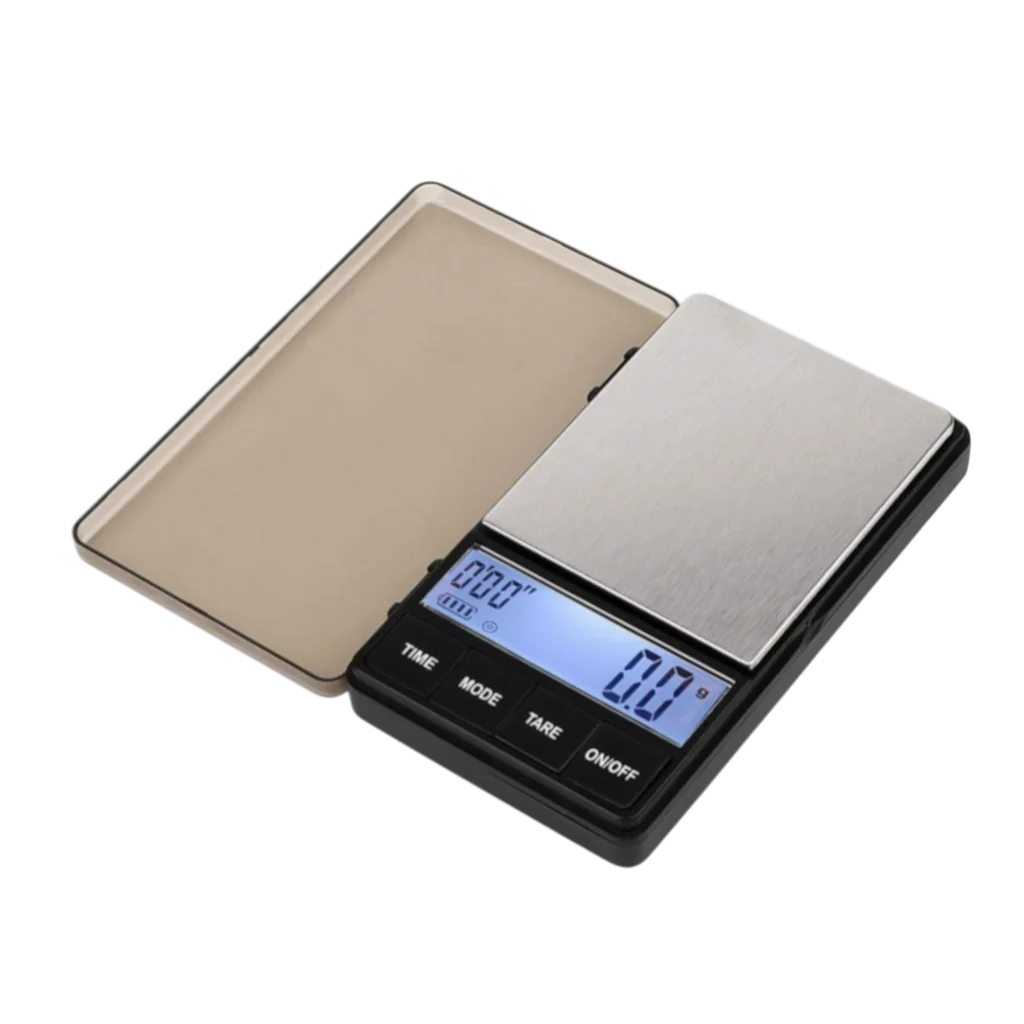
A good grinder doesn't grind precisely only on the first shot – it does so on the fifteenth as well. For consistency measurement, we grind 15 × 18 g with 30-second intervals and measure each output quantity to 0.1 g precision. From this we calculate mean and standard deviation.
Standard deviations around 0.1 g are solid. Below 0.05 g is excellent. Above 0.2 g starts to disrupt workflow – if you dose to 0.1 g precision, you need a grinder that maintains it too.
For grinders with Grind-by-Weight function (like the Eureka Libra 65 AP or Zuriga G2 GbW) we additionally check how precisely the scale works and how it handles grind size changes.

Espresso tasting protocol
All measurements in the world can't replace the decisive test: How does the espresso taste? We taste in parallel with each test phase and conduct tastings where all tested grinders are rated side-by-side at the end of a larger test series.
Our tasting protocol is based on the World Barista Championship score sheet, though we've extended the scale to 10 points and divided the attributes more finely. We evaluate two dimensions:
- Flavor balance includes sweetness (balancing, shows extraction evenness), acidity (clarity, transparency, liveliness – not sharpness) and bitterness (integrated and positive vs. harsh and disruptive).
- Tactile experience includes weight (heaviness in the mouth, independent of quality), texture (creamy, oily, silky, dusty – the quality of the weight) and aftertaste (length and quality after swallowing).
Each rating is supplemented with a free description. More on this in our Espresso tasting protocol.

RPM Setting (rotation speed)
Not all grinders offer variable speed control – when available, it's treated as its own data point in the test. The rotation speed of the grinding discs influences the ratio of fine dust to coarse particles without needing to adjust the grind size.
At higher RPM, beans are smashed with more kinetic energy, creating more shattering and thus more fines. At lower RPM, comminution is more controlled. The consequences in the cup are noticeable: Low RPM delivers a narrower main peak in the particle curve, clearer aromas and more transparency – but less body. High RPM creates more dust, more body and denser texture, but also increases the risk of uneven extraction.
RPM setting is thus a tool for flavor control that works independently of grind size – particularly valuable for single-dosing grinders like the DF64V, Lagom P64, or Varia VS6. It can help calm a ragged extraction profile through lower RPM, or create a more body-forward espresso by increasing RPM.
What the protocol does not evaluate
A good test protocol also defines its limits.
Design and haptics do not factor into the measurements. A beautifully finished grinder gets no points bonus from us – but if you spend €1,000, you can expect no plastic parts to rattle, and we note that in the comments.
Long-term behavior we cannot capture within our test framework. Our old Mazzer grinders have been running for 15+ years – that's experiential knowledge, not a test result.
Filter coffee we only test where a grinder is explicitly marketed as all-purpose. Some grinders, like the Eureka Libra 65 AP, surprise us positively here.
All espresso grinders in the test
Find all results at a glance in our comprehensive espresso grinder comparison.