





La Marzocco stands for cult espresso machines that excite the barista scene. With the La Marzocco Pico, the Florence-based manufacturer is introducing its first grinder development for the home barista. We tested the espresso grinder and present it in the video.
La Marzocco approached us before the market launch and requested a video. As always, we purchased the Pico ourselves (around 1,160 Swiss francs), with no early access or content requirements. All measured values come from our test protocol for espresso grinders – the Pico is grinder number 52 in the field.
Buy the La Marzocco Pico
The following specialist retailers distribute the La Marzocco Pico and we can recommend purchasing a grinder from these businesses. They all offer to adjust the grinder's offset.
Germany: Stoll Espresso, Lücke Technik
*We search for specialist partners we know do good work and provide good service. We're in close contact with the retailers. These are affiliate links. If you order through this link, it doesn't cost you more, but we receive a small commission that we invest in new test equipment. We continue to look for competent partners for you in the DACH region.
What do we test on the Pico?
Our test protocol for espresso grinders is clearly defined. The Pico is grinder number 52, which we test according to our established measurement protocol and place in context with espresso grinders in the home segment. We're also interested in comparing the La Marzocco Pico with La Marzocco's own definition, which positions the grinder as a counterpart to the Linea Micra and Linea Mini. Find out more about the brand in our La Marzocco overview.
What does that mean? We expect a design language that matches the cult form of the two espresso machines. La Marzocco stands for high-quality components and durability. In particular, the Micra is a modern interpretation of a dual boiler espresso machine. Are we therefore allowed to expect innovation from the Pico as well? Let's take a closer look.
A La Marzocco Linea grinder?
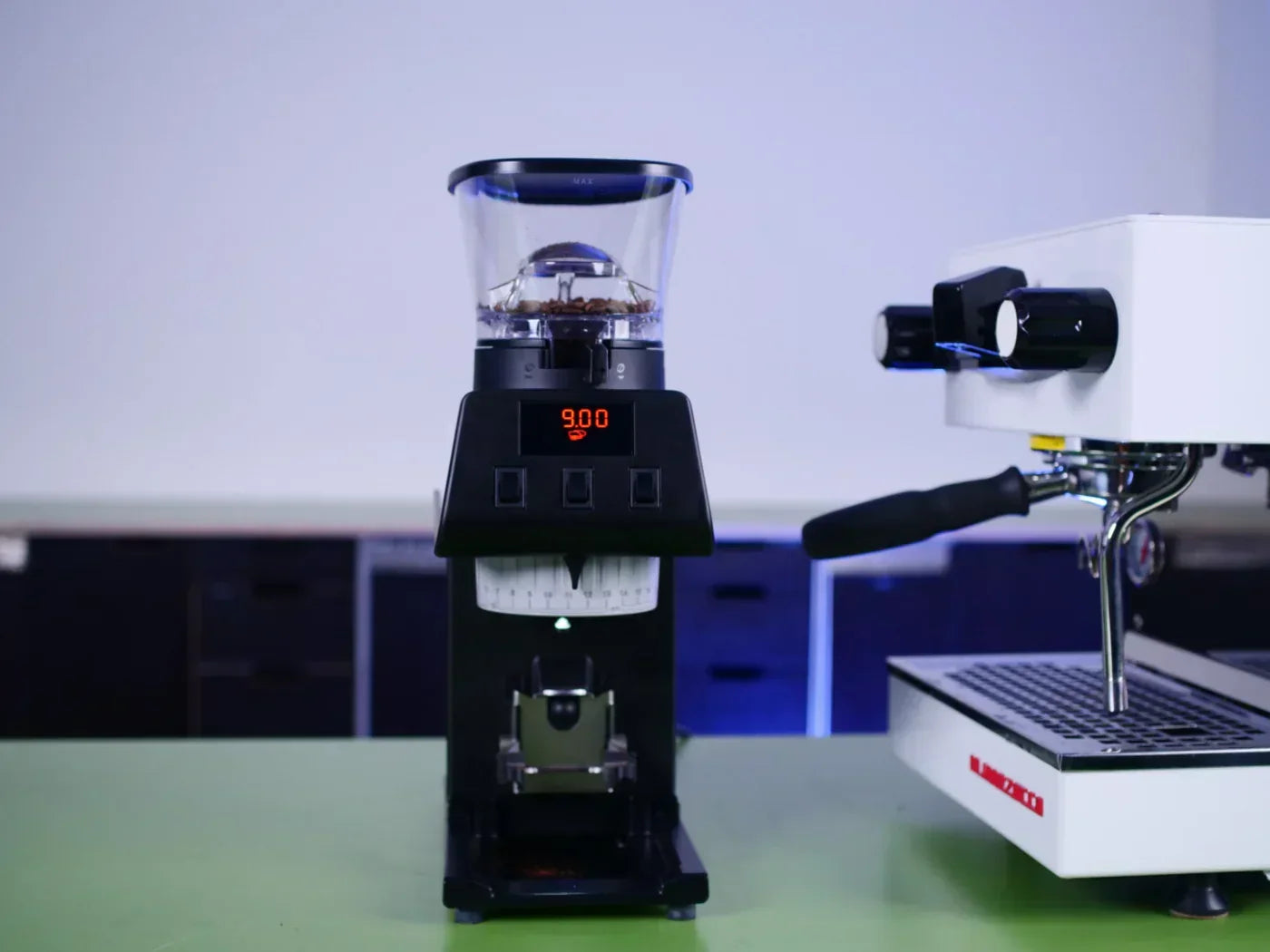
We're standing in front of our Pico, and it's next to the Linea Micra. And to be honest, we're perplexed. Because from the front, the kinship to the Linea series is only recognizable on the flanks. The front of the Pico is designed in high-quality-looking plastic, but doesn't pick up the color and design language of the Lineas. Not even one of the best portafilter holders changes that.

Only when we stand behind the grinder and espresso machine – the perspective that many guests have from the other side of the counter in a café bar – does the unmistakable "La Marzocco" in red on the white Pico mark the connection to the Linea series. From the back, the grinder is well executed, even if angles and edges represent their own interpretation.

At home, though, we usually stand in front of the machine, not behind it. In that sense, the design decisions here seem reversed. If you have your grinder standing in the middle of a kitchen island, for example, you'll certainly make an impression.
The similarity of the La Marzocco Pico to grinders like the Baratza Sette or the Swift Mini is unmistakable. Both were developed by Etzinger, the latter on behalf of La Marzocco. La Marzocco insists that the Pico is an in-house development. But these grinders probably served as models for the inspiration of the form and implementation of the grinding mechanism.
Purring kitten and dosing consistency
As we would expect from a La Marzocco device, much about the Pico seems well executed and shows itself in its functions. What stands out is the repeatability of the dose amount. While other manufacturers now integrate scales into grinders, the Pico delivers the set amount of coffee with a standard deviation of just 0.07 grams from shot to shot. At a target value of 18 grams, we consistently measure 17.9 to 18.0 grams, with just a single outlier at 17.8 grams. That's remarkable and ranks among the best we've measured in home grinders.
At just under 73 decibels, the grinder is also one of the quietest espresso grinders in the home segment. If you're noise-sensitive or live in a thin-walled apartment, you can definitely consider the Pico – the first Sunday coffee won't wake anyone up.
In 10 seconds, the Pico grinds approximately 20.5 grams of coffee; for an 18-gram espresso grind, it needs about 9 seconds. This is an average value in the field of grinders we've tested: not super fast, not super slow, but a decent, everyday-practical speed.
2.2 grams retention is also a good value. Not very good, but still good – and impressive for a dosing grinder with inverted conical burrs. The coffee falls practically straight down, with very little sticking to the star that holds the inner cone. The Pico has no crevices where coffee can collect: the retention is purely temporary. On 20 grams in the basket, about 2 grams of residue from the previous shot is a fraction that has little impact on taste.
Is the Pico a single-dosing grinder?
Short and clear: no. While La Marzocco supplies a dosing cup and matching holder. If you put 18 grams of beans in from above and grind them, you won't get the same 18 grams back. At 30 seconds of grinding time, we measure a single-dosing loss of 1.6 grams per grinding. Essentially, you're only exchanging the retention when single-dosing – that's enough for a clean bean change, but not for precise single-dosing by weight. So the Pico doesn't meet our single-dosing requirements. It's designed as a dosing grinder with a bean hopper, and that's exactly where it excels.
Temperature: quiet has its price
While the low noise level clearly speaks in the Pico's favor, it also has a consequence. Little grinding noise escapes because the grinder has few openings and therefore poor ventilation. This leads to heating inside, which can be seen in the temperature of the ground coffee. Over six consecutive shots with 30-second intervals, the Pico warms up by about one degree to 38.7 degrees. But it starts at 37 degrees, which is a high starting value. We sense taste changes starting around 40 degrees. The Pico just barely reaches this value in the protocol, but in continuous use it comes close. We would therefore advise against high-frequency operation – the Pico apparently isn't built for that. Five grinds in the morning are no problem at all, though.
Construction: 39-mm conical burrs and thoughtful handling
The Pico is equipped with a small 39-mm conical burr set – a further development from in-house production, related to the principle of the Swift, which was developed together with Etzinger back then. It grinds at 700 to 800 revolutions per minute and is relatively quiet in doing so. With a weight of 8.3 kilograms and dimensions of 15 centimeters wide, 28.5 centimeters deep, and 39 centimeters tall, it's compact and sits solidly on the work surface.
The grind adjustment is not stepless, but stepped – and deliberately so. The main notches run along the visible scale, with several fine intermediate steps in between. One click changes the extraction only in small increments, making adjustment pleasantly fine-tuned without jumping over five seconds of extraction time per click like some hand grinders. Adjustment is comfortable from the front, even while sitting. Since buttons and display are also on the front, the Pico can also be easily operated by shorter people or from a wheelchair.
Among the best aspects of the Pico is the closure mechanism of the bean hopper. It holds 350 grams and closes very easily without crushing beans, as happens with many grinders. When you remove it afterward, no beans fall out of the chute, and the hopper can be easily reattached – that's also far too rare with espresso grinders. Only about 9 grams of coffee remain in the chute between the burrs and hopper. This is the amount that would need to be ground out or removed when switching beans – a very small amount that makes bean switching much easier. While we can't recommend the Pico as a single-dosing grinder, it's really excellent for bean switching with a hopper.
Three buttons on the front control the grinder. They're easily programmable, and a display in red radio-style shows the setting. You can program a single-shot and a double-shot portion, plus manual operation via the third button. The controls are intuitive, with a minimal display and buttons – no unnecessary menu. One criticism: the display only shows which portion is programmed when you press it, a bit of blind date with your ground coffee. If you know the grinder, that won't bother you. The hidden main switch on the underside is practical: it also turns off the small standby dot that otherwise glows constantly.
We really like the portafilter holder. 58-mm portafilters can be clamped very securely and don't shift during grinding. The ground coffee falls without lumps, centered into the portafilter. Crumbs that land outside? We search in vain. That's really well done.
Taste and particle distribution: lots of body, little delicacy
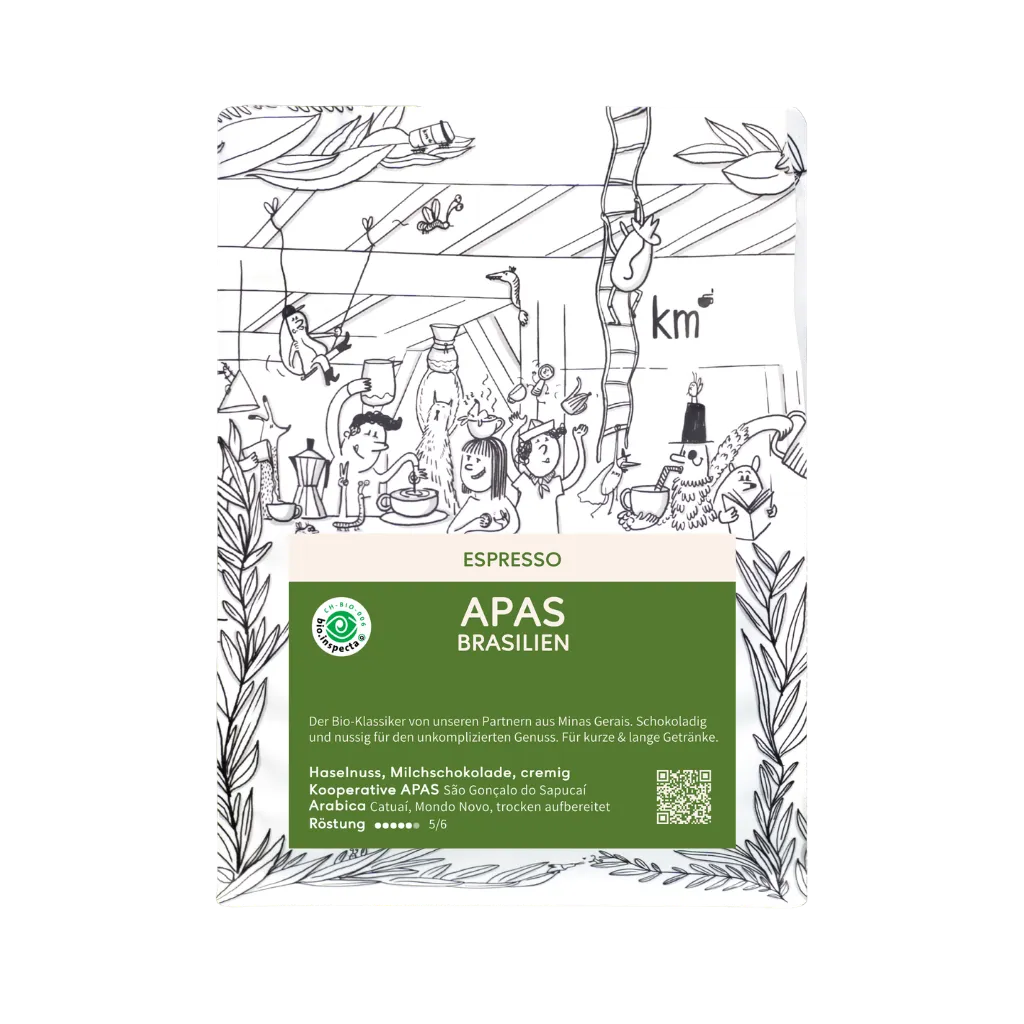
Let's get to what it's really about: the espresso in the cup. We tasted the Pico blind with our Apas espresso, a naturally processed Brazilian coffee from the APAS cooperative, which we know from countless tests. In the cup, an espresso emerges with lots of creaminess and body – heavy, dense, with distinctly cocoa-like, chocolatey notes. It emphasizes the dark sides of the coffee, with the acidity noticeably receding. A darker, body-focused interpretation, not a delicate, acid-forward presentation.
We measured the particle distribution in cooperation with the Coffee Excellence Center at ZHAW using the Retsch Camsizer X2 – using the same standard recipe on the Apas espresso that we use for all other espresso grinder tests. In the comparison curve you can see the Varia VS3, which was measured together with the La Marzocco Pico in September 2023. Thanks for the support from the Coffee Excellence Center at ZHAW.


At espresso settings, the median (x50) is around 320 µm. The fine fraction (particles smaller than 100 µm) is around 27 percent – relatively high. And we measure the width of the main peak, meaning how uniform the coarser particles are, double-verified at 346 and 350 µm. From experience, we classify anything above around 320 µm as broad, so the Pico is clearly on the broad side. What's remarkable is the combination: a broad main peak and simultaneously a high fine fraction.
Based on this curve alone, we would have expected an aggressive, acidic, "scattered" espresso. But that's exactly what it wasn't. Our interpretation: the high fine fraction masks the sharp acidity and pushes the body forward. What the measurement makes look heterogeneous appears in the cup as density and weight. That's consistent with our sensory impression – we had described the espresso as intense and full-bodied before we even saw the curves.
For practical purposes, this means: the Pico is a grinder that strongly supports body. For classic, body-focused and rather dark roasts, it's in its element. However, if you want to extract delicate, complex, light and fruity coffees with clear acidity, you won't find the right tool here – the range is noticeably limited. Its espresso potential thus depends heavily on your own roasting preference: those who like dark and strong will be happy, those who want to play the full keyboard of light coffees, probably not.
Strong is the grind setting replicability. In the adjustment test, we moved from the espresso setting to coarse and back to the same point. Seconds and amount-wise, the grinder behaved the same afterward, and the particle curves from the starting point and return point are practically on top of each other (x50 around 320 µm in both cases). If you adjust the grind setting, you can reliably return to your espresso setting.
Frequently asked questions about the La Marzocco Pico
Does the Pico have conical or flat burrs?
The Pico grinds with an inverted 39-mm conical burr set (conical) from in-house production. The compact conical burrs are partly responsible for the low retention, because the ground coffee falls straight down.
How quiet is the Pico?
At just under 73 decibels, it's one of the quietest espresso grinders in the home segment. That's a real selling point if no one should be woken up for the first morning coffee.
Is the Pico a single-dosing grinder?
No. At 30 seconds of grinding time, 1.6 grams remain in single-dosing operation. The Pico is designed as a dosing grinder with a bean hopper. For bean switching, the low chute residue of about 9 grams is very convenient.
Which coffees is the Pico suitable for?
For body-focused, classic espressos. Through its broad main peak and high fine fraction, it delivers plenty of body and creaminess, while sharp acidity recedes. It's less suitable for delicate, light and fruity coffees.
Does the Pico match the Linea Micra and Linea Mini?
From the back, yes – the red "La Marzocco" lettering marks the connection there, and the set looks like one piece. From the front, where you usually stand at home, the plastic front doesn't really pick up the color and form of the Lineas.
Is the Pico worth its price?
At around 1,160 Swiss francs, you're noticeably paying for brand and design. Technically, the Pico does many things well and is very strong in individual disciplines. But there are grinders between 500 and 800 francs that also deliver – some even with single dosing. Whether the overall package is worth the premium to you is ultimately your decision. It's best to try out the grinder in this price segment beforehand.
KM rating: the Pico in numbers
We apply the test criteria of our measurement to all espresso grinder tests equally. This is how the La Marzocco Pico fits in:
Test results: La Marzocco Pico
Evaluation according to KM test protocol for espresso grinders. All measured values collected by us. Low retention is green, single-dosing performance is red: the Pico retains 1.6g during long grinding – that's the core criticism. Particle distribution intentionally doesn't factor into the color rating because it's roast-dependent.
Technical data overview
| Property | Value |
|---|---|
| Price | approx. 1,160 Swiss francs (MSRP, as of August 2026) |
| Burrs | 39 mm conical burrs, inverted |
| Speed | 700–800 rpm |
| Operating mode | Dosing grinder with bean hopper (not a single-dosing grinder) |
| Grind adjustment | stepped, main notches with fine intermediate steps |
| Grinding speed | approx. 20.5 g / 10 sec · approx. 9 sec for 18 g (espresso) |
| Volume | just under 73 dB |
| Grinding temperature | 37 °C (first shot) to 38.7 °C (after 6 shots) |
| Retention | 2.2 g (temporary) |
| Single-dosing loss | 1.6 g (at 30 sec grinding time) |
| Dosing consistency | 0.07 g standard deviation (target 18 g) |
| x50 (espresso setting) | approx. 320 µm |
| Fine fraction (< 100 µm) | approx. 27 % |
| 60 % peak width | 346–350 µm |
| Bean hopper | 350 g |
| Chute residue (bean switching) | approximately 9 g |
| Weight | 8.3 kg |
| Dimensions (W × D × H) | 15 × 28.5 × 39 cm |
| Scope of delivery | Dosing cup, magnetic portafilter holder |
Further reading
To see how the Pico compares to other grinders, check out our comprehensive espresso grinder comparison. If you're looking for a true single-dosing grinder, you'll find more suitable candidates in the comparison of single-dosing grinders from 500 to 1,000 Swiss francs. And if you want to put the Pico next to a machine: here's where to go for Linea Micra and Linea Mini R.
As always, we purchased this grinder ourselves. La Marzocco requested a video before the market launch, but there were no content specifications or early access provided.