





We've tested, measured, and blind-tasted over one hundred coffee grinders. We stopped selling electric grinders three years ago, which is precisely why we can write objectively about them. If you're shopping for a coffee grinder right now, the starting question isn't which one is the best. Rather: what do you want to grind with it? Espresso from a portafilter places completely different demands than filter coffee in a hand dripper or coarser coffee for a French press. That one decision determines almost everything that follows.
Why should you grind coffee fresh?
A whole bean is a pretty good aroma storage. Once it breaks apart, the surface area increases many times over, volatile aroma compounds escape, and the oils oxidize. We saw just how quickly this happens in our measurements on retention: after just 15 minutes, the volatile components noticeably lose presence, and after 30 minutes, the difference is clearly perceptible to the senses with dark roasts.
That's the real reason for owning a grinder. It's about freshness and the simple fact that pre-ground coffee has already lost a large part of its aroma before water even touches it.
Hand grinder or electric coffee grinder?
That's the first fork in the road, and it's more important than the question of brand.
A hand grinder is the most affordable way to truly high-quality grounds. We tested 14 hand grinders under 100 euros against each other, and the good ones among them deliver a quality for filter coffee that you'd pay multiples for with an electric version. All makers of high-quality hand grinders rely on stainless steel burrs, not ceramic. Plus: a hand grinder needs no electricity, makes almost no noise, and fits in a backpack.
The line is drawn at the effort required. Grinding espresso fine is work, and if you pull four espressos in the morning, you'll feel it in your wrist. When guests come over, hand cranking quickly becomes tedious.
An electric grinder buys you out of that effort. In return, it costs more, takes up counter space, and is louder. For everyday espresso, it's usually still the right choice.
Timemore C5 ESP Pro, approx. 99 CHF: the entry point that can also do espresso.
Comandante C40 MK4 Nitro Blade, from approx. 260 CHF: the benchmark from German manufacturing.
Kinu M47 Classic, approx. 360 CHF: in terms of clarity and complexity, hard to beat.
You can find all hand grinders in the shop here.
"I used the Kinu in my last three Brewers Cup championships because the sweetness and mouthfeel are outstanding."
Which coffee grinder do you need for which brewing method?
That's where it gets decided how much you need to spend. The requirements differ more than most expect.
Filter coffee, hand dripper, and Chemex
The grind size is about coarse sand. What matters isn't fineness, but uniformity: you want as few very fine particles as possible, because those over-extract and become bitter, while the coarse ones aren't done yet. A good hand grinder is more than sufficient here.
French Press
As coarse as sea salt, and it's the most forgiving method of all. Almost any decent grinder can handle that. If you exclusively drink French press, you don't need an expensive grinder. A good grinder certainly helps make the coffee tastier.
Espresso and portafilter
Between powdered sugar and fine sand, and this is the most demanding discipline. You need a fine, well-resolving grind adjustment here, because a few hundredths of a millimeter decide between sour and bitter. That's exactly where cheap and good grinders part ways.
We've taste-tested 30 espresso grinders ranging from 80 to 2,200 euros. Which one won in which price bracket is in the big grinder test.
Fully automatic coffee machine
With a fully automatic machine, the grinder is built in. So you're not buying a separate one; you're deciding on a burr set through the machine itself. How it compares to the portafilter, we've written up in the comparison of portafilter or fully automatic machine.
One grinder for everything?
Possible, but it costs comfort. Commercial grinders can grind everything from espresso to filter, but they're more complicated to use than a specialized grinder. If you seriously do both, you often do better with an electric grinder for espresso and a hand grinder for filter.
What burr types are there in coffee grinders?

Flat burrs on the left side, the conical burrs of the Baratza Sette 270wi on the right.
Blade grinders: not really a grinder
Devices with rotating blades chop the bean; they don't grind it. The result is a mix of dust and coarse chunks, and there's no defined grind size. For coffee where taste matters, that's not an option.
Conical burrs
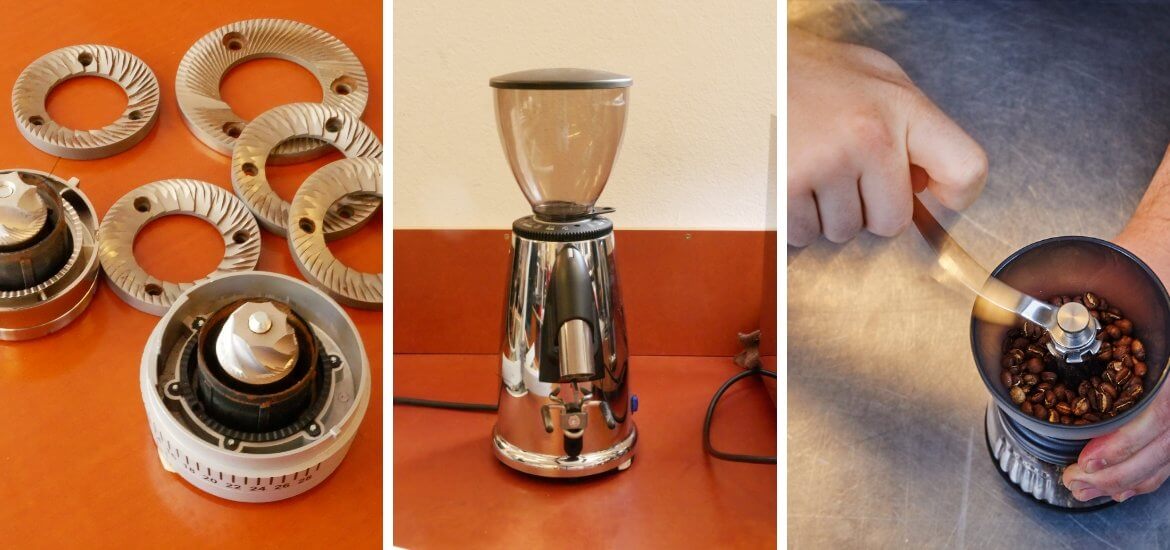
A central cone with milled teeth faces a rotating ring with a similar tooth pattern, usually the cone rotates. The burr gap and tooth depth determine the grind size. In this geometry, a relatively imprecise particle size distribution forms because the bean or its fragment travels only a limited distance. Conical burrs require stronger motors, allowing for lower speeds.

Conical burrs of the Mazzer Robur.
The higher fine fraction isn't automatically bad. It works well with dark roasts and short extractions. With lighter roasts, however, the distribution becomes muddier.
Flat burrs
Two very similar or identical rings, one stationary and one rotating. The beans fall in centrally and are driven outward into the burr gap by centripetal force. The burrs can sit horizontally or vertically; in the latter case, a feed screw is needed. The result is a more discrete distribution, especially with larger burr diameters and strong motors with constant torque.
Steel or ceramic?
Most burrs are milled from steel blanks. Alloy and coating, often titanium oxides or titanium nitrides, determine hardness, friction coefficient, thermal conductivity, and durability, and they have an influence on aroma that shouldn't be underestimated. To quantify this scientifically in a rigorous way, however, requires more research than currently exists.
For hand grinders, the matter is clearer: all makers of high-quality hand grinders use stainless steel. You find ceramic burrs almost only in the cheap segment.
How can you tell a good coffee grinder?
Four things, and none of them are on the box.
Particle size distribution
When a grinder breaks down beans, it never produces a single particle size, but a whole spectrum. We measure this via dynamic image analysis with a Retsch Camsizer X2, and we've now measured over 100 grinders. Three values matter: the median x50, which for espresso typically lies between 200 and 300 micrometers, the fine fraction below 100 micrometers, and the width of the main peak.

Particle distribution of six espresso grinders compared.
Why that matters: coffee is extracted at the interface between water and particles. The more surface area, the more extraction. With a broad distribution, the fine particles are long since over-extracted while the coarse ones have given up nothing yet. That tastes unbalanced, somewhere between sour and bitter. A homogeneous distribution yields a clear, harmonious espresso.
Retention
Retention is the coffee that sticks in the grinder and comes out with the next grind. Old, oxidized, and it lands in your cup. The differences are substantial: the Niche Zero comes in at 1.1 grams, G-Iota and Zuriga G2 at 1.5 grams each, the Rommelsbacher EKM300 also at 1.5 grams. The Eureka Mignon Magnifico comes in at 2.1 grams, the Baratza Sette 270 at 2.7 grams. Some models are over 10 grams.
We also distinguish between temporary retention, permanent retention, and the sum of both, the absolute retention. Temporary retention fills with each grind and releases the "old" stored coffee. Permanent retention sticks and fills permanently and isn't exchanged with each grind.
Grind adjustment
Not how many settings there are, but how finely they resolve. Commercial grinders often grind very well but have too coarse an adjustment to hit espresso precisely. With hand grinders you count in clicks; with electric grinders, the question is whether the scale is stepless or stepped. When preparing espresso, we clearly feel the effect when the scale doesn't resolve finely. If we adjust the grind one step and the extraction time jumps by several seconds, precise targeting of the desired recipe is hardly possible. Poor grinders jump more than five seconds per step here.
Motor, speed, and heat
With very hard beans—that is, light roasts with high density—the motor might not deliver the necessary torque and the grinder can jam. Breaking down the beans also inevitably generates heat. A 2016 Nature study explained why shots get faster as the day goes on: roasted coffee exists in a glassy state, a pseudo-solid, that breaks apart differently when heated. This changes the particle distribution and thus the extraction.
At fine grind sizes, a moderate speed produces a better cup than a high speed in our experience. At coarse grind sizes, it's more: the faster through, the better, because slow turning works the particles longer and the cumulative energy input harms the coffee.
How do you set the grind size?
The quickest orientation is visual and tactile: French press is coarse sea salt, filter coffee is fine sand, espresso is somewhere between powdered sugar and fine sand.
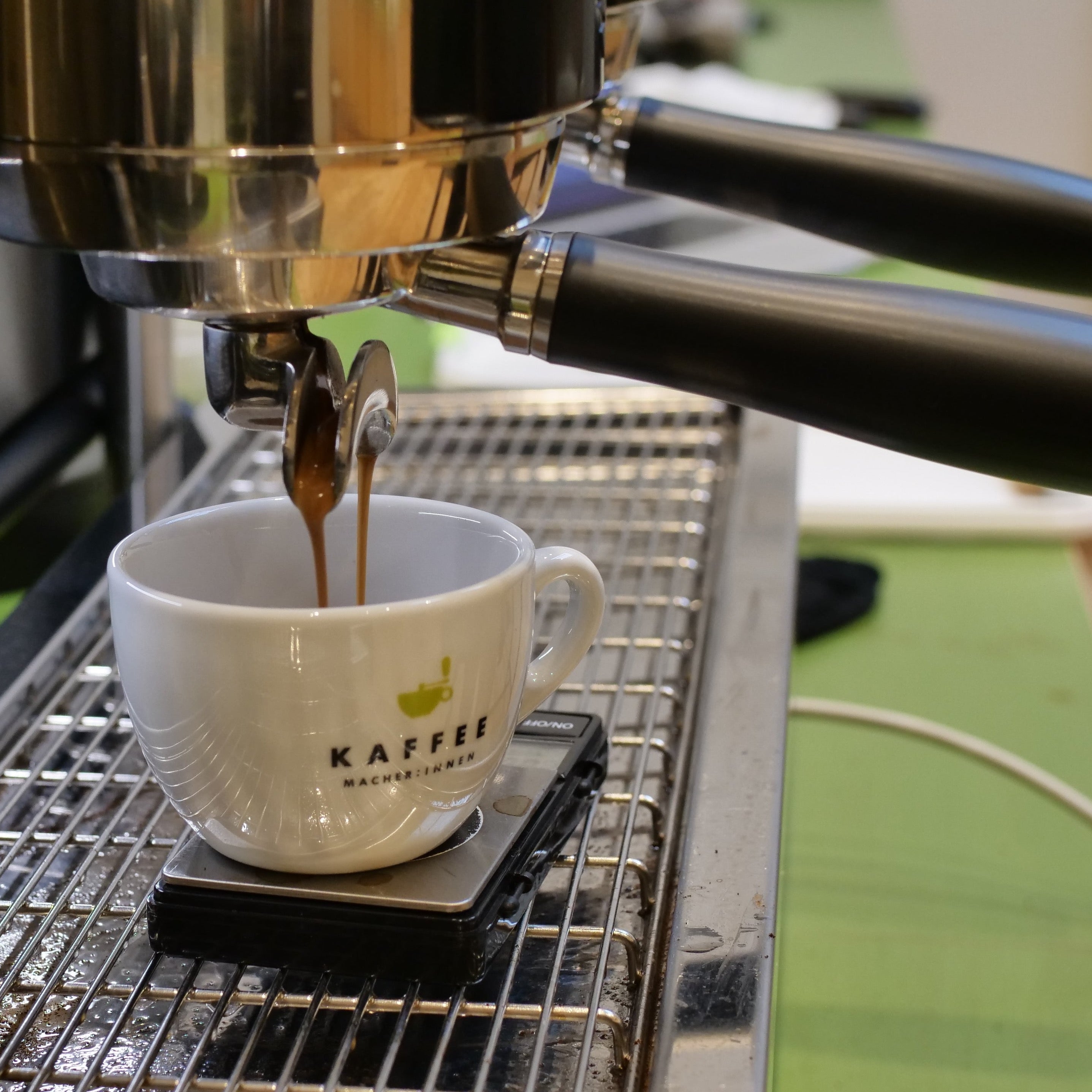
For espresso, there's a reliable rule. Take 18 grams of coffee, aim for 36 grams of espresso in the cup, and time it. Between 25 and 30 seconds is the window. If the shot runs through in under 20 seconds, the grind is too coarse and the espresso tastes sour and thin. If it takes over 35 seconds, it's too fine and becomes bitter.
Adjust in small steps and discard 2 to 6 grams of grounds after each change, otherwise the retention will mix the old grind size into your next shot.
What does a good coffee grinder cost?
For filter coffee, you'll be happy with a hand grinder from about 100 euros, and durably so. For espresso by hand, you should expect around 250 euros and up, because the grind adjustment needs to resolve more finely. But there are also rare exceptions. After a long search, we've added hand grinders to the shop that grind espresso-fine and filter-clear in all price categories.
With electric espresso grinders, our test range goes from 80 to 3,000 euros, and the jumps in quality aren't where you'd expect them. The category winner in the 150 to 250 euro range was the Sage Smart Grinder Pro in 2023. Meanwhile, there are single-dose grinders like the Eureka Mignon Manuale, the DF54, Emil Em1, or the Varia VS3 that have overtaken the Smart Grinder Pro in terms of quality.
One more thing, because it's done wrong so often: if you're making espresso and have a fixed budget, shift it in favor of the grinder. Simple household grinders can't compare to semiprofessional ones, and the result in the cup disappoints regardless of how good the machine is.
Single dosing, bean hopper, or grind by weight?
When you've landed on electric grinders, you'll encounter these three terms. Sorted quickly:

Coffee grinder types at a glance.
Which category fits you depends less on the technology than on your daily life. We've worked through that in a separate article.
How do you clean your coffee grinder?
The bean fat deposits in the bean hopper and becomes rancid over time. At home, it's enough to vacuum the empty grinder from both sides every two weeks and run cleaning granules through it. At a café, that should happen twice a week.
Opening the grinding chamber itself is another matter. Modern grinders are designed to be easily opened and cleaned. In our tests, we also rate how simple opening and cleaning is. Especially grinders with large retention need to be cleaned more frequently down to the last crevice.
Never poke sharp objects into the powder outlet; there's often a delicate silicone membrane sitting there.
Frequently asked questions about coffee grinders
Is a hand grinder worth it for espresso?
Yes, if you make one or two espressos a day. From three to four, it becomes work, and then an electric grinder pays for itself through convenience. Unless you enjoy the daily workout.
Conical or flat burrs—which is better?
Neither one across the board. Conical burrs produce more fine fraction, which works well with dark roasts and short extractions. Flat burrs deliver a cleaner distribution, especially with large diameter. The implementation in the concrete machine matters more than the principle.
How fine does coffee need to be ground for filter coffee?
About like fine sand. Coarser than espresso, noticeably finer than French press.
Can I grind filter coffee with an espresso grinder?
Often only in a limited way. A pure espresso grinder doesn't cleanly cover the coarser range for filter coffee. Conversely, a filter grinder usually can't achieve the fine espresso range. However, there are also all-round grinders with a narrow main peak that grind well across the entire coffee range, such as the Eureka Libra 65 AP. Other grinders solve this through flexible burrs that can be swapped. As a rule: if a grinder has a narrower main peak in particle distribution, it's better suited for filter coffee.
How often should I clean my coffee grinder?
At home every two weeks, at a café twice a week.
Do you sell coffee grinders?
Hand grinders yes, electric grinders no. We stopped selling electric grinders three years ago so we can test them objectively.
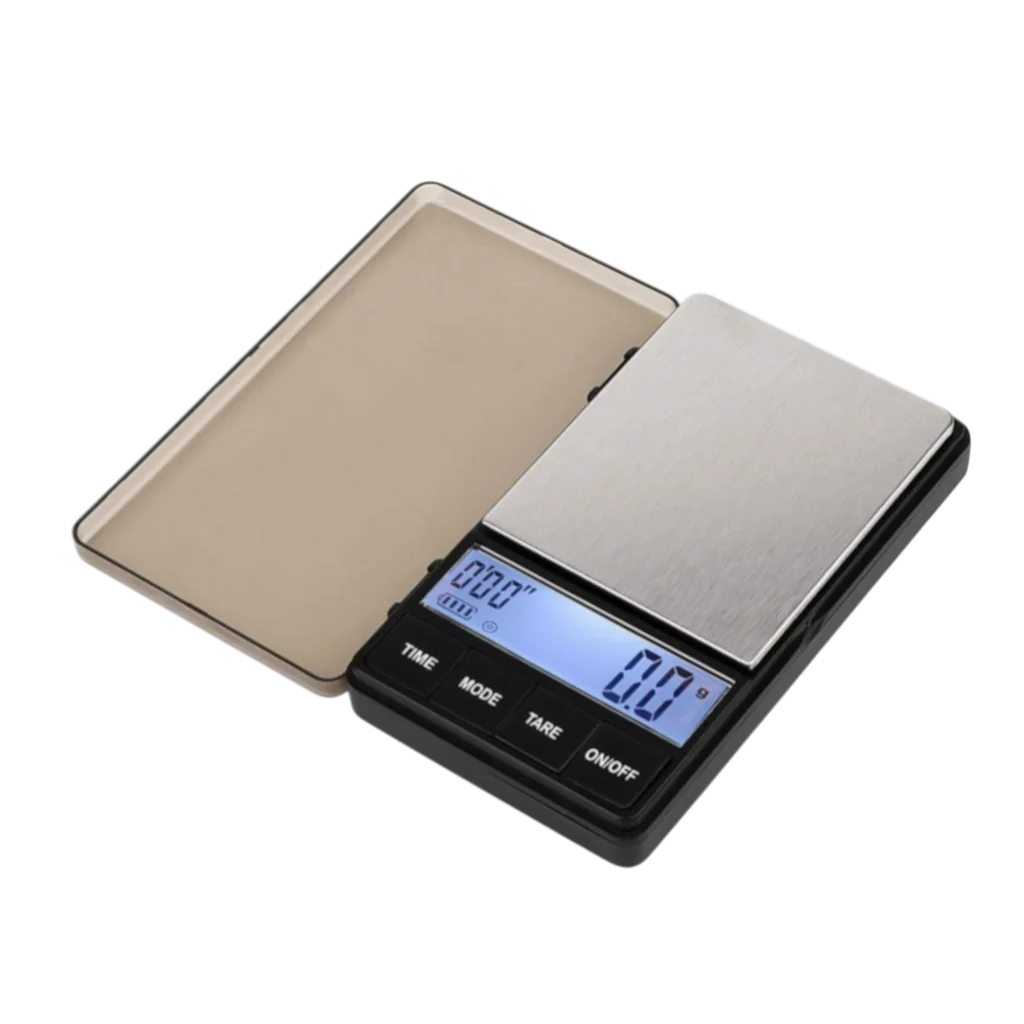
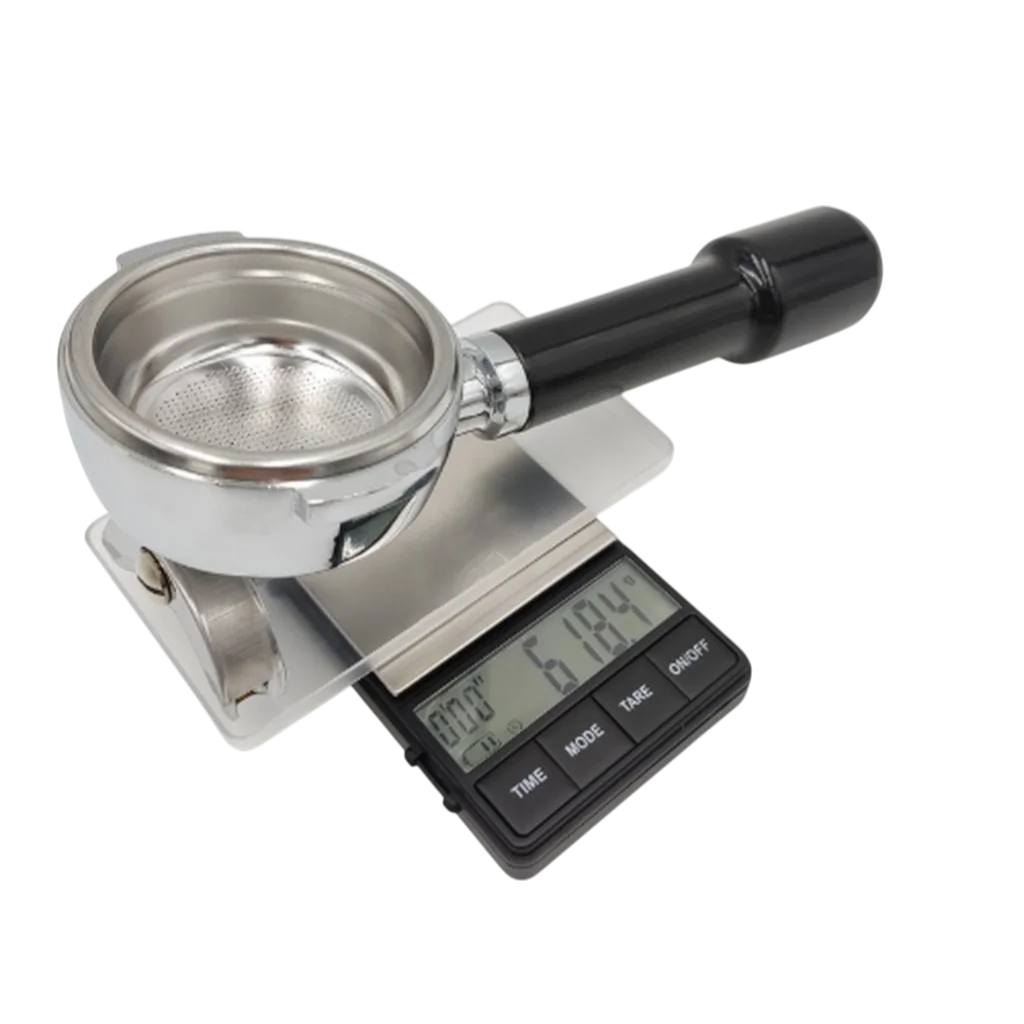
We've personally used all our hand grinders in daily use for months before they came into our range. And without a scale, there's no reproducible grind size.
Conclusion
If you make filter coffee or French press, a good hand grinder from about 100 euros is enough, and you'll be satisfied with it for years.
If you make espresso, the grinder is the more important part of your purchase. Shift your budget there, not into the machine.
Pay attention to the grind adjustment resolution and retention, not the number of settings or the wattage.
And whatever grinder you choose: grind shortly before brewing, not in advance.