
In the hand grinder coffee market, there's a wide range of no-name products for €20 to grinders that cost several hundred euros. We want to help you identify the right hand grinder for you.
In this article, we'll also discuss the hand grinders available in our online shop. However, the criteria and tips discussed are universal and applicable to other hand grinders as well.
Which hand grinder is right for me?
Choosing the right grinder depends heavily on which coffees you drink and which brewing method you use: espresso, filter coffee, French press, or Moka pot.
As a general rule: The finer the required grind size, the higher quality the hand grinder and grinding mechanism must be. Fine espresso grinds are, so to speak, the champions league.
This also means: The more espresso-compatible you want it to be, the higher the purchase price.
Other important factors for using a hand grinder are build quality, durability, everyday practicality, and the grinding mechanism.
Build quality and durability of hand grinders
In 2020, we conducted a large test of hand grinders in the under €100 category. Many of the tested grinders are no longer available today. In the test, we also noticed that some hand grinders showed signs of deterioration during their first uses.
Ask the seller before purchasing whether they offer spare parts or repairs for the grinder they're offering.
What is the best hand grinder mechanism?
You'll find hand grinders made from different materials. In our tests, we haven't found a convincing ceramic grinding mechanism for hand grinders.
All manufacturers of high-quality hand grinders such as Comandante, Timemore, Etzinger, and Kinu rely on stainless steel grinding mechanisms.
A look at the grinding mechanism types of electric grinders shows that some use ceramic grinding mechanisms and not exclusively stainless steel grinding discs.

The shape of the grinding cones used in hand grinders varies from manufacturer to manufacturer, as manufacturers develop their own patents, which are then produced by large grinding mechanism manufacturers.
The everyday practicality of hand grinders
The right ergonomics
A very important factor is the everyday practicality of a hand grinder. Even if a hand grinder manages to achieve the right grind size for your preferred brewing method, that doesn't mean grinding will be easy.
Many of the very cheap grinders, for example, have a very thin handle that doesn't allow ergonomic comfortable grinding. Thus, everyday practicality is not given and the grinder quickly gathers dust in the cupboard because it's simply not fun to use.
The grinding speed
The second important factor in daily use is speed – how long it takes for the beans to be ground.
You typically won't find information about this from the manufacturer or seller. The background is that it's not uncommon for a hand grinder to take more than 5 minutes for 18 g of espresso-fine grounds. It's important to note that the most transparent method of indicating grinding speed is the number of crank rotations required. How fast you turn is very individual.
Ask about the number of rotations needed for an espresso grind size.
Which hand grinder for espresso?
For brewing espresso, very fine grounds are essential. Therefore, it's absolutely necessary that the hand grinder can grind finely enough.
Caution: This is not the case with every hand grinder, even if some manufacturers claim otherwise.
It's also important that grinding is easy. This means: ergonomics, smoothness, and grinding speed must form a working package overall.
Look for hand grinders that provide both a setting recommendation for espresso and a rotation or time specification for a standard amount of beans (18 g).
Setting the grind size on a hand grinder
Almost all hand grinders work with a click system. The challenge is to find the right click setting for your desired brewing method combined with the coffee you're using.
Sounds complicated, but with the right information and guidance, it's not that difficult. Generally speaking: The lower the click number, the finer the grounds. However, you shouldn't use the lowest click settings, as the grinding mechanism could wear out faster through grinding (the grinding discs touch each other).

What grind size for espresso?
Setting the hand grinder for espresso follows these steps:
Ask the seller for the recommended grind size setting for your brewing method.
What grind size for filter coffee?
For filter coffee, first orient yourself by the manufacturer's or seller's click recommendation for your filter coffee method.
From the AeroPress to the classic V60 hand filter to the press pot, or French press, increasingly coarser grind sizes are needed.
The seller or grinder manufacturer should provide click recommendations for these grind sizes.
Which hand grinders do we sell?
We work intensively with hand grinders every day. Based on our experience, we've put together our hand grinder range.
There are many coffee hand grinder manufacturers and even more different models. We've deliberately decided on the selection we offer because we want to simplify your decision. In our view, it doesn't make sense to offer dozens of hand grinders – that would only complicate the decision further.
| Hand grinder | Special feature |
|---|---|
| Timemore C3 ESP Pro | Very strong price-to-performance ratio with good manufacturing quality |
| Timemore Slim 3 | Made from one piece of aluminum, impresses with design and quality |
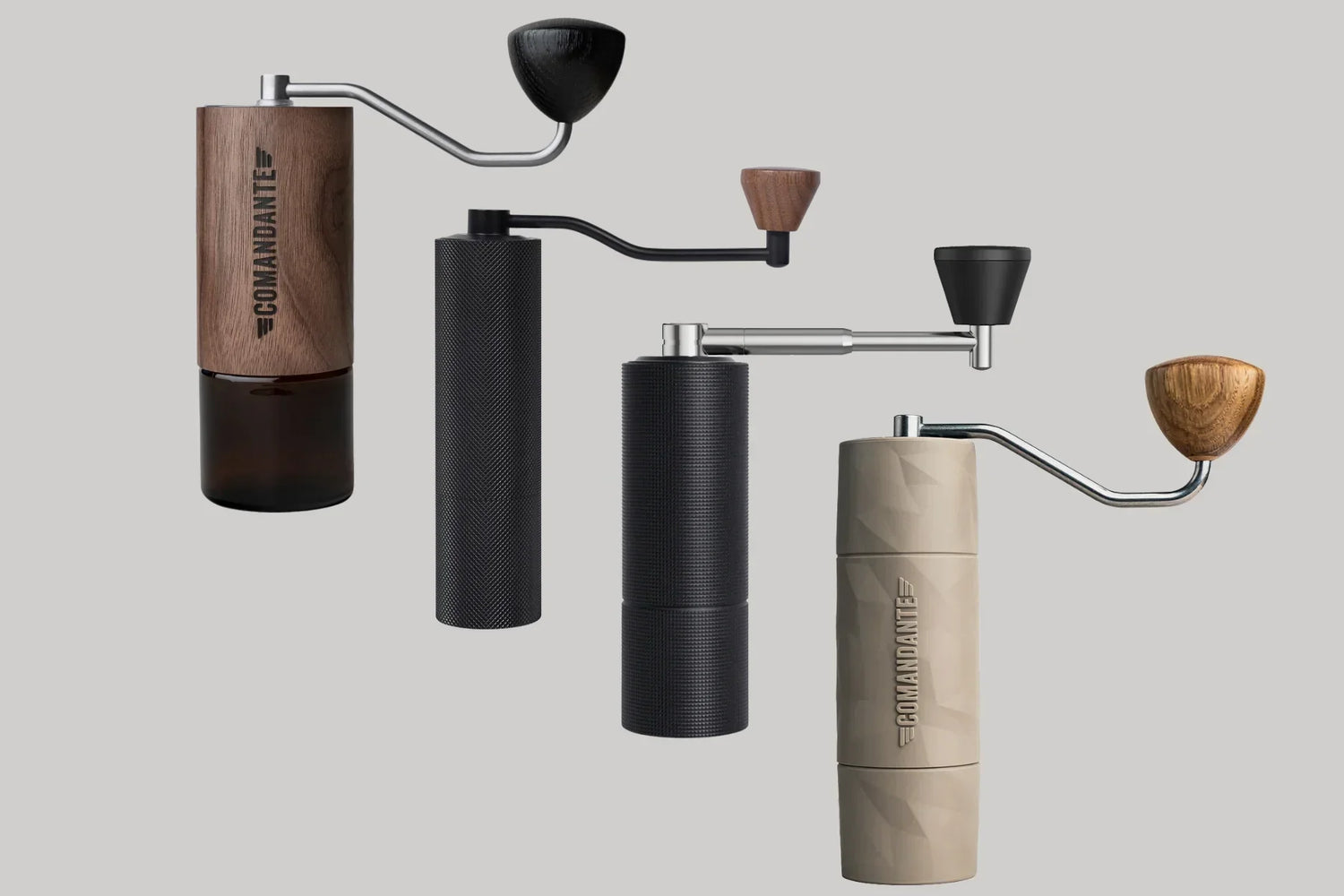
| Comandante C40 MK4 | Premium segment, manufactured in Germany, with RedClix very finely adjustable |
| Comandante X25 Trailmaster | For outdoor use, grinding characteristics comparable to the C40 MK4 |
| Kinu M47 | – |
Timemore C2 and Timemore Slim Plus are no longer produced by Timemore, so we've expanded our range with the two successor products Timemore C3 ESP Pro and Timemore Slim 3.
All mentioned Timemore hand grinders are from the Timemore Chestnut series. You'll occasionally find the designation Timemore Chestnut Slim 3 or Timemore Chestnut C3 Pro. These are the same hand grinders as listed in the table above.
Our hand grinder range in detail
These four hand grinders cover a wide range of coffee preferences.
Timemore C3 ESP Pro
The Timemore C3 ESP Pro offers a very strong price-to-performance ratio with good manufacturing quality.

Timemore Slim 3
The Timemore Slim 3 offers an excellent price-to-performance ratio, is made from one piece of aluminum, and impresses with design and quality.

Comandante C40 MK4
The Comandante C40 MK4 is a high-quality hand grinder from the premium segment and is manufactured in Germany.

With the optional RedClix upgrade, the Comandante C40 MK4 can make very fine adjustments in the espresso range. In terms of adjustability for precise grind size, the Comandante C40 MK4 with the RedClix upgrade receives full marks.

Comandante X25 Trailmaster
The newest hand grinder in our range is the Comandante X25 Trailmaster. The RedClix axis can also be installed here. The grinding characteristics are comparable to the Comandante C40 MK4.
The Trailmaster is particularly suitable for outdoor use. We took a closer look at this grinder in this video.