




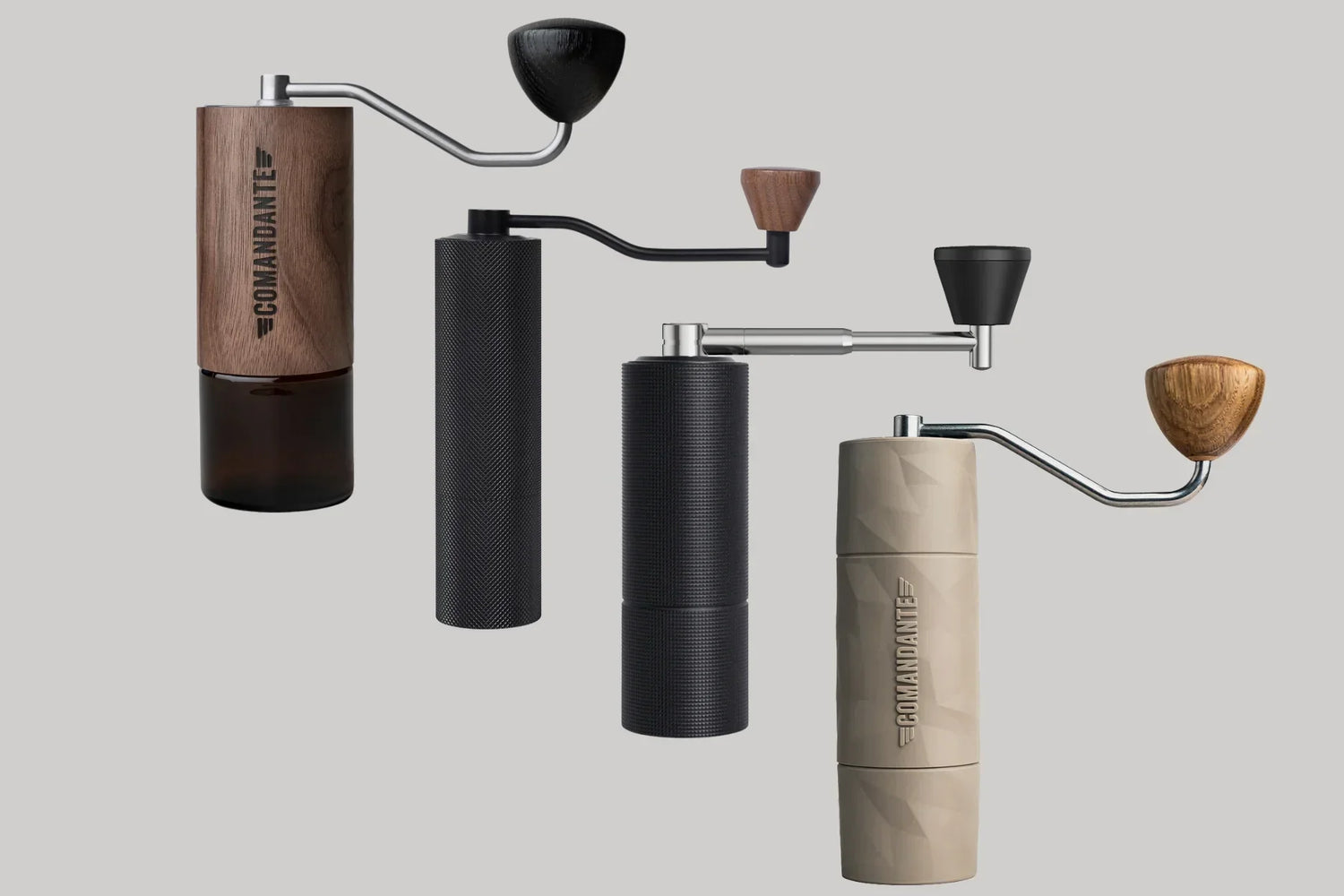

The manual coffee grinder landscape offers a vast selection, ranging from generic €20 models to precision grinders that cost several hundred euros. We want to help you identify the right hand grinder for your daily routine.
In this guide, we will also take a look at the manual grinders available in our online shop. However, the evaluation criteria and recommendations discussed here are universally applicable to any manual grinder on the market.
Which Hand Grinder Suits Me?
Selecting the right grinder depends fundamentally on the types of coffee you enjoy and your preferred brewing method: espresso, pour-over filter coffee, French press, or moka pot.
As a rule of thumb: the finer the required grind size, the higher the quality of the manual grinder and its burrs must be. Fine espresso grinding is, so to speak, the Champions League of manual grinding.
This also means: the more espresso capability you demand, the higher the initial purchase price will be.
Other crucial factors when choosing a manual grinder include build quality, durability, everyday ergonomics, and burr design.
Build Quality and Durability of Manual Grinders
In 2020, we conducted an extensive group test of manual grinders priced under €100. Many of the grinders tested back then are no longer available today. During testing, we also noticed that several budget grinders showed signs of mechanical failure after just a few uses.
Ask the seller before purchasing whether they offer spare parts or repair services for the grinder in question.
What Is the Best Burr Set for a Manual Grinder?
You will encounter various materials used for manual grinder burrs. However, throughout our hands-on tests, we have yet to find a ceramic burr set that performs convincingly in a manual grinder.
All reputable manufacturers of premium manual grinders—such as Comandante, Timemore, Etzinger, and Kinu—rely strictly on stainless steel burrs.
A look at the burr types used in electric grinders shows that ceramic burrs are sometimes used there, but for hand grinding, steel burrs are vastly superior.

The geometry of the conical burrs varies from manufacturer to manufacturer, as each develops its own patented burr profiles and has them produced by specialized manufacturers.
Everyday Usability of Manual Grinders
The Right Ergonomics
Everyday usability is a decisive factor when choosing a hand grinder. Even if a manual grinder is technically capable of achieving the correct grind size for your preferred brew method, that doesn't necessarily mean the grinding action will feel smooth and comfortable.
Many ultra-cheap grinders, for example, have very thin crank handles that prevent an ergonomically comfortable grip. If grinding feels tedious, the grinder will quickly end up gathering dust in a kitchen cupboard because it simply isn't fun to use.
Grinding Speed
The second critical factor in daily use is speed—specifically, how long it takes to grind your dose of beans.
Manufacturers and retailers rarely publish concrete figures for this. It is not uncommon for an inferior hand grinder to take more than 5 minutes to grind an 18 g espresso dose. Notably, the most transparent way to quantify grinding speed is by counting the required crank revolutions. How fast one spins the crank, on the other hand, is entirely individual.
Inquire about the number of crank rotations required to grind a standard espresso dose.
Which Manual Grinder for Espresso?
Brewing espresso requires an exceptionally fine, consistent grind. It is therefore mandatory that the manual grinder can grind fine enough in a reliable manner.
Caution: This is not the case with every hand grinder, even when manufacturers claim so on the packaging.
Furthermore, grinding must feel manageable. Ergonomics, smooth bearing rotation, and grinding speed must form a cohesive, functional package.
Look for manual grinders that provide both click recommendations for espresso and a rotation or time estimate for a standard dose of beans (18 g).
Adjusting Grind Size on a Manual Grinder
Almost all manual grinders utilize a stepped click mechanism. The challenge lies in finding the exact click setting for your chosen brewing method in combination with the specific coffee beans you are using.
While that may sound complicated, it is quite straightforward with the right guidance. As a general rule: the lower the click number, the finer the grind. However, you should avoid grinding at the lowest click settings where burrs rub together, as this causes premature wear.

Which Grind Size for Espresso?
Dialing in a manual grinder for espresso is best done in the following steps:
Ask the seller or roaster for the recommended grind setting for your specific brew method.
Which Grind Size for Filter Coffee?
For filter coffee, start with the click setting recommended by the manufacturer or retailer for your specific pour-over device.
From the AeroPress to the classic V60 pour-over dripper all the way to a French press, a progressively coarser grind size is required.
A reputable seller or manufacturer should provide clear click recommendations for each of these brew methods.
Which Hand Grinders Do We Offer?
We work with manual coffee grinders on a daily basis. Based on our hands-on experience, we curated our manual grinder lineup.
There are countless hand grinder brands and hundreds of individual models. We intentionally selected a focused range to make your decision easier. Offering dozens of nearly identical grinders would only add unnecessary confusion.
| Manual Grinder | Key Feature |
|---|---|
| Timemore C3 ESP Pro | Very strong price-performance ratio with solid build quality |
| Timemore Slim 3 | Machined from a single block of aluminum; impressive design and quality |
| Comandante C40 MK4 | Premium segment, made in Germany; ultra-fine micro-adjustments with RedClix |
| Comandante X25 Trailmaster | Built for outdoor adventures; grinding performance identical to the C40 MK4 |
| Kinu M47 | – |
The Timemore C2 and Timemore Slim Plus are no longer produced by Timemore, which is why we updated our lineup with the two successor models: the Timemore C3 ESP Pro and Timemore Slim 3.
All featured Timemore manual grinders originate from the Timemore Chestnut series. You may occasionally see designations like Timemore Chestnut Slim 3 or Timemore Chestnut C3 Pro. These refer to the exact same grinders listed in the table above.
Our Hand Grinder Lineup in Detail
These four hand grinders cover a wide spectrum of brewing needs.
Timemore C3 ESP Pro
The Timemore C3 ESP Pro offers an outstanding price-performance package paired with dependable manufacturing quality.

Timemore Slim 3
The Timemore Slim 3 delivers excellent value for money, is machined from a single block of aluminum, and stands out with its compact design and build quality.

Comandante C40 MK4
The Comandante C40 MK4 is a high-precision manual grinder from the premium segment, crafted with exacting standards in Germany.

With the optional RedClix upgrade axle, the Comandante C40 MK4 enables micro-fine adjustments specifically for espresso. In terms of precise grind calibration, the Comandante C40 MK4 equipped with RedClix achieves top marks.

Comandante X25 Trailmaster
The latest addition to our lineup is the Comandante X25 Trailmaster. The RedClix axle can be installed here as well. Its grinding performance and burr geometry are identical to the Comandante C40 MK4.
The Trailmaster is tailored specifically for outdoor and travel use. We took a closer look at this grinder in this video review.