



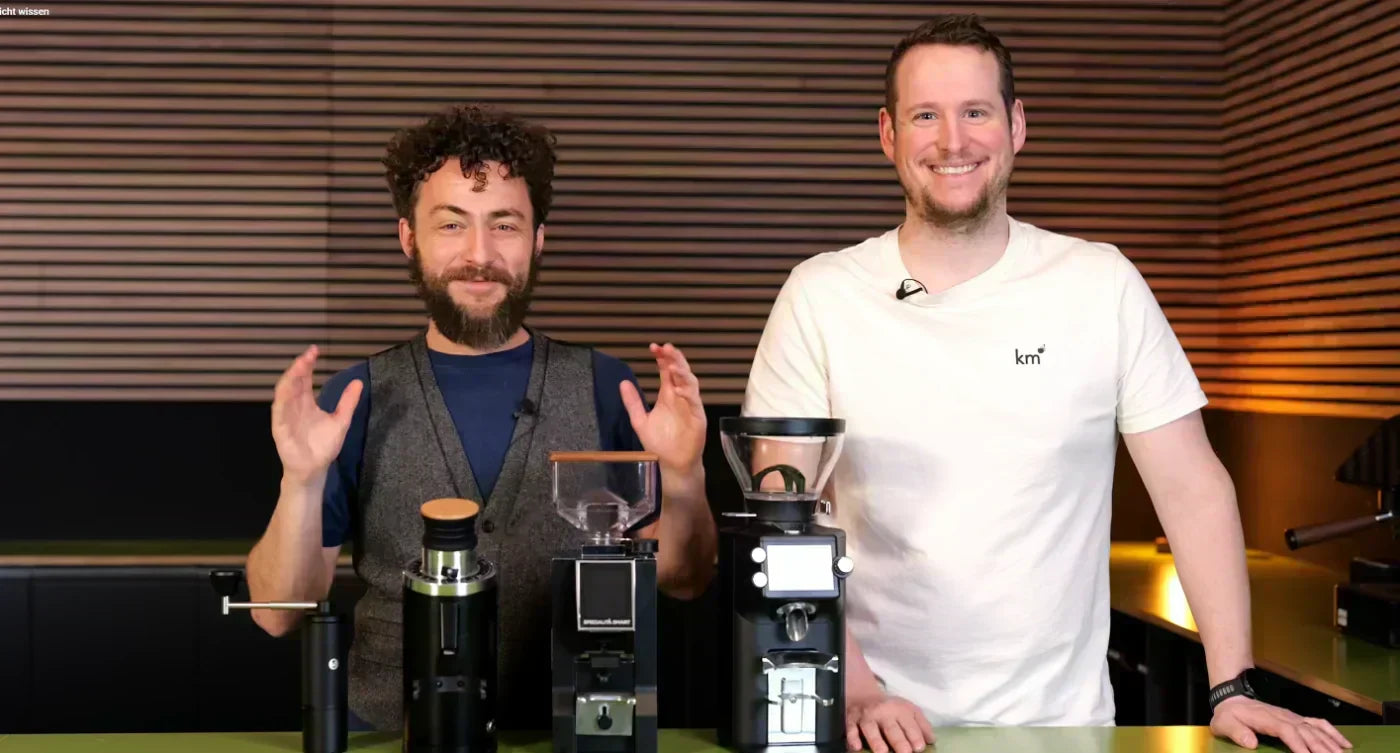

There are numerous good and bad espresso grinders on the market. But before you decide on a grinder, choosing the right grinder category is the first step. If you're starting even further back and want to clarify which coffee grinder is suitable for which brewing method, read up there.
Four main categories, an emerging fifth – and none of them is automatically the best. Hand grinders, single-dosing grinders, doser grinders with timers, grind-by-weight grinders, and recently grinders with electronic grind adjustment: they can all deliver excellent espresso. The question isn't which category makes the best coffee, but which fits your daily routine. How often do you switch beans? How many espressos a day? How much do you want to control yourself? We go through all five types – with honest assessment of strengths and weaknesses.
The four main categories at a glance
Hand grinder: You weigh the coffee, crank, done. No power, no retention, smallest budget. But: manual labor with every shot.
Single-Dosing grinder: You weigh the coffee, put it in the top, the grinder grinds it all out. Bean switching anytime, minimal retention, direct feedback when adjusting.
Doser grinder with timer (bean hopper): Beans in the hopper, press button, the grinder grinds for a set time. Fast once properly dialed in. But: retention, little flexibility for bean switching.
Grind-by-Weight grinder: Like the bean hopper grinder, but with integrated scale. It doesn't stop after time, but after weight. Solves the biggest problem with timer grinders – but costs more too.
Strengths & Weaknesses in Detail
Click on a type for advantages, disadvantages, and target audience.
Cheapest entry point▼
Single-dosing principle▼
Zero retention▼
Espresso potential like expensive electric grinders▼
Mobile and power-independent▼
Easy to clean and maintain▼
Workout included▼
Workout included (the flip side)▼
Particle distribution sometimes a problem▼
Step adjustment on many models▼
Bean switching anytime▼
Maximum freshness▼
Low retention▼
Easier grind size adjustment▼
Strong price-to-performance ratio▼
Best for beginners▼
Experimentation possibilities▼
Cleaning often easier▼
Often more modern design▼
Compact design▼
Mindful ritual▼
Static▼
Slightly more steps▼
Not designed for high frequency▼
More comfortable workflow (when dialed in)▼
Built for high frequency▼
High throughput▼
Proven technology, robust, durable▼
Not cheaper than single dosing▼
Freshness is a problem — in multiple ways▼
High retention▼
More variation in output▼
Grind size change = amount change▼
"Less accessories" isn't true▼
Problematic for beginners▼
Can't easily be used as a single doser▼
Eliminates the biggest weakness of the doser grinder▼
No re-weighing after grind size change▼
Good dosing accuracy▼
Future trend▼
No fresher than a bean hopper grinder▼
High entry price▼
Retention to consider▼
Often slower than single dosing▼
Sometimes not vibration-stable▼
Software not universally convincing yet▼
The grinder adjusts itself▼
Save recipes▼
Combination with integrated scale▼
Ideal for home baristas without much experience▼
Future: Full integration▼
Software susceptible and immature▼
Eureka Specialità Smart: display only▼
Retention must be factored in▼
Contact time vs. drop time▼
High price and expensive repairs▼
Still limited selection▼
Hand grinder: The underestimated entry point
A good hand grinder for under 100 euros can deliver the same espresso quality as an electric grinder for 1,500 euros. That sounds like marketing, but it's measurable: good hand grinders achieve particle distributions that compete with expensive flat-burr grinders. The catch isn't quality. The catch is the effort.
Depending on the burr, you hand-crank for about a minute per serving. Every morning. And if you're dialing in the grind size, every attempt also costs a minute of cranking. If you understand it as a ritual, you'll be happy with it. If you want your espresso quickly in the morning, probably not.
Hand grinders work on the single-dosing principle: weigh, fill, grind. No retention, no old coffee in the system. Plus they're mobile, power-independent, and disassembled and cleaned in seconds. For travelers, minimalists, and everyone on a tight budget, they're the smartest entry point.
What to watch out for: not every hand grinder has stepless adjustment. Some work with step increments so coarse that with espresso you jump from one step to the next with a huge extraction jump. And: check in advance whether the grinder can grind fine enough for espresso – not all of them can.
Hand grinders from our shop*▼
| Grinder | Price | |
|---|---|---|
| Timemore Chestnut C5 ESP Pro | approx. 99 € | Go to product → |
| Timemore Slim 3 Hand Grinder | approx. 119 € | Go to product → |
| Comandante C40 MK4 | approx. 249 € | Go to product → |
Single-dosing grinder: The best choice for most
If you ask us which grinder type we'd recommend to most home users: Single dosing. The reasons are solid.
You weigh 18 g, put them in the top of the grinder, and the grinder grinds them all out. With good single-dosing grinders, less than 0.5 g remains in the grinder. This has a direct effect on adjusting: every grind size change takes immediate effect. No purging old coffee, no guessing. With bean hopper grinders, the amount changes with the grind size – with single dosing it doesn't. That's why we prefer single-dosing grinders in our courses. They've replaced doser grinders there.
Bean switching? Anytime. One person gets light filter coffee, the next a dark espresso. No waste, no effort. Good quality starts much cheaper here than with bean hopper grinders – from 150 to 250 euros you can get started.
The disadvantages: single-dosing grinders charge statically more because the charge distributes less than with bean hopper grinders. RDT – a drop of water on the beans – helps. And for high frequency, i.e., many espressos in a row at a party or in the office, the type isn't built. With weighing and bellows, it gets slow eventually.
Some single-dosing grinders offer extras like variable RPM settings. This allows you to shift the flavor profile without changing the grind size – a tool that bean hopper grinders don't offer.
All tested single-dosing grinders (24)▼
| Grinder | Retention | Speed | Price | |
|---|---|---|---|---|
| G-Iota DF54 | 0.5 g | 10.0 g/10s | approx. 279 € | Test → |
| Emil EM1 Single Doser | 0.7 g | 14.0 g/10s | approx. 229 € | Test → |
| Eureka Mignon Manuale | 3.0 g | 11.8 g/10s | approx. 239 € | Test → |
| Varia VS3 | 1.8 g | 6.7 g/10s | approx. 331 € | Test → |
| Eureka Mignon Zero | 1.9 g | 19.9 g/10s | approx. 339 € | Test → |
| Emil T64 Coffee Grinder | 1.0 g | 19.0 g/10s | approx. 379 € | Test → |
| G-Iota DF64 Gen-2 | 0.2 g | 19.1 g/10s | approx. 429 € | Test → |
| Mahlkönig X64 SD | 0.9 g | 35.0 g/10s | approx. 499 € | Test → |
| G-Iota DF64V | 2.3 g | 19.2 g/10s | approx. 550 € | Test → |
| G-Iota Pro83 | 0.8 g | 35.6 g/10s | approx. 599 € | Test → |
| Eureka Mignon Single Dose Pro | 0.8 g | 28.0 g/10s | approx. 639 € | Test → |
| Profitec Twist SD54 | 0.8 g | 14.7 g/10s | approx. 645 € | Test → |
| Option-O Casa | 0.4 g | 6.0 g/10s | approx. 650 € | Test → |
| Niche Zero | 0.7 g | 11.9 g/10s | approx. 690 € | Test → |
| Timemore 064S | 0.3 g | 12.4 g/10s | approx. 699 € | Test → |
| Varia VS6 | 2.4 g | 11.5 g/10s | approx. 784 € | Test → |
| Niche Duo | 0.9 g | 10.8 g/10s | approx. 800 € | Test → |
| G-Iota DF83 V | 0.8 g | 66.0 g/10s | approx. 839 € | Test → |
| Timemore 078S | 0.3 g | 21.6 g/10s | approx. 899 € | Test → |
| Mazzer Philos | 0.6 g | 22.4 g/10s | approx. 1,195 € | Test → |
| Zerno Z1 | 0.8 g | 11.7 g/10s | approx. 1,504 € | Test → |
| Weber Workshop Key | 0.2 g | 8.1 g/10s | approx. 1,895 € | Test → |
| Acaia Orbit | 0.7 g | 14.0 g/10s | approx. 1,899 € | Test → |
| Option-O Lagom P64 | 0.2 g | 24.8 g/10s | approx. 2,080 € | Test → |
Doser grinder with timer (bean hopper): Proven, but with pitfalls
The most widespread category. If you want to go deeper into the subject, you'll find a detailed overview in our espresso grinder guide. Here's the principle: beans in the hopper, set grind size, timer to 7, 8, 9 seconds – and the grinder gives you a certain amount of coffee. As long as grind size and coffee remain the same, that's more or less consistent.
The strength: once properly dialed in, you press a button and you're off. For high throughput – gastronomy, family celebrations, offices – a bean hopper grinder is the right choice.
But the weaknesses are heavier than many think. As soon as you adjust the grind size, the amount per time unit also changes. Finer grinding means less coffee in the same time, coarser means more. After each grind size change you have to re-weigh. So you need a scale just like you would with a single-dosing grinder. The argument "less accessories needed" isn't true.
Then there's the retention. With bean hopper grinders we often measure 4 g and more. This affects taste and makes adjusting sluggish because each grind size change only takes effect after purging the old coffee. The coffee in the bean hopper ages, the coffee in the feed chute gets partially ground, and the coffee in the retention is already old anyway. Freshness looks different.
For beginners, the bean hopper grinder is problematic: many adjust the grind size but don't check the amount – and wonder why the espresso tastes bad. The brew ratio is no longer correct, but you don't see why.
Common argument: bean hopper grinders are cheaper. Not really. Cheap models often come without time control – then you might as well get a single-dosing grinder. Good models with timer quickly cost 400 to 500 euros.
All tested doser grinders with timers (17)▼
| Grinder | Retention | Speed | Price | |
|---|---|---|---|---|
| Rommelsbacher EKM300 | 1.5 g | 22.7 g/10s | approx. 55 € | Test → |
| Graef CM800 | 6.2 g | 19.1 g/10s | approx. 119 € | Test → |
| Lelit PL043MMI | 5.0 g | 15.1 g/10s | approx. 185 € | Test → |
| Lelit PL044MMT | 4.5 g | 14.3 g/10s | approx. 257 € | Test → |
| Eureka Specialità | 2.7 g | 21.3 g/10s | approx. 369 € | Test → |
| Eureka Mignon Magnifico 55 | 2.1 g | 22.5 g/10s | approx. 419 € | Test → |
| Lelit PL72 | 5.1 g | 31.8 g/10s | approx. 417 € | Test → |
| Macap Leo55 | 2.4 g | 16.9 g/10s | approx. 479 € | Test → |
| Mahlkönig X54 | 7.6 g | 13.7 g/10s | approx. 499 € | Test → |
| Quamar M80 | 10.9 g | 33.6 g/10s | approx. 490 € | Test → |
| Rocket Faustino V2 | 2.4 g | 13.7 g/10s | approx. 559 € | Test → |
| Ceado Life | 1.9 g | 17.7 g/10s | approx. 629 € | Test → |
| Eureka Mignon XL 65 | 3.1 g | 28.7 g/10s | approx. 629 € | Test → |
| Rocket Fausto 2.1 | 10.0 g | 30.5 g/10s | approx. 659 € | Test → |
| Baratza Forté AP | 3.9 g | 22.7 g/10s | approx. 700 € | Test → |
| ECM Automatik-S64 | 12.2 g | 27.5 g/10s | approx. 869 € | Test → |
| La Marzocco Pico | 2.2 g | 20.0 g/10s | approx. 1,159 € | Test → |
Grind by Weight: Timer problem solved – but not all problems
The grind-by-weight grinder (GBW) works on the same principle as a bean hopper grinder, with one difference: it doesn't stop after a time, but after a weight. An integrated scale tares out the portafilter and grinds until the set gram amount is reached.
This solves the biggest problem with timer grinders: quantity inconsistency. When you adjust the grind size, the grinder automatically adjusts the amount. No re-weighing needed. Many GBW grinders achieve ±0.1 g – that's more accurate than most timer grinders deliver.
What GBW doesn't solve: freshness. You have just as full a bean hopper, just as much retention. Sometimes it's claimed that GBW combines the advantages of single dosing and bean hopper grinders. That's only half true. You get the comfort but not the freshness. You even need the weight of the beans on top for it to work cleanly.
The entry price is high. Below 800 euros, there are hardly any usable GBW grinders with convincing particle distribution across a wide roast spectrum. The 300 to 500 euros extra over a good bean hopper grinder is for the weighing technology. And the software isn't mature yet in some manufacturers.
When does it pay off? If you drink a lot of coffee at home, don't constantly switch beans, and don't want to weigh. Tip: after longer idle periods, program a portion as a purge portion to get the old coffee out of the system.
All tested grind-by-weight grinders (6)▼
| Grinder | Retention | Speed | Price | |
|---|---|---|---|---|
| Baratza Sette 270wi | 2.7 g | 29.3 g/10s | approx. 499 € | Test → |
| Eureka Mignon Libra 65 All Purpose | 2.1 g | 12.5 g/10s | approx. 599 € | Test → |
| Fiorenzato Allground Sense | 7.1 g | 23.8 g/10s | approx. 849 € | Test → |
| Zuriga G2 GBW | 1.5 g | 11.1 g/10s | approx. 1,150 € | Test → |
| Ligre Siji | 2.7 g | 22.9 g/10s | approx. 1,180 € | Test → |
| Mahlkönig E64 WS | 4.1 g | 27.3 g/10s | approx. 999 € | Test → |
Smart grinders / Electronic grind adjustment: The emerging fifth category
A lot is happening here right now. Grinders with electronic grind adjustment measure the distance between the burrs digitally and allow grind size adjustment in tiny increments – so fine that one step might make a second's difference in extraction time.
The exciting part: you tell the grinder your target recipe, brew your espresso, report the result back – and the grinder adjusts the grind size itself. Recipes can be saved and retrieved at the push of a button. Combined with an integrated scale, this becomes a system that thinks while adjusting. How it works in practice is shown in our test of the Mahlkönig E64 WS. The underlying concept is called Grind by Sync.
However, the market is still young. Relevant grinders in the home segment: the Mahlkönig E64 WS with full integration, the Nunc system (grinder and machine communicate directly), the forthcoming Eureka Tio, and the Eureka Specialità Smart – although the latter only recognizes the grind size electronically but doesn't adjust it. And without a physical grind size dial, a purely electronically controlled grinder doesn't work reliably if the software glitches. That's currently the biggest risk: no fallback for software issues.
For whom? If you're willing to invest in the upper price range and want a grinder that actively supports you while adjusting. The technology is exciting. But it still needs to mature.
And what quality do they deliver?
Here's perhaps the most important insight: all five categories can deliver the same espresso quality. A 100 euro hand grinder produces the same espresso as a 2,000 euro grinder when properly dialed in. The difference lies in workflow, comfort, and error tolerance – not in cup quality. If you master your grinder, you get good coffee with any of these categories.

Conclusion: Which type are you?
Instead of a single recommendation, here's the honest breakdown:
You want the cheapest entry point and don't mind manual work? → Hand grinder. It starts from 50 to 100 euros.
You like to switch beans, want to learn, and get direct feedback when adjusting? → Single dosing. The most versatile choice for most home users.
You always drink the same coffee, need speed, and supply a lot of people? → Doser grinder with timer. Built for gastronomy, parties, and offices.
You want hopper comfort without the quantity problem? → Grind by weight. If the budget fits.
You want the grinder to think while adjusting? → Smart grinder. If you're willing to invest in technology that's still maturing.
No matter which type: a grinder is the most important investment in your espresso setup. Not the machine.