




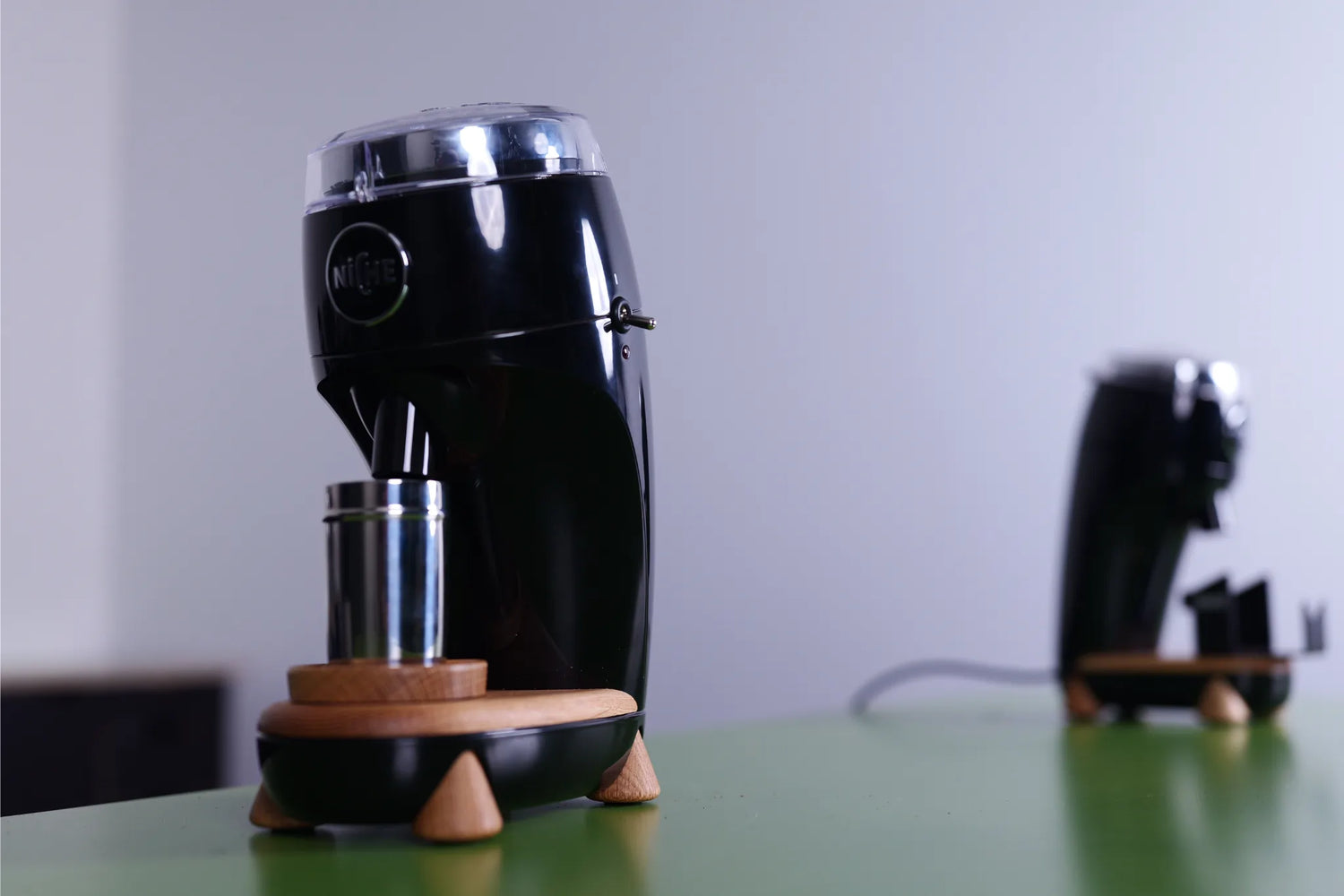

The Niche Duo is the second espresso grinder from Niche. With the Niche Zero, Niche essentially developed the single dosing espresso grinder market at home virtually single-handedly. Now comes the Niche DUO with 83mm burrs. Can the British company raise the bar even higher?
Instead of a conical grinding mechanism, flat burrs are now installed. Instead of one pair, there are now two—one for filter and one for espresso. This is meant to provide the home barista with flexibility and quality, building on Niche's proven performance. We test whether it succeeds.
We compared 10 single dosing grinders in the price range of 500 to 1000 euros. Learn more about it in our article on the subject.
A First Impression
The Niche Duo is "a penguin with an appetite," says coffee expert Michel Indelicato, who took a close look at the Niche Duo together with Benjamin Hohlmann. A charming description for the robust appearance of the grinder, which has added a few centimeters compared to the Zero. It now weighs 5 kg, comes to a height of 35cm, a depth of 23cm, and a width of 18cm.
That's not significantly more than the smaller Zero, but noticeably so. Otherwise, Niche stays true to its own line. Good workmanship, glossy black or white metal, and an elegant curve that vaguely reminds one of kitchen appliances. The Niche could have been an orange press or a mixer in its past life. Sharp edges are nowhere to be found, and the wood finish contributes to the fact that the Niche, while quirky—like a penguin—certainly shines elegantly next to the espresso machine.
The only weak point of the grinder also seems to be the plastic lid and its suspension on the DUO. It's not very convincing, though we must say that we've never had one break off.
Otherwise, we stick with proven features. The grinder has no buttons, no display, and operates only with an on and off switch or starts when the lid is closed. And then the grinder works consistently vertically, which is reflected in minimal retention.

Performance and Handling
The Duo hums at a noise level of 77.6 dB, which is quite acceptable for its size and heavy construction. While the small sibling Zero is quieter at just 72.9 decibels, that was the absolute top value in our previous grinder tests. At 77.6 dB, the Duo performs well.
With a retention of just 1.6g, the grinder positions itself at the top of the field, which is particularly impressive in relation to the size of the burrs. Here too, we measure less with the small sibling at 1.1 grams, but of course there are naturally fewer gaps within the range of the small grinding cone diameter. It's important to note that we measured the absolute retention, which plays a lesser role with single dosing grinders.
For this, the grinding is interrupted, the remaining beans are removed, and we check what filling remains in the grinder. More important with single dosing grinders is the single dosing retention. Here, the Niche Duo achieves 0.16 grams. For this, we grind for 30 seconds and check how much residue we still have in the grinder. How much of the input coffee amount doesn't find its way out. 0.16 grams is a very good value.
In terms of speed, the Duo requires some patience: At 10.8g per 10 seconds, it ranks among the slowest espresso grinders. This is mainly due to the relatively slow rotational speed of the burrs.
A temperature increase of only 1.5°C during grinding over 6 consecutive grinds shows that the Duo was designed with heat development in mind. Despite the closed design, we remain consistently in the range of 30.4 degrees on average, which is also due to the large diameter of the burrs and the low RPM.
Consistency and Grind Setting Repeatability
The consistency of the grinding result with a standard deviation of 0.16g is good, although we see the small sibling slightly ahead here (0.11 grams). The grind setting repeatability was excellent even after adjusting the grinder. It is easily possible to set different recipes, switch between them, and return to the original grind setting.
This makes the Niche Duo a grinder that brings joy to everyone who likes to switch coffees and try different recipes and methods.

Pricing and Additional Costs
The Niche Duo is offered at a price of 549 British pounds with one burr set or for 649 British pounds with both burr sets, plus import, shipping, and VAT. Therefore, total costs must be expected that are significantly above the base price. Almost 900 francs were on the bill for us for the package with both burr sets.
Speaking of acquiring grinders: as always, we purchased the Niche DUO ourselves and paid the full price for it. If that were ever different with a test, we would make it clear to you.
Particle Distribution and Flavor Profile
Our espressos with the Niche Duo tasted good. They were relatively differentiated in their nuances of the various aspects of the coffee, but showed a slightly less pronounced body than we know from the Niche Zero.
However, the increased clarity was not so pronounced that we would upgrade from the Niche Zero to the Niche Duo because of it.
We also brewed delicious filter coffees with the filter burrs, which exhibited a lot of clarity and transparency. However, there was something lacking in sweetness in our brews. But that can be worked on by varying the brewing.
We were surprised that the Niche Duo had a relatively high proportion of fines and also a rather broad main peak. In terms of taste, we would have expected the opposite.

Cleaning and Burr Test
Cleaning the Duo and changing the burrs is very easy to do. It's intuitive and can be accomplished in less than a minute. Even after changing, we were able to easily return to the base recipe thanks to marking and calibration.
Conclusion on the Niche Duo
The Niche Duo is a very good grinder that impresses in almost every respect. Only in terms of speed is it to be classified as slow; otherwise it scores "good" to "very good" in all categories.
Nevertheless, the Niche Duo leaves us somewhat bewildered, because it's not really clear who the Duo is the right grinder for. If you own the Zero, you won't experience a real upgrade with the Duo. The ability to switch from espresso to filter burrs is nice. But in everyday life, it doesn't seem really compelling to us, despite the easy handling. It simply remains a hassle, and in that time, the filter coffee is also already ground with a good hand grinder, which costs just as much as the filter coffee burrs.
Those who are primarily looking for transparent, clear, and complex coffees may find the Duo's flavor profile more appealing. Otherwise, the Niche Zero continues to be a good choice for both espresso and filter, and reaching for the Duo is a nice option that certainly doesn't impose itself. But you won't go wrong with it either.