




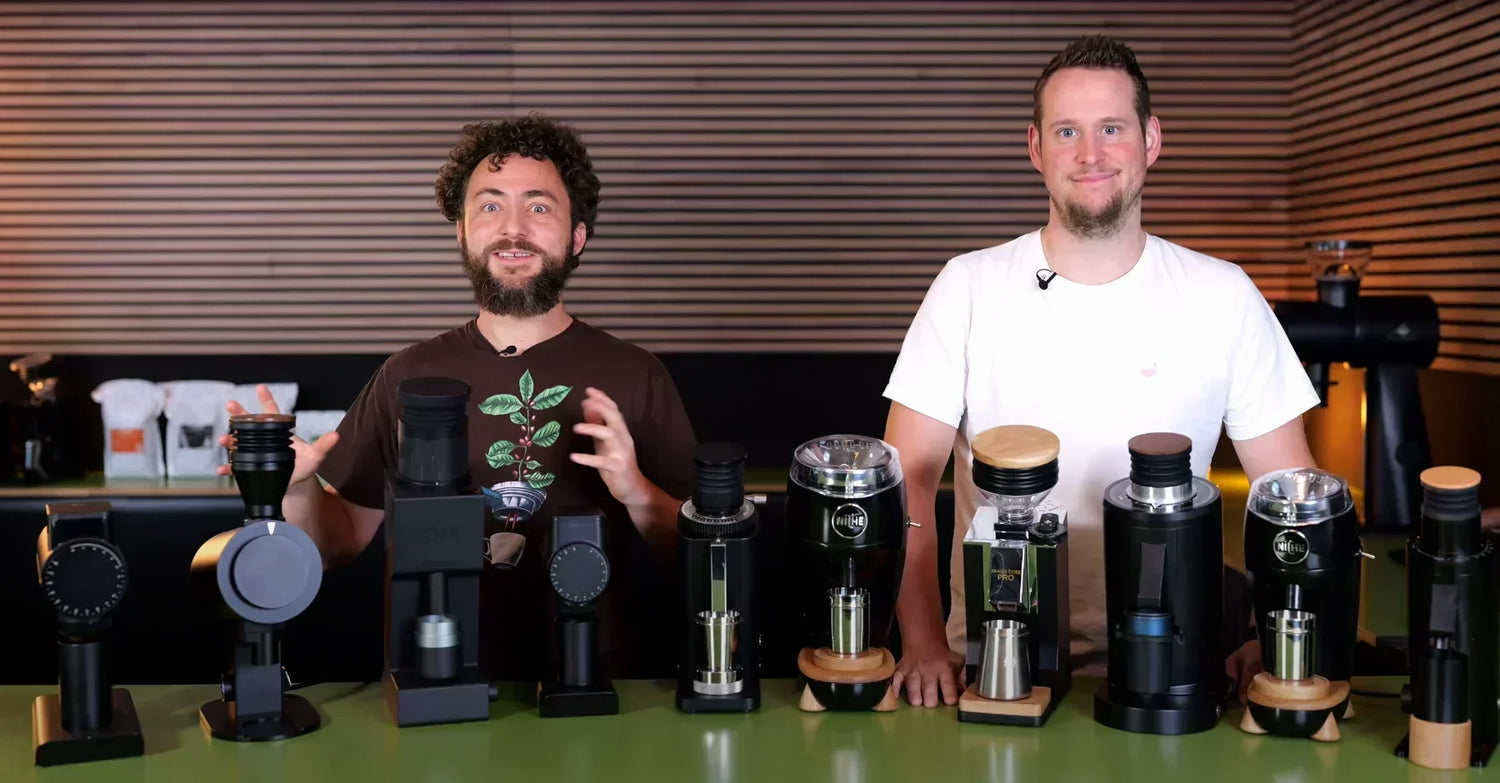

Over the years, we've delved deep into espresso grinders – and, quite frankly, we rarely see such a dense and high-quality test field: ten single-dosing (SD) grinders in the upscale home barista segment between €500 and €1000. Whoever shops in this category today is fundamentally making no mistake. That's why the criteria need to become a little finer: We no longer ask whether a grinder can make good espresso, but rather which espresso style it brings out best – and how smoothly the workflow runs in everyday use. We've tested this extensively in our Basel coffee academy and roastery.
In this report, we consolidate the results from several months of testing and show in detail what technically and sensorially sets these grinders apart.
More on the topic of single dosing as well as general pros and cons we've written about here.
Anyone who prefers the convenience of automatic dosing and doesn't constantly switch between bean varieties should also consider grinders with grind by weight. From €600, there are usable models with integrated scales.
The tested grinders in individual blog posts
| Grinder | Price (approx.) | Link to individual test |
|---|---|---|
| Timemore Sculptor 78S | approx. €900 | View individual test |
| Timemore Sculptor 64S | approx. €700 | View individual test |
| DF64V | approx. €500 | View individual test |
| DF83 | under €600 | View individual test |
| DF83V | approx. €840 | View individual test |
| Niche Zero | approx. €600 - 750 (import) | View individual test |
| Niche Duo | approx. €850 (import) | View individual test |
| Varia VS6 | approx. €760 - 770 | View individual test |
| Eureka Mignon Single Dose Pro | approx. €630 - 650 | View individual test |
| Profitec Twist SD54 | approx. €650 | View individual test |
The test field and the philosophy of single dosing
The test field ranges from the DF64V as the most affordable entry point (just over €500) to the Timemore Sculptor 78S, which at around €900 represents the most expensive grinder in this round.
The mechanical variety is impressive and shapes the specialization of each grinder. We see 54-mm flat burrs on the Profitec Twist SD54, the standard 64-mm burrs on the Eureka Single Dose Pro, the Timemore 64S and the DF64V. The DF83, the DF83 V and the Niche Duo come with powerful 83-mm burrs. The Niche Zero occupies a special position as it's the only grinder in this comparison that uses a conical burr set.
What they all have in common is the single-dosing principle: Only the required amount of coffee is weighed, placed in the hopper, and ground completely. The elementary advantage is that no coffee ages in the bean container and we can switch between different coffee varieties or grind sizes without much effort.
The central challenge: specialization rather than just basic quality
The high quality of the grinders leads to an expanded perspective. In the past, tests primarily focused on individual grinders, grind consistency and the absolute reduction of retention.
In comparing grinders, we additionally focus strongly on which sensory specialization the single-dosing grinders exhibit – does the grinder deliver clarity and complexity ("clarity extremist") or body and sweetness ("body emphasis")? Or do grinders manage to bring out all facets of a coffee?
At the same time, workflow becomes a decisive quality characteristic. We found: The best grind quality is useless if the blower misaligns the grind setting, the dosing cup destroys the grounds in the portafilter, or cleaning becomes so complicated that the home barista avoids it.
Our entire analysis aims to tease out these nuances and show that in the €500–€1000 segment, you're paying for smooth everyday operation and a specific sensory orientation.
Acoustics and speed: The time factor
Speed is certainly not the most important criterion when single dosing at home. Yet it correlates directly with noise level and the thermal behavior of the grinder.
The extremists: tempo and noise
The test field shows drastic differences in performance. The leaders in terms of speed are the two 83-mm grinders: The DF83 is extremely fast at 35.6 grams in 10 seconds and requires only 5.1 seconds for 18 grams. The DF83 V tops this and achieves an impressive 66 grams in 10 seconds, grinding 18 grams in just 6.5 seconds.
However, this speed comes at an acoustic price: The DF83 V is the loudest grinder in the comparison at 91.6 dB. We like to call it internally the "little bazooka". At least: thanks to the extremely short grinding time, you barely have to endure the high noise level for long.
At the other end of the spectrum we find the quietest grinders: The Niche Zero is whisper-quiet at only 72.9 dB. The Timemore grinders (74.9 dB and 76.7 dB) as well as the Varia VS6 (75.7 dB) also operate in a very pleasant range below 80 dB.
However, these grinders achieve their low noise level through significantly slower speed. The Niche Duo (10.8 g/10s), the Varia VS6 (11.5 g/10s) and the Timemore 64S (12.4 g/10s) are among the slowest in the round and all require around 20 seconds for 18 grams of grounds.
The relationship between speed, temperature and grounds
One detail we determined in our measurements is the ground temperature after multiple shots. The DF83 V heats up the strongest on average. While this is uncritical for flavor, it's still noticeable. The Profitec Twist SD54, on the other hand, provides a surprise: it achieves the lowest ground temperature and thus demonstrates excellent thermal management.
The slower speed of the Niche and Timemore models is by no means a flaw, but rather an intentional characteristic directly related to particle distribution. A slower burr speed (RPM) can lead to a narrower main peak in the grounds, which in turn has a positive effect on the sensory clarity of the espresso.
Here we see a direct correlation between lower mechanical power and higher sensory precision. However, we can note one thing: the heating of all grinders is completely uncritical and very minimal. No impact on flavor is to be expected.
Core technical performance in comparison
| Grinder | Noise level (dB) | Speed / 10 sec. (g) | Time / 18g (s) | Temperature (grounds, °C) |
|---|---|---|---|---|
| Timemore 78s | 74.9 | 21.6 | 14 | 30.8 |
| DF 83 V | 91.6 | 66 | 6.5 | 34.58 |
| Varia VS6 | 75.7 | 11.5 | 20 | 28.6 |
| Timemore 64s | 76.7 | 12.4 | 20.5 | 31.3 |
| Profitec Twist SD54 | 84.3 | 14.7 | 15 | 25.44 |
| Niche Duo | 77.6 | 10.8 | 18 | 30.6 |
| Eureka SD Pro | 81.1 | 28 | 11 | 32.38 |
| DF 83 | 85.2 | 35.6 | 5.1 | 29.1 |
| Niche Zero | 72.9 | 11.9 | 13.5 | 30.4 |
| DF 64V | 81.6 | 19.2 | 12.5 | 32.4 |
The key: Retention and single dosing performance
Arguably the most important technical criterion for a single dosing grinder is the retention – that is, the amount of coffee powder that remains in the grinder instead of landing in the portafilter. Why so important? Anyone who chooses a single dosing grinder expects that the coffee put into the grinder is ground and dispensed 100%.
We distinguish clearly between permanent and temporary retention.
Retention: distinguishing between permanent and temporary
Permanent retention is that coffee which settles in hard-to-reach areas (for example, on screws, in gaps of the burr chamber) and doesn't exchange from grinding to grinding. This coffee ages, becomes rancid, and can affect the flavor of future shots if the grinder isn't regularly completely disassembled and cleaned.
The Single Dosing Performance (SDP), which we refer to as temporary retention, is the daily relevant metric. It indicates how much coffee from the last grind makes it into the cup on the current shot. Our target is values under 0.2 grams.
The champions of zero-retention
In the SDP category, the Timemore Sculptor models deliver the best results in the entire test field. The 78S and 64S both achieve a temporary retention of only 0.1 grams. This value is achieved through the vertical arrangement of the burrs, a direct grinding path, and a clever ejection mechanism that eliminates the need for a separate blower.
The Niche Zero (0.2 g) and the DF64V (0.3 g) are also excellent. The Niche Zero achieves this in a particularly uncomplicated way: Simply closing the lid is often enough to maintain retention at this low level.
Things become particularly critical with the bottom performers. The Eureka SD Pro sits at 0.7 grams of temporary retention at the upper end of the field. While this is better than many conventional grinders, it's not optimal for a dedicated single-doser.
A clear outlier is the Varia VS6. Although its single dosing performance of 0.35 grams is still very good, its permanent retention of 2.0 grams weighs heavily. The absolute retention is 2.3 grams.
But be warned: We didn't use the blower on the Varia VS6, thus essentially penalizing it. However, there's a reason for this: operating the blower regularly misaligns the grind setting on this grinder. Nevertheless, it remains true that the construction of the Varia burr chamber promotes the accumulation of old coffee and demands the most regular and thorough cleaning of all grinders in the comparison.
Retention as a symptom: static as a catalyst
We've found that one of the main causes of increased retention is electrostatic charging of the grounds. High static causes fine particles and coffee dust to stick to the interior walls of the chute and not move.
The DF64V tends toward massive static buildup without targeted measures and is barely usable without water spray (Ross Droplet Technique, RDT) on many coffees. Only through consistent work with blower and RDT does it achieve its good SDP value of 0.3 grams.
In contrast, grinders like the Timemore models or the Eureka SD Pro naturally exhibit lower static charge. This significantly contributes to their frictionless workflow and low retention, as less powder sticks to the walls.
Retention and single dosing performance (retention in grams)
| Grinder | Temp. Retention (g) | Perm. Retention (g) | Abs. Retention (g) | SD Performance (g) |
|---|---|---|---|---|
| Timemore 78s | 0.1 | 0.2 | 0.3 | 0.1 |
| DF 83 V | 0.4 | 0.4 | 0.8 | 0.4 |
| Varia VS6 | 0.35 | 2.0 | 2.3 | 0.35 |
| Timemore 64s | 0.1 | 0.2 | 0.3 | 0.1 |
| Profitec Twist SD54 | 0.6 | 0.2 | 0.8 | 0.6 |
| Niche Duo | 0.6 | 0.8 | 1.4 | 0.6 |
| Eureka SD Pro | 0.7 | 0.1 | 0.8 | 0.7 |
| DF 83 | 0.4 | 0.4 | 0.8 | 0.4 |
| Niche Zero | 0.2 | 0.7 | 0.9 | 0.2 |
| DF 64V | 0.3 | 0.5 | 0.8 | 0.3 |
The heart of flavor: particle distribution and extraction behavior
Particle size distribution (PSD) is the foundation for flavor in the cup. We examine two main factors: the width of the main peak (a measure of ground uniformity) and the fines content Qf (the proportion of particles under 100 micrometers, important for body and puck stability).
A narrow main peak stands for more uniform extraction and clarity. A higher fines content provides body, but too much particle dust can quickly turn to bitterness.
Analytical foundation: peak width and fines content
The grinders in this segment clearly fall into two extremes and a large middle field of all-rounders.
The extremes: clarity versus body
Clarity extremists: Timemore Sculptor 78S and 64S
The Timemore Sculptor models are extremists in their particle distribution. They deliver the narrowest main peaks we've ever measured in this segment (64S: 145 µm; 78S: 154 µm). This profile sensorially produces maximum clarity and complexity, with precise definition of sweetness and acidity. For light and complex roasts, these grinders are fantastic.
The downside of this extremely narrow distribution lies in the extraction behavior: the puck is fragile, and extremely fine grinding is needed to build any resistance to the pump. This often leads to a long pressure buildup followed by a sudden, fast extraction runthrough (stall-and-shoot phenomenon). These grinders are therefore more "nerd devices" for advanced home baristas who master precise puck preparation (WDT) and ideally possess an espresso machine with pressure or flow profiling.


Body extremist: Niche Zero
The Niche Zero forms the clear contrast. As the only grinder with a conical burr set in the test field, it shows the broadest main peak (270 µm) and the lowest fines content (19.8%).
Sensorially, this means a profile emphasizing sweetness, body, and balance. The shots are smooth, creamy, and forgiving. It delivers the "classic" espresso, strongly tending toward chocolate, nut, and marzipan. The coarser x50 combined with low fines creates a stable puck that's uncomplicated to extract, even if you're not yet at the highest level of puck preparation.
The broad middle field of all-rounders
Bold & punchy: DF83 V and Profitec Twist SD54
Both grinders show one of the highest fines contents in the test (approx. 34–35%). This results in a denser texture and stronger body ("punch"). For the Profitec Twist SD54, this is particularly remarkable since despite its smaller 54-mm burrs, it delivers a surprisingly dense particle profile. Anyone seeking a robust, dark-oriented espresso finds the right profile here. However, the high fines content requires clean puck preparation since the risk of astringency or channeling increases.
Clarity-oriented all-rounders: DF64 V and Varia VS6
These models offer a relatively tight peak (VS6: 183 µm; DF64 V: 196 µm), giving them more clarity compared to the broad middle field. The DF64 V offers the most affordable entry into this "clarity" spectrum. The Varia VS6 combines a tight peak with RPM adjustment, making it an exciting all-rounder for structured espressos.
Well-balanced middle: DF83, Niche Duo, Eureka SD Pro
These grinders sit in the middle field regarding fines and peak width. They're solid all-rounders that deliver good results across all roast levels without drama and are easy to dial in. The Eureka SD Pro tends toward a somewhat coarser grind (x50 298 µm) with rounder, less "snappy" results in the cup.

The RPM lever: actively controlling flavor profiles
An essential feature present on several grinders in this segment (DF83 V, DF64 V, Varia VS6, Timemore 78S/64S) is variable speed (RPM). This is the strongest lever the home barista has to control the flavor profile.
Changing the speed has a causal effect on particle distribution: lower RPM reduces turbulence in the burr chamber, making the main peak narrower. This enhances clarity and is ideal for light roasts or filter coffee preparation.
Higher RPM does the opposite: it tends to widen the peak and can add more body and sweetness. The ability to vary these parameters allows the home barista to temporarily shift the grinder's specialization and get the best out of different coffees.
Particle distribution and flavor profiles (T4 espresso)
| Grinder | Main peak width (µm) | Fines content Qf (<100µm) | x50 (µm) | Sensory profile |
|---|---|---|---|---|
| Timemore 64s | 145 (Narrowest) | 31.0% | 205 | Extreme clarity, complexity, focus on fruit. |
| Timemore 78s | 154 | 29.7% | 221 | Extreme clarity, complexity, focus on fruit. |
| Niche Zero | 270 (Broadest) | 19.8% (Lowest) | 343 | Silky, creamy, body. |
| DF 83 V | 232 | 34.4% (Highest) | 251 | High body and punch, tends toward astringency. |
| Profitec Twist SD54 | 206 | 34.5% (Highest) | 285 | Dense, sensual, can tend toward bitterness. |
| DF 64V | 196 | 27.0% | 255 | Good clarity, well-balanced all-around readability. |
| Varia VS6 | 183 (Very tight) | 32.0% | 243 | Lively, structured, pulls well. |
| Niche Duo | 255 | 26.4% | 271 | Solid balance, easy to dial in. |
| DF 83 | 204 | 28.4% | 249 | Solid balance, crowd-pleaser. |
| Eureka SD Pro | 201 | 30.2% | 298 | Round, medium, less "sparkly" at the top. |
Tactile quality, workflow, and usability in everyday use
Beyond the pure grinding results, the feel of the grind adjustment wheel, the quality of accessories, and the overall workflow determine whether a grinder truly brings joy in daily use.
The grind adjustment feel and its pitfalls
Here we see serious construction weaknesses that can even overshadow the best grinding quality. We rate the grind adjustment feel of the Varia VS6 as red (poor). The adjustment is too loose and shifts when you use the blower or tap on the grinder. This is a "worst-case scenario for a single-dosing grinder" since your carefully dialed-in setting keeps getting lost.
Grinders like the Niche Zero and Niche Duo, on the other hand, receive an excellent rating (dark green). Their large adjustment range means small turning steps on the wheel have only minimal effect on extraction time, making "dialing in" very pleasant and forgiving.
The biggest workflow killer: criticism of the dosing cups
An inconspicuous accessory can completely ruin a perfect workflow. With the Timemore Sculptor models, the included dosing cup is such a "workflow killer".
The problem: The cup has a thick rim. When we pour the ground coffee directly into the portafilter, this thick rim leaves an uneven, ring-shaped crater at the edge of the coffee puck. This unevenness promotes massive channeling, even after WDT (coffee bed distribution) has been applied. This means the home barista must replace the cup or awkwardly transfer the coffee, contradicting the otherwise perfect single-dosing workflow of the grinder.
Other grinders, like the DF83, the Eureka SD Pro, and the Niche Duo/Zero, provide better cups that sit cleanly on the portafilter and allow homogeneous ground distribution.
Maintenance and cleaning: a hidden consistency factor
Cleaning procedures are an often-underestimated factor. They impact not only daily routine but also long-term sensory quality, since permanent retention must be removed.
Cleaning and grind setting retention
A major advantage during cleaning is when the dialed-in setting remains preserved. Only the Timemore Sculptor models manage to maintain the grind setting after disassembly, eliminating tedious recalibration. For the Eureka SD Pro, this is theoretically possible but requires loosening and re-tightening set screws that press on a plastic part, which may be damaged with frequent tightening.
The Profitec Twist SD54 receives the worst rating in this category. Disassembly is relatively complicated, requires much screwwork, and parts like the grind indicator wheel are loose, making recalibration a tedious process.
The DF models and the Niche Zero/Duo are easier to open (by turning the grind adjustment ring), but the grind setting is lost and must be re-dialed afterward.
The maintenance program for dark roasts
Looking at permanent retention, particularly the Varia VS6 (2.0 grams), shows that regular maintenance is essential. Permanent retention builds up, especially with oily, dark roasts.
We therefore recommend completely opening and dry cleaning all grinders prone to such buildup at least once monthly. Those hesitant about this effort should either choose grinders with minimal permanent retention (Eureka SD Pro, Profitec Twist, Timemore models, all 0.1 g to 0.2 g) or use only light roasts.

Conclusion and our recommendations
Our conclusion upfront: All grinders in this comparison are first-class devices that bring joy. An upgrade through different burrs usually only makes sense if you deliberately want to pursue a different sensory extreme or solve a specific workflow shortcoming.
The best value for money and entry to clarity: DF64V
The DF64V offers excellent performance for its price of just over €500. It delivers very good single dosing performance (0.3 g) and a clarity-oriented grinding peak (196 µm). It's a fantastic prosumer entry point with RPM control, but requires consistent use of RDT (water spray) to manage static.
The classic for beginners and body lovers: Niche Zero
The Niche Zero is the quietest grinder in the test (72.9 dB) and thanks to its conical burr set, delivers a forgiving, sweet and body-rich profile with the lowest fines content. Its workflow is uncomplicated, and the reproducibility of the grind setting is excellent (dark green).
For perfectionists and clarity nerds: Timemore Sculptor 78S/64S
Anyone seeking the absolute maximum in sensory clarity and complexity won't get around the Timemore models. They offer the narrowest grinding peaks (down to 145 µm) and the best single dosing performance (0.1 g). These are uncompromising tools for home baristas willing to invest in advanced puck preparation (WDT) and flow profiles.
The 78S offers higher speed; the 64S delivers the same grinding output at a lower price. However, the dosing cup must be replaced immediately. Additionally, the grinder demands rather advanced abilities in ground distribution and very uniform coffee preparation – otherwise, due to the special particle distribution, channeling threatens and the coffee will be far below the grinder's potential.
The power user and aspiring gastro: DF83
The DF83 (non-V) is the fastest grinder (5.1 seconds/18 g) and delivers a balanced, punch-oriented profile. Anyone who grinds larger quantities of coffee daily or seeks a grinder for use in a small office or gastro environment will find a machine with enormous throughput reserves here.
The all-rounder with a catch: Varia VS6
The Varia VS6 impresses with low noise level, RPM adjustment, and a clear grinding profile (183 µm peak). However, its central weakness – the grind adjustment wheel shifting when using the blower (red) – and critically high permanent retention (2.0 g) require a conscious decision against using the blower, holding the adjustment wheel firmly, and rewarding yourself with very regular, thorough cleaning.
We believe that today's home barista in the €500–€1000 segment is paying not just for grinding quality but especially for a frictionless, well-thought-out workflow. Poor tactile feel (VS6) or inadequate accessories (Timemore) can overshadow the best mechanics in everyday use. It's worth choosing the grinder whose compromises best match your usage profile.