




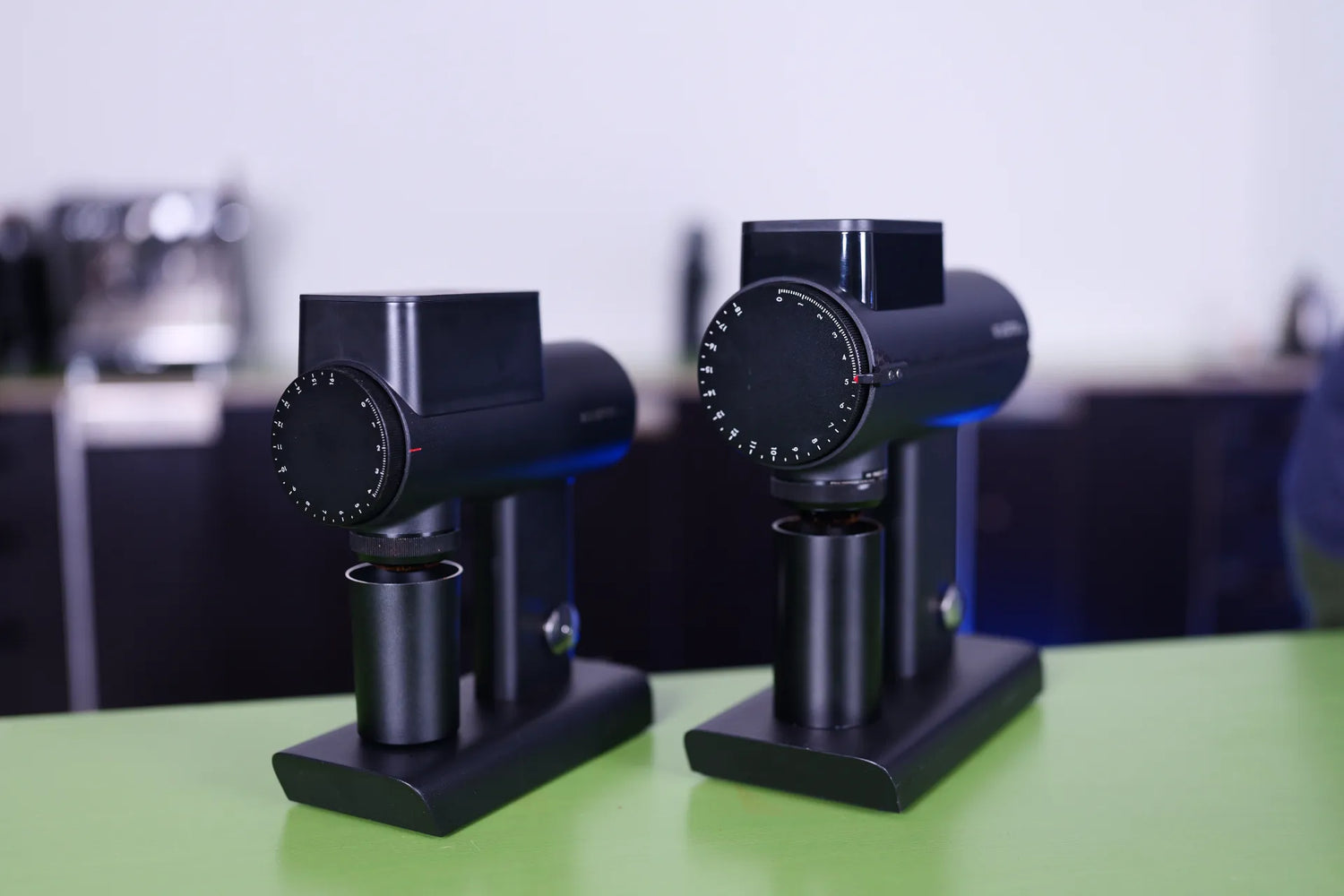

The two espresso grinders Sculptor 78s and Sculptor 64s from Timemore make a very good impression in our test. In the video, we discuss both grinders in detail and present their respective strengths and weaknesses. Both Timemore Sculptor grinders are designed for single dosing.
Quick summary upfront: Both deliver extremely reproducibly, with a very narrow main peak in the particle distribution – that's rare, especially in this price range.
We compared 10 single dosing grinders in the price range of 500 to 1000 euros. More on that in our article on the topic.
Specialty Retailer Timemore Sculptor
We search for specialty partners on your behalf – partners we know provide good work and good service. We maintain close contact with the retailers. These are commission links. If you order via this link, it won't cost you any more, but we'll receive a small commission that we reinvest in new test equipment. For the Timemore Sculptor, we'd recommend Die Röster.
Design & Build Quality
Although the 78S and 64S look very similar visually, there are significant differences beneath the surface. The 78S is a true powerhouse, weighing 7.9 kilograms – almost double the 64S (3.8 kilograms). This discrepancy runs through all components, from the motor to the burrs to the lid. We find the massive base housing on both grinders to be of very high quality, as is the oversized start button.
The difference in construction is most apparent in motor power and acoustics. The 78S features a 400 watt motor and 78-millimeter burrs, while the 64S is equipped with a 150 watt motor and 64-millimeter burrs. While both grinders are comparably quiet (78S: 74.9 dB; 64S: 76.7 dB), the sound quality is strikingly different. The 78S sounds full, pulls the grinding process through in one go, and acoustically reminds you of an "electric car". The 64S, on the other hand, sounds more like a "children's lawn mower" or a "2001 Renault Clio". With dense, light roasts, the 64S noticeably reaches its limits, while the 78S works effortlessly.
In fact, the motorization directly correlates with grinding speed. The 78S grinds an impressive 21.6 grams in 10 seconds, which is considered fast in the home barista range. The 64S is significantly slower at only 12.4 grams in 10 seconds. The 78S is thus the more uncompromising choice for baristas who grind extremely dense coffees and expect high torque.
Unfortunately, the discrepancy in materiality shows in the peripheral equipment, particularly in the dosing cup of the 64S. Although the grinding quality of the 64S is very good sensorially – a "toy that works well" – the build quality of the cup is weak. We criticize the shiny, sharp edge at the top here, as it's a poorly cut metal tube that isn't even straight. This is a clear sign of where cuts were made to maintain the lower price. Both cups do feature a useful magnetic function, which works very "smoothly" on the heavier 78S.
Operation & Everyday Practicality
Single dosing, as it should be: 18 g in, 18 g out – through all extractions. In our tests, there was virtually no variation; one of the lowest retention measurements we've ever taken!
Occasionally, with RDT a bean might stick on the bean chute. If you press start-stop again, these beans come loose too. The temperature increase under continuous extraction is minimal.
Speed and noise level (with Apas) from our measurement protocol:
- 78S: 21.6 g/10 s, ~14 s for 18 g, 74.9 dB
- 64S: 12.4 g/10 s, ~20.5 s for 18 g, 76.7 dB.
Prices at time of testing: approx. 899 € (78S) and 699 € (64S).
The Dosing Cup: A Workflow Killer
The biggest shortcoming in the entire daily workflow is the included dosing cup, which in our opinion is "not extraction-promoting". When the cup is placed directly in the portafilter, the thick rim of the cup leaves a ring-shaped "Zermatt-like landscape" on the coffee puck when removed.
This uneven distribution at the edges promotes massive channeling, even if we used a precise WDT tool before tamping. We therefore had to change our workflow and strongly recommend that users not use the cup directly. You must either transfer the coffee to a second cup and sift it, or use a higher-quality dosing vessel to ensure homogeneous distribution in the portafilter. This avoidable detail undermines the otherwise perfect single-dosing workflow of the grinder and can increase overall costs through the need to purchase a replacement dosing cup.
Single-Dosing Perfection
The Sculptor models set new standards for single-dosing performance. The exchangeable retention is only 0.1 grams. This is by far the best value in our single-dosing comparison. We were able to consistently convert 18 grams of beans into 18 grams of ground coffee.
This success is due to the vertical burr arrangement and the straight, direct grinding path. Additionally, the grinders feature a "totally clever mechanism" on the discharge. By turning this wheel, residue and chaff are removed, which effectively empties the chamber and makes a separate air blower unnecessary to achieve zero retention. Another factor enabling this low retention is the measured low static charge of the ground coffee. Low static prevents fine particles and coffee dust from adhering to the inner walls. The low temporary retention is therefore the result of an interplay between mechanically optimal grinding path and minimized electrostatic adhesion.
Particle Distribution Measurement and Comparison
The Sculptor grinders are extremists when it comes to particle distribution. They deliver a grind profile that is unique across our entire test field. The width of the main peak is extremely narrow: the 64S achieves 144 micrometers, the 78S 155 micrometers. These are among the lowest values we've ever measured in a grinder test. You could call the main peak a "tower" – a very precise accumulation of particles of the same size.
The Fines Paradox
Such a narrow main peak is closely related to fines content. Although the homogeneity of the main particles is very high, the fines content below 100 micrometers is around 30 percent.
Normally, a high fines content would lead to muddiness or grittiness. Here, however, the fines fulfill a different function: they create the necessary resistance (puck resistance) against pump pressure, since the extremely homogeneous main peak alone could not achieve this. The high clarity we observed sensorially comes from the fact that the particles in the main peak are nearly perfectly extracted, while the fines seal the pores of the coffee puck.
Sensorially, this results in a "very sexy mix" of clarity, complexity, and brilliant texture, since the fines can also contribute to body. The particle distribution of the 64S is even slightly narrower (144 µm), which may explain the higher differentiation in espresso we observed in testing.
However, this profile forces the barista to grind very fine, making extraction behavior unpredictable: we often experience a very long pressure buildup (12 to 14 seconds), followed by rapid gushing. Using these grinders therefore requires precise puck preparation (WDT) and is best supported by advanced machine technology such as pressure or flow profiling.
- 78S: more differentiation and "juiciness", somewhat less body.
- 64S: slightly fuller body, simpler in finish.
In summary: very good espressos that make complexity visible and tasteable. The particle distribution of both grinders is outstanding, but also demanding. To brew with this narrow main peak, you must grind very fine. This also means that puck preparation of the ground coffee must be perfect.
We recommend the grinder to demanding and advanced home baristas, ideally those who can run pressure or flow profiles on their espresso machine. 
Revolutions Per Minute (RPM)
Both grinders have the ability to adjust the speed of the burrs. This function is specified in RPM, English for revolutions per minute. We seized the opportunity and performed some tests with different RPMs. We checked extraction, particle distribution, and taste.

The values in the particle distribution measurement don't differ significantly. At higher RPM of 1400 on the Timemore Sculptor 78s, we measured a slightly narrower main peak (10 microns) and slightly more fines (1.4%). Sensorially this fit the picture, as the extractions tasted clearer and rounder at higher RPM.
We made the sensory assessment of the grinders for espresso at the fastest RPM. Filter coffees tasted better to us at lower RPM. We'll publish another test report on this as a video.

Comparison in the 500–1000 € Range
The Timemore Sculptor S models position themselves as "clarity extremists" in the single-dosing segment between 500 and 1000 euros. They offer a direct contrast to other dominant grinders on the market. The most obvious contrast is the Niche Zero, which with its conical burrs is designed for a broader main peak, few fines, and an emphasis on sweetness and body. The Sculptor pursues the opposite goal: maximum clarity and complexity.
| Criterion | Timemore Sculptor S | Niche Zero (Conical) | DF Series (Flat, 64/83mm) |
|---|---|---|---|
| Burr Profile | Extremely narrow peak (144-155 µm) | Broad peak (approx. 255 µm) [1] | Medium to narrow (depending on burr) |
| Taste | Clarity, complexity, juiciness [1] | Sweetness, body, balance [1] | Flexible, playable |
| Retention (Temporary) | Excellent (0.1 g) [1] | Very good (0.2 g) [1] | Good (0.3 g+) [1] |
| Noise Level | Quiet (~75 dB) [Image 1] | Very quiet (~72 dB) [1] | Medium to loud (DF83V > 90 dB) [1] |
Due to their tight grind profile, the Sculptor grinders require much finer grinding than, for example, the Niche Zero to achieve the necessary resistance in the first place. This demanding extraction behavior, which often results in a long stall, requires advanced handling of the espresso machine. The Sculptor models are therefore ideal for baristas willing to work with complex machines (pressure profiling, flow control) to unlock the full potential of the extremely homogeneous particles.
Conclusion Timemore Sculptor 78s and 64s
The Timemore Sculptor 78S and 64S are technically outstanding devices that impressively demonstrate how to use mechanical precision to minimize retention. They do "a lot right" when it comes to single dosing. The strengths of the Sculptor series are undeniable: they deliver class-leading retention (0.1 g temporary), excellent grind setting reproducibility, and an extremely narrow particle distribution that is unmatched and enables maximum clarity in the cup. The weaknesses lie in usability: the grind setting is somewhat fiddly on the 64s for precise fine-tuning, and the included dosing cup is a "workflow killer" that by its design promotes channeling at the edge of the coffee puck. We clearly classify the grinders as a nerd device for the advanced home barista. They're not for beginners looking for simple, forgiving operation.
- The Sculptor 78S: It's the uncompromising choice. The 400-watt motor delivers the speed and robustness needed for dense roasts. Anyone wanting maximum power, speed, and robust construction should go for the 78S.
- The Sculptor 64S: It's the surprise in the cup. For less money, it delivers almost the same (marginally more differentiated) cup quality as the 78S. You only have to accept the lower speed (12.4 g/10s) and weaker motor. If you're after maximum clarity in your grind and willing to replace the dosing cup and work with focus, the 64S offers the most affordable entry into this high-end segment.
The Timemore Sculptor series proves that it's possible to construct single-dosing grinders with virtually zero retention and thereby sets a new, high standard for future devices in the high-end segment.