



























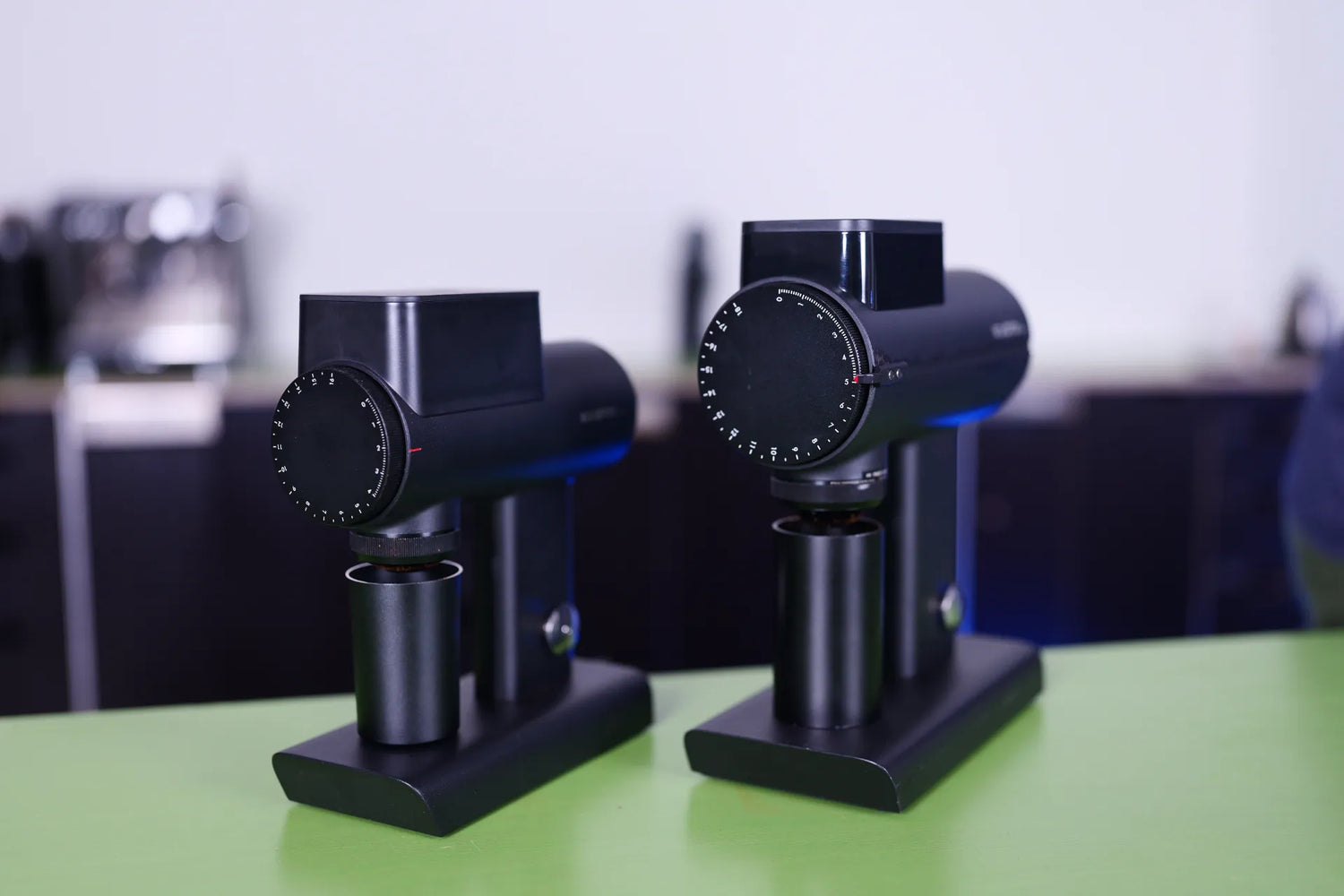

The two espresso grinders Sculptor 78s and Sculptor 64s from Timemore make a very good impression in the test. In the video, we discuss both grinders in detail and present their respective strengths and weaknesses. Both Timemore Sculptor grinders are designed as single dosing machines.
Summary upfront: Both deliver extremely reproducibly, with a very narrow main peak in the particle distribution – that's rare, especially in this price range.
We compared 10 single dosing grinders in the price range of 500 to 1000 euros. More about this in our article on the topic.
Design & Finish
Although the 78S and 64S appear visually very similar, there are significant differences beneath the surface. The 78S is a true powerhouse and weighs 7.9 kilograms, almost double that of the 64S (3.8 kilograms). This discrepancy runs through all components, from the motor to the burrs to the lid. The massive base housing feels very high-quality on both grinders, as does the generously sized start button.
The difference in construction is most evident in motor power and acoustics. The 78S features a 400 watt motor and 78-millimeter burrs, while the 64S is equipped with a 150 watt motor and 64-millimeter burrs. Both grinders are similarly quiet (78S: 74.9 dB; 64S: 76.7 dB), but the sound quality is markedly different. The 78S sounds full, pulls the grinding process through in one go and acoustically reminds one of an "electric car". The 64S, on the other hand, sounds more like a "children's lawn mower" or a "Renault Clio 2001 model year". With dense, light roasts, the 64S is noticeably taxed, while the 78S works effortlessly.
In fact, motorization directly correlates with grinding speed. The 78S grinds an impressive 21.6 grams in 10 seconds, which is considered fast in the home barista sphere. The 64S is significantly slower at only 12.4 grams in 10 seconds. The 78S is thus the more uncompromising choice for baristas who grind extremely dense coffees and expect high torque.
The discrepancy in materiality is unfortunately evident in peripheral components, particularly in the dosing cup of the 64S. Although the grinding performance of the 64S is sensorially very good – a "toy that works well" – the finish of the cup is weak. We criticize here the shiny, sharp edge at the top, since it is a carelessly cut metal tube that isn't even straight. This is an obvious sign of where cuts were made to maintain the lower price. Both cups do, however, feature a useful magnetic function, which works very "smooth" on the heavier 78S.
Operation & Everyday Usability
Single dosing, as it should be: 18 g in, 18 g out – across all pulls. In our tests, there was practically no scatter; one of the lowest retention measurements we've ever made!
Occasionally, with RDT, a bean can get stuck on the bean chute. If you press start-stop again, these beans will come loose as well. The temperature increase under continuous pulling is minimal.
Speed and Loudness (with Apas) from our measurement protocol:
- 78S: 21.6 g/10 s, ~14 s for 18 g, 74.9 dB
- 64S: 12.4 g/10 s, ~20.5 s for 18 g, 76.7 dB.
Prices at time of measurement: approx. 899 € (78S) or 699 € (64S).
The Dosing Cup: A Workflow Killer
The biggest flaw in the entire daily workflow is the included dosing cup, which in our opinion is "not conducive to extraction". When the cup is placed directly into the portafilter, the thick rim of the cup leaves a ring-shaped "Zermatt hill landscape" on the coffee puck when removed.
This uneven distribution at the edge promotes massive channeling, even if we used a precise WDT tool before tamping. We therefore had to change our workflow and strongly recommend that users not use the cup directly. You either have to transfer the coffee to a second cup and sieve it, or use a higher-quality receiver vessel to ensure homogeneous distribution in the portafilter. This avoidable detail undermines the otherwise perfect single-dosing workflow of the grinder and can increase overall costs through the need to purchase a replacement dosing cup.
The Single-Dosing Perfection
The Sculptor models set new standards for single-dosing performance. The exchangeable retention (temporary retention) is just 0.1 grams. This is by far the best value in our single-dosing comparison. We were able to consistently convert 18 grams of beans into 18 grams of grounds.
This success is due to the vertical burr arrangement and the straight, direct grinding path. Additionally, the grinders feature a "totally clever mechanism" at the discharge. By turning this wheel, residue and chaff are removed, which effectively empties the chamber and makes a separate air blower (blower) unnecessary to achieve zero retention. Another factor enabling this low retention is the detected low static charge of the grounds. Low static prevents fine particles and coffee dust from adhering to the inner walls. The low temporary retention is thus the result of an interplay between mechanically optimal grinding path and minimized electrostatic adhesion.
Particle Distribution Measurement and Comparison
The Sculptor grinders are extremists when it comes to particle distribution. They deliver a grinding profile that is unique across our entire test field. The width of the main peak is extremely narrow: the 64S achieves 144 micrometers, the 78S 155 micrometers. These are among the lowest values we've ever measured in a grinder test. You could call the main peak a "tower" – a very precise accumulation of particles of similar size.
The Paradox of Fines
Such a narrow main peak is closely related to the fines content. Although the homogeneity of the main particles is very high, the fines content below 100 micrometers is roughly 30 percent.
Normally, a high fines content would lead to muddiness or grittiness. Here, however, the fines content fulfills a different function: it creates the necessary resistance (puck resistance) against pump pressure, since the extremely homogeneous main peak alone could not provide this. The high clarity we detected sensorially comes from the fact that the main peak particles are nearly perfectly extracted, while the fines seal the pores of the coffee puck.
Sensorially, this results in a "very sexy blend" of clarity, complexity, and brilliant texture, since the fines can also contribute to body. The particle distribution of the 64S is even marginally narrower (144 µm), which may explain the higher differentiation in the espresso we found in testing.
However, this profile forces the barista to grind very finely, which makes extraction behavior unpredictable: We often experience a very long pressure build-up (12 to 14 seconds), followed by rapid blowthrough. Using these grinders therefore requires precise puck preparation (WDT) and is best supported by advanced machine technology such as pressure or flow profiles.
- 78S: more differentiation and "juiciness", slightly less body.
- 64S: slightly fuller body, simpler in the finish.
In sum: very good espressos that make complexity visible and palatable. The particle distribution of both grinders is outstanding, but also demanding. To brew with this narrow main peak, very fine grinding is required. This also means that the puck preparation of the grounds must be perfect.
We recommend the grinder to demanding and advanced home baristas, who ideally can run pressure or flow profiles with their espresso machine. 
Rotation per Minute (RPM)
Both grinders offer the ability to adjust the speed of the burrs. This function is specified in RPM, English for rotations per minute. We seized the opportunity and conducted some tests with different RPMs. We checked extraction, particle distribution, and taste.

The values in the particle distribution measurement do not differ significantly. At higher RPM of 1400 on the Timemore Sculptor 78s, we measured a slightly narrower main peak (10 microns) and somewhat more fines (1.4 %). Sensorially, this fit the picture, as the shots tasted clearer and rounder at higher RPM.
We made the sensorial assessment of the grinders for espresso at the fastest RPM. Filter coffees tasted better to us at lower RPM. We will publish another test report on this as a video.

Comparison in the 500–1000 € Field
The Timemore Sculptor S models position themselves as the "clarity extremists" in the single-dosing segment between 500 and 1000 euros. They offer a direct contrast to other dominant grinders on the market. The most obvious contrast is the Niche Zero, which with its conical burr is designed for a wider main peak, few fines, and emphasis on sweetness and body. The Sculptor pursues the opposite goal: maximum clarity and complexity.
| Criterion | Timemore Sculptor S | Niche Zero (Conical) | DF Series (Flat, 64/83mm) |
|---|---|---|---|
| Burr Profile | Extremely narrow peak (144-155 µm) | Wide peak (approx. 255 µm) [1] | Medium to narrow (depending on burr) |
| Taste | Clarity, complexity, juiciness [1] | Sweetness, body, balance [1] | Flexible, playable |
| Retention (Temporary) | Excellent (0.1 g) [1] | Very good (0.2 g) [1] | Good (0.3 g+) [1] |
| Loudness | Quiet (~75 dB) [Image 1] | Very quiet (~72 dB) [1] | Medium to loud (DF83V > 90 dB) [1] |
The Sculptor grinders demand much finer grinding than, for example, the Niche Zero due to their narrow grinding profile in order to achieve the required resistance at all. This demanding extraction behavior, which often leads to a long stall, requires advanced handling of the espresso machine. The Sculptor models are therefore ideal for baristas willing to work with complex machines (pressure profiling, flow control) to unlock the full potential of the extremely homogeneous particles.
Conclusion Timemore Sculptor 78s and 64s
The Timemore Sculptor 78S and 64S are technically outstanding devices that impressively demonstrate how to use mechanical precision to minimize retention. They do "a lot right and correctly" when it comes to single-dosing. The strengths of the Sculptor series are undeniable: they deliver class-leading retention (0.1 g temporary), excellent grind consistency reproducibility, and an extremely narrow particle distribution that is unmatched and enables maximum clarity in the cup. However, the weaknesses lie in usability: the grind setting is tactilely a bit fiddly on the 64s for precise fine-tuning, and the included dosing cup is a "workflow killer" that provokes channeling at the edge of the coffee puck through its design. We clearly classify the grinders as nerd gear for the advanced home barista. They are not for beginners looking for simple, forgiving operation.
- The Sculptor 78S: It is the uncompromising choice. The 400-watt motor provides the speed and robustness needed for dense roasts. If you want maximum power, speed, and robust construction, go with the 78S.
- The Sculptor 64S: It is the surprise in the cup. For less money, it delivers almost the same (minimally more differentiated) cup quality as the 78S. You only have to accept the lower speed (12.4 g/10s) and weaker motor. If you seek the absolute maximum clarity in grounds and are willing to replace the dosing cup and work with focus, you'll find the most affordable entry into this high-end segment in the 64S.
The Timemore Sculptor series proves that it is possible to design single-dosing grinders with virtually zero retention and thereby sets a new, high standard for future devices in the high-end segment.



