




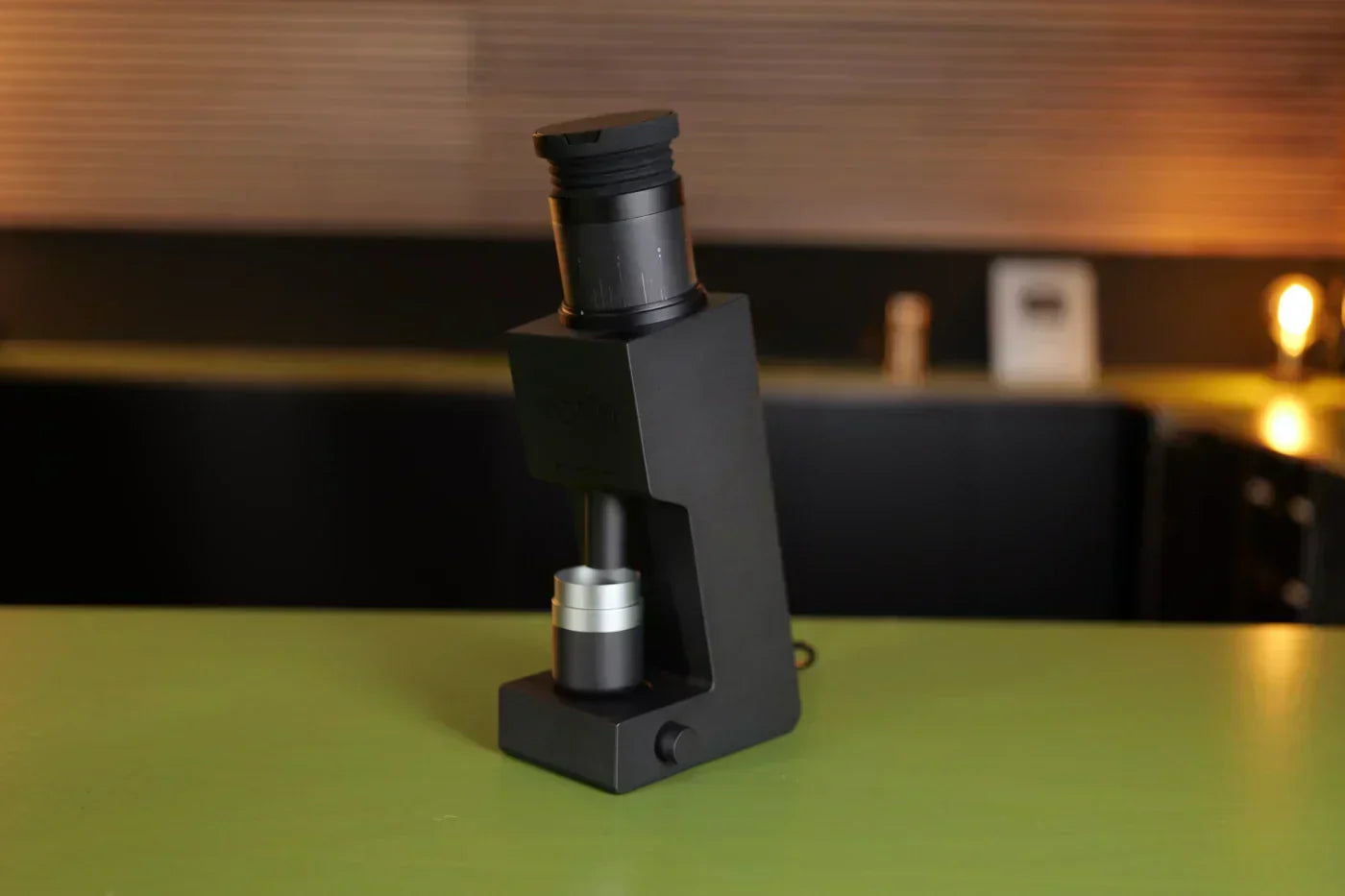

The Varia VS6 coffee grinder has arrived on the market as the "big sister" to the Varia VS3 and is aimed at discerning home baristas. The grinder market is currently experiencing a boom – new manufacturers are releasing smart single-dosing grinders, and Varia is following this trend with the VS6. In this blog post, we summarize the findings from a six-month test. With the help of university support, we analyzed particles, tested the grinder at home and in our coffee school, and are now ready to present our results.
We examine design and build quality, espresso and filter coffee performance, particle distribution, speed, noise level, retention, and cleaning. At the end, we provide a conclusion highlighting the strengths and weaknesses of this grinder and whether the VS6 is worth its premium price tag.
Many user reports on the Varia VS6 have already accumulated in the comments section. We're happy if you use the comments section to continue sharing your experiences and exchanging views.
Note: We purchased the Varia VS6 and report freely and independently on our experience with the grinder.
We compared 10 single-dosing grinders in the price range of 500 to 1000 euros. Read more in our article on the topic.
Design, Quality, and Specifications
The Varia VS6 presents itself in a minimalist, modern design. Manufactured from a solid aluminum block, it radiates high quality. The housing is robust, durable, and thanks to precise workmanship, feels very premium. The shape is functional: The grinder stands at an angle of 76.5°, which not only looks sleek and elegant but is also intended to minimize retention. How well this succeeds is discussed further below…
With dimensions of approximately 13 × 19 × 40 cm (W×D×H) and a weight of just over 10 kg, the VS6 is a substantial device – significantly larger and heavier than the entry-level VS3. Varia clearly positions the VS6 in the professional league: Priced at around 850–900 €, it costs almost three times as much as the smaller VS3.
The grinder follows the single-dosing principle, where only the pre-weighed portion of coffee beans is freshly ground each time (instead of storing beans in a hopper). Varia recognized this trend and implemented it consistently. There is no large bean container – you simply fill your desired dose into the short chute at the top. A premium metal dosing cup is included to catch the ground coffee, held magnetically at the bottom directly under the outlet for convenient positioning. This cup matches the grinder's aesthetic and fits perfectly into a 58mm portafilter basket, making transfer clean and straightforward. The grind adjustment is stepless at the top of the grinder. The scale is fine enough and smooth-running, allowing for very precise adjustment. Overall, the design conveys a thoughtful, minimalist impression – a high-quality construction that unites form and function.

Espresso and Particle Distribution
For espresso, grind quality plays a crucial role. The VS6 impressed in testing with very uniform particle distribution. We examined the particles in collaboration with the Zurich University of Applied Sciences: The ground coffee shows a narrow main peak (concentrated particle sizes) and a certain proportion of very fine particles. A tight particle distribution means the coffee powder is relatively homogeneous – an important factor for even extraction. Indeed, the espresso from the VS6 tasted accordingly clear and structured, with pronounced sweetness and soft texture. Even with longer pull times, the espresso showed no disturbing "dustiness" or bitterness, which is attributable to the good grind composition. We were amazed at how full-bodied and clean the espresso turned out with the VS6's 58mm flat burrs – especially with such a narrow main peak. Our Apas Espresso extractions tasted "very sweet" with a silky texture and clear flavor profile.
A special feature of the VS6 is variable speed control. A rotary knob allows you to adjust the grinding speed between 500 and 1600 RPM. Testing showed that this setting has noticeable effects on particle distribution and taste. Slow speed (e.g., 500 RPM) resulted in a narrower main peak in the particle curve – the ground coffee is even more homogeneous, with a "clearer" taste in the cup. Increasing the speed toward maximum (1600 RPM) widened the particle peak somewhat; espresso then tended to show more body, but sometimes also less consistent extraction. We recommend experimenting with the RPM setting: With "frayed" flavor profiles or slight channeling, lower speed can help stabilize and focus the extraction. This "play with speed" is an exciting feature of the VS6, enabling different flavor profiles without changing the grind setting.
In terms of consistency and reproducibility, the VS6 does an excellent job. In testing, the grinder was deliberately adjusted – from an espresso grind to coarser for, say, lungo or filter, and then back to the original espresso point. It turned out that you can precisely reset to your previously found grind: Both the median particle size and the main peak were nearly identical to the original values after resetting. This stability is reflected in the cup as well – once determined recipes can be reliably reproduced. Overall, we rate the VS6's espresso potential as very high, in the very good to outstanding range. The grinder consistently delivers full, well-balanced espressos with pronounced flavor profiles and can compete with top models on the market in this discipline.

Filter Coffee
Single-dosing grinders are often developed primarily for espresso – so it was all the more interesting to see how the VS6 performs with filter coffee. The answer in advance: surprisingly well. In our intensive testing, the VS6 proved capable of grinding coarse easily and is therefore also suitable for pour-over filters, French press & co. We were able to set an appropriate filter grind without difficulty and obtained a clear, sweet filter coffee with soft character. The filter coffees were also "round and sweet" with very clean cups, which is due to the even grinding and narrow main peak.
We brewed various filter coffees in testing. For comparability with other grinders, we standardly use our Amigo filter coffee, which, like the Apas espresso, is very consistent and accessible. The sweetness and clarity of the coffee especially pleasantly surprised us.
A major advantage is the sensitive grind adjustment of the VS6, which allows quick switching between brewing methods. You can, for example, make espresso in the morning and filter coffee in the afternoon without worrying about finding the exact espresso grind later. The scaling is so precise and repeatable that you hit exactly the same point again after resetting – this type of grind repeatability is hard to find in many other grinders. In testing, for instance, after brewing a filter coffee, the previously noted espresso point could be reset, and the next shot ran exactly as before. This makes the VS6 excellent as an all-purpose grinder for households or small cafés where you frequently switch between different brewing methods.
Speed, Noise, Retention
The VS6 prioritizes thoroughness over speed. In testing at medium speed (~1000 RPM), approximately 11.5 g of coffee were ground in 10 seconds. For a typical espresso dose of 18 g, it takes around 20 seconds until all beans are fully processed. This is noticeably slower than some other electric grinders – the VS6 belongs to the more leisurely models. For its typical use case (single dosing, meaning individual shots in sequence rather than continuous bar use), this is rarely a problem. When preparing at home, a difference of 5–10 seconds per grind barely matters and hardly weighs negatively in a careful workflow. If you're in a hurry, you can also increase the speed – at 1600 RPM the grinding time would be shorter (though with the mentioned effects on the grind).
Retention
Retention: A critical point with single-dosing grinders is retention – coffee powder that remains inside the grinder after grinding. Here the VS6 shows both light and shadow. Technically, the grinder is designed to have minimal retention: The discharge chute is short and angled, and a blow-back tube (rubber pump) is supplied to puff remaining particles out of the grinding chamber. With this, retention could theoretically be reduced to nearly zero – ideally only about 0.05 g of coffee powder remains in the grinder. In practice, however, a problem emerged in testing: Normal pressing of the blow-back tube slightly rotates the grind setting. That is, you unintentionally adjust the grind when trying to puff out the last bit of coffee powder. This seemingly small issue has a big impact, as it makes single dosing uncomfortable in practice – nobody wants to re-adjust the grind after each puff. Consequently, we did not use the blower and accepted the retention. This is frustrating, because here the grinder's concept doesn't quite work out.
Without using the blow-back tube, however, somewhat more coffee powder remains in the grinding chamber. In our long-term testing, approximately 2.3 g of retention was measured when not tapping or blowing extra after grinding. Of this, around 0.3–0.4 g could be dislodged by gently tapping the grinder – this is referred to as temporary retention. The remaining roughly 2 g, however, sits firmly in corners of the grinding chamber (permanent retention) and only comes loose with thorough grinder cleaning. This requires opening the grinder and removing the retention around the burrs.
Compared to other single-dosing grinders, this is relatively high retention – some competing models achieve <0.2 g without major tricks. Theoretically, the VS6 could also reach this level thanks to its efficient discharge and blower. But as things stand, this potential remains untapped. The Varia VS6 essentially ties its own hands here.
We'll see if Varia makes improvements in the future. Some form of grind-setting lock would be desirable. Until then, you must weigh your options: either accept minimal retention and clean regularly and thoroughly – or use the blower very carefully each time while grinding and keep watch on the grind setting. In daily use, this weakness somewhat diminishes the otherwise excellent impression of the VS6 as a true single-dosing grinder.

The Varia VS3 on the left and the Varia VS6 on the right.
Cleaning
With cleaning and maintenance, the Varia VS6 proves pleasantly user-friendly. The device is designed so that you can reach the grinding chamber with just a few steps: First, remove the magnetically held adjustment ring, then unscrew the upper burr element. Now the grinding chamber is open and you can easily brush it out with the included brush. This procedure is simple and takes only a few minutes – overall, cleaning is very easy to handle. In our long-term testing, thorough cleaning every 4–6 weeks proved beneficial (with daily use). We recommend this because the grinder's permanent retention is 2 grams.
To make cleaning easier, Varia has installed anti-static pins in the discharge chute. These ionization needles are meant to reduce the static charge of the coffee powder so fewer particles stick to walls and the outlet. In testing, it was indeed evident that little coffee powder stuck statically, especially compared to grinders without this technology.
Nevertheless, it's advisable – as is typical with single dosing – to very lightly dampen the beans before grinding (known as the RDT method, e.g., with a quick spray from a spray bottle). Especially if you don't use the blow-back tube, a touch of water helps minimize static charge and reduce clumping. That way, hardly anything sticks, and you need to completely disassemble the grinding chamber less often. Some users reported in forums minor challenges with thorough cleaning, particularly in getting all residue out of corners. In our testing, however, it showed: With the described procedure (regular brushing, occasional disassembly), the VS6 can be kept clean without much effort. The maintenance intervals are absolutely practical, and thanks to the well-thought-out design, there are no inaccessible spots – even the permanent retention of ~2 g can be completely removed if needed by removing the burrs and blowing/vacuuming out the grinder. Overall, there's hardly reason to complain about cleaning and maintenance.

Conclusion on the Varia VS6
The Varia VS6 proves to be a high-quality coffee grinder with many strengths in testing. The design and build quality are at a professional level – from the solid housing to the precise burrs, you feel the quality. In espresso performance, the VS6 fully impresses: It produces very homogeneous particle distribution, resulting in clear, sweet, and structured espressos. We were impressed by the consistency of results and the grinder's versatility. Both espresso and filter coffee succeed at a high flavor level – a rare combination that makes the VS6 an all-rounder for coffee enthusiasts. Particularly noteworthy is the excellent grind repeatability: You can switch between different settings and always return exactly to the starting point. This stability, combined with the ability to play with speed, opens room for experimentation with flavor profiles without switching beans or owning a second grinder.
But where there's light, there's shadow too. The main criticism of the VS6 concerns precisely the central single-dosing promise – namely retention-free operation. While the grinder, thanks to its design and blow-back tube, would theoretically be capable of virtually zero coffee powder retention, a design detail prevents this perfection in practice: The blow-back tube rotates the grind setting when used. To avoid jeopardizing the laboriously chosen setting, we prefer to skip the blower – thereby accepting that about 0.3 to 0.4 g of coffee remains in temporary retention. That's annoying!
For a grinder designed for single dosing, this is an frustrating shortcoming, as it undermines the advantage of always having freshly ground coffee in your cup. While Varia pioneered variable speed and interchangeable burrs, it falls short on this small (yet important) detail. All told, the Varia VS6 is nonetheless an excellent grinder: superbly built, technically well thought out, and powerful in the cup. Anyone primarily preparing espresso and occasionally filter coffee will love the precise adjustability and balanced taste. Only those expecting absolute zero-retention single-dosing must be aware of the mentioned limitation. Should Varia be able to improve here, the VS6 would be nearly perfect. As it is now, it remains one of the best grinders in its class, but with a particular quirk that every home barista should weigh for themselves. For many ambitious coffee enthusiasts, however, the benefits offered are likely to significantly outweigh this – the Varia VS6 delivers in everyday use exactly what you'd expect from a first-class single-dosing grinder: consistently excellent coffee.