



























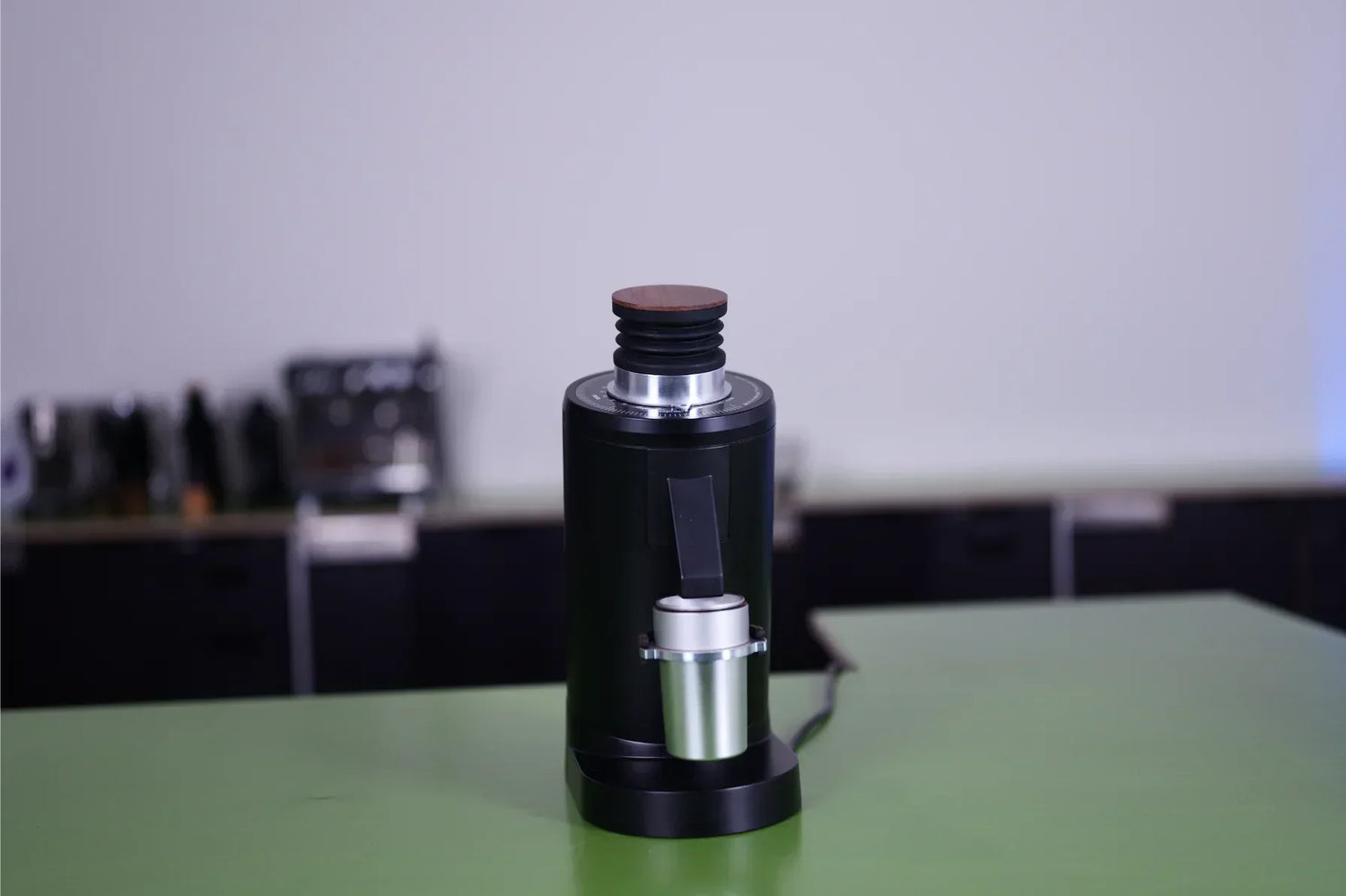

The DF83 V2 from G-Iota, also known as Turin DF83 V2, positions itself as a top contender in the segment of single dosing espresso grinders for home use in the sub-€1000 range.
Single dosing has become indispensable in many households since the success of the Niche Zero. G-Iota already placed its own good single dosing grinder in the lowest price segment with the DF64. The DF83 V is intended to build on this success and could end the success story of the Niche Zero with its performance. Because what the DF83 V2 has to offer is really good in terms of performance, build quality, particle distribution, and espresso quality.
We tested the DF83 extensively and compared our results with data from more than 50 espresso grinders. We purchased the grinder from the Bohnendealer*. This is the importer for the German and Austrian market. Unfortunately, the grinder is currently not available in Switzerland.
We compared 10 single dosing grinders in the price range of €500 to €1000. More on this in our article on the topic.
Design and construction
The DF83 V2 impresses with its robust, powder-coated housing, which guarantees both stability and durability. With dimensions of 365 mm (height) x 153 mm (width) x 252 mm (depth) and a weight of 10.5 kg, which reflects its sturdy construction, it is compact yet prominent on any kitchen counter. What stands out is the side-mounted power cable, which can be quite annoying. It is inexplicable why the manufacturer routes the cable to the side.
With espresso machines where the steam wand is on the right, the grinder can be placed to the left of the machine and as a result the cable can be routed under the espresso machine. However, with many espresso machines the steam wand is on the left and we explicitly recommend against this if you frequently froth milk. The steam from frothing affects the grinding behavior of the beans, at least if they are in the bean hopper. With single dosing grinders this may be negligible.
As with the G-Iota DF64, the permanent illumination of the grinding button is annoying. Modern devices should be switched off when not in use and should not glow without reason. Who needs a night light on their grinder at night?!

Performance and technology
The grinder is driven by a single-phase induction motor that achieves an impressive grinding capacity of 35.6 grams in 10 seconds at a speed of 1400 rpm. The 83mm Italmill grinding discs deliver uniform and fluffy ground coffee. The option to upgrade to titanium or SSP universal grinding discs offers additional flexibility.
The grinder is one of the fastest espresso grinders we have tested to date. With this speed, it is basically also suitable for gastronomy, although a quick single dosing process in gastronomy is difficult to accomplish. The DF83 does come with a bean hopper - but the question remains what it's for?
After all, no meal can be programmed and therefore no amount either. But if you want to quickly grind 250 grams for your neighbor, you can do it with this grinder with its speed in principle.
Noise level and retention
The noise level of the grinder is 85.2 decibels, which is in the higher range. This is a consequence of high grinding capacity, speed and motor power.
The retention is 1.6 grams when filled, but is properly ground down to 0.11 grams when the air blower is activated. The "Björn Method" has proven to be the best air blower method in home barista championships. This involves pressing the air blower at high frequency but with less force.
During grinding, the temperature of the grinder rises slightly over 6 extractions with 30 seconds intervals between grinds. We measured an increase of 1.5 degrees Celsius to extremely low 29.5 degrees Celsius on average.

Grind adjustment and usability
The espresso grinder is reduced to the essentials. Essentially there is only one (illuminated) button to start the grinder. The grind cannot be programmed. Single dosing grinders work on a different principle. The coffee is weighed, put into the grinder and completely ground.
The grind consistency was not good in comparison to the particle analysis, which Michel and Benjamin discuss appropriately in the video as well. In practice, however, we had less difficulty returning the grinder to the recipe than the particle distribution analysis suggests.

Important: in the video we accidentally display the particle curve of the grinder with the abbreviation M50. This is the G-Iota DF64V, not the DF83. The content explanation in the video, however, refers to the DF83 data.
The large grind setting makes it relatively easy to return to the original recipe.
Single dosing and accessories
The DF83 V2 is consistently designed for single dosing. The included metal dosing cup and blow-out funnel make handling the ground coffee easier. The blow-out funnel has a constriction that also reduces popcorning. This refers to beans jumping up during grinding.
To support single dosing, the grinder comes with two practical aids. The aluminum dosing cup is one of them. It fits flush with 58mm portafilters and can be clamped into the portafilter holder. An attachable ring reduces the distance to the coffee chute and ensures that all the ground coffee is ground into the dosing cup.
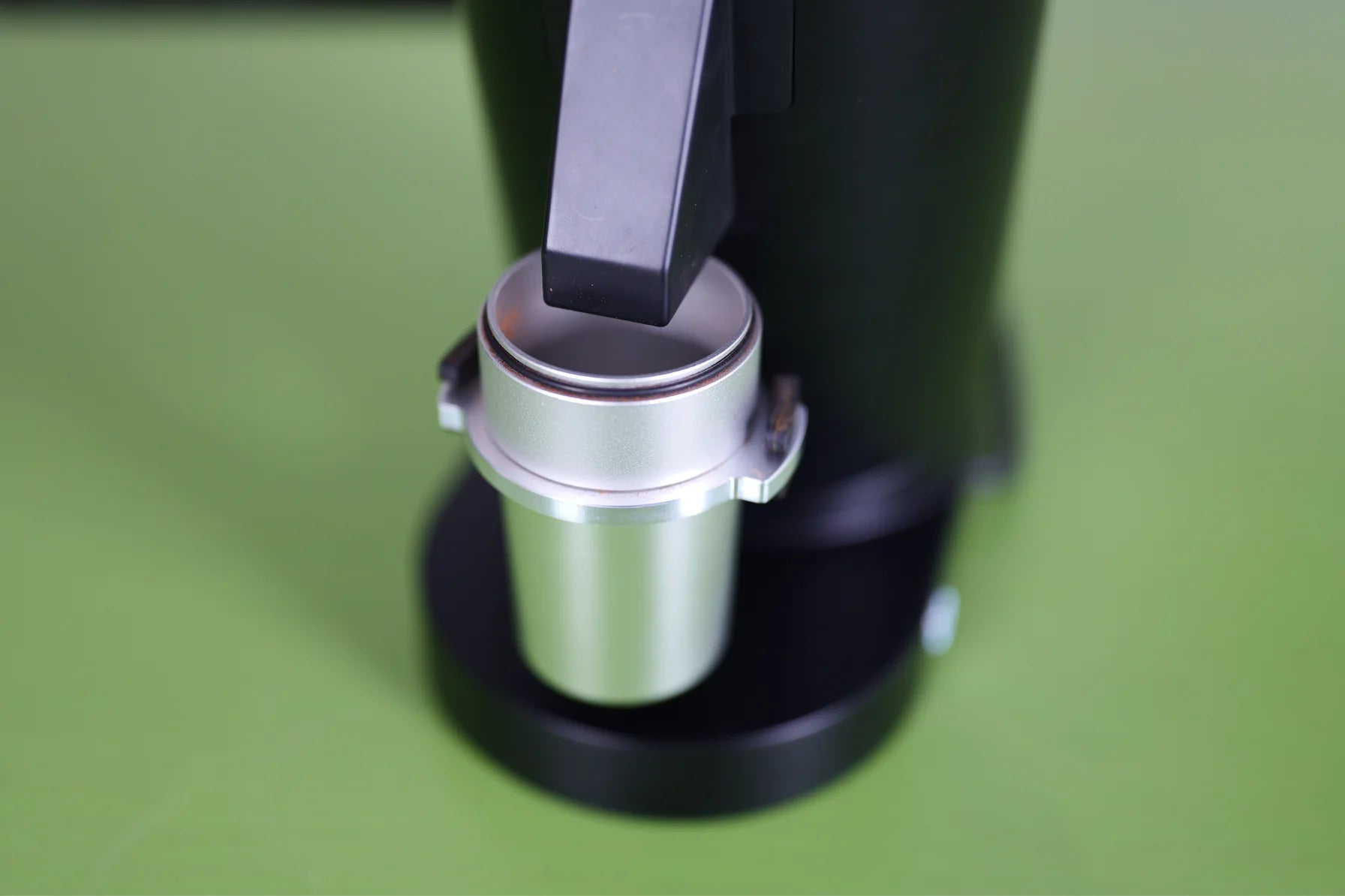
The same ring can also be placed directly on the portafilter and the grinder then grinds just as precisely into the portafilter. The portafilter mount is well made, although the rubber covers are weak points and don't last as long as the mount itself. And without the rubber covers, the portafilter doesn't sit well either. Unfortunately, some coffee powder collects on the inner edge of the dosing ring. This is missing from the portafilter, but it is very little, though it does need to be wiped regularly.
A small water sprayer is also included in the package. This reduces the static charge of the ground coffee, which is also pronounced in this DF83 model. We discuss this topic as well as the flapper topic in detail in our test video.
Espresso quality and particle distribution
The DF83 V2 has a narrow main peak with a relatively high fine content. The narrow main peak can be read as evidence of a result in the cup that we found again and again in our extractions. The espressos tasted clear and transparent and the complexity of the coffees shows itself positively and, for example, much more pronounced than we experienced with the Niche Duo. Nevertheless, the espresso also had a creamy and heavy body, which can be seen in connection with the still high fine content.
In summary, we can say that the espresso we extracted with the DF83 tasted good to us again and again.

Criticisms
The DF83 V2 does many things right. In some respects, however, it also misses important development opportunities. Unfortunately, the manufacturer did not take on all impulses from the community and so static is also a problem with this model, clogging behind the flapper is not uncommon (which is why we removed ours) and the placement of the side cable is a matter of getting used to.
Also, the grind adjustment is not easily visible from the front for people in wheelchairs, as it is mounted on the grinder.
The RDT water spray bottle is included and that is a nice gesture from the manufacturer. In terms of quality, however, it falls significantly short of the high-quality overall appearance of the Turin DF83 V2.
Conclusion on the DF83 V2
The DF83 V2 from G-Iota/Turin is a high-quality, powerful espresso grinder that is particularly suitable for demanding home baristas who value precision, quality and versatility. At around €699, it is positioned in the mid-price range and offers a strong performance package for this price.
In particular, with the difficult import situation and hidden costs from customs and VAT, the Niche Zero has fallen behind as a similarly performing single dosing grinder. What the DF83 V2 also does significantly better is the mounting of portafilter and dosing cup. This is real added value, allows for clean and precise work and brings great joy in everyday use.
Our DF83 V2 will have a permanent place in our academy routine and we are already looking forward to further tests and comparisons with other grinding discs and a more in-depth analysis of filter coffee performance. At least one sentence to that: yes, the grind range also covers filter coffee and the filter coffees we have tried so far have been pleasing to us. More on that in one of the next videos and then also with a written supplement.

*This is a commission link. If you order through this link, it won't cost you any more. However, we receive a small commission. This helps us buy more test material and publish new tests. Thank you in advance! We would also like to point out a shop that we know well and that we know provides good service.


