



























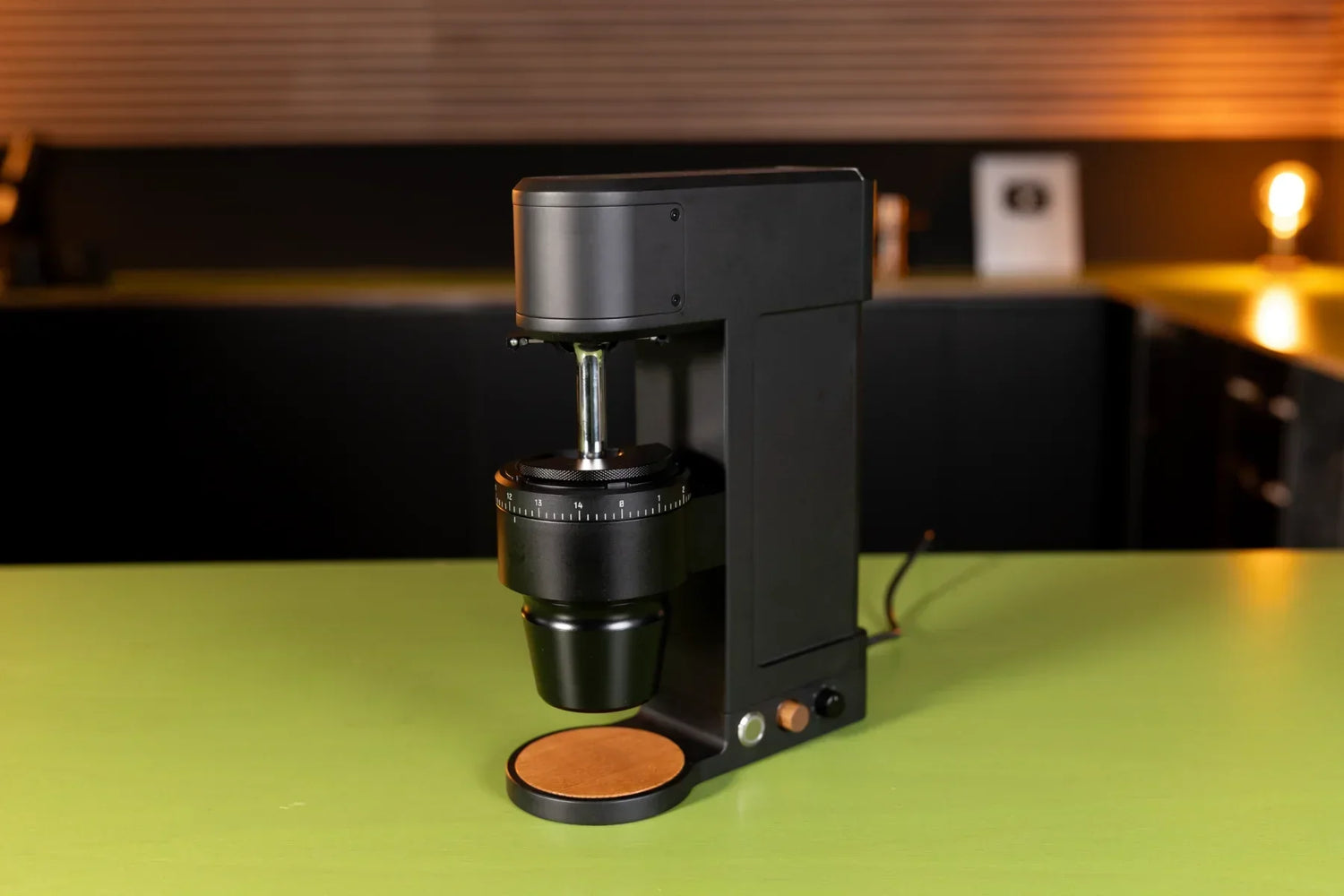

The Weber Key Espresso grinder in the MK2 version is a high-quality single dosing grinder from Weber Workshops. It costs around 2200 euros in stock in Germany! A proud sum of money, though not surprising. At Weber Workshops, the elegant BIRD milk pitcher also costs over 300 euros.
Every product from Weber is an investment, and every product we've looked at so far has been well-made and of very high quality. And that applies to the Weber Key as well!
And while the grinder does many things well, we weren't entirely convinced by everything. As you'll find out in this test, we believe that the Weber Key does not fulfill its main task well: The flavor performance in espresso preparation did not convince us.
Quality and Impression
The Weber Key Mk2 in your own coffee corner is a statement about quality, aesthetics, and investment willingness. It looks visually different from other espresso grinders on the market and also sets itself apart in terms of workmanship. However, it is noticeable that Weber does not communicate anywhere the exact material of the housing. At least we could not find this information.
Technical Specifications
- Dimensions: Depth 248mm x Width 109.2mm x Height 349.6mm
- Weight: 9 kg
- Power Supply: 90-240V (worldwide compatible)
- Power: 350W max
- 83mm conical burrs from Mazzer with TiN coating
- Variable speed range from 30-150 RPM
The grinder is available in white and black and the wooden elements can be customized.
Weber has redesigned the grinder compared to model 1. The current model has higher torque and should be able to grind lighter beans without any problems. We also had no issues with the grinder jamming even with very light roasts.
The Magic Tumbler was also improved, enlarged, and equipped with a different lid. What improvements this led to, we cannot say exactly, since we only looked at the MK2 model. This test report is therefore based only on examining the Weber Mk2.

Noise Level Weber Key Mk2
The Weber Key is the quietest espresso grinder we have measured so far. We measure only 67 decibels. This is a very low value, considering that many grinders are over 80 decibels.
Typically, espresso machines are quieter than grinders. The Weber Key is one of the few grinders that is also quieter when grinding beans than some espresso machines.
Retention, Speed, and Construction
In structure, the Weber Key resembles a large hand grinder. A central axis brings the conical 83mm burr set into action. The Weber Key shares with a hand grinder its low retention. We measure a total of only 0.2 grams of absolute retention. That is really very, very little, especially since we did not detect any permanent retention. We've never seen that before! The low temporary retention of 0.2 grams is technically already halfway into the portafilter. It gets stuck in the Magic Tumbler: on one hand on the wire agitator and on the other hand on the edge of the tumbler. Again: that's almost nothing. But it is still unpleasant because these 0.2 grams sometimes fall out of the grinder at a later time and then dust the surface around the grinder.
Due to its design and thanks to the low retention, the grinder is extremely consistent and reliably outputs the amount of coffee put in from shot to shot. Thanks to the grinder's design, we can also quickly disassemble it without any effort and clean it completely. However, the low retention makes this rarely necessary.
Like a hand grinder, the Weber also has slow grinding, which of course is due to the low speed. When we put 18 grams into the grinder, it takes 25 seconds to completely grind the coffee at 90 RPM. If we fill the hopper and grind for 10 seconds, we get an output of 8.1 grams. This puts the grinder in the slowest category of all coffee grinders we have tested so far. This test is always performed with the same espresso and preset recipe.
The grinder also owes to its slow grinding speed that the ground coffee does not heat up during grinding. We measure an average temperature of 30.92 °C across five consecutive shots, which we take at 20-second intervals. This means there is no risk of the coffee grounds heating up and changing sensory properties.

Particle Distribution and Espresso Performance
In the most important category of our test, the Weber Key shows a peculiarity that leads to a negative test result. After grinding with each grinder, we take samples for comparative particle distribution analyses. To do this, we set each grinder to the Apas Espresso with the same recipe and take a sample (T4). We then set the grinder to Ristretto (T5) and Lungo (T6) and then return to the original espresso (T7). We send these samples to the Zurich University of Teacher Education (ZHAW). At their Coffee Excellence Center, the particle distribution is measured.
In recent years, we have examined and compared over 60 grinders and cross-referenced the particle distribution curves with our taste perception. Before testing the particle curves, we were already surprised by the taste of the espresso shots. We had the feeling that our coffees, which we know very well from daily brewing, were noticeably not on point. They tasted unstructured, the acidity was rather unpleasant, and there was a lack of balancing sweetness.
This result matched the particle distribution measurements. The Weber Key delivers a very, very broad main peak of over 447 micrometers! For comparison: in the past, we have discussed how a main peak from 320 micrometers wide leads to less structured cups and less clarity in the coffee.
A broad main peak means that a grinder produces little precise ground coffee of one size. With the Weber Key, we find especially many particles in the coarse side range of the main peak. There is a pronounced right flank.

This is particularly evident in comparison to other grinders we have recently measured. The Weber Key shows a particle distribution that we otherwise only know from very inexpensive espresso grinders. And no, this has nothing to do with the conical burr set. See, for example, the comparison with the Niche Zero in the graph above.
Extraction Comparison
To better understand extraction behavior, we conducted several measurement series. We performed extractions at the same recipe with both a medium roast (Apas, Brazil) and a lighter roast (Limontitla, Mexico) and measured the TDS. We used a relatively inexpensive grinder as a comparison grinder, namely the Eureka Specialità.
The extractions and strength of the Specialità were significantly higher with both coffees. Especially with the darker roast, the extraction yield was on average almost two percent higher! The TDS was on average 0.7% higher. This is possible due to the more uniform ground coffee of the Specialità as well as the lower number of boulders (coarse particles).
High extraction yield is desirable with high-quality coffees!


With the lighter roast, the difference was less pronounced, but still clear. We're talking about around 1.2% more extraction yield here too!
Conclusion: For Whom Is the Weber Key MK2 the Right Grinder?
The Weber Key is well-made. We see little reason why the grinder should not last several decades at the home barista bar. The low noise level also expands its application. As the quietest grinder we have measured, the Weber Key looks good alongside very quiet machines like the Sanremo You or Maro Model 1 in offices or medical practices as well as in households that place great value on aesthetics and high quality.
The retention is exceptionally low, and the grinder's consistency is very good. Switching between recipes is also possible without any problems, though smaller increments would be desirable. It is important that you are aware of the slow speed. The Weber Key Mk2 is one of the slowest grinders on the market!
While the importance of speed is a matter of taste, we rate the actual espresso performance of the grinder as limited. Especially with lighter specialty coffees, we were often disappointed by the espresso results. The huge main peak in the particle distribution is responsible for this. We otherwise only know such a broad main peak from very inexpensive grinders. As a result, our espressos were often inharmonious in flavor, less sweet, and could not match the results of other, even significantly cheaper grinders. What often led to unpleasantly dominant acidity with lighter roasts can sometimes show itself positively with some darker espressos. We would therefore see the Weber Key MK2 more in the range of darker roasts. It shares this with a grinder like the Pico by La Marzocco.
Since the Weber Key MK2 did not convince us in terms of taste, this test report also concludes on a disappointed note. The high-quality craftsmanship and the reputation for creating great materials precedes Weber Workshops. In testing the Weber Key MK2, these expectations were not met for us.



