



























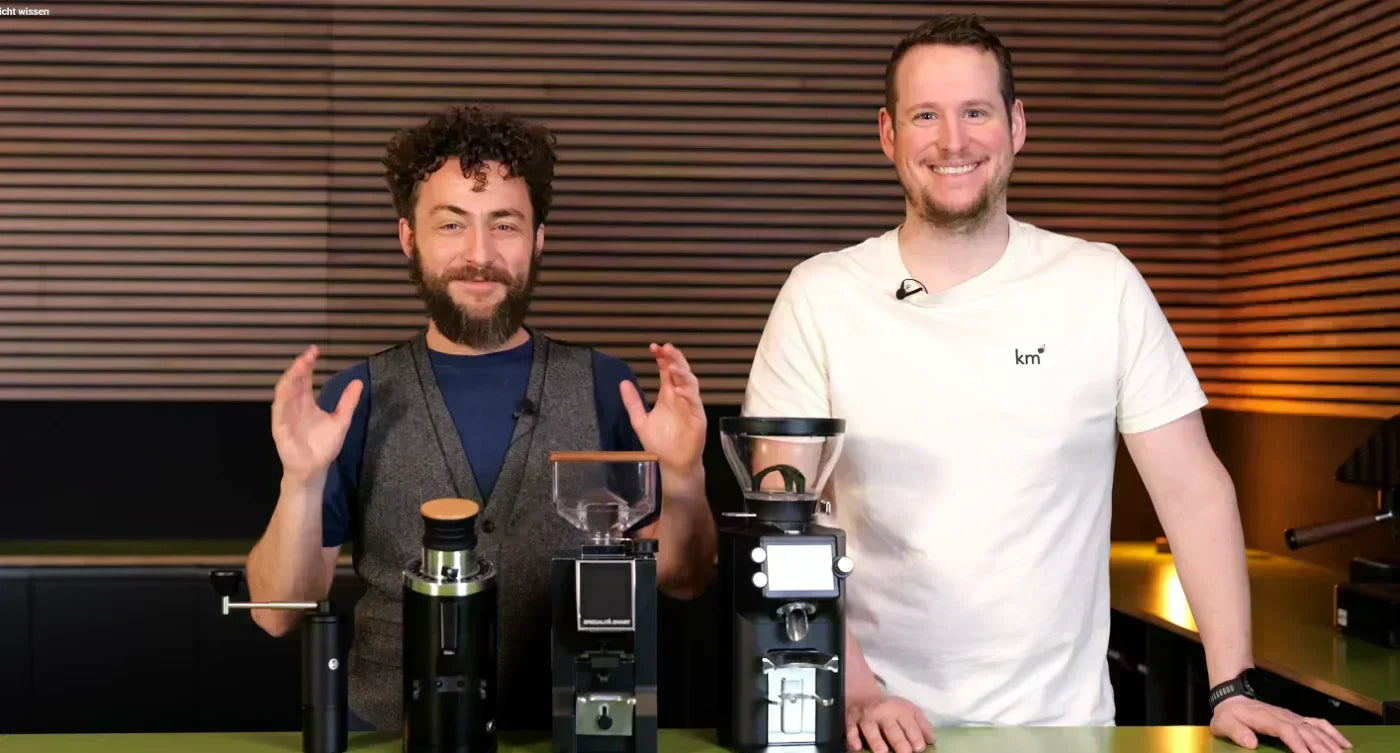

There are numerous good and bad espresso grinders on the market. Before you decide on a grinder, however, choosing the right grinder category is the first step. If you're starting even further back and first want to clarify which coffee grinder is suitable for which preparation method, read up on that.
Four main categories, an emerging fifth one – and none of them is automatically the best. Hand grinders, single-dosing grinders, timer doser grinders, grind-by-weight grinders, and recently grinders with electronic grind adjustment: they can all deliver excellent espresso. The question is not which category makes the best coffee, but which fits your daily routine. How often do you switch beans? How many espressos per day? How much do you want to control yourself? We go through all five types – with an honest assessment of strengths and weaknesses.
The four main categories at a glance
Hand grinder: You weigh the coffee, crank, done. No electricity, no retention, smallest budget. But: manual work with every shot.
Single-Dosing grinder: You weigh the coffee, put it in the top, the grinder grinds it all out. Bean switching anytime, low retention, direct feedback when adjusting.
Timer doser grinder (bean hopper): Beans in the hopper, press the button, the grinder grinds for a set time. Fast once it's properly set. But: retention, little flexibility when switching beans.
Grind-by-Weight grinder: Like the hopper grinder, but with an integrated scale. It doesn't stop after time, but after weight. Solves the biggest problem of the timer grinder – but costs more too.
Strengths & Weaknesses in Detail
Click on a type for benefits, drawbacks, and the target audience.
Cheapest entry point▼
Single-Dosing principle▼
Zero retention▼
Espresso potential like expensive electric grinders▼
Mobile and power-independent▼
Easy to clean and maintain▼
Workout included▼
Workout included (the downside)▼
Particle distribution sometimes a problem▼
Step adjustment on many models▼
Switch coffee anytime▼
Maximum freshness▼
Low retention▼
Adjusting grind size is easier▼
Strong price-to-performance ratio▼
Best for beginners▼
Experimentation options▼
Cleaning often easier▼
Often more modern design▼
Compact design▼
Conscious ritual▼
Static▼
Slightly more steps▼
Not designed for high frequency▼
Comfortable workflow (once set)▼
Built for high frequency▼
High throughput▼
Proven technology, robust, durable▼
Not cheaper than Single Dosing▼
Freshness is a problem — in multiple ways▼
High retention▼
More variation in output▼
Grind adjustment = amount adjustment▼
"Less accessories" isn't true▼
Problematic for beginners▼
Can't easily be used as single doser▼
Eliminates the biggest weakness of doser grinders▼
No reweighing after grind adjustment▼
Good dosing accuracy▼
Future trend▼
Not fresher than a hopper grinder▼
High entry price▼
Keep retention in mind▼
Often slower than Single Dosing▼
Sometimes not vibration stable▼
Software not always convincing▼
The grinder adjusts itself▼
Save recipes▼
Combination with integrated scale▼
Ideal for home baristas without much experience▼
Future: Full integration▼
Software prone to errors and immature▼
Eureka Specialità Smart: display only▼
Retention must be calculated in▼
Contact time vs. drip time▼
High price and expensive repairs▼
Still limited selection▼
Hand Grinder: The Underestimated Entry
A good hand grinder for under 100 euros can deliver the same espresso quality as an electric grinder costing 1,500 euros. That sounds like marketing, but it's measurable: good hand grinders achieve particle distributions that keep up with expensive flat-burr grinders. The catch isn't quality. The catch is effort.
Depending on the burr, you crank for about a minute per portion. Every morning. And if you're looking for the right grind size, every attempt also costs a minute of cranking. If you understand this as a ritual, you'll be happy with it. If you want your espresso quickly in the morning, probably not.
Hand grinders work on the single-dosing principle: weigh, fill, grind. No retention, no old coffee in the system. Plus, they're mobile, power-independent, and disassembled and cleaned in seconds. For travelers, minimalists, and everyone with a small budget, it's the smartest entry.
What to watch out for: Not every hand grinder has infinitely variable adjustment. Some work with fixed steps that are so coarse that in espresso you jump from one step to the next with a huge change in extraction. And: check beforehand whether the grinder can grind fine enough for espresso – not all of them can.
Hand grinders from our shop*▼
| Grinder | Price | |
|---|---|---|
| Timemore Chestnut C5 ESP Pro | approx. 99 € | To the product → |
| Timemore Slim 3 Hand Grinder | approx. 119 € | To the product → |
| Comandante C40 MK4 | approx. 249 € | To the product → |
Single-Dosing Grinder: The Best Choice for Most
If you ask us which grinder type we'd recommend to most home users: Single Dosing. The reasons are solid.
You weigh 18 g, put them in the top of the grinder, and the grinder grinds them all out. With good single-dosing grinders, less than 0.5 g remains in the grinder. That has a direct effect on adjustment: every grind size change takes effect immediately. No purging old coffee, no guesswork. With hopper grinders, the amount changes with the grind size – with single dosing it doesn't. That's why we preferentially use single-dosing grinders in our courses. They've replaced doser grinders there.
Need to switch beans? Anytime. One person gets light filter coffee, the next a dark espresso. No waste, no effort. Good quality starts significantly cheaper than with hopper grinders – from 150 to 250 euros you can find grinders to get started with.
The downsides: single-dosing grinders build up more static charge because the charge distributes less than with hopper grinders. RDT – a drop of water on the beans – helps. And for high frequency, i.e., many espressos in a row at a party or in an office, the type isn't designed. With weighing and air blower it eventually becomes slow.
Some single-dosing grinders offer extras like variable RPM adjustment. This lets you shift the flavor profile without changing the grind size – a tool that hopper grinders don't offer.
All tested Single-Dosing grinders (31)▼
| Grinder | Retention | Speed | Price | |
|---|---|---|---|---|
| G-Iota DF54 | 0.5 g | 10.0 g/10s | approx. 279 € | Test → |
| Emil EM1 Single Doser | 0.7 g | 14.0 g/10s | approx. 229 € | Test → |
| Eureka Mignon Manuale | 3.0 g | 11.8 g/10s | approx. 239 € | Test → |
| Varia VS3 | 1.8 g | 6.7 g/10s | approx. 331 € | Test → |
| Eureka Mignon Zero | 1.9 g | 19.9 g/10s | approx. 339 € | Test → |
| Emil T64 Coffee Grinder | 1.0 g | 19.0 g/10s | approx. 379 € | Test → |
| G-Iota DF64 Gen 1 | 1.5 g | 19.1 g/10s | approx. 400 € | Test → |
| G-Iota DF64 Gen-2 | 0.2 g | 19.1 g/10s | approx. 429 € | Test → |
| Eureka Mignon Single Dose | 0.9 g | n/a | approx. 480 € | Test → |
| Mahlkönig X64 SD | 0.9 g | 35.0 g/10s | approx. 499 € | Test → |
| Varia VS4 | 2.0 g | 15.0 g/10s | approx. 539 € | Test → |
| G-Iota DF64V | 2.3 g | 19.2 g/10s | approx. 550 € | Test → |
| G-Iota Pro83 | 0.8 g | 35.6 g/10s | approx. 599 € | Test → |
| Eureka Mignon Single Dose Pro | 0.8 g | 28.0 g/10s | approx. 639 € | Test → |
| Profitec Twist SD54 | 0.8 g | 14.7 g/10s | approx. 645 € | Test → |
| Option-O Casa | 0.4 g | 6.0 g/10s | approx. 650 € | Test → |
| Niche Zero | 0.7 g | 11.9 g/10s | approx. 690 € | Test → |
| Timemore 064S | 0.3 g | 12.4 g/10s | approx. 699 € | Test → |
| Femobook A68 | 0.1 g | 17.3 g/10s | approx. 750 € | Test → |
| Varia VS6 | 2.4 g | 11.5 g/10s | approx. 784 € | Test → |
| Niche Duo | 0.9 g | 10.8 g/10s | approx. 800 € | Test → |
| G-Iota DF83 V | 0.8 g | 66.0 g/10s | approx. 839 € | Test → |
| Timemore 078S | 0.3 g | 21.6 g/10s | approx. 899 € | Test → |
| WPM ZP-1 | 0.7 g | 21.5 g/10s | approx. 1,140 € | Test → |
| Mazzer Philos | 0.6 g | 22.4 g/10s | approx. 1,195 € | Test → |
| Zerno Z1 | 0.8 g | 11.7 g/10s | approx. 1,504 € | Test → |
| Option-O Lagom P80 | 0.2 g | 26.2 g/10s | approx. 1,600 € | Test → |
| Weber Workshop Key | 0.2 g | 8.1 g/10s | approx. 1,895 € | Test → |
| Acaia Orbit | 0.7 g | 14.0 g/10s | approx. 1,899 € | Test → |
| Option-O Lagom P64 | 0.2 g | 24.8 g/10s | approx. 2,080 € | Test → |
| Option-O Lagom 01 | 0.5 g | 75.0 g/10s | approx. 2,999 € | Test → |
Timer Doser Grinder (Hopper): Proven, But With Pitfalls
The most widespread category. For those wanting to dive deeper, our espresso grinder guide offers a detailed overview. Here's the principle: beans in the hopper, adjust grind size, set timer to 7, 8, 9 seconds – and the grinder outputs a certain amount of coffee. As long as grind size and coffee stay the same, it's roughly consistent.
The strength: once properly set, you press a button and you're done. For high throughput – catering, family parties, offices – a hopper grinder is the right choice.
The weaknesses, however, outweigh this in many ways. As soon as you adjust the grind size, the amount per time unit changes too. Finer grind means less coffee in the same time, coarser means more. After every grind adjustment you must reweigh. So you need a scale just as much as with a single-dosing grinder. The argument "less accessories needed" doesn't hold up.
Then there's the retention. With hopper grinders we often measure 4 g and more. This affects flavor and makes adjustment sluggish because every grind change only takes effect after the old coffee is purged. Coffee in the bean hopper ages, coffee in the feed chute partially pre-grinds, and coffee in the retention is already old anyway. Freshness looks different.
For beginners, the hopper grinder is problematic: many adjust the grind size but don't check the amount – and wonder why the espresso tastes bad. The brewing ratio is off, but you don't see why.
Common argument: hopper grinders are cheaper. Not really. Cheap models often come without timer control – then you might as well get a single-dosing grinder. Good models with timer quickly cost 400 to 500 euros.
All tested Timer Doser grinders (24)▼
| Grinder | Retention | Speed | Price | |
|---|---|---|---|---|
| Rommelsbacher EKM300 | 1.5 g | 22.7 g/10s | approx. 55 € | Test → |
| Graef CM800 | 6.2 g | 19.1 g/10s | approx. 119 € | Test → |
| De'Longhi Dedica KG521 | 1.4 g | 17.1 g/10s | approx. 159 € | Test → |
| KitchenAid Artisan 5KCG8433 | 3.4 g | 13.5 g/10s | approx. 180 € | Test → |
| Lelit PL043MMI | 5.0 g | 15.1 g/10s | approx. 185 € | Test → |
| Sage Dose Control | 3.4 g | 17.2 g/10s | approx. 185 € | Test → |
| Sage Smart Grinder Pro | 2.7 g | n/a | approx. 199 € | Test → |
| Lelit PL044MMT | 4.5 g | 14.3 g/10s | approx. 257 € | Test → |
| Eureka Specialità | 2.7 g | 21.3 g/10s | approx. 369 € | Test → |
| Eureka Mignon Magnifico 55 | 2.1 g | 22.5 g/10s | approx. 419 € | Test → |
| Lelit PL72 | 5.1 g | 31.8 g/10s | approx. 417 € | Test → |
| Lelit Steve | 5.5 g | 30.3 g/10s | approx. 469 € | Test → |
| Macap Leo55 | 2.4 g | 16.9 g/10s | approx. 479 € | Test → |
| Mahlkönig X54 | 7.6 g | 13.7 g/10s | approx. 499 € | Test → |
| Quamar M80 | 10.9 g | 33.6 g/10s | approx. 490 € | Test → |
| Rocket Faustino V2 | 2.4 g | 13.7 g/10s | approx. 559 € | Test → |
| Ceado Life | 1.9 g | 17.7 g/10s | approx. 629 € | Test → |
| Eureka Mignon XL 65 | 3.1 g | 28.7 g/10s | approx. 629 € | Test → |
| Rocket Fausto 2.1 | 10.0 g | 30.5 g/10s | approx. 659 € | Test → |
| Baratza Forté AP | 3.9 g | 22.7 g/10s | approx. 700 € | Test → |
| Mazzer Mini Electronic A | 5.3 g | 16.0 g/10s | approx. 750 € | Test → |
| ECM Automatik-S64 | 12.2 g | 27.5 g/10s | approx. 869 € | Test → |
| La Marzocco Pico | 2.2 g | 20.0 g/10s | approx. 1,159 € | Test → |
| Ceado E37S | 8.8 g | n/a | approx. 1,549 € | Test → |
Grind by Weight: The Timer Problem Solved – But Not All Problems
The Grind-by-Weight grinder (GBW) works in principle like a hopper grinder, with one difference: it doesn't stop after a time, but after a weight. An integrated scale tares the portafilter and grinds until the set gram amount is reached.
That solves the biggest problem with timer grinders: amount inconsistency. No matter where the grind size is, you always get the set gram amount. No reweighing needed. Many GBW grinders achieve ±0.1 g – that's more accurate than most timer grinders deliver.
What GBW doesn't solve: freshness. You still have a full bean hopper, same retention. It's sometimes claimed that GBW combines the advantages of single dosing and hopper grinders. That's only half true. You get the comfort, but not the freshness. You even need the pressure of the beans on top for it to work properly.
The entry price is high. Below 800 euros there are hardly any usable GBW grinders with convincing particle distribution across a broad roast range. The 300 to 500 euro premium over a good hopper grinder is what you pay for the weighing technology. And with some manufacturers the software isn't mature yet.
When is it worth it? For anyone who drinks a lot of coffee at home, doesn't constantly switch beans, and doesn't want to weigh. Tip: after longer idle time, program one portion as a purge portion to get the old coffee out of the system.
All tested Grind-by-Weight grinders (12)▼
| Grinder | Retention | Speed | Price | |
|---|---|---|---|---|
| Tchibo Coffee Grinder with Scale | 3.2 g | 19.2 g/10s | approx. 90 € | Test → |
| Baratza Sette 270wi | 2.7 g | 29.3 g/10s | approx. 499 € | Test → |
| Eureka Mignon Libra | 2.4 g | 20.2 g/10s | approx. 549 € | Test → |
| Eureka Mignon Libra 65 All Purpose | 2.1 g | 12.5 g/10s | approx. 599 € | Test → |
| Compak Fino Scale | 0.3 g | 15.4 g/10s | approx. 790 € | Test → |
| Fiorenzato Allground Sense | 7.1 g | 23.8 g/10s | approx. 849 € | Test → |
| Eureka Atom W65 Casa | 19.3 g | 30.0 g/10s | approx. 1,000 € | Test → |
| Zuriga G2 GBW | 1.5 g | 11.1 g/10s | approx. 1,150 € | Test → |
| Ligre Siji | 2.7 g | 22.9 g/10s | approx. 1,180 € | Test → |
| Mahlkönig E64 WS | 4.1 g | 27.3 g/10s | approx. 999 € | Test → |
| Mazzer Mini G | 11.8 g | 21.2 g/10s | approx. 1,200 € | Test → |
| Mahlkönig E65S GbW | n/a | n/a | approx. 2,099 € | Test → |
Smart Grinders / Electronic Grind Adjustment: The Emerging Fifth Category
There's exciting movement here. Grinders with electronic grind adjustment digitally measure the burr spacing and allow you to adjust the grind size in tiny increments – so fine that one step might make just a second difference in extraction time.
What's exciting: you tell the grinder your target recipe, brew your espresso, report back the result – and the grinder corrects the grind size itself. Recipes can be stored and retrieved with the press of a button. Combined with an integrated scale, this becomes a system that actively helps with adjustment. See our test of the Mahlkönig E64 WS. The underlying idea is called Grind by Sync.
The market is still young, though. Relevant grinders in the home segment: the Mahlkönig E64 WS with full integration, the Nunc system (grinder and machine communicate directly), the upcoming Eureka Tio, and the Eureka Specialità Smart – though the latter only detects grind size but doesn't adjust it electronically. And without a physical grind adjustment wheel, a purely electronically controlled grinder doesn't work reliably if the software fails. That's currently the biggest risk: no fallback if software problems occur.
For whom? Anyone willing to invest in the upper price range and wanting a grinder that actively supports adjustment. The technology is exciting. But it still needs to mature.
And What Quality Do They Deliver?
Here's perhaps the most important insight: all five categories can deliver the same espresso quality. A 100 euro hand grinder produces the same espresso as a 2,000 euro grinder when properly adjusted. The difference is in workflow, comfort, and error tolerance – not in cup quality. If you master your grinder, you get good coffee with any of these categories.

Conclusion: Which Type Are You?
Instead of a single recommendation, here's the honest breakdown:
You want the cheapest entry and don't mind manual work? → Hand grinder. Starting from 50 to 100 euros.
You like switching beans, want to learn, and prefer direct feedback when adjusting? → Single Dosing. The most versatile choice for most home users.
You always drink the same coffee, need speed, and serve many people? → Timer Doser. Built for catering, parties, and offices.
You want the hopper comfort without the amount problem? → Grind by Weight. When the budget allows.
You want the grinder to actively help with adjustment? → Smart grinder. If you're willing to invest in technology that's still maturing.
No matter which type: a grinder is the most important investment in your espresso setup. Not the machine.

