





Grinding coffee by weight makes adjusting any espresso machine easier. That's exactly what the Mazzer Mini G is for: it delivers the amount you've set — even if you've adjusted the grind size. This helps both beginners and professionals. The grind-by-weight grinder with 64 mm burrs costs around 1150 francs.
The question remains: what else can the grinder do? What does the particle distribution look like? How does the espresso taste? And does it have retention? We can say right up front: it does. And the amount is the most unpleasant number in this test.
For a comparison of all grind-by-weight grinders for home, click here.
Workmanship: hard to beat in this price range
The Mini G is unmistakably a Mazzer. Michel nails it: "In this price range, this is the most robustly built and longest-lasting device out there." If you buy a Mazzer, you'll probably still use it in 30 years, even though you may need to replace the burrs over the years — they typically last about ten years depending on throughput.
There's one downside in the portafilter holder. You can fine-tune it in height and depth, and every portafilter we tested fits. For the adjustment, however, you'll need Phillips head, hex, socket head, and a wrench — quite a collection of screws on a grinder that's otherwise so cleanly engineered.
Buy the Mazzer Mini G
The following specialty shops carry the Mazzer Mini G and we can recommend buying from these retailers.
Switzerland: [Partner links] Simons Kaffee
* We search for specialist partners for you, ones we know provide good work and good service. We maintain close contact with the retailers. These are commission links. If you order through this link, it won't cost you more, but we'll receive a small commission that we invest in new test equipment.
The discharge is the benchmark
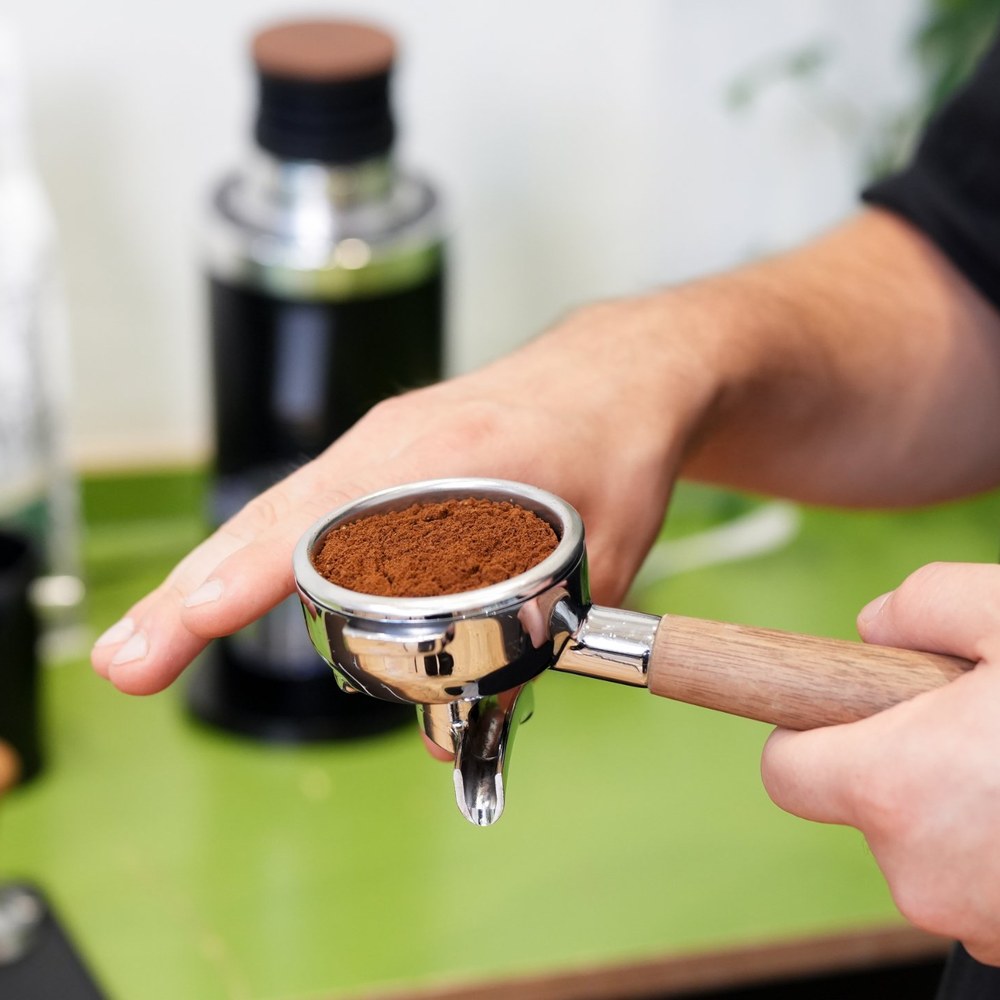
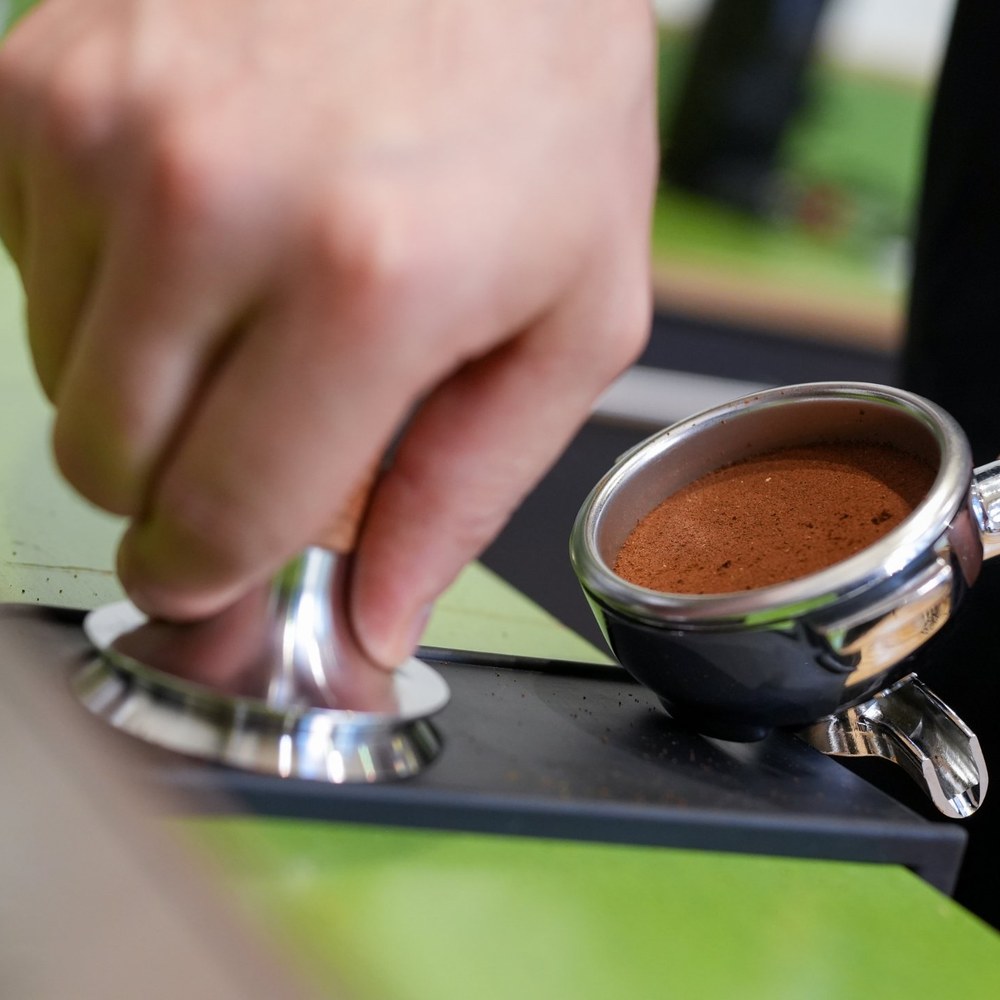
The best part of the Mini G happens in the seconds as the ground coffee falls into the basket. A fine, powdery stream, evenly distributed, clean pile in the basket. You can completely skip WDT or other distribution aids. The ground coffee is fluffy and very well distributed and fits nicely into the basket despite its fluffiness: it dropped easily into our coffee maker basket with 18.5 grams. If any falls outside, you can easily adjust the portafilter holder position.
Important: fluffiness is not the same as particle distribution. More on that shortly.
21.2 grams in 10 seconds, 84.9 dB
With a full bean hopper, the Mini G dispenses 21.2 grams in 10 seconds; for 18 grams it needs 9.5 seconds. This isn't blazingly fast, but it's on the quick side and very convenient for daily use.
During continuous operation we measure 84.9 dB. It's certainly not the quietest grinder. But the number alone doesn't tell the whole story. The sound is pleasant, not combat mode, but rather a powerful, elegant motor grinding through the coffee swiftly.
Thermally, the grinder stays relaxed. The beans go in at 22.6 °C, the first sample measures 27.9 °C, after five consecutive grinds with 20-second pauses we're at 29.9 °C. Average 28.5 °C. The burrs don't heat up, not even with multiple shots back to back.
Consistency and Grind by Weight: it's honest
The Mini G doesn't show you what you've set, but what actually came out. This is by no means a given with grind-by-weight grinders: you see where you stand.
Over five grinds of 18 grams we measure 17.8 / 17.9 / 17.8 / 17.7 / 18.0 grams. The mean deviation is 0.1 grams, the standard deviation 0.11 grams. Solid. For a grinder that should weigh to the gram, we would have preferred 0.1 grams as the maximum. Outliers at 17.7 grams are quite a bit for a GbW grinder.
When the grinder doesn't reach the target weight, it grinds again briefly. Correct in principle, because the end result is the right dose in the portafilter. Michel sees a catch in it, though: every motor has a startup phase, and a slightly different particle image develops during this startup phase. With 0.2 to 0.3 gram adjustments, however, this won't change the extraction.

Retention: 11.8 grams — and that's the end of the story for home use
With an eye toward home espresso, the Mazzer Mini G has a major drawback. The retention of the Mini G is 11.8 grams absolute. We measure 10.6 grams temporary and 1.2 grams permanent. This value puts it on the negative podium among grinders intended for home use.
In defense: most of it is temporary, meaning it exchanges with each grind. Very little sticks permanently. The 1.2 grams permanent are unremarkable for a hopper grinder.
Still: 10.6 grams of temporary retention means your portafilter always receives just over half a dose of coffee that's one grind older. And if you adjust the grind size, you first have to grind out these roughly 11 grams before you see the new setting in the extraction. This is frustrating in daily use and expensive when setting up a new bean.
Dear Mazzer team: the grinder is fun, we enjoy working with it. But 11.8 grams is too much for home. Make the grinding chamber smaller or flatter.
For single dosing, the Mini G is not an option, and that's not its goal either. For that there's the sister model, the Mazzer Philos.
We empty our grinder bean hoppers in the evening. Then you set once in the morning and keep going, and the retention barely matters over the course of the day. The Mini G feels right at home in this rhythm.

Grind size adjustment: one mark equals five seconds
The grind size adjustment is typical Mazzer: you adjust via a fine-pitch thread the entire upper part of the grinder. This has become significantly more pleasant than the old models, where you had to apply so much force during adjustment that it was hard to hit the grind size precisely.
One mark on the scale corresponds to roughly four to five seconds of extraction time. In our test block we were either at 23, 24 or 25 seconds or directly at 30 to 32. Intermediate positions are possible if you adjust gently enough. But then you have to grind out the roughly 11 grams again before you see the result. Finding the grind size requires a good measure of feel, patience, and willingness to waste coffee because of the high retention.
A tip for cleaning: when you take the grinder apart, thoroughly clean the fine-pitch thread with the brush before reassembling. Otherwise you'll have trouble getting it back together.
Replicability: the main peak comes back, the fines don't
For the adjustment test we go from espresso (T4, grind size 7.4) to ristretto (T5, 7.2), then to café crème (T6, 7.8) and visually back to the starting position (T7).
The main peak returns cleanly: 217.7 µm at T4, 220.6 µm at T7. The x50 value, however, drops from 238.9 to 191.8 µm — a good 47 µm deviation. The reason lies in the fines: the fines peak shifts from 32.1 to 40.1 µm and is significantly higher in the curve at T7 than at T4. Coarse is coarse again, but more fines come along. In the cup this shows up in the extraction time: instead of the set 25 seconds, we land between 23 and 27 seconds at T7.
Practical consequence: simply turning back to the old mark visually isn't enough. If you switch between recipes, it's best to adjust with a scale and timer.

Particle distribution: main peak at 217.7 µm — good for many coffees
We measure the particle distribution in cooperation with the Coffee Excellence Center at ZHAW on the Retsch Camsizer X2.
In the espresso setting (T4) the main peak is at 217.7 µm, the x50 at 238.9 µm, the fines peak at 32.1 µm. For comparison: ristretto (T5) comes in at 196.0 µm x50, café crème (T6) at 275.5 µm.
The 220 range at the main peak is a good spot for many coffees. With dark and medium roasts you get more clarity without losing body and texture. And with fruity coffees there's definitely some clarity, while the body and texture layer remains intact. The grinder combines the best of two worlds: light coffees perform well with minimal compromise on clarity, dark and strong roasts do too.
The installed Mazzer burrs are 233M in 64 mm format. Mazzer sets standards in burr technology, which is one of the company's strengths. In addition to the 233 burrs, k202 burrs were tested, which particularly impressed with their sweetness and clarity.

Operation, display and app
Mazzer took a strange turn here. To change the dose, you go into the menu, then to the cup, then to the lock setting, then to dose 1, adjust and save. Previously you just held button 1 for a long time and you were done. The display is a simple display, not a touchscreen. Plus oddities in the English translation. If you switch from the dosing cup to the portafilter without recalibrating, the grinder tells you you have "overweight." Michel took that a bit personally.
You should calibrate anyway. The calibration weight is included and also serves as the basis for the magnetic dosing cup. Recalibrate each time you switch between cup and portafilter. This contributes to consistency.
And about the app — as with so many apps, we wonder about its added value. If a grinder has such detailed menu navigation and a sufficiently large display, a second control level on your phone isn't needed — unless perhaps for future integration with machine or scale. At least the translation errors could be fixed via the interface. We tested firmware 2.1.00008.
By the way: unlike the Mahlkönig E64 WS, the Mazzer Mini G has no portafilter recognition.

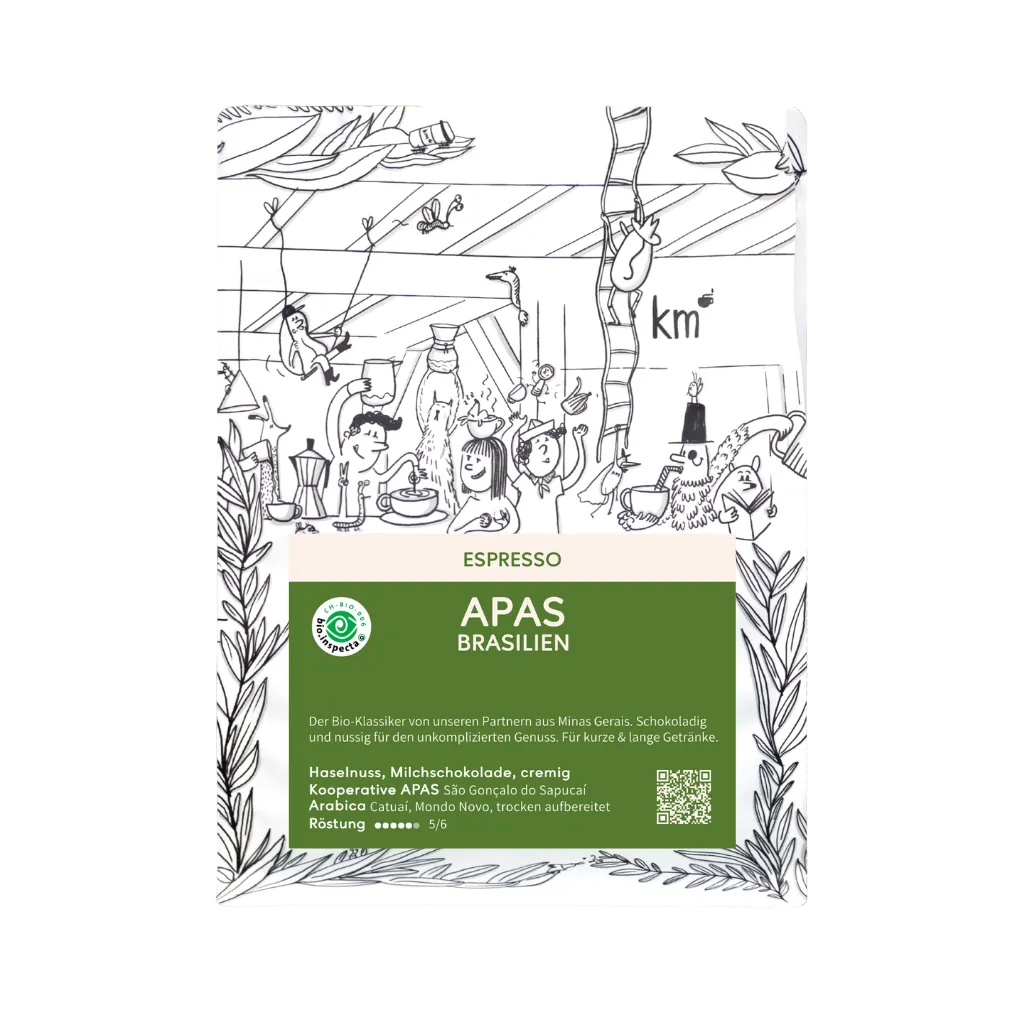
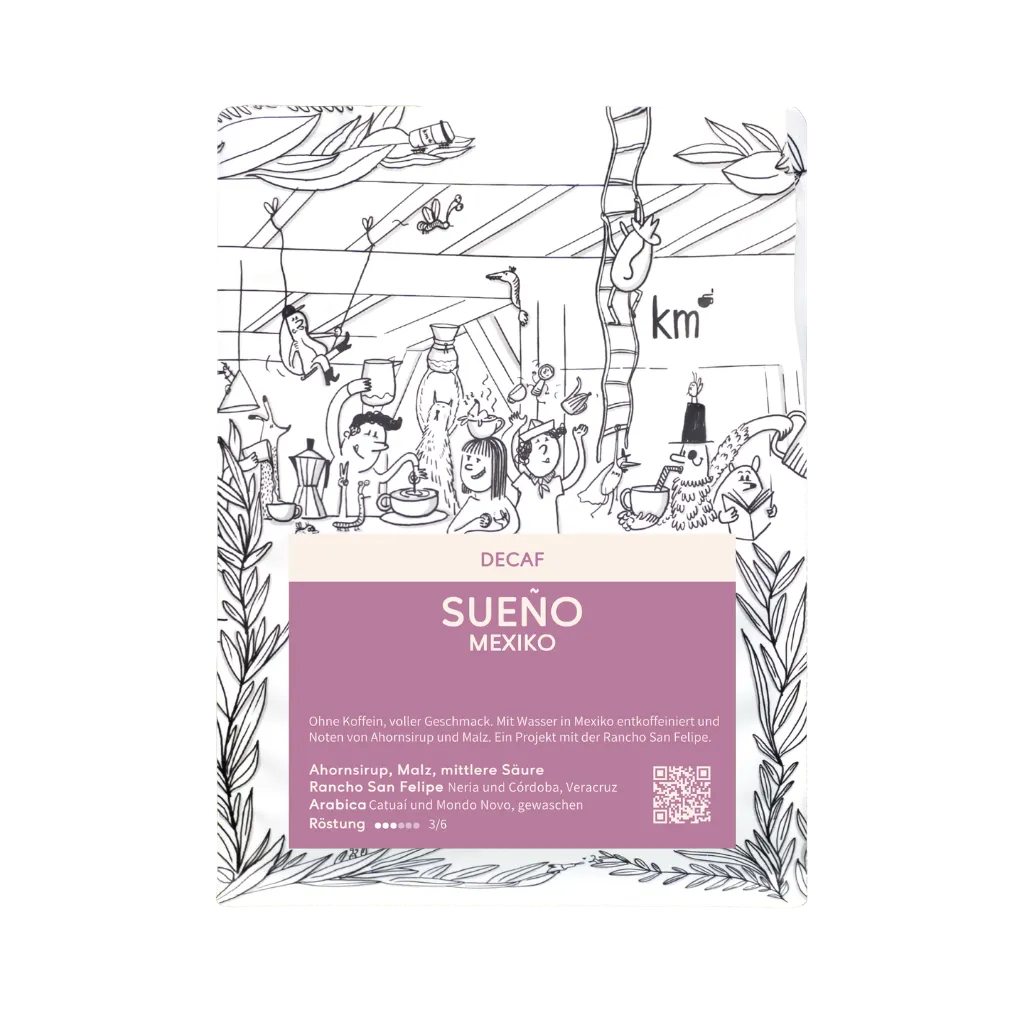
Apas Decaf, decaffeinated espresso from Brazil
The coffee from this test: sweet and cocoa, malt, marzipan and dark chocolate, plus a fine acidity. The reason why we can still experiment in the evening.
In the cup
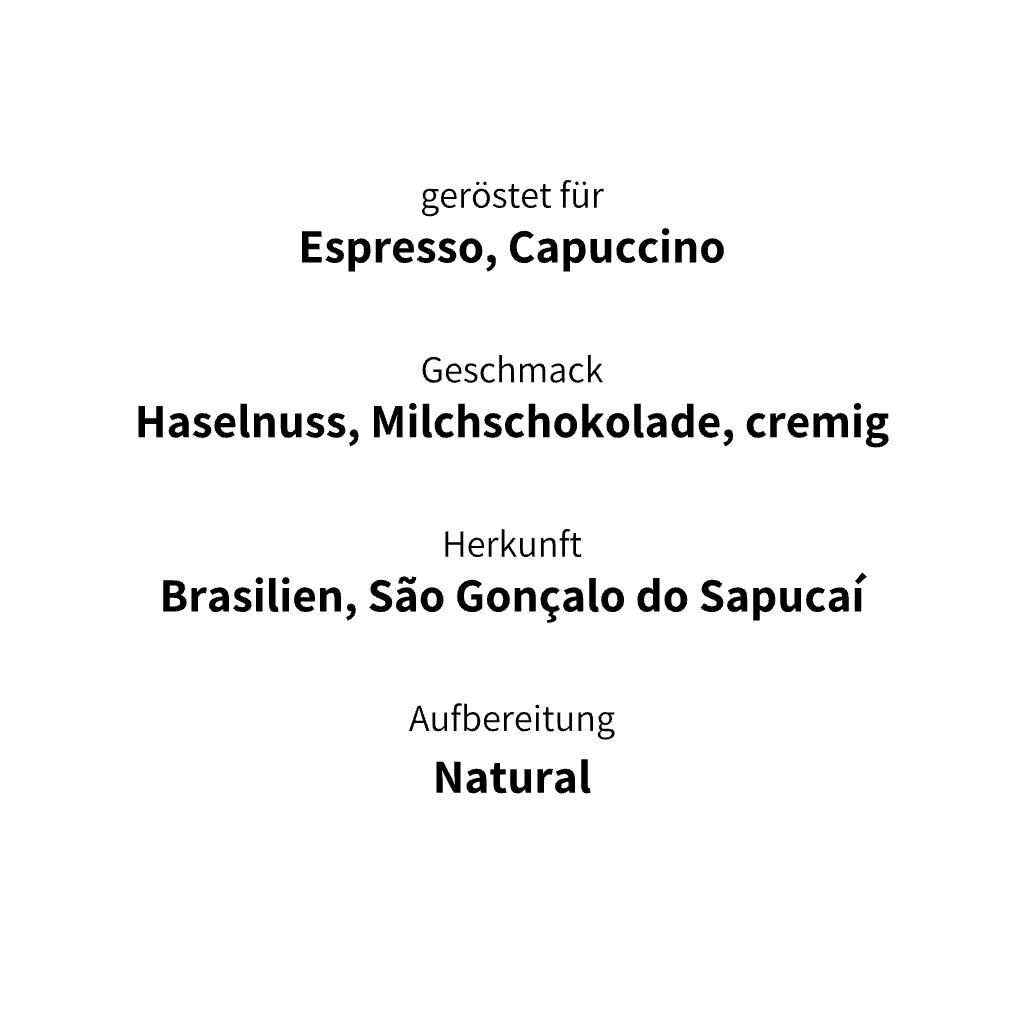
We tasted with our reference coffee, the Apas Espresso from the APAS cooperative from Brazil — in the video in the decaffeinated version. Sweet, cocoa, some malt, marzipan and dark chocolate. The nuttiness remains, plus a fine, subtle acidity. Dense mouthfeel. This matches the measurement: the Mini G builds body and texture, and a certain clarity remains. For classic, more traditional roasts that's exactly right, but light coffees also do well with it.
Conclusion
The Mazzer Mini G is excellently built, grinds excellently into the basket, and grinds espresso that we enjoy in all directions of the spectrum. We've tried light and dark roasts and particularly enjoyed drinking a very good decaffeinated coffee with the Apas Decaf.
Let's put it this way: when the grinder is set and we've made several shots in a row, it's convinced on all counts. The way to setting and the breaks in between, however, significantly disrupted the workflow. The 11.8 gram retention becomes a problem when you haven't made coffee for a while or are adjusting the grinder. Because that means you have to grind out those roughly 12 grams each time before you see the effect of the new grind size in the extraction.
Strengths: Build quality and durability, hard to beat in this price range. The discharge into the basket is fluffy and homogeneous — you can skip a WDT tool.
What's really cool: the Mazzer delivers "honest" grind by weight and shows what actually came out. If it only grinds 17.7 grams, the grinder admits it, and you can add more.
Thermally the grinder is unremarkable at 29.9 °C after five grinds. The grinding noise despite 84.9 dB is pleasant in tone quality.
Weaknesses: 11.8 grams retention. Stiff grind size adjustment where one mark equals four to five seconds. Not very intuitive menu navigation, an app with no apparent added value with translation errors. And pure visual reset isn't enough: 47 µm x50 deviation between T4 and T7.
For whom? For the small commercial setting. Do you have an office with twenty people and a single-group portafilter machine with volumetric dosing? Then the Mazzer Mini G is perfect for you. Want to run a food festival stand with coffee on the side? Or looking for a second grinder for café crème or decaf with 30 to 40 shots a day for a small café? These are the use cases where the Mini G will make a good impression, as well as in a large shared apartment.
The Mini G from Mazzer will impress where it's set once in the morning and then runs. Then the retention barely matters and the robustness shows its full strength.
Not for whom? For anyone pulling two to four espressos a day at home. If you have to grind out roughly 11 grams every time you adjust, you lose exactly the convenience that grind by weight was supposed to provide. For single dosing the grinder is the wrong choice anyway. In our large espresso grinder test you'll find more suitable candidates for home use.
Value for money: For around 1150 francs you get build quality at gastronomic level, a grinding pattern that falls into the portafilter like hardly any other, and a functioning scale. What you don't get: contemporary operation and contemporary retention. We've known the grind size adjustment in this form since 2007 from our old Mazzer Robur. We would have wished development work went there instead of into an app.
Test results: Mazzer Mini G
Assessment according to the KM test protocol for espresso grinders. All measurements taken by ourselves. Single dosing performance corresponds to temporary retention because this amount remains in the chamber after grinding. Particle distribution is deliberately not colored into the assessment because it is roast-dependent.
Technical specifications overview
| Property | Value |
|---|---|
| Price | approx. 1150 francs (MSRP, as of August 2026) |
| Burr size | 64 mm |
| Burr type | Flat, Mazzer 233M |
| Operating mode | Hopper / Grind by Weight |
| Grinding speed | 21.2 g / 10 sec; 9.5 sec for 18 g |
| Volume level | 84.9 dB(A) |
| Grinding temperature | 27.9–29.9 °C (average 28.5 °C; beans 22.6 °C) |
| Absolute retention | 11.8 g (10.6 g temporary, 1.2 g permanent) |
| Consistency (std dev) | 0.11 g over 5 × 18 g |
| x50 espresso (T4 / T7) | 238.9 µm / 191.8 µm |
| Main peak (T4 / T7) | 217.7 µm / 220.6 µm |
| Fines peak (T4 / T7) | 32.1 µm / 40.1 µm |
| x50 ristretto (T5) / café crème (T6) | 196.0 µm / 275.5 µm |
| RPM regulation | No |
| Weight | 10 kg |
| Special features | Grind by Weight, magnetic dosing cup with calibration weight, WiFi and app, firmware tested 2.1.00008 |
As always, we tested this grinder according to our KM protocol and purchased it ourselves. This test was not requested by Mazzer. The cups in the video come from the ceramic studio of Annika Vogler in Lindau on Lake Constance. We bought the cups and love to show cups from small ceramic studios in our videos to support them.