




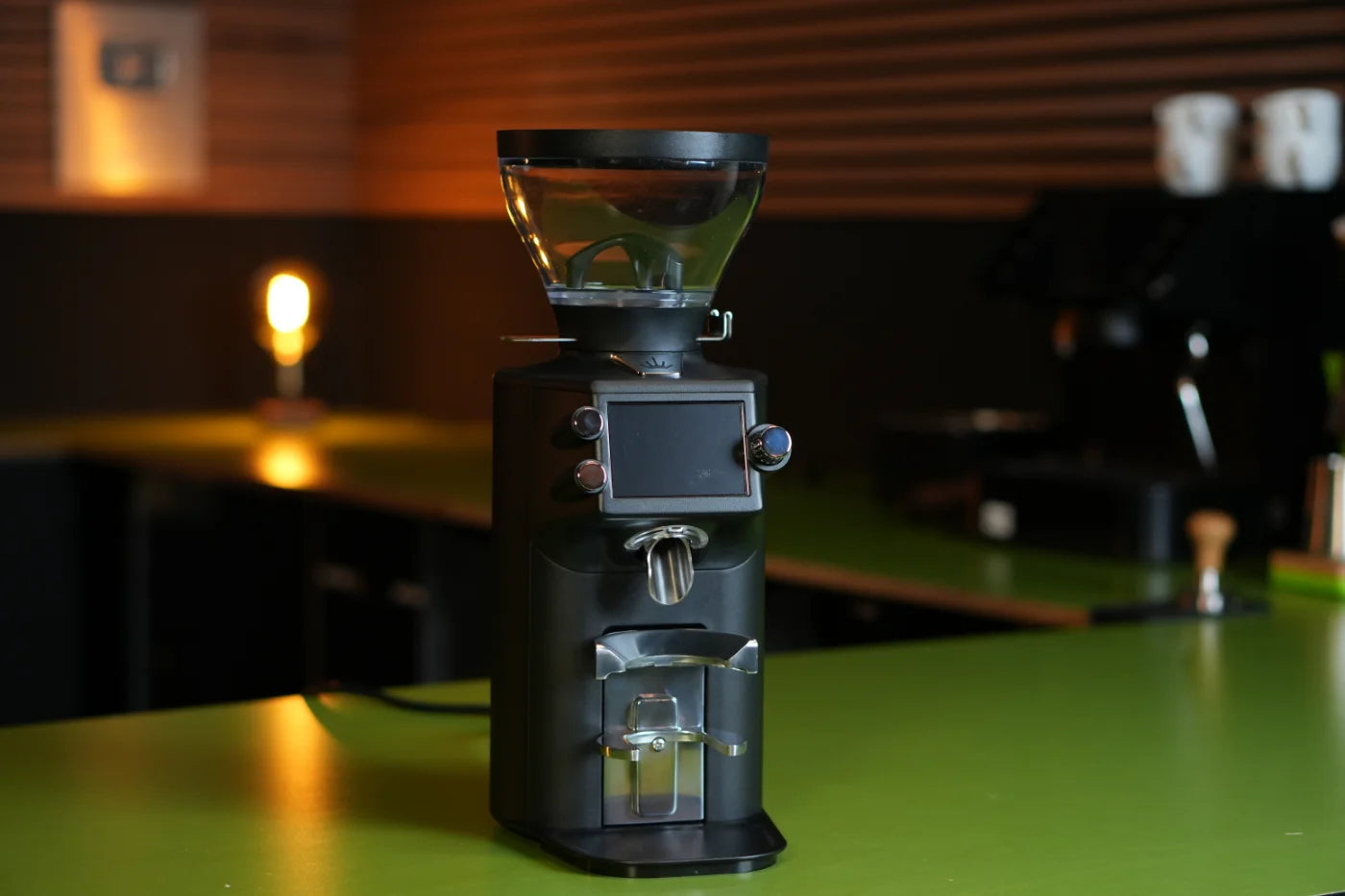

Mahlkönig packs the technology of its E65S gastro grinder into a compact home unit – including Grind by Weight, electronic grind adjustment in micron steps, and a portafilter detection that you won't find in this price range anywhere else. The E64 WS costs 999 EUR, is manufactured in China, and shares its burr chamber with the well-known Mahlkönig SD64. We purchased the grinder and tested it through several iterations.
By now, the third Mahlkönig E64 WS is on our test bench. And gradually, the potential of this small grinder is becoming apparent. Model number three is shaping up to be the most interesting espresso grinder for home use at entry level. If you want to invest 1000 euros and if you're genuinely interested in all the grinder's features.
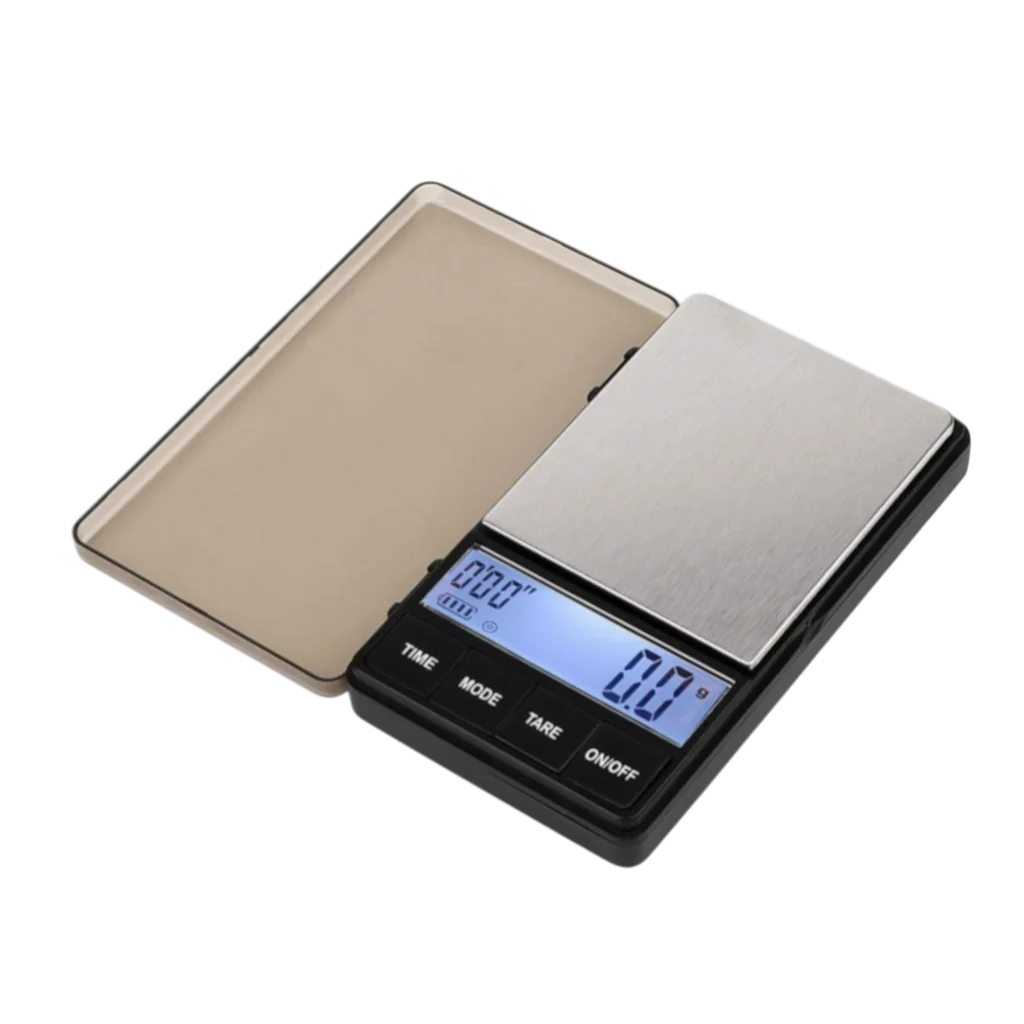
Small note: we tested the grinder on its own and synchronized with the Mahlkönig Sync Scale. In the future, we'll also take a look at synchronization with the Mahlkönig Xenia.

🛠️ Recommended specialist workshop for Mahlkönig E64 WS: Stoll Espresso: [Partner link]
We recommend specialist partners from whom we know they do good work and provide reliable service. When you order through our commission links, you don't pay extra, but we receive a small commission – which we invest directly in new test equipment.
Design & Build Quality
The E64 WS weighs just under 6 kg at 39 cm height and sits stably on the counter. The housing feels solid, the portafilter mount is high-quality and has been revised compared to earlier models. The bean hopper holds 250 g.
What stands out negatively: The buttons feel a bit wobbly, especially compared to what we've seen on other grinders in this price range. And the outlet – actually a feature because it's height-adjustable – still sags slightly at the highest position. Better than the first models, but not yet perfect.
One important point: The original flapper from the first shipments is no good. The static is enormous, coffee sprays in all directions. Mahlkönig now supplies a metal flapper as a replacement – definitely order it from your dealer if you have one of the earlier versions. Newer shipments come with the revised flapper as standard. With the new flapper, the grinder is in a different league: clean, powdery grinding results, few clumps. Without it, working properly is barely possible.
Burrs & Technology
The heart of it: 64 mm flat burrs – the same burr chamber as the Mahlkönig SD64. No RPM control; the motor runs at a fixed ~1,950 RPM at idle.
What sets the E64 WS apart from every other grinder in this price range is the electronic grind adjustment. There's no dial, no ring – everything runs internally via a motor, controlled by the display. The adjustment happens in microns, and the precision is impressive: a single micron? Barely a second's difference in grind setting.
We recommend calibration or zero-point setting right after purchase. In the menu under "Maintenance," you drive the burrs together until you hear the grinding point, and set the zero. Then every E64 WS operates in comparable micron ranges – which allows us as roasters to give you specific grind-setting recommendations that you can use as a starting point. We set our Compadre to 95 Micron, for example. You should find the right grind setting with +/- 10 Micron.
Grind by Weight & Guided Dial-In
The E64 WS is a weighing grinder: insert the portafilter, the integrated scale tares, and the grinder grinds to the set weight. No timer fiddling, no fluctuations from changing grind settings. That's the central advantage over timer-based grinders and why we consider this category the future of home espresso. Making the right grind setting is actually fun this way.
The portafilter detection deserves special mention: You can save different portafilters, the grinder recognizes which one is inserted by weight, and automatically adjusts the recipe. No other grind-by-weight grinder in this price range has this. Practical if you alternate between single and double baskets.
The guided dial-in is the feature we were most curious about. You enter whether your coffee is light, medium, or dark, set your target recipe and brew time – and the grinder adjusts itself. You tell it how long the shot actually ran, and the grinder corrects its grind setting.
Our result: In two to three brews we were in the target range for every coffee. That's impressive. Particularly clever: The grinder anticipates the retention. It knows that after a grind adjustment, old coffee with the previous grind setting still sits in the chamber, and corrects proactively.
But – and this is important – there are unfortunately (still) software limitations: You can't set less than 40 g brew weight for a double shot. That's a problem for anyone working with 36 or 38 g. The input amount is also capped at a maximum of 19 g – if you use a 21-basket, you're out of luck. Mahlkönig has announced they'll fix this via update. Over-the-air updates are possible, which is good news.
Grind Speed & Noise
27.3 g in 10 seconds – a medium speed. For 18 g the grinder takes 7.5 seconds, which is fast and fun in everyday use.
During operation we measure 85.1 dB(A). That's the upper-middle range – audible, but not bone-conduction. For context: a vacuum cleaner is around 80 dB, and the E64 WS is just above that. Still acceptable for the morning kitchen, but if you're noise-sensitive you'll notice it.
Grind Temperature & Consistency
After five consecutive grinds (18 g each, 20-second pause) we measure an average grind temperature of 32.52 °C. That's in the good range – no thermal stress, no problem with multiple shots back-to-back.
0.067 g standard deviation across the consistency measurements. That's excellent. The scale works precisely: 18.0 – 18.1 – 18.0 – 18.1 – 18.2 g. For a grind-by-weight grinder, exactly what we expect. This is where the gastro DNA of the E65S shows.
Retention
The retention is 4.1 g absolute – of which 3.8 g temporary and only 0.3 g permanent. The low permanent residue is positive: barely any coffee sticks permanently in the burr chamber.
But 3.8 g temporary retention – that's noticeable at home. For an 18 g dose that's over 20% of the total amount that's one generation older with each grind compared to the freshly ground. When you pull your first espresso in the morning after a night's rest, those 3.8 g have been ground since yesterday. You can taste that.
For comparison: grinders like the Zuriga or Acaia Orbit are at 0.5–0.7 g. The Fiorenzato Allground at around 6 g. The E64 WS is in between – not catastrophic, but not a highlight either. Retention becomes particularly relevant when combined with the grind-by-sync function: The grinder is supposed to adjust automatically, even after hours of pause. But if almost 4 g from the old grind setting sits in the chamber without being ground out in between, the anticipation becomes more complex. The software solves this surprisingly well – but less retention would make it easier.
Single-Dosing Performance
The E64 WS is not a single-dosing grinder. It's designed as a hopper grinder with grind by weight. The 3.8 g deviation on an 18 g input corresponds exactly to the temporary retention – the grinder simply doesn't output everything that goes in. That's by design and not an error.
If you want to switch between beans, you need to grind out the retention – around 4 g. That works, but is noticeably more cumbersome than with a pure single-dosing grinder.

Particle Distribution
We analyze particle distribution in cooperation with ZHAW using the Retsch Camsizer X2.
The E64 WS shares its burr chamber with the Mahlkönig SD64 – but the results differ. The reason: bean load and presumably the flapper. In hopper operation, the weight of the beans pushes the ground coffee through the burrs differently than in a single-dosing grinder where only 18 g are fed in without pressure from above. We also know this effect from the gastro grinders E65S and E80: when the bean hopper is almost empty, extraction behavior changes.
Espresso Setting (T4):
x50: 289.8 µm
Fines fraction (Qf <100 µm): 32.2 %
60%-Peak Width: 265.4 µm
For comparison – the SD64 in single-dosing mode achieves a main peak of 209 µm at T4. The E64 WS at 265 µm is noticeably wider. The fines fraction at 32% is similarly high, providing body and density – but the wider main peak means less homogeneous extraction.
What does that mean in the cup? The E64 WS plays to its strengths with medium to dark roasts: body-forward, dense, with integrated sweetness. For these coffees the particle distribution is good. But if you're chasing maximum clarity and transparency in the super-light specialty range, you'll get the narrower, more homogeneous grind from the SD64. For the target audience of the E64 WS – a grinder with assistance functions that makes entry easier – that's not particularly problematic. Most coffees you'll grind with it will be in the medium roast spectrum. And it delivers there.
Grind Setting Replicability
In the adjustment test: Espresso (T4), Ristretto (T5), Lungo (T6), back to Espresso (T7). The grinder was visually reset to the starting mark of T4.
The x50 value deviates between T4 and T7 by around 34 µm (289.8 vs. 256.0 µm). The fines fraction also shifts from 32 to 35%. That's more than we'd expect from a grinder with electronic micron adjustment. However, we can only document this result with one measurement series. So we measured again.
In the practical test with fixed extraction time, a more nuanced picture emerges: At 95 microns and 27 seconds, the grinder reliably delivers 44–48 ml in the morning. After an adjustment to 50 microns (Ristretto) and return to 95 microns the result remains stable. Even after a three-hour pause without adjustment: 46 ml with the same recipe. Only with larger adjustments (103 microns and back to 95) do outliers appear – 53 ml instead of the expected 46. The next shot then settles back in.
The grinder replicates overall well, but not as well as you'd expect from electronic grind adjustment. Occasionally the micron display shows a different value after powering off and on than before. Occasionally there are unexplained deviations. Maybe that's exactly what happened during our particle distribution measurement.
That's a weakness at the current software level. In everyday use it means: After larger adjustments, it's worth checking the first shot and adjusting if needed. For small adjustments in the espresso range, replicability isn't an issue.
Software & Operation
To put it bluntly: the E64 WS's software isn't finished yet.
Boot time is around 30 seconds – an eternity when you want your espresso in the morning. The display responds with noticeable latency. Settings you've saved in a recipe are occasionally not applied. A grind setting is assigned but the grinder doesn't move to it. That's frustrating.
The WLAN connection to the optional scale (Mahlkönig Sync Scale, around 200 EUR extra) works, but setup literally put us on the edge of our seat: grinder to WLAN, scale to WLAN, assign scale to grinder, set mode on the scale. There are Mahlkönig videos for this, and once you understand it, it works. Intuitive it's not.
The scale itself offers multiple modes. If you already have a scale, the added value is limited. Automatic timing starts at the first drop in the cup, not at the brew start. So you're forced to time it yourself anyway, along with the machine. The scale transmits this information to the grinder automatically when connected. And in sync mode, the grinder adjusts itself, compensating for the espresso shot by adjusting its grind setting.
Mahlkönig can push updates over the air. A lot of what's glitchy now is software – and therefore fixable. But as it stands today, you're buying a grinder that has some maturing to do.
Tasting
In the cup, the E64 WS delivers what the particle distribution promises: structured, clear espressos with pronounced sweetness and nice crema. The versatility of the 64 mm burrs shows across different roasts – from our Apas Espresso through medium-light specialty roasts to darker blends, we've achieved consistently positive results.
Dialing in espresso with the guided dial-in is surprisingly quick: two to three shots, then the recipe is set. That's faster than most of us manage manually. If you normally need eight tries to dial in a new coffee, you'll appreciate that.
Conclusion
The Mahlkönig E64 WS is the most feature-rich grinder we've ever tested – and at the same time, one that isn't completely finished yet.
Strengths:
- Electronic grind adjustment in micron steps: precision you won't find in this price range elsewhere
- Guided dial-in with intelligent algorithm that anticipates retention
- Portafilter detection with recipe memory
- Excellent dosing consistency (0.067 g std dev)
- Particle distribution versatile – light to dark
Weaknesses:
- Software still buggy: latency, occasionally ignored settings, long boot time
- 4.1 g retention – noticeable at home, especially on first shot after breaks
- Software limitations in recipe input (min. 40 g brew weight, max. 19 g grounds)
- Flapper on earlier versions (must be ordered), now comes standard
- WLAN setup cumbersome
For whom? For home baristas who want a weighing grinder and don't want to dial in the grind manually. Especially for beginners who feel uncertain about dial-in – here the grinder really takes work off your hands. And for anyone who finds Mahlkönig's vision of a connected chain of grinder, scale, and espresso machine (Xenia) exciting and wants to get in early.
For whom not? If you want single dosing and switch beans daily, you're better off with the SD64 or other single-dosing grinders. If you expect a grinder that works completely polished on day one, you might be frustrated. And if you expect perfect build quality down to the last button for 999 EUR – the buttons show where corners were cut.
Value for Money: For 999 EUR you get gastro technology in home format: GbW, electronic grind adjustment, portafilter detection, OTA updates. Nobody else in this price range offers that. The question is how much patience you have with software that's still maturing. We're at 85 percent. And we'd buy the grinder anyway.
This grinder won't be on our test bench for the last time. We're testing the connection to the Mahlkönig Xenia and seeing what the next updates bring. The potential is there.
If everything Mahlkönig has set out to do here succeeds, then for this price the E64 WS is an almost unbelievably good offer. The promise is: assisted brewing. A grinder that guides you to the perfect espresso.
Manufacturers like Maro have done it at the espresso machine level. Mahlkönig is following at the grinder level. In how this grinder is engineered, a real statement and already almost where it could be.
Test Results: Mahlkönig E64 WS
Technical Specifications at a Glance
| Price | 999 EUR (MSRP, as of February 2026) |
|---|---|
| Burr Size | 64 mm |
| Burr Type | Flat (parallel flat) |
| Operating Mode | Hopper (Grind by Weight) |
| Grind Speed | 27.3 g / 10 Sec (Hopper) / 7.5 Sec for 18 g |
| Noise Level | 85.1 dB(A) |
| Grind Temperature | 32.52 °C (Average, 5 × 18 g) |
| Retention Absolute | 4.1 g (of which 3.8 g temporary, 0.3 g permanent) |
| Single-Dosing Deviation | 3.8 g (not a single-dosing grinder) |
| Consistency (Std Dev) | 0.067 g |
| x50 (Espresso T4) | 289.8 µm |
| Fines Fraction Qf <100 µm | 32.2 % |
| 60%-Peak Width | 265.4 µm |
| RPM Control | No (fixed ~1,950 RPM idle) |
| Weight | 5.8 kg |
| Dimensions | 39 × 21.8 × 15.4 cm (H × D × W) |
| Bean Hopper | 250 g |
| Special Features | GbW, Grind by Sync (Xenia connection planned), electronic grind adjustment in microns, portafilter detection, guided dial-in, OTA updates, WLAN |