



























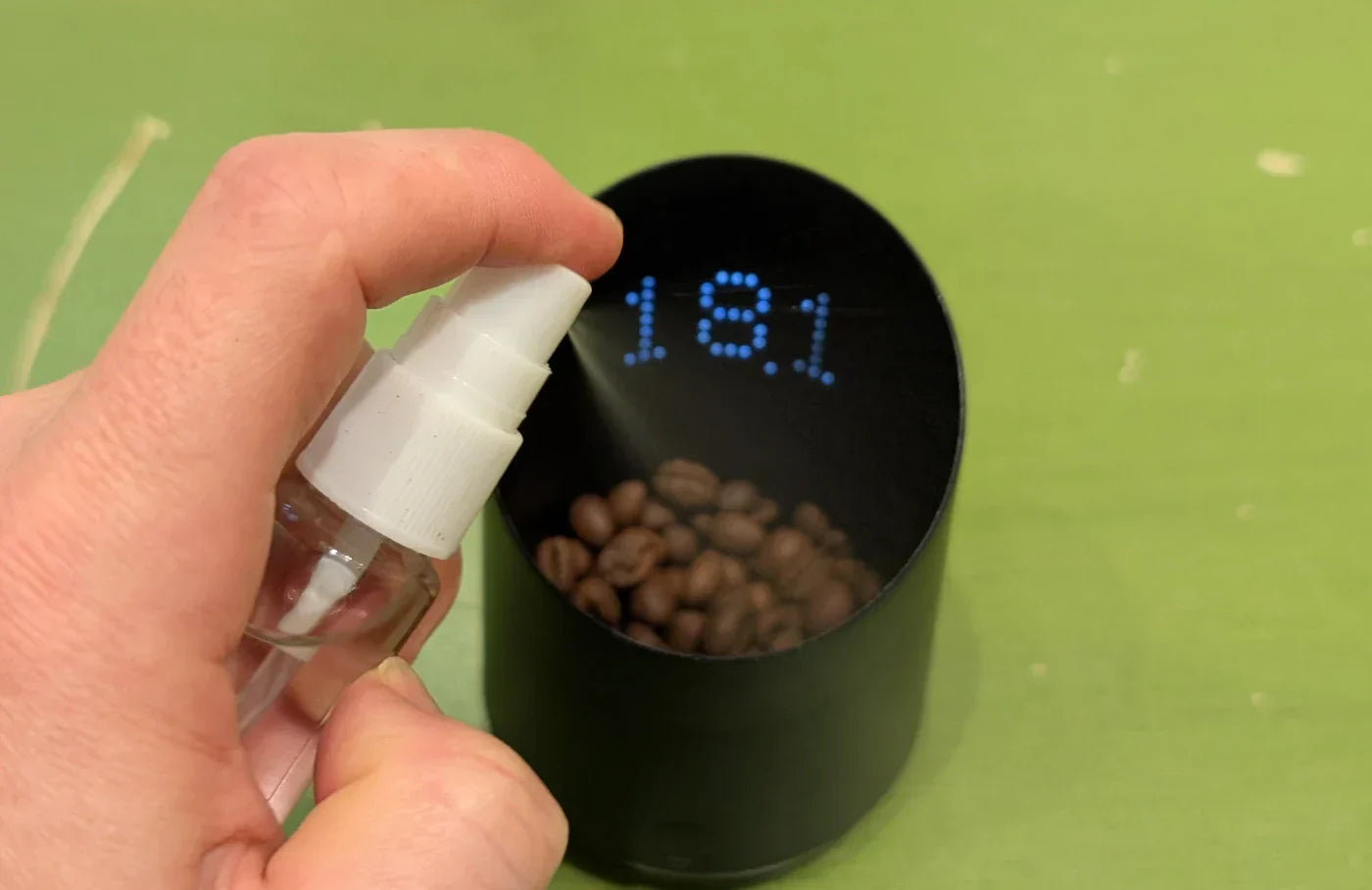

Static charge in ground coffee is to blame when ground coffee doesn't slide into the portafilter or dosing cup, but instead sticks to the grinder body or chute. This happens especially with single-dose grinders, but grinders with bean hoppers can also have static issues. However, static charge doesn't just create a dirty work environment, it can also negatively affect espresso extraction. But a simple method can help: a spray of water on the beans before grinding.
This technique is called the Ross Droplet Technique (RDT) and was introduced in 2005 by David Ross in the Home Barista Forum. Since then, it has been refined and scientific studies on the topic have been published. In this article, you'll learn how to apply RDT, which studies underlie it, and how static charge is created.
How RDT Works
- After weighing the coffee in the dosing container, 2-3 drops of water are added.
- A spray bottle works best for distributing the water evenly.
- The container is gently shaken to distribute the water over the beans.
- After that, grinding can begin.
Studies show that 0.1 - 0.2 g of water per 18 g of coffee is enough to significantly reduce static charge. This means less coffee gets stuck in the grinder and the ground coffee is distributed more evenly.
Why Does Static Charge Occur?
Static charge during coffee grinding occurs through two main mechanisms:
- Triboelectrification: Friction between coffee particles and grinding tools generates electrical charge.
- Fractoelectrification: When coffee beans break, charge shifts occur at the fracture points.
This charge causes fine coffee particles to stick to larger particles and form agglomerations (clumps). The different charges (positive and negative) cause the particles to attract each other and form electrically neutral aggregates. As a result, the density of the coffee bed is distributed unevenly – areas of high density and areas of empty space are created, making even extraction difficult.

Influence of Coffee Type, Roast Level, and Humidity
- Moisture content of beans: Beans with less than 2% moisture tend to be negatively charged, while more humid beans are more positively charged.
- Roast level: Darker roasts produce stronger negative charges than lighter roasts.
- Particle size: Smaller particles (<100 μm) tend to be negatively charged, while medium-sized particles (100-300 μm) are more positively charged.
- Ambient humidity: Higher humidity (>60%) reduces static charge.
Scientific Findings on RDT
- Reduction of static charge leads to less coffee deposits in the grinder.
- Fine coffee particles remain better distributed, making extraction more homogeneous.
- However, the scientific evidence on extraction improvement is inconclusive. Some experiments show increased extraction, while others found no significant differences.
Probably the most comprehensive study by Méndez Harper et al. (2024) showed that moisture is a central factor for static charge. Beans with less than 2% moisture content tend to have a negative charge, while more humid beans are more positively charged. This explains why different roast levels are charged to different degrees.

Is RDT Safe for the Grinder?
A frequently discussed point is whether water in the grinder can cause long-term damage. However, studies and practical reports suggest that the small amount of water evaporates quickly and leaves no moisture residue. Moreover, many roasteries industrially add up to 5% water per kilogram of coffee – significantly more than the 1 - 1.5% with RDT (0.1 - 0.2 grams per 18 grams of coffee).
Conclusion
RDT is a simple and effective method to reduce static charge when grinding. It provides a cleaner work surface, more even distribution of ground coffee, and can have a positive effect on espresso extraction. While scientific studies have yet to provide clear evidence of improved extraction, the practical benefit for many home users and professionals is clear: Less static charge means more control over the grinding process and more enjoyable coffee preparation. And if it's more fun, you'll taste it in the cup afterward too.
Sources and further reading:
- "Moisture-controlled triboelectrification during coffee grinding" by Joshua Méndez Harper, Connor S. McDonald, Elias J. Rheingold, Lena C. Wehn, Robin E. Bumbaugh, Elana J. Cope, Leif E. Lindberg, Justin Pham, Yong-Hyun Kim, Josef Dufek, and Christopher H. Hendon
-
"A study of espresso puck resistance and how puck preparation affects it" Jonathan Gagné, Coffee ad Astra
-
"Assessing the impact of RDT on espresso extraction" by Jeremy and Joe from Socratic Coffee
-
"BETTER WAY TO GRIND COFFEE: Deep Dive on New Hendon Paper" by Lance Hedrick


