




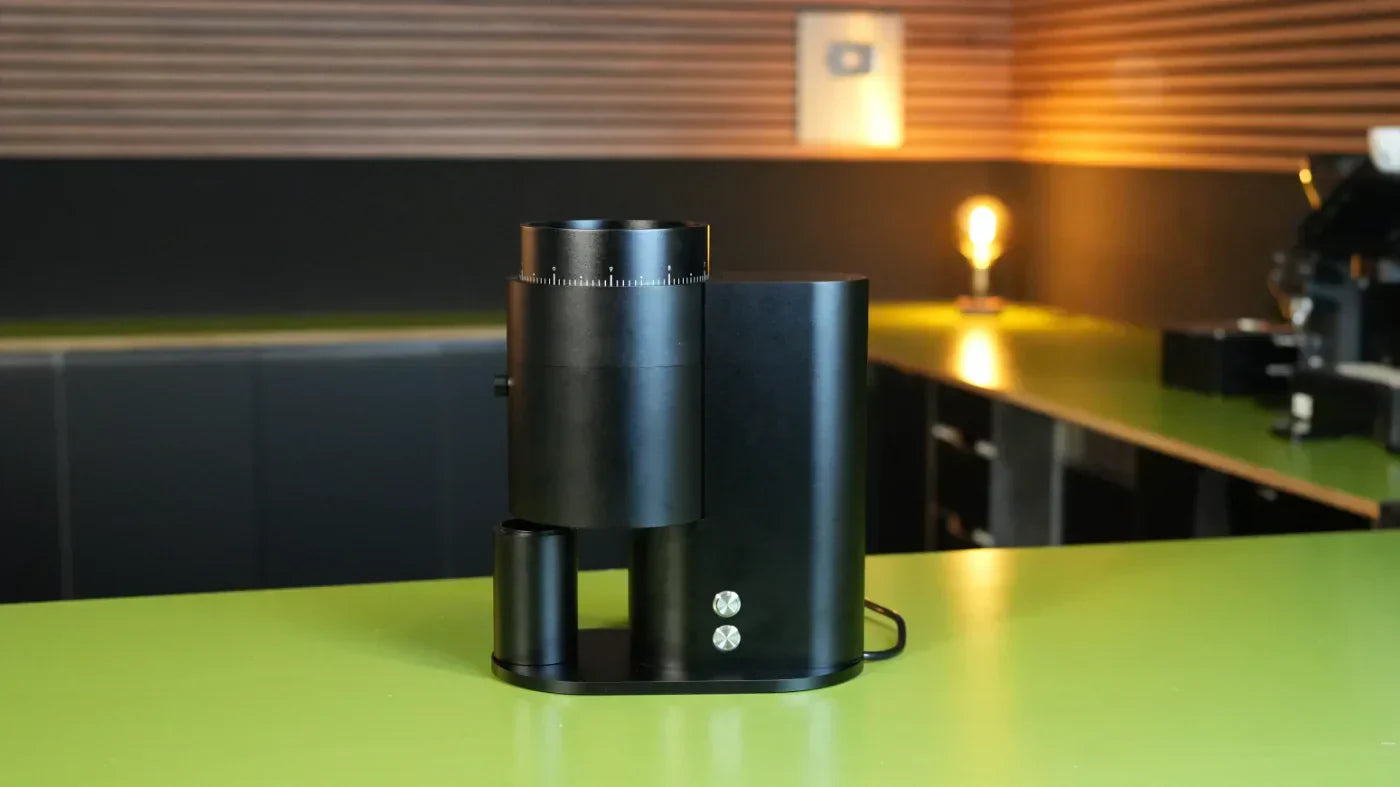

2,999 euros, 2,999 francs. The Option O Lagom O1 is the most expensive single-dosing grinder we've tested so far, and at the same time the official filter coffee grinder of the World Brewers Cup Championship 2026–2029. An evolution of the P100, in our version with 102mm Mizen 102OM burrs (blind burrs), stepless RPM control from 200 to 1,700, and a weight that would make some espresso machines jealous: 15.3 kg.
We didn't buy this grinder. We borrowed it from Urs Rotzinger, the German Brewers Cup champion, who used the O1 on his path to the world championship. Thanks, Urs.
The question hanging over this test: What justifies 3,000 euros for a grinder?
Design & Build Quality
The Lagom O1 is not a design piece – at least we don't think so. It's a robustness statement. 15.3 kg of CNC-milled 6061-T6 aluminum, 17 cm wide, 30 cm deep, 36 cm tall. No elegance like the P64 or Casa, but a grinder that feels like it was built for the next twenty years.
The build quality is what we're used to from Option O: everything solid, everything well-thought-out. The burrs are almost tool-free to access – lift the top, turn, remove. Technically you need a thin pin to release them, but that's as close to tool-free as we get, so we rate the cleaning option as very good. More importantly: after reassembly, you're back at exactly the same grind setting. No recalibration needed.
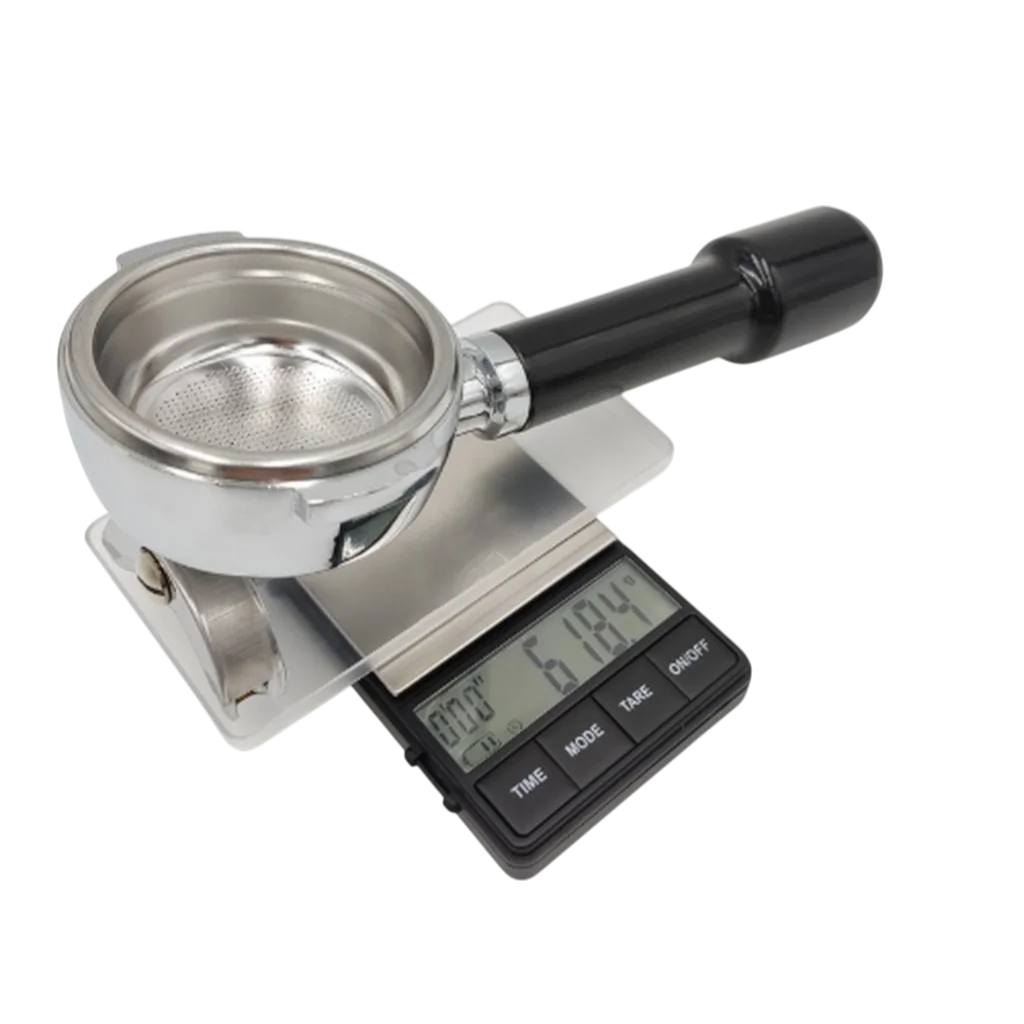
The magnetic dosing cup (50 g) sits neatly. However, it's quite large so it reaches under the chute. That makes it functional, but takes away the elegance of working with it. Much more pleasant: the included portafilter holder, which snaps in magnetically and directs the coffee directly into the portafilter.
Grinding Mechanism & Technique
Mizen 102OM flat burrs, in the version as blind burrs. The burrs are screwed in from the back, which shows in the homogeneity of the ground coffee. The RPM control ranges from 200 to 1,700 rpm, adjustable via a scale from 1 to 9. This range is massive and opens up an enormous field of play for both filter coffee and espresso.
Low speeds typically deliver narrower main peaks in particle distribution and more clarity, high speeds more body. More on this in the PVM section shortly.
The grind adjustment is stepless, each main line moves the burrs by 7.5 micrometers. Between espresso and filter coffee is less than a full turn. This makes adjusting the grinder very pleasant and also allows better findability of the grind setting. With other grinders you have to note down how many times the 1 passed the marking when switching from espresso to filter coffee. Integrated are a knocker against residue in the chute and a purge function that briefly increases the RPM at the end of grinding to blow out the temporary retention.
Buy Option O Lagom O1
🛠️ Recommended specialist retailer for Option O Lagom O1 in Germany: coffee24*
In Germany you can get the grinder via coffee24.de, but currently only with SSP HU burrs, which have an even narrower main peak. Suitable for absolute high specialty.
*We search for specialist partners you can trust, whom we know do good work and provide good service. We are in close contact with retailers. These are affiliate links. If you order via this link, it won't cost you more, but we receive a small commission that we invest in new test equipment.
Grinding Speed & Noise
75 g in 10 seconds. 18 g in 4 seconds. At espresso grind setting. These are values we normally see from the upper class of commercial grinders. The motor (peak 1,300 W, brushless DC) and the large burrs make this possible.
The downside: 89.2 dB. The O1 is loud. Not an annoying whining, more of a turbine sound that ramps up briefly and stops. We're at the border between our medium and loud range.
The consolation: At 4 seconds of grinding for an espresso, the noise is gone quickly. But if you want to grind early in the morning in an apartment while others are sleeping – you should know this.
Grinding Temperature & Consistency
In the temperature test (5 × 18 g, 20 seconds pause each), we stay consistently under 30.5 °C. The average is 29.3 °C. Despite the enormous speed, no significant heating. Top category.
What this means practically: You can grind multiple portions in succession without losing volatile aromas through heat. For light roasts, where thermal stress quickly becomes noticeable, this is relevant.
The consistency confirms the picture: 0.04 g standard deviation over 15 consecutive grinds. Excellent. The O1 reliably dispenses the same amount, grind after grind.
Retention
Retention with 102mm burrs is the most interesting measurement. The grinding chamber of the O1 offers plenty of air space between the drive pins – with a classical grinder of this size you would face double-digit gram values.
We measured retention in two configurations:
Without purge function (start-stop): 0.7 g temporary, 0.1 g permanent, 0.8 g absolute.
With purge function (auto mode): 0.4 g temporary, 0.1 g permanent, 0.5 g absolute.
0.5 g absolute retention at 102mm burrs. That's really impressive. We wouldn't have been surprised by much higher values. The design of the drive pins and the purge function push the value to a level that many significantly smaller grinders don't reach.
Single-Dosing Performance
18 g in, 18 g out. Over five consecutive grinds we measure deviations between 17.9 and 18.0 g, provided the purge function is active.
The built-in anti-static works remarkably well. Unlike the P64, which is barely usable without water spray, you can operate the O1 without RDT just fine. A bit of static at the edge of the dosing ring, but nothing that disrupts the workflow.
With RDT the output amount rises minimally above 18 g (18.1–18.2 g), because water adds weight.
If you want to grind directly into the portafilter: The included portafilter holder is the more pleasant way. Magnetic, cleanly positioned, the coffee lands where it should. Really nicely made, this holder. And a real design advantage that the coffee falls from top to bottom into the portafilter, not down a slanted chute like most espresso grinders.
Grind Setting Replicability
In the adjustment test (espresso → ristretto → lungo → back to espresso), the O1 shows what stepless adjustment and mechanical precision are worth.
The peak width at T4 (espresso initial setting): 183.9 µm. After the complete adjustment sequence back to espresso (T7): 182.5 µm. A deviation of 1.4 µm – practically identical. You arrive back exactly where you started.
The x50 value deviates between T4 (274 µm) and T7 (287 µm) by around 12 µm, which is within normal variation.
What this means for everyday use: If you switch between espresso and filter, you don't need to recalibrate after resetting. The grinder delivers reproducibly. Very good.
Particle Distribution
We analyzed particle distribution in cooperation with ZHAW using the Retsch Camsizer X2.
Espresso setting (T4):
x50: 274 µm | Fine portion (Qf <100 µm): 32.7 % | 60% peak width: 184 µm
A peak width of 184 µm is tight. The ground coffee is homogeneous, extraction accordingly even. In the cup this shows as clarity and structure – the espresso doesn't feel "scattered". For comparison: From around 300 µm peak width we regularly experience espressos where individual flavor notes fall apart.
The fine portion of 33% provides enough body without overloading the espresso. This works for medium-light roasts as well as more classic profiles. For those who prefer very light, complex roasts: With lower RPM the fine portion can be reduced further.
RPM Comparison (Filter Coffee):
We also tested the O1 in filter coffee operation with two RPM settings: minimum (200 rpm) and maximum (1,700 rpm). Both cups are clean and balanced. The low speed delivers a narrower peak, more clarity, less bitterness. The high speed brings a bit more body, but a slightly drier finish.
However, even at maximum RPM the O1 has so much clarity through the tight particle distribution that the difference is more subtle than expected. Both settings work. The RPM control is a tool for fine-tuning, not mandatory.
Tasting
In the cup, the O1 shows what the particle distribution promises: clarity. That's the word that comes to mind most often with this grinder.
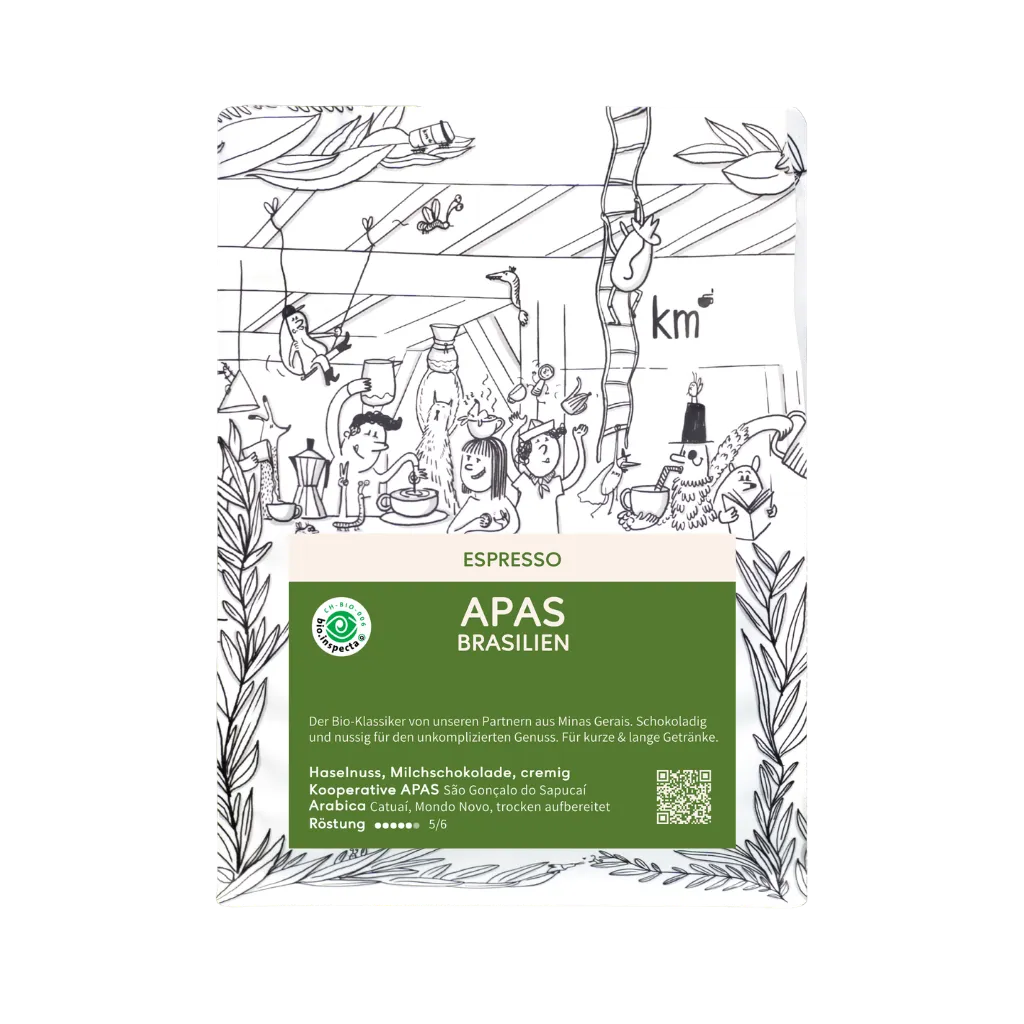
Espresso with the Apas (our reference coffee): Lots of sweetness, soft texture, clear acidity without sharpness. The body is rather on the softer side – no heavy, pressing espresso. This works with medium-light roasts but can also be dialed in cleanly with slightly darker profiles.
In the filter coffee test (Amigo): Surprisingly low bitterness, a clean cup with lots of balance. Both RPM settings deliver cups that the grinder doesn't limit.
And then there was a light, complex coffee from the Coffee Maker orange line called Yulieth. Extreme clarity, lots of sweetness, lively acidity. The grinder pulls the maximum out of such coffees without over-extracting.
Filter Coffee
The O1 is the official WBrC grinder 2026–2029. That's no coincidence. If you see filter coffee as your main application, you get a grinder that grinds quickly and temperature-stably even at 40 g for batch brew.
The combination of speed, RPM control, and tight particle distribution makes the O1 interesting for filter coffee use in hospitality. Even more so at home – if space isn't an issue.
The limitation: No whole bag fits under the grinder to run through. If you want to grind entire packages for customers, you need a different solution.
Conclusion
The Option O Lagom O1 is the benchmark in most measurement categories among grinders we've tested so far. 0.5 g retention at 102mm burrs, 29.3 °C grinding temperature at 75 g/10 sec, 0.04 g standard deviation, peak width of 184 µm, nearly perfect replicability. The numbers speak a clear language.
Strengths:
– Particle distribution and cup quality at benchmark level
– Retention for this burr size outstanding
– Temperature, consistency, speed: top in every category
– RPM control as a tool for flavor management
– All-purpose (espresso + filter) within one turn
– Anti-static works without RDT
Weaknesses:
– 89.2 dB: loud
– 2,999 EUR/CHF: high entry price
– Design functional, not elegant
– Dosing cup handling somewhat clunky
For whom?
High-end home baristas who want a grinder for espresso and filter coffee without compromises on particle distribution. For specialty hospitality as a filter coffee grinder or as a single-dosing solution with high throughput.
For whom not?
Anyone looking for an elegant, quiet grinder for the kitchen counter. Anyone who can't or won't invest 2,999 euros in a grinder. Anyone who already has a specialized espresso grinder and doesn't make filter coffee.
If the O1 cost 1,500 euros, the recommendation would be clear for everyone who wants both. At 2,999 euros it's an investment you have to make consciously. But what you get for it is hard to beat right now. However, to be honest, the qualitative difference to some grinders in the 1,400–2,000 euro price range (like the DF83 V2) is mainly the speed. Qualitatively and sensorially, good grinders with good burrs don't differ much from each other.
Of course you can order the grinder directly from Option-O.
🛠️ In Germany you can get the grinder via coffee24.de [affiliate link], but currently only with SSP HU burrs, which have an even narrower main peak. Suitable for absolute high specialty.
We recommend specialist partners we know provide good work and reliable service. When you order via our affiliate links you don't pay more, but we receive small support – which we invest directly in new test equipment.
Test Results: Option O Lagom O1
Technical Specifications at a Glance
| Price | 2,999 EUR / 2,999 CHF (RRP, as of 2026) |
|---|---|
| Burr Size | 102 mm (98/102 mm inner/outer) |
| Burr Type | Flat (Mizen 102OM Blind Burrs) |
| Operating Mode | Single Dosing / Hopper (300 g) |
| Grinding Speed | 75 g / 10 Sec | 18 g in 4 Sec |
| Noise Level | 89.2 dB(A) |
| Grinding Temperature | 28.3–30.2 °C (average 29.3 °C) |
| Absolute Retention | 0.5 g with purge (0.4 g temp. / 0.1 g perm.) |
| Retention without Purge | 0.8 g (0.7 g temp. / 0.1 g perm.) |
| Single-Dosing Deviation | 0–0.1 g (with purge) |
| Consistency (Std Dev) | 0.04 g |
| x50 (Espresso T4) | 274 µm |
| Fine Portion Qf <100 µm | 32.7 % |
| 60% Peak Width | 184 µm |
| RPM Control | Yes (200–1,700 rpm, scale 1–9) |
| Weight | 15.3 kg |
| Dimensions (W × D × H) | 17 × 30 × 36 cm |
| Motor | Brushless DC, peak 1,300 W |
| Material | 6061-T6 CNC Aluminum |
| Special Features | Purge function, integrated anti-static, knocker, portafilter holder, stepless (7.5 µm/tick) |
You can find all our espresso grinder tests in the espresso grinder overview.