








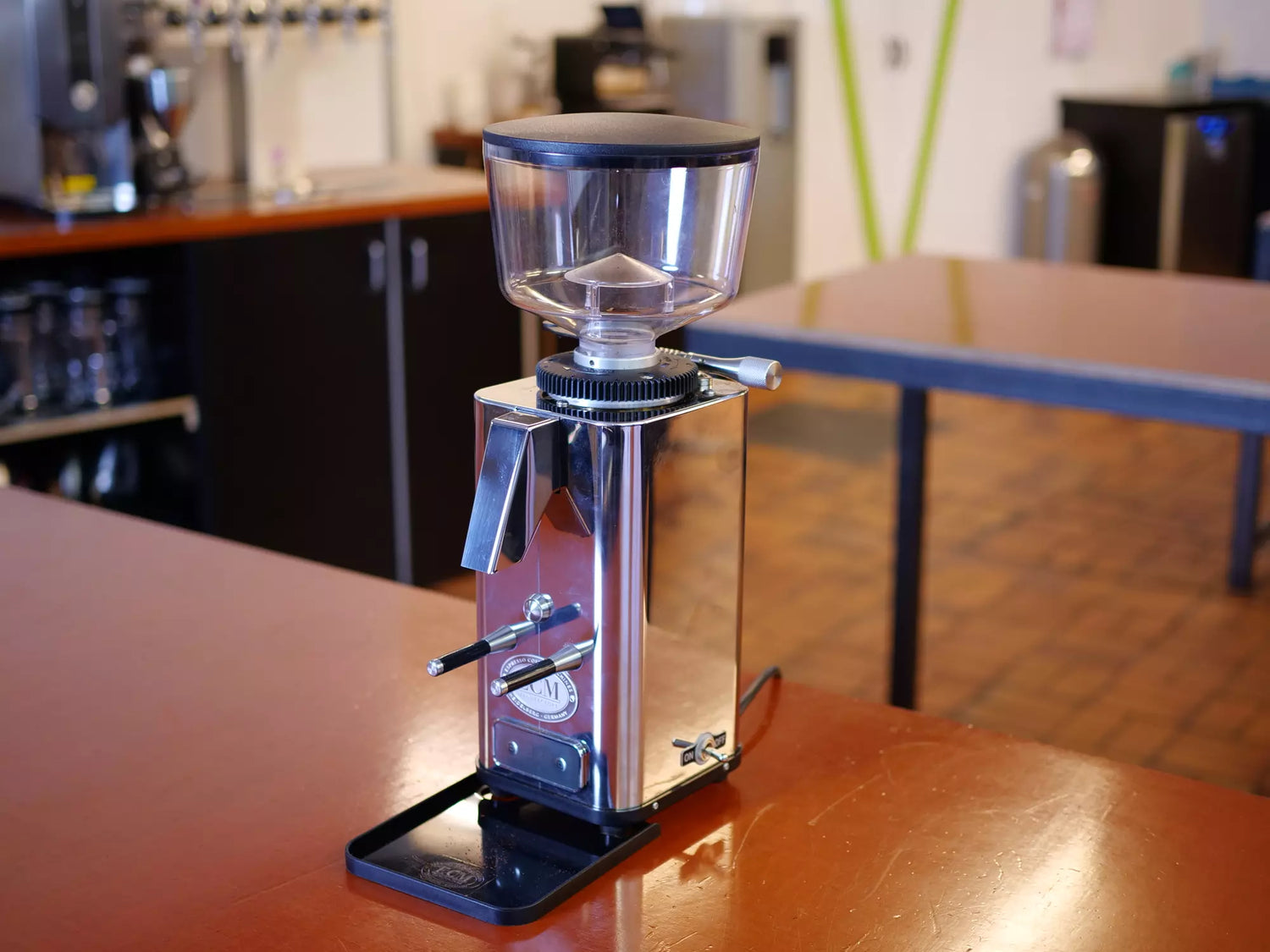

The ECM-S Automatik 64 impresses us with good espresso. That's the good news first and foremost. Unfortunately, it leaves some potential on the table along the way. In our comprehensive espresso grinder test, we examined the ECM S-64 compared to 23 other espresso grinders. In this article, we summarize the most important results of our test.
We conducted the test again with our Apas espresso. You can find it here in Switzerland and here in Germany.
Buy ECM S-Automatik 64
The following specialty retailers stock the ECM S-Automatik 64 and we can recommend purchasing from these businesses. All offer the possibility to adjust the machine's offset.
Germany: [Partner links] Stoll Espresso, Lücke
We search for specialist partners on your behalf, partners we know provide good work and excellent service, and we maintain close contact with the mentioned retailers. The links are what we call commission links. If you order through one of these links, you won't pay a single cent more – however, we receive a small commission that we invest directly in new test equipment.
We continue to search for competent partners in the DACH region on your behalf.
First Impression, Material and Appearance
A narrow, tall and beautiful espresso grinder shines at us when we first unpack it. And at first glance, we like almost everything about the ECM S-Automatik 64. The grinder weighs a solid 6.9kg, which stands on perfect feet. Why perfect? They absorb the vibration of the grinder, give slightly, yet remain stable. This also means that the grinder, at 77.9 decibels, ranks among the quietest in the test field.
The high gloss of the polished stainless steel remains, but becomes garnished with numerous fingerprints over the course of testing. Home baristas will have to get used to this as well. It's virtually unavoidable with the ECM S-64. A width of 16cm, a depth of 250cm and a height of 41.5cm make the espresso grinder appear slim and elegant. The S-64 doesn't push itself to the foreground next to an espresso machine but rather takes a step back.
The grinding burrs of the ECM S-Automatik 64 have a diameter of 64mm and are made of hardened steel. The burr grinder can be adjusted continuously. Adjustment works well and precisely - even if it's difficult to read the exact grind size. Small changes in grind size already lead to large changes in particle size. Always adjust slowly!

The programmability of the grinder suffers somewhat from the old, somewhat fiddly controls. These always jump out of the setting of the two programming buttons if you don't work quickly. ECM has relied on similar technology for many years that works well and produces no errors, but it does restrict user-friendliness somewhat. (Clearly visible in the video from minute 20:30 onwards.)
Single Dose Grinder? Not a Chance!
The ECM S-Automatik 64 cannot convince as a single dosing grinder. It simply wasn't built for that. The most important counterargument is the enormous retention. With 12.2 grams of measured retention, the ECM S-64 sets a negative exclamation mark. As a reminder: retention means that ground coffee sits around the grinding burrs and in front of the grinding output, which is not ejected with the current grind. Instead, the ground coffee gets stuck and is only pushed out during the next grind by the ground coffee pressing forward from behind.
The ECM S-64 functions more like a dosing grinder with storage and not like a direct grind grinder. Up to 12 grams of coffee from the current espresso will be prepared with "old" coffee if the grinding chamber is not completely ground out before pulling the shot. Of course, this is not necessary if multiple shots are pulled in succession. Especially at home, this is often not the case, so either 12 grams of good coffee are lost or become part of the fresh espresso as old coffee. And remember: within less than an hour, we lose over 50% of volatile aroma components after grinding.
Unfortunately, with this grinder, the bean hopper also cannot be easily removed and the coffee cannot be easily swapped. Our barista trainer Michel Aeschbacher could only remove the bean hopper with considerable force. ECM signals here quite clearly: the grinder is rather not intended for regular bean changes. In fact, when the grinder came to market a few years ago, this was less of an issue. However, bean hoppers also need to be cleaned regularly. That's doubly unpleasant when removal is such a feat of strength.
Between the sliding carriage of the grinder and the grinding burrs, after removing the bean hopper, there are still 23 grams. So if you do want to swap beans, you first have to remove this coffee before you can get to the new coffee.
Where do I order the ECM S-64 from a competent address? We recommend the following specialist partners: Lücke Technik*
Espresso Quality
We have drunk some excellent espressos ground with the ECM S-Automatik 64. What surprised us was the sensory profile. Many coffees tasted very complex, had an elegant acidity and a soft texture.
Unfortunately, it wasn't easy to replicate the grind setting precisely, as the grinder lacks a clear scale or the numbers don't indicate the same grind precisely enough. The following curve shows the deviation between two grinds. With the gray curve, we had the grinder perfectly adjusted. Then we set the grinder to ristretto and then to café crème. Despite careful marking, we were unable to precisely reset the grinder to the original recipe. This is not critical at first, but it means that the coffee needs to be re-adjusted each time. Recording recipes and flexibly switching between recipes becomes difficult.
The consistency of the ECM S-Automatik 64 across multiple shots shows greater fluctuations. Our target setting was 18 grams, but over ten shots we had values between 16.9 and 19.1 grams. That's a lot! Reliable grinding is no fun like this. Espresso drinkers with aspirations are advised to reweigh the coffee powder amount before pulling the shot.
Ten shots with the ECM S-Automatik 64.
| 18.5 | 16.9 | 18.3 | 17.6 | 19.1 | 17.6 | 17.8 | 19 | 17.3 | 19.5 |
Despite all challenges, it should be noted that the ECM S-Automatik 64 delivers an interesting particle distribution curve. It has a relatively low proportion of fines compared to other grinders and maintains a solid main peak. In fact, the grinder adjusts the grind setting mainly via fines in the range between espresso and ristretto and remains quite consistent in the main peak.

The particle distribution curves shown here represent our measurements 4 - 7. 4 in gray is the re-adjusted espresso recipe. T5 green is the setting for a 1:1 ristretto at 25 seconds extraction time. T6 in blue represents the setting for a café crème. T7 is the reset espresso recipe.
Conclusion on the ECM S-Automatik 64 Espresso Grinder
The ECM S-Automatik 64 leaves us with mixed feelings and impressions. While we rate it as good in terms of espresso quality, find the low noise level pleasant compared to other grinders, and the overall operation leaves a solid impression, other factors frustrate. The large retention is a real drawback. Consistency also leaves something to be desired and, like the fixed bean hopper, leads to frustration.
But this much is clear: whoever learns to live with their ECM, knows the weaknesses and deals with them, has a good espresso grinder at home for espresso quality and that's what it's all about!

*We search for specialist partners on your behalf, partners we know provide good work and excellent service. We maintain close contact with the retailers. These are commission links. If you order through this link, it won't cost you any more, but we receive a small commission that we invest in new test equipment.