




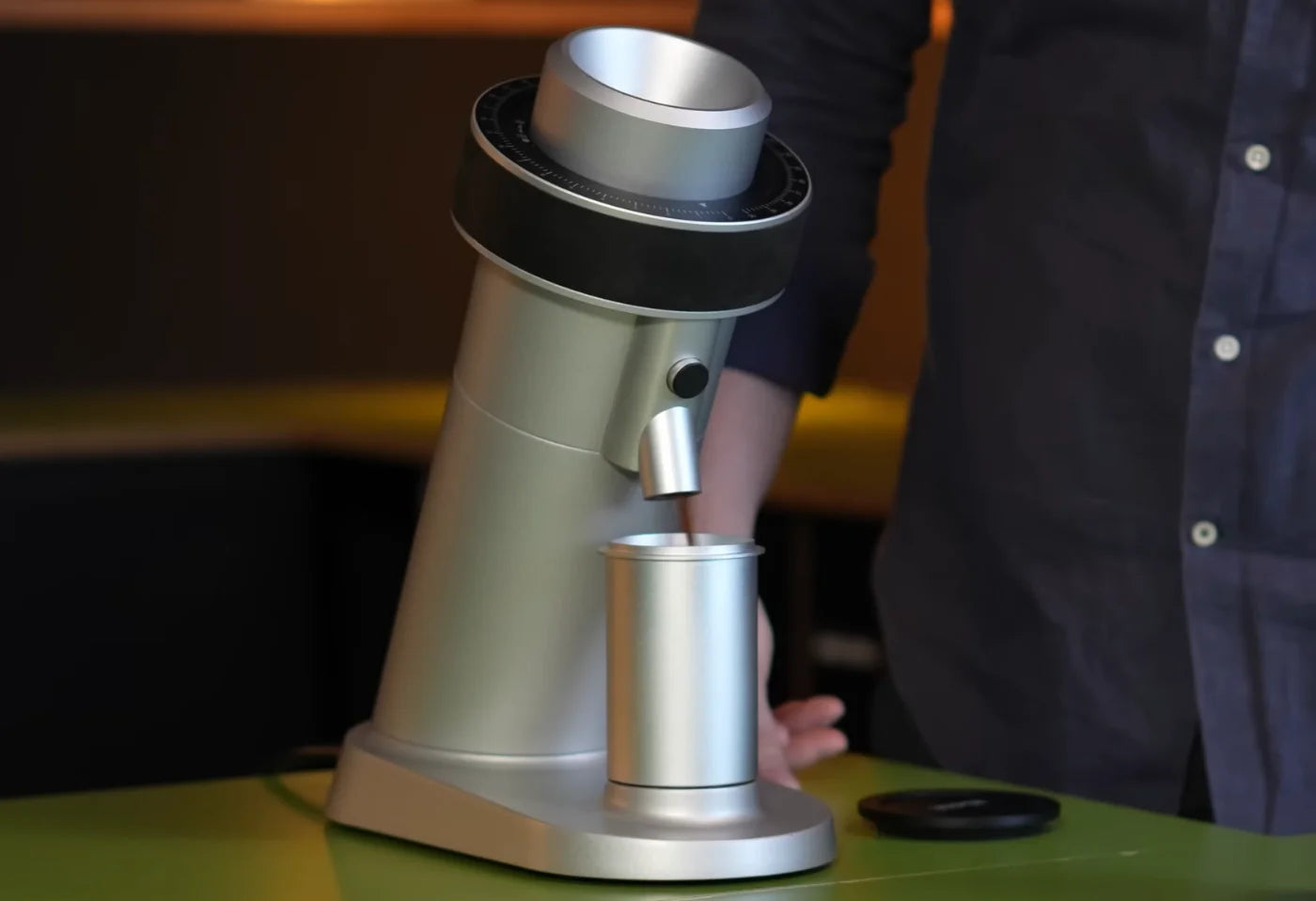

The WPM ZP-1 is a single dosing espresso grinder for €1,140 / CHF 1,180. WPM comes from Hong Kong, has been active in the milk pitcher segment for years, and has made a name for itself with thermoblock espresso machines. The ZP-1 is their first grinder venture on the European market. We purchased it ourselves, like all our grinders, and put it through our test protocol. What came out: The ZP-1 does several things really well. But at €1,140, you can ask what you're getting that you couldn't find cheaper elsewhere.
Overhang and a dial that's fun to use
The ZP-1 weighs 8 kg, is roughly 13 cm wide, 27 cm deep, and just over 30 cm tall. The housing is tilted noticeably forward; the grinder has pronounced overhang. Whether that fits aesthetically is a matter of taste.
The grind adjustment dial is not a matter of taste. It's oversized, precisely engraved with 30 main numbers and 4 subdivisions each, and infinitely adjustable. One of the best adjustment dials we've ever tested. During operation, you feel a natural and pleasant resistance that allows even the finest adjustments. Minor criticism, though: The pointer doesn't sit quite optimally, and the spacing between the subdivisions is so large that you have to actively use the in-between ranges. For a dial this size and this standard, more subdivisions would make sense.
The discharge spout is magnetically removable. In terms of premium appearance, it's the only element of the grinder that falls a bit short. It's made of plastic, which only becomes noticeable when you remove it. It's otherwise finished exactly like the rest of the grinder. The manufacturer states that the plastic discharge reduces static buildup.
The integrated knocker works well and eliminates the need for a blow-back tube. It works reliably with light and medium roasts. With dark roasts, a bit more tends to stick.

Buy WPM ZP 1
🛠️ Source in Germany and Austria [Affiliate link]*: Bohnendealer
*We search for specialist partners on your behalf, whom we know provide good work and good service. We maintain close contact with the retailers. These are affiliate links. If you order through this link, it doesn't cost you more, but we receive a small commission that we invest in new test equipment. We continue to do so and are looking for competent partners for you in the DACH region.
Burr set and cleaning. The best we've ever experienced
64 mm flat burrs are in the grind mechanism, more precisely 63.8 to 63.9 mm, which means that SSP burrs don't fit directly. WPM supplies an adapter that allows SSP burrs to be mounted.
The RPM adjustment ranges from level 1 (600 RPM) to level 10 (1,300 RPM). What this means for particle distribution is clarified further below.
With cleaning, the ZP-1 sets a standard that has never been matched. In just a few steps, without adjusting the grind, you have access to the grinding chamber. No tools, no screw turning, no settings to remember. Boom, open, brush out, back together. By the way, you can use the cleaning agent much less frequently here than with grinders where you're reluctant to open the grinding chamber.
Grinding speed and noise
The ZP-1 handles 21.5 g in 10 seconds, which is a medium-fast grind. For 18 g, the grinder needs 12 seconds. Not a record, but not an everyday annoyance either. The grinding time gives you time to put the lid on, which reduces the noise level from 85 to 80 decibels (in the case of the highest RPM). At RPM 1, it's 80.8 dB(A) or 75 dB(A) with the lid, which falls into the quiet category. Excellent.
Grinding temperature and consistency
The first sample is at 31.3 °C; after five consecutive grinds with 20 seconds pause each, the ground coffee rises to 32.6 °C. The average is 32.02 °C. That's good. Even light, aromatically sensitive roasts are not thermally stressed, and if you pull multiple espressos in succession, you won't have a temperature problem to worry about.
Consistency is also convincing. A standard deviation of 0.11 g over 15 grinds is very good. Anyone who relies on reproducible recipes will find a reliable foundation here.

retention. Remarkably little for this space
When you first see the grinding chamber of the ZP-1 open, you get worried. The space around the burrs is generous; visually, a retention of more than a gram would come as no surprise. The measurement yields 0.5 g temporarily, 0.2 g permanently, 0.7 g absolute. That's very good.
0.5 g of temporary retention means that with each grinding process, half a gram from the previous run is carried along. Hardly noticeable in everyday use. Those who switch between light and dark beans should run two to three purge beans through; then the transition is clean. The permanent retention of 0.2 g is minimal and non-critical for the aroma climate in the grinder. That the ZP-1 maintains this value despite the generous construction space is a respectable engineering achievement.

Grind Setting Replicability
In the adjustment test (espresso, ristretto, lungo, return to espresso), the ZP-1 shows a peculiarity. The x50 value of the starting setting (T4) is 254.6 µm; after the return (T7) it is 225.9 µm—a deviation of just under 29 µm. At the same time, the fine fraction increases from 28.7% to 35.3%. The grinder thus returns to the correct range but does not hit the exact same position.
However, since we achieved almost exactly the same particle distribution in repeated T4 measurements (T4-1, T4-2) with different RPM, we consider the T7 measurement to be an outlier. We had no difficulty finding the exact grind setting again when adjusting recipes.

Particle Distribution. Broad-Based, RPM Without Effect
We analyze particle distribution in cooperation with ZHAW Zurich using the Retsch Camsizer X2.
In the espresso setting (T4, RPM 5.5), the x50 value is 254.6 µm, the fine fraction (Qf <100 µm) is 28.7%, and the 60% main peak width is 230.7 µm.
A fine fraction of 28.7% is in the medium to lower range. The cup turns out transparent, the acidity is clearly structured, body remains rather restrained.
The main peak width of 230.7 µm occupies an interesting sweet spot that reliably grinds both light and darker roasts. For very light roasts where maximum clarity is desired, switching to SSP burrs would be a good step.
RPM Comparison. We drew separate PVM samples at RPM 1 (600 rpm) and RPM 10 (1,300 rpm), adjusting the recipe to 18 g in, 45 g out, 25 seconds. The main peak width remains nearly identical—233.6 µm at RPM 1 and 231.0 µm at RPM 10. Unlike other grinders with variable speed where the RPM setting noticeably shifts particle distribution, the ZP-1 with its factory burrs shows hardly any effect. The RPM function is present but changes little with the standard burrs.
Tasting
For the PVM measurements and all grinding samples, we use our reference coffee as always: Apas Espresso, a naturally processed Brazilian coffee from the APAS Cooperative. In the video, we brewed Yulieth, a washed Pink Bourbon from Colombia, which shows what the ZP-1 brings out of light roasted coffees. The acidity was clearly structured, the finish long and fruity. Not an espresso with a lot of body, but a balanced shot with lots of transparency—exactly what the moderate fine fraction of 28.7% suggests.
Conclusion. Excellent Overall Package with One Open Question
The ZP-1 is a well-thought-out, solid single-dosing grinder. With its size, the grind adjustment wheel ranks among the best we've had on the bench. Accessibility to the grinding chamber is simply unmatched. The retention is very low despite the large construction space. Thermal stability is impressive.
Strengths
- Grind adjustment wheel precise, stepless, pleasant to use
- Cleaning: fastest access to grinding chamber we've ever tested
- Retention absolutely 0.7 g, very good for this construction space
- Grinding temperature 32 °C, thermally problem-free
- Low static, interesting particle distribution suitable for many roasts
Weaknesses
- RPM function has no measurable effect on particle distribution (with factory burrs)
- Grind setting replicability between T4 and T7 not reproducible, likely due to coarse detents and distant arrow
Who is the ZP-1 from WPM suitable for? Anyone looking for a high-quality single-dosing grinder, who works daily with light to medium roasted coffees and experiences cleaning not as a tedious chore but as a quick handgrip, will be well served by the ZP-1. For frequent bean switchers, 0.7 g retention is more than sufficient.
Who is it not suitable for? For us, it remains unclear what justifies the €1,140 purchase price when similar burrs and particle distributions are sometimes available for €500 to €800. And grinders like the Timemore models (64 and 78) offer light roast enthusiasts a more interesting ground distribution from the start.
One thing is certainly clear: the quality of the ZP-1 speaks for itself.
We purchased our WPM ZP-1 model from jeronimo kaffee in Switzerland.
Technical Data Overview
| Property | Value |
|---|---|
| Price | €1,140 / CHF 1,180 (as of January 2026) |
| Burr Size | 64 mm (63.8–63.9 mm) Flat Burr |
| Operating Mode | Single Dosing |
| Grinding Speed | 21.5 g / 10 sec | 12 sec for 18 g |
| Noise Level | 80.8 dB(A) (RPM 1) | 85.2 dB(A) (RPM 10) |
| Grinding Temperature | 31.3–32.6 °C (first to last sample) |
| Absolute Retention | 0.7 g (0.5 g temporary, 0.2 g permanent) |
| Consistency (Std. Dev.) | 0.11 g |
| x50 (Espresso T4, RPM 5.5) | 254.6 µm |
| Fine Fraction Qf <100 µm (T4) | 28.7% |
| 60% Main Peak Width (T4) | 230.7 µm |
| RPM Control | Yes, Levels 1–10 (600–1,300 rpm) |
| Weight | 8 kg |
| Dimensions (W × D × H) | approx. 13 cm × 27 cm × 30 cm |
| Special Features | Integrated knocker, instant grinding chamber accessibility, magnetic dosing cup, SSP possible via adapter |
* Prices incl. VAT, as of January 2026.