




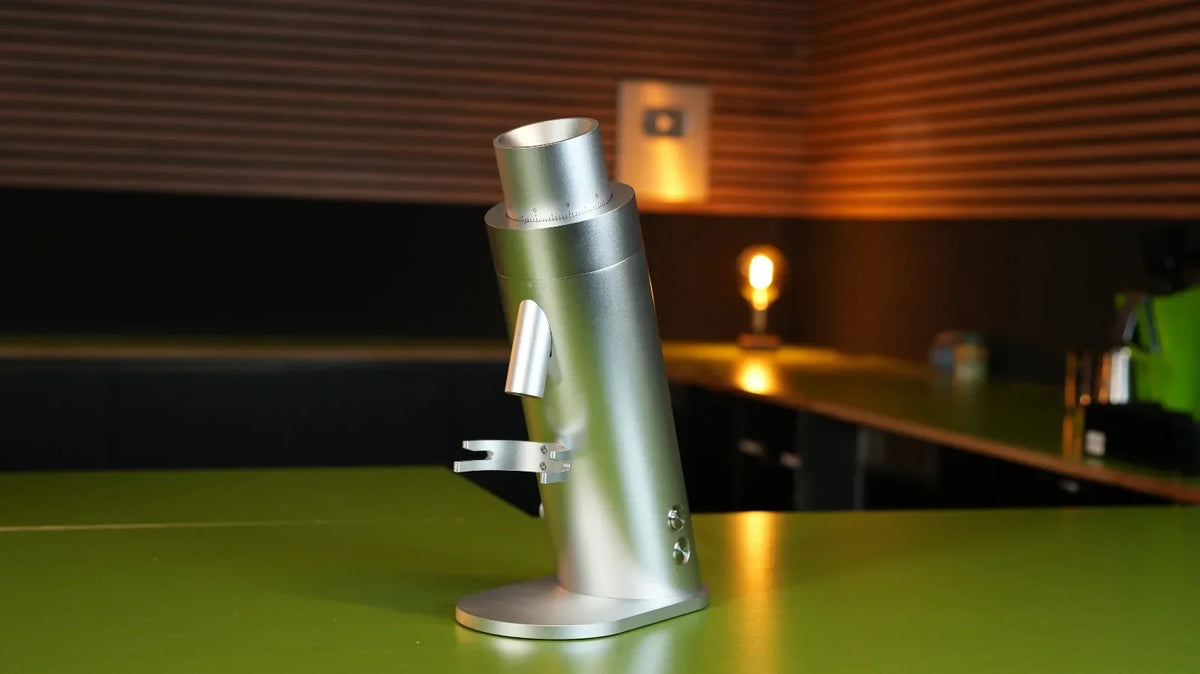

The Lagom P80 by Option-O is the 100th grinder in our test field. You requested it as our anniversary grinder, and it has delivered numbers that we have never seen in over a hundred tested grinders. In Switzerland, it costs 1,799 francs; ordered directly from the manufacturer in Germany, including tax and shipping, it's around 1,600 euros. For that you get 80-mm flat burrs, a 500-watt brushless motor, a grind speed adjustable from 300 to 1,700 RPM, and a single-dose grinder that follows the basic design of its smaller sister, the P64.
Three things we want to get out of the way first. The main peak in the particle distribution is the narrowest we have ever measured. The retention is 0.2 grams. And the grind setting scale is difficult to excuse for a grinder in this price class. One by one.
Design and Technology: the Bigger Sister of the P64
If you know the P64, you'll recognize the P80 immediately. Everything is a bit bigger, a bit more powerful, which is also due to the burr size. 8.1 kilograms at 24 × 14 × 38 centimeters, milled from anodized aluminum and stainless steel. Inside, Option-O has rebuilt almost everything: the upper grinding chamber is now a single-piece component, there are no loose springs and separate bearings when you take it apart. The burrs sit magnetically on a three-point mount, two-screw burrs in M6x7 format also fit.
In everyday use, two details stand out positively. The dosing ring closes cleanly with the sieve. And you can grind directly into a 58-mm basket without having to adjust the sides.
There is criticism for the knocker at the grinding outlet. It effectively helps eject residual coffee powder. However, the mechanism is dimensioned so tightly that it occasionally gets stuck at the bottom and only comes back after slight wiggling. Course participants have also reported this to us. For me personally, the design feels strange: I don't want to milk my grinder. And at the gap setting, the knocker is almost flush at the top and stands out about a millimeter at the bottom.

Loudness and Speed: 9 Seconds for 18 Grams, 82.8 dB
At 1,100 RPM, our measurement speed for test sections two and three, the P80 takes nine seconds for 18 grams. With a full hopper, it outputs 26.2 grams in ten seconds. This is remarkable because the beans are deliberately fed slowly through the screw. Despite the throttled feed, the 80-mm burrs grind through quickly.
In continuous operation we measure 82.8 dB. According to our protocol, this is in the mid-range, and by the number alone the grinder wouldn't be considered quiet. But the number describes it poorly here: the tone is pleasant, a rich motor noise that I compare in the test video to an electric car. No resonances, no screeching. Even in purge mode at high RPM, it remains tolerable.
Thermally, the grinder is unremarkable. The beans go in at 21.7 °C, over five consecutive grinds with 20-second intervals we measure 29.9 / 26.0 / 26.7 / 29.3 / 29.8 °C, averaging 28.3 °C. The sequence doesn't rise, so the grinder doesn't heat up even with multiple consecutive shots. This is exactly right for light and dark roasts.
Retention: 0.2 Grams, Better Than We've Ever Measured
On the retention front, the P80 delivers the value against which all future single-dose grinders must be measured. Andrea is responsible for this measurement on our test team and proceeds uncompromisingly: loosen every screw, brush the burrs clean from below, scrape together everything that can be found. He barely managed 0.1 gram temporarily and 0.1 gram permanently. Absolutely, that's 0.2 grams.
The consequence in everyday use is bigger than the number suggests. You can switch beans without grinding anything off first. You can adjust the grind setting and see the effect immediately in the next shot, instead of first running through half a portion of old stock. And the coffee in the basket is the coffee you just ground. That's exactly what single dosing is all about, and Option-O has done the right detailed work here. We would hope that a few other manufacturers take a page from their book.
This is achieved through two things: the knocker, which is tuned to the angled grinding chamber, and a purge function that ramps up the RPM at the end of the grind and blows the rest out of the chamber. The grinder recognizes through a torque sensor when resistance drops, spins up once, then shuts off. On request, you can also trigger the purge with a double press. This fits with the other values: of 18 grams of beans input, 17.9 grams land in the cup, that's 0.1 gram deviation. Over five portions, the standard deviation is 0.04 grams. Both are excellent.
As with the P64, we recommend tapping the top of the grinder by hand after grinding. Be careful not to accidentally move the grind adjustment. In testing, we had this happen when tapping firmly.
The Grind Setting Scale is the Biggest Criticism

The P80 adjusts continuously via a fine-pitch thread, and Option-O specifies ten micrometers per line. In practice, this means: one line equals eight to ten seconds of extraction time, depending on the coffee. Half a line has given us six to eight seconds difference multiple times when pulling shots. At grind setting 0.65 we were at 22 and 23 seconds, at 0.6 then 28 seconds.
This is a problem because there are no intermediate markings between the vertical lines on the dial. So you inevitably have to work between the lines, but you can't read exactly where you've landed. 8.1 or 8.15 or 8.16 looks the same. Michel photographs the setting for every coffee, and even with that he doesn't hit the position exactly again. Additionally, the reference line on the housing is thicker than the lines on the dial, and the spacing between the lines isn't even consistent: the distance from 3.5 to 3.6 is noticeably different from 3.6 to 3.7.

On a grinder whose strength is precision, this destroys part of that precision. For a single-dose grinder where you switch between recipes multiple times a day, it's the most expensive design flaw in the entire device. If you always grind the same coffee, you'll hardly notice it. If you change beans daily, photographing the setting will become a required exercise.
Dear Option-O team: you build sensational grinders. Make the scaling finer and even. And until then, a cleanly printed scale to stick on would be an interim solution you could ship. Some users are currently DIYing this themselves on online platforms. For a 1,799-franc grinder, that shouldn't be the job of the customer.
Repeatability: The Main Peak Comes Back, the x50 Doesn't
For the adjustment test, we switch from espresso (T4, grind setting 0.7) to ristretto (T5, 0.55), then to lungo (T6, 0.95) and visually back to the starting mark (T7).
The main peak comes back almost spot-on: 106.0 µm at T4, 110.0 µm at T7. The x50 value, however, shifts from 144.8 to 172.3 µm, about 27 µm. At the same time, the fine peak drops from 44.1 to 39.8 percent. So the even main fraction is back, but the rest of the curve isn't. And because it's precisely the fines that build resistance in the puck with this grinder, you feel that in the cup.
Practical consequence: simply turning back visually to the old mark isn't sufficient. What appears in our measurement data as inaccuracy is largely due to the coarse scale from above. Michel notes that with practice it certainly works, but it requires building a relationship with this grinder. So the P80 grinds reproducibly well once you have the scale under control.
Particle Distribution: Main Peak at 106 µm, the Narrowest We've Ever Measured
We measure particle distribution in cooperation with the Coffee Excellence Center at ZHAW using the Retsch Camsizer X2. In the espresso setting at 1,100 RPM (T4), the x50 is at 144.8 µm, the main peak at 106.0 µm, and the fine peak at 44.1 percent; this is the proportion of ground material under 100 micrometers.
The 106 micrometers are the value because of which we planned this video twice. We tried SSP burrs, 80 and 100 dimensions, blind and non-blind mounted. We've never found such a narrow main peak. For comparison: anything beyond about 300 µm peak width we classify as heterogeneous, and good espresso grinders typically lie somewhere between 150 and 250 µm.
Responsible for this is the feed mechanism. A screw delivers the beans slowly and evenly to the burrs, and the Mizen-80OM burrs have an integrated crusher that pre-breaks the beans before they reach the cutting zone. Slow feeding then, only built-in rather than hand-dosed. The burrs are also mounted screw-free from the back, which further emphasizes the consistency of the grinder. Screws mounted from above are actually one of the harshest interventions in burr grinding behavior imaginable.
Interesting is the apparent contradiction in the numbers. The main peak is extremely narrow, yet 44.1 percent of the ground material is under 100 micrometers. This is no accident, but a necessity: because the main fraction is so even and in the middle range there are hardly medium and small particles above the 100-micrometer threshold, we have to grind so fine on the other side that we have a lot of fines to generate enough resistance and reach reasonable extraction times. We know this same pattern from all-purpose burrs.
In the shot, however, the grinder or the ground coffee behaves differently. Instead of first drops appearing after over 13 seconds as with all-purpose burrs, we see the first drops after about nine seconds. Unlike with AP burrs, the puck also maintains its integrity much longer and stabilizes toward about 4 milliliters per second. So the P80 accelerates, but significantly less brutally than expected.
Who is this curve made for? For light, complex roasts, definitely. But our tests with various roasts have proven that medium to dark roasts also work very well and maintain body. What you do need: proper puck preparation. The high fine peak creates clumping, and without WDT, channeling is a real danger! With this grinder, that's not a recommendation, it's a requirement.

RPM from 300 to 1,700: What Speed Changes
You adjust RPM with a click-stepped dial with a numerical scale on the side, from 300 to 1,700 revolutions. Because we pulled three shots at the same grind setting, we can show what RPM does to the curve.
| Espresso Setting | x50 | Main Peak | Fine Peak |
|---|---|---|---|
| 300 RPM (T4_1) | 153.5 µm | 98.2 µm | 42.4 % |
| 1,100 RPM (T4) | 144.8 µm | 106.0 µm | 44.1 % |
| 1,700 RPM (T4_2) | 146.0 µm | 106.1 µm | 43.6 % |
At 300 RPM, the main peak becomes even slightly narrower and the fine peak drops slightly. This is the setting for maximum clarity. Between 1,100 and 1,700 RPM, however, the curve barely changes, which is unusual for a grinder with RPM control.
From the data and also looking at other slow-feeding experiments, we interpret that the slow feeding here already reduces the chaotic distribution and grinding in the grinder so significantly that the slower RPM doesn't benefit additionally. Read more about this in our article on slow feeding.
Static, Cleaning, and Operation
The ground coffee strands that we affectionately called that with the P64 are history. An ionizer reduces static buildup, and in principle you don't need RDT anymore. Some residual charge remains, and it increases the darker and finer you grind. For everyday use at home we would still work with water spray. But this is no longer a requirement as with the P64, it's a comfort gain. A noticeable difference from the previous model.
To clean, you remove the collection ring and loosen two hex socket screws, then you're at the grinding chamber. This is simple and logically laid out, but not entirely tool-free. So we rate cleaning as good rather than very good. For basic daily cleaning you don't need to unscrew anything, for deep cleaning you do. If you want to additionally use grinder cleaner, you'll find Cafetto Grinder Clean in our shop.
On the side are two buttons: a real on/off switch that clicks into place, and the grind button, which runs the grinder until the torque sensor recognizes the end of grinding. Zero calibration is simplified compared to the P64, a limiter protects the burrs during calibration and can be removed if you want full control.
In the Cup: From Light to Decaf
In the test video, we deliberately brewed at nine bar standard, without flow or pressure profiling. Not because it's the best solution, but because nine bar is most common and not many machines can regulate flow and pressure.
The first espresso was a light roast, our Shyira. Incredibly complex, with everything this coffee contains and surprisingly plenty of body. Heavy, but elegant, full-bodied, with a creaminess that lingers in the mouth. We weren't expecting that with this particle profile; we had anticipated a lighter, more juicy body. First drops at eleven seconds.
Then our take on an Italian espresso, the Compadre. Fat-caramel, with a cocoa note so clear and tangible you could trace it. Sweetness fully present, medium to heavy body, as it cools toward caramelized nuts and dark chocolate. Acidity is low with this coffee anyway, but what's there is clearly structured. Set to 24 seconds and it tastes the same at 26 or 28 seconds, so the window isn't extremely tight.
Finally, the Apas Decaf, decaffeinated in Bremen using subcritical CO₂, so with natural sparkling water. Decaffeination significantly changes a coffee's structure and thus its extraction behavior: this coffee doesn't accelerate toward the end, the flow actually drops. We've never seen that before. In the cup the nougat note we know from Apas Espresso, our reference coffee from the test protocol.

Apas Decaf, Decaffeinated Espresso from Brazil
The coffee from the last shot in the video: sweet and cocoa-like, nougat and dark chocolate, plus an extraction behavior that's quirky with the P80.
Across all three coffees: the espresso potential of this grinder is outstanding. But it's not a grinder for beginners. You need an understanding of extraction, of brewing, and clean puck preparation. The path to the sweet spot is a narrow ridge over a wide river: too fine and you have a clogging moment, working close to that edge. Grinders with this particle profile show their strengths most clearly on machines that can profile flow or at least pressure. Nine bar works, but profiling gets you more out of it.
Conclusion
The Option-O Lagom P80 is among the best grinders we've tested and on some days we'd say: it's the best. It delivers the most consistent particle distribution of our entire test field, virtually no retention, and consistency that leaves few questions. Then there's this grind setting scale that takes some of that away again.
Strengths: 0.2 grams of retention absolutely, the best value we've measured. A main peak of 106 µm, narrower than any other grinder in our field. 0.04 gram standard deviation over five portions. Nine seconds for 18 grams with pleasant grinding noise and no heat development. Plus RPM control from 300 to 1,700 and static reduction that makes RDT optional rather than mandatory.
Weaknesses: The grind setting display. One line is eight to ten seconds of extraction time, there are no intermediate markings, the reference line is too thick, and the spacing is uneven. Plus a knocker that occasionally gets stuck and deep cleaning that requires a hex key.
For whom? For people who single-dose at home, write down their recipes, and enjoy really understanding a coffee. If you brew light specialty roasts and seek clarity and complexity, you have a fantastic tool here. And if you have an espresso machine with flow or pressure profiling, you'll get even more from this particle distribution.
For whom not? For espresso beginners. The puck forgives little; without WDT you get channeling, and finding the right grind takes patience and practice. If you just want a reliable espresso in the morning without thinking about extraction, you'll be happier with a less demanding grinder. In our large espresso grinder test, you'll find more suitable options.
Value for money: For 1,799 francs or 1,600 euros, you get measurement values you won't find elsewhere, high-level manufacturing, and a device built to be user-serviceable. What you don't get for this money: a scale you can actually use to harness this grinder's precision. That's annoying because it would be the cheapest component in the entire device.
In the video we mention around 2,000 euros. We based that on the grinder's size and retail pricing, where it's listed at Coffee24 for 2,150 euros. Ordered directly from the manufacturer and shipped from Germany, it's significantly less.
Test Results: Option-O Lagom P80
Evaluation according to the KM Test Protocol for Espresso Grinders. All measurements self-conducted, sections two and three at 1,100 RPM.
Technical Specifications at a Glance
| Feature | Value |
|---|---|
| Price | 1,799 CHF in Switzerland; around 1,600 euros directly from the manufacturer, shipped from Germany including tax; 2,150 euros at Coffee24 (as of September 2026) |
| Burr Size | 80 mm |
| Burr Type | Flat, Mizen 80OM blind burrs with integrated crusher |
| Burr Mount | Magnetic, 3-pin blind mount; alternatively two-screw burrs M6x7 |
| Operating Mode | Single Dose (hopper up to 45 g, continuous feed possible) |
| Grinding Speed | 26.2 g / 10 Sec; 9 Sec for 18 g (at 1,100 RPM) |
| Loudness | 82.8 dB(A) |
| Grinding Temperature | 26.0–29.9 °C (average 28.3 °C; beans 21.7 °C) |
| Absolute Retention | 0.2 g (0.1 g temporary, 0.1 g permanent) |
| Single-Dose Deviation | 0.1 g |
| Consistency (Std Dev) | 0.04 g over 5 × 18 g |
| x50 Espresso (T4 / T7) | 144.8 µm / 172.3 µm |
| Main Peak (T4 / T7) | 106.0 µm / 110.0 µm |
| Fine Peak (T4 / T7) | 44.1 % / 39.8 % |
| x50 Ristretto (T5) / Lungo (T6) | 117.4 µm / 215.4 µm |
| RPM Control | Yes, 300–1,700 RPM, click-stepped |
| Grind Setting Adjustment | Continuous, per manufacturer 10 µm per line; range Turkish to French Press |
| Motor | 500 W Brushless DC |
| Dimensions and Weight | 24 × 14 × 38 cm, 8.1 kg |
| Voltage | 100–120 V or 220–240 V |
| Special Features | Integrated slow feeding via screw, purge mode, auto-off via torque sensor, ionizer, knocker at outlet |
| Warranty | 1 year for manufacturing defects, thereafter lifetime support (manufacturer claim) |
As always, we tested this grinder according to our KM protocol and purchased it ourselves. This test was not requested by Option-O.