




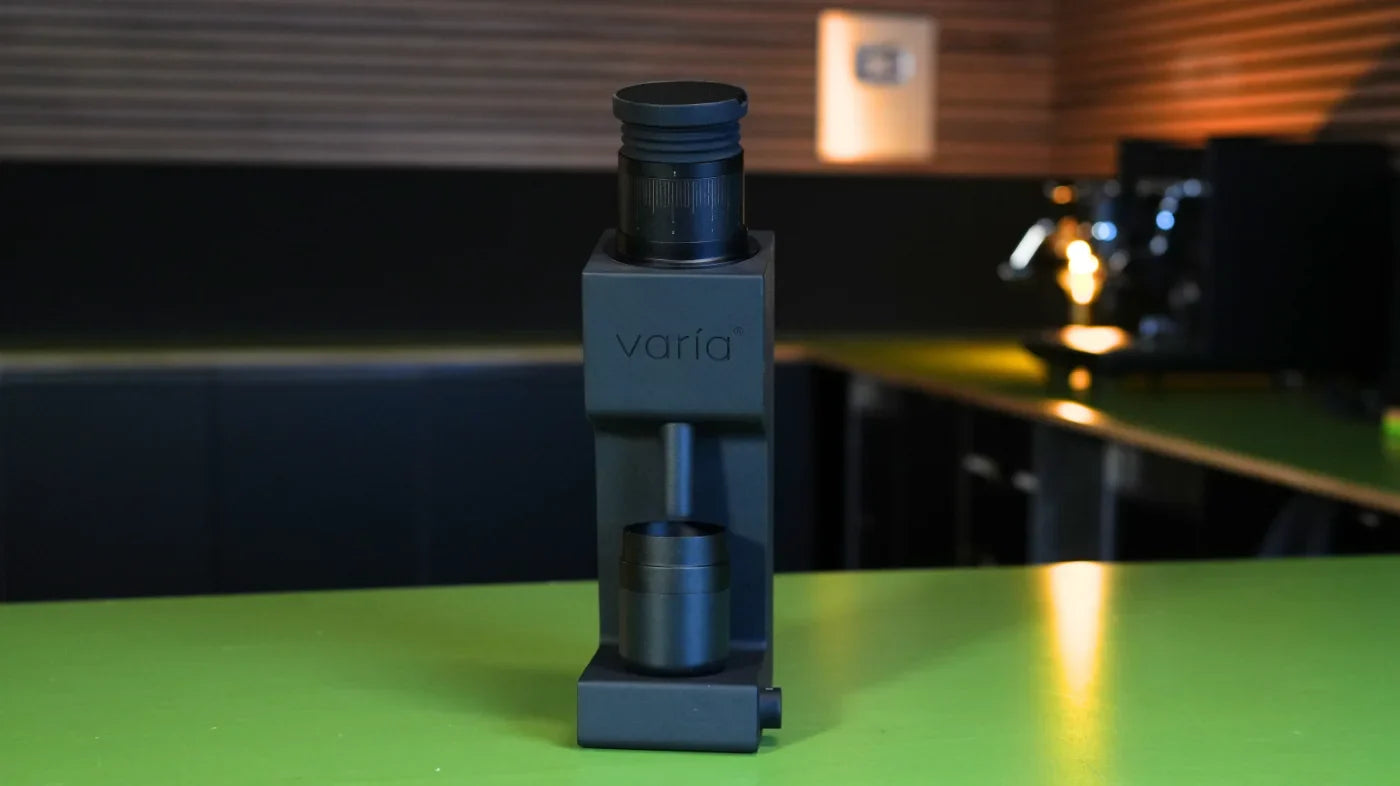

The Varia VS4 was one of the most anticipated grinders of recent months. When we first held it in our hands at a coffee trade show, we raved about it. Now the detailed test is behind us: we took nearly half a year to thoroughly test two Varia VS4s completely. We wanted to make no mistakes and confirm our findings on a second grinder. It costs 499 US dollars directly in the Varia online shop, here it's just under 500 euros, size-wise between the smaller VS3 and the larger VS6. A 53-mm conical burr set, a brushless motor, and once again a genuine single-dosing grinder. The question we pursued over months: Does the VS4 deliver on the hype, and what's going on with its particle distribution?
Aluminum Block with Two Real Innovations
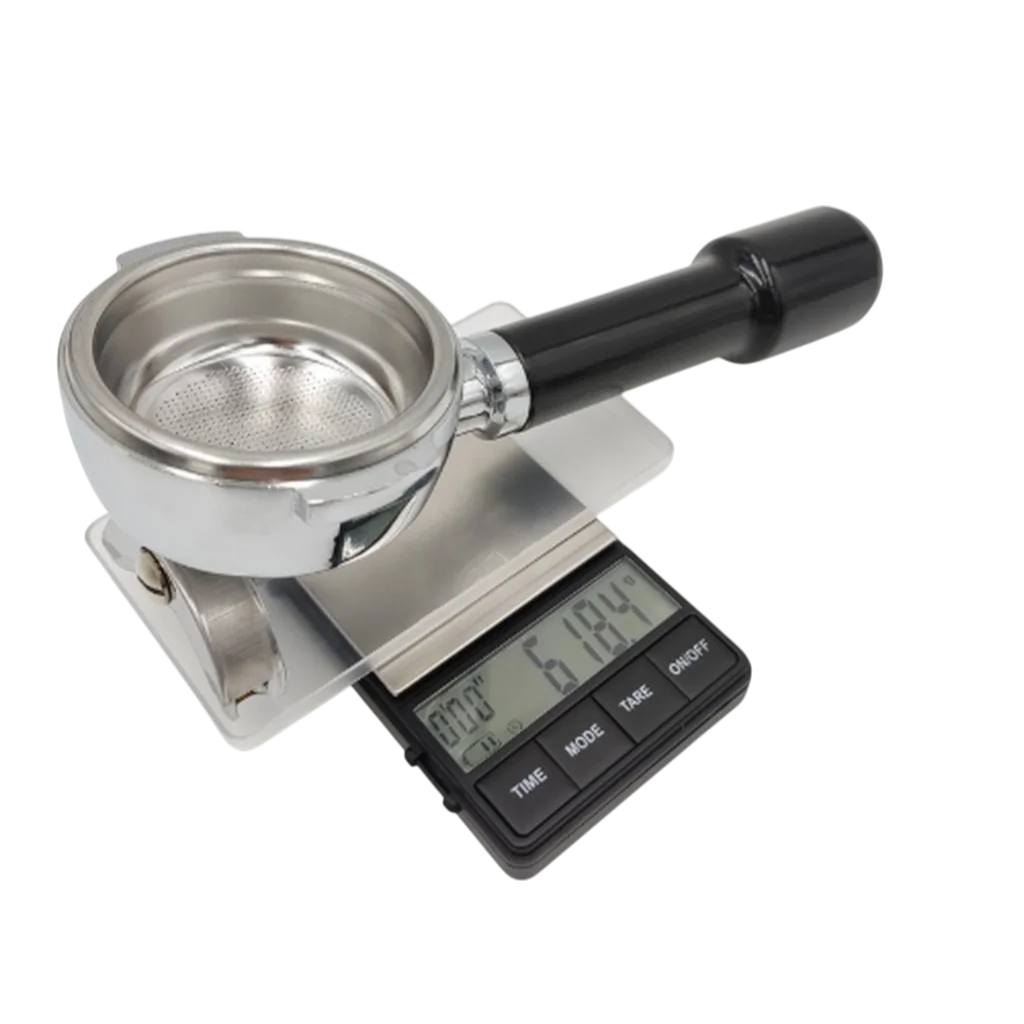
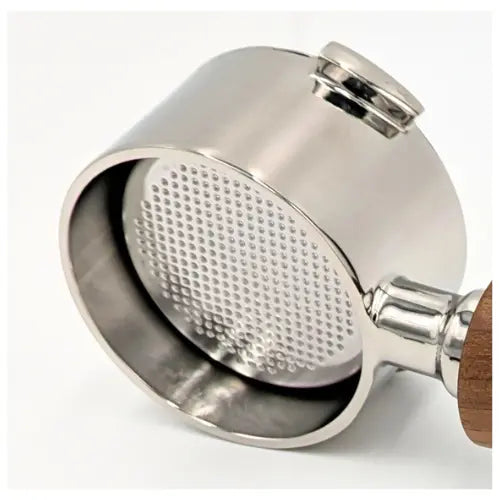
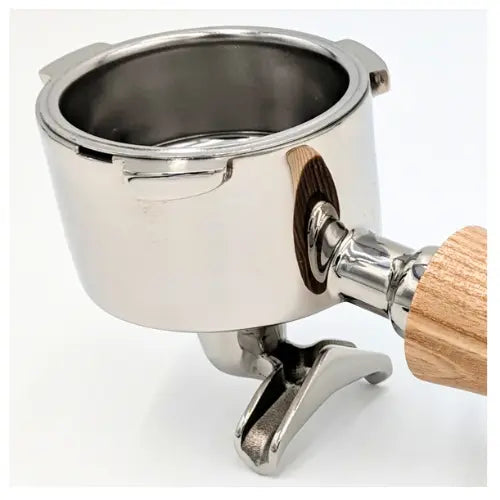
The VS4 sits as a compact aluminum block on the counter, weighs just over 5 kilos, just under 10 cm wide, 33 cm tall, 16 cm deep. It looks high-quality and sits firmly on the test desk. The package includes a 58-mm dosing cup; with the VS3, it was still a small cup that nobody was really happy with. The new cup is high-quality, but has a quirk: if you leave it on while grinding, it sinks down, and its rim pushes into the portafilter. We're not fans of a rim that protrudes into the portafilter. In practice, we had hardly any channeling at the rim because this rim is very narrow. Anyone who additionally distributes with a needle tool (WDT) has the issue completely resolved.
Two things about the VS4 really excite us. The first is the grind adjustment. It's now decoupled from the grinder's body and, even more importantly, from the bellows. With the VS6, the adjustment was fine and precise, but when blowing with the bellows, you often accidentally adjusted the grind as well. That doesn't happen here anymore because there's no more direct pressure on the adjustment ring. Plus, a scale whose indicator line points precisely at the respective line. One line corresponds to approximately one to one and a half, at worst two seconds of extraction time. It's hard to get finer than this in the home range.
The second great strength of the construction is that you can open and clean the grinder with just one hand. You remove the grinding chamber in just a few seconds, brush it out, put it back in, done. We don't need to discuss grinder cleaner anymore with this grinder—you don't need it here. Why this ability to open the grinder so quickly is a non-negligible advantage becomes relevant again unintentionally when discussing retention.

The Burr Set: 53 mm Conical, Slow Speed
Inside, a 53-mm conical burr set operates, driven by a 200-watt brushless motor with planetary gearing. You adjust the rotation speed via a knob on the side between 150 and 300 rpm in 50-rpm increments, deliberately chosen slowly for an espresso grinder. The grind adjustment runs steplessly via an internal thread with 10-micrometer resolution. Active ionization is built in against static charge, and an RDT spray bottle is included anyway.
Faster and More Pleasant than the VS3
Varia has noticeably stepped up their game here. For 18 grams, the VS4 needs around 13 seconds. The VS3 took about 30 seconds, roughly twice as long. That makes a difference in the morning.
The noise level gets interesting because the number alone can be misleading. We measure around 80 to 81 decibels (precisely: 81.5 dB at 150 RPM, 82.5 dB at 300 RPM). On paper, the VS3 measured significantly lower at 73 decibels, but it sounded shrill and aggressive—a high-pitched tone over 30 seconds, somewhere between a bee and a circular saw. The VS4 hums deeper, more like a fast bumblebee, and sounds powerful rather than like an engine in its last fight. Subjectively, it's more pleasant, even though the meter shows more decibels.
The temperature of the ground coffee stays uncritical. On the first machine we measure an average of 26.9 °C, so near room temperature; the second ran slightly warmer at 30.4 °C. Both are in the green zone. The consistency across portions is very good, with a standard deviation of 0.08 grams.
Retention: the sore point
With retention, or the retention, we're struggling. With a single-dosing grinder, we want the coffee we put in at the top to come out at the bottom. For this type of construction, we already consider more than 0.7 grams of temporary retention quite a lot. The VS4 is around 1.8 grams of temporary retention, plus about 0.2 grams of permanent retention, totaling around 2 grams absolute. For a single-dosing grinder, that's a poor value.
That's surprising at first, because conical burrs usually have little retention since little sticks to the cone itself. The problem lies elsewhere: with the drives that rotate under the cone. Coffee sticks there, breaks off, and falls in again with the next grind. We've remeasured this, as with every grinder: one grind, weigh, vacuum empty, clean out, and repeat five times in a row. After the first grind with a clean grinding chamber, more than 0.4 to 0.8 grams stuck each time.
The trick is in the design. The more permanent retention settles into the drives, the more fresh coffee it holds back the next time, and the larger the temporary portion becomes. If you ignore this phenomenon, you quickly end up with well over a gram of old coffee in the chamber—in the worst case several weeks old—mixed into the fresh grounds. But you can open the grinder faster than you refill coffee, and that's exactly what mitigates the high value.
The VS4 is only a good single-dosing grinder if you regularly open it and brush it out. That takes no more than a minute. If you neglect it, the temporary retention grows further, and the first espresso after a longer pause tastes flat.
In pure throughput, single dosing works solidly: 18 grams in, plus/minus 18 grams out. Sometimes it's 17.7 or 17.8 grams, then you know that a bit more has stuck and naturally some of the current coffee still comes from the last grind. So the coffee is reliably exchanged, just with this sediment that travels along.
Operation and grind setting repeatability
Operation is excellent. RPM control on the right, switch on, the grinder grinds until you stop it.
The grind setting repeatability is really fun. We switched from espresso to ristretto, then to lungo and back to espresso, and the VS4 finds its starting point cleanly again. The peak width comes back at 279.4 to 277.1 micrometers, practically identical. Together with the fine, decoupled adjustment, this is one of the real strengths of this grinder.
Particle distribution: a story in two measurements
This is where it gets interesting, and unfortunately the result isn't positive for everyone. At the beginning of the year we measured the first unit and got a very broad particle distribution, with a main peak of 308 or 316 micrometers. That was noticeably higher than we expected. So we decided to take a second measurement and order another VS4 model.
The second measurement shows solid particle distribution. At the lowest RPM, the main peak is at 279 micrometers, the median (x50) at around 254. At 300 RPM the main peak rises to 299. So the VS4 is still on the broader side, but at lower RPM somewhat further from values we'd sensorically describe as unbalanced and sometimes scattered. A classic, good value we've known from the market for a long time. Clarity grinders for light specialty coffees tend to be under 240, the best at 160 to 170 micrometers. That's a different grind profile than what the VS4 delivers.
The fines content is relatively high at around 36 percent. That brings a certain dustiness with it, but also supports body. Overall, this is a distribution related to the VS3. Both grinders work with conical burrs, and both show their strength with body-rich, classic coffees. For fruity coffees you want to brew for maximum clarity, they're the wrong choice, and we'd reach for the VS6 in the Varia family.
Stick with 150 RPM. The coffee becomes more balanced, the main peak narrower, the fines content lower. For 300 RPM there's hardly an argument, unless you want to grind a few seconds faster and consciously accept the quality compromise.
In the cup
We tasted blind with our reference coffee, and in the video additionally with our Compadre, an Italian-style espresso with a focus on body. That's exactly what the VS4 delivers: a dense, creamy espresso that sits heavy in the mouth and fills the cup. Somewhat dusty, yes, but fitting for this type of coffee that wants to be exactly this rich in the cup. With classic and medium roasts, the grinder feels at home. With light, very complex coffees, the result is satisfactory, but not its specialty.
Conclusion
The Varia VS4 is a very good grinder for clear use cases, and it's fun in everyday use. The grind setting adjustment and easy opening are real innovations; operation and repeatability are among the best in this class, and it's noticeably faster and more pleasant than the VS3. For around 500 euros you get a lot of grinder and quality.
The catch is the retention. At around 2 grams absolute, it's too high for a single-dosing grinder, and it builds up if you ignore it. The fact that you can open and brush out the grinder in seconds mitigates that, but doesn't eliminate it: this grinder needs regular cleaning.
Who is it for? For anyone pulling solid, body-forward espresso from classic to medium roasts and willing to clean it regularly. If you switch between one or two medium or darker roasts, you're in the right place. It fits less well if you change beans very frequently and want to brew many light, complex specialty coffees for maximum clarity. Then the high retention and rather broad distribution work against you, and you're better served with the larger VS6 or a clarity-oriented grinder.
As always, we sourced the grinder ourselves and tested it independently.
Test results: Varia VS4
| Price | 499 USD (Varia Online Shop), just under 500 EUR |
|---|---|
| Burr Size | 53 mm |
| Burr Type | Conical, stainless steel |
| Operating Mode | Single Dosing |
| Grinding Speed | 13 sec for 18 g (Unit 2: 12 sec) |
| Volume | 81.5 dB (150 RPM) / 82.5 dB (300 RPM) |
| Grinding Temperature | 26.9 °C (Unit 1) / 30.4 °C (Unit 2) |
| Absolute retention | ~2 g (of which ~1.8 g temporary, ~0.2 g permanent) |
| Single-Dosing Deviation | ~1.8 g (retention) |
| Consistency (Std Dev) | 0.08 g (Unit 1) / 0.05 g (Unit 2) |
| x50 (Espresso) | 254 µm (150 RPM) / 235 µm (300 RPM) |
| Main Peak (Peak Width) | 279 µm (150 RPM) / 299 µm (300 RPM) |
| Fines Content Qf <100 µm | around 36% (150 RPM) / around 39% (300 RPM) |
| RPM Control | Yes, 150–300 RPM in 50 RPM increments |
| Motor | 200 W Brushless with planetary gearbox |
| Weight | just over 5 kg |
| Dimensions (W × H × D) | ~10 × 33 × 16 cm |
| Special Features | Tool-free grinding chamber, decoupled grind setting adjustment, active ionization, stepless 10-µm adjustment |
You can find all our espresso grinder tests in the Espresso Grinder Overview.