




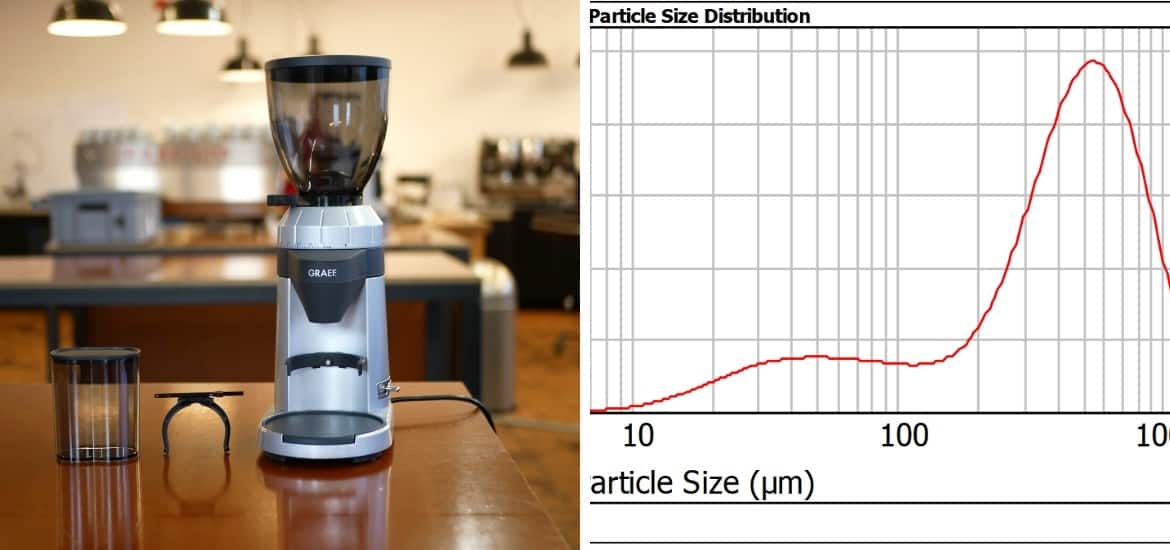

It has earned a reputation as THE entry-level grinder for the world of espresso. The Graef CM800 is often touted as an affordable beginner machine, but how good is it really? What can you expect for 130 euros and is it truly suitable for getting started? We put the Graef through its paces and were frustrated after the first few hours! The coffee didn't taste good. But we didn't give up on it; instead, we continued testing and tinkering for a long time to get something out of the machine after all. Our two-year journey with the Graef is summarized in this report.
Why we test this way and why we test at all?
Our goal is to bring machines and tips closer to you, showing you how to achieve a great coffee experience with simple means and a limited budget. That's why at Kaffeemacher:innen we operate our own coffee farm, a roastery and cafés, as well as a coffee academy.
When we recommend a machine, it's because we're convinced of it and know that you can make good coffee with it. If operating tips are necessary for a good result, you'll get them along with it. For transparency: we don't earn anything from this machine or our tips, so we can be fundamentally honest!
Overall impression Graef CM 800
The price and size are the big plus points of the Graef. 13.5 cm depth, 23 cm width, and a height of 39 cm, allow it to fit into any kitchen. Its construction with 2.6 kg feels solid.
Another plus point: It CAN produce espresso-fine coffee powder, unlike other grinders in the price range up to 200€. So if you find the right setting for your beans, you can actually brew a proper espresso.
Our conclusion up front on the Graef CM 800
So you can grind espresso-fine. But getting to the right grind size is extremely difficult. Operating the machine is not easy. You should even be able to handle a screwdriver to get everything out of the grinder. In our opinion, the Graef is suitable for sensory beginners and technically advanced users.
Grind espresso fresh with the Graef CM800
Already 15 minutes after grinding, coffee loses an extreme amount of aroma. This is due to the large increase in surface area and the reaction of the powder with the oxygen in the air. That's why pre-ground coffee is always worse than freshly ground. Espresso grinders can grind finer than coffee grinders. This is necessary to build up appropriate resistance when preparing espresso. If the powder is ground too coarsely, the espresso flows too quickly and the coffee is not sufficiently extracted (under-extraction), it tastes sour. So the Graef can make a big difference in taste, a quantum leap from pre-ground to freshly ground espresso.
Can it be delicious at such a low price?
We spent many hours with the Graef to master the elaborate grind size adjustment and brew a perfect espresso. To ensure our negative points don't lie with the espresso machine itself, we pulled the espressos with a La Marzocco GS3, which is in the price range of a small car.
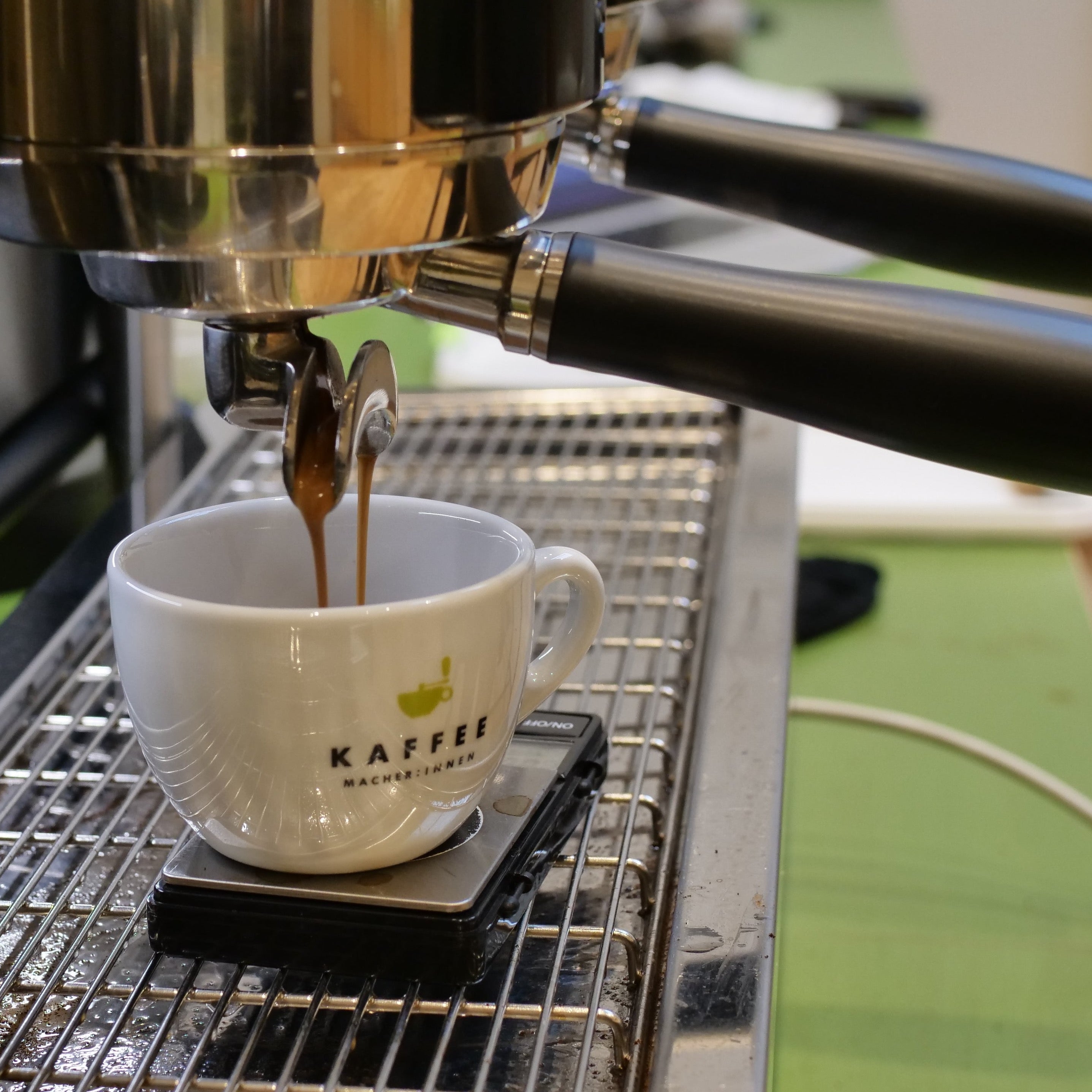
Our espressos were bitter and at the same time had an aggressive acidity. Despite our usual brewing ratio (18 grams of coffee to 45 grams of espresso) and an optimal flow time of 25 seconds, the espresso didn't taste good.
To keep our perceived taste experience more objective, we applied the so-called triangle test. In this test, three espressos are tasted blind. Two are from the same pull, one differs. We also asked the taster to name the worst espresso. In 6 sets, the Graef CM 800 was consistently identified as the worst espresso.

Grind distribution as a reason for poor espresso
During the grinding process, coffee beans are ground into somewhat different sized pieces. This results in some larger particles and some smaller particles. This is called particle distribution. The greater the spread of these particles, the more difficult it is to produce a balanced espresso. During extraction, large coffee particles are under-extracted, and small ones are over-extracted. Thus, instead of a balanced cup, you get a mixture of bitter and acidic components. With the Graef, the particle distribution is too widely spread. Using a laboratory sieve, we were able to determine that out of 50 grams of espresso powder, only 20 grams were ground to the perfect size. About 10 grams are too fine, about 20 grams too coarse.
Grind size analysis using laser and image capture
With the help of Benjamin Schütz, roaster and coffee expert, and the company Symphatec, we were able to compare the grinding of different grinders. I set the grinders for a perfect espresso (18 grams of powder to 50 grams of beverage in 25 seconds). We tested the following grinders:
Anfim Practica as a professional benchmark, Eureka Mignon Perfetto, Macap M2D, Sage Smart Grinder Pro, Sette 270wi, Graef CM800.
The Graef CM 800 showed the lowest peak. This means the grind spreads significantly and doesn't have a truly uniform grind size. The amount of coarse particles is also higher than with the other tested grinders.
Lowest strength and extraction evaluation for the Graef CM800
We also tested the "strength" of the coffee, that is, the amount of dissolved coffee particles in the espresso. The Graef was significantly behind the other grinders. There were only about 17.9% dissolved coffee particles in the cup. Other grinders achieved up to 21.5%. In terms of taste, this manifested itself in an espresso that tasted somewhat watery.
Grinder test 2022 - Graef CM800 under the microscope again
The tests we conducted in 2022 also support the above results. In a renewed laboratory analysis, there was again a very wide distribution of particles and a high coarse peak. It's simply difficult to precisely grind a specific size of coffee particles.
Operation and grind size adjustment of the Graef CM800
The grind size adjustment is the most important setting option for the coffee grinder. This is where you set how coarse or fine the powder needs to be to achieve the perfect flow rate during extraction.
With the Graef there is an adjustment range of 0-40. Unfortunately, even at the finest setting, the espresso shot through in just 12 seconds. So it was still too coarse. That's why we had to make an internal adjustment to the grinding burrs instead of the external setting.
For this, the grinder had to be opened and two small screws on the upper grinding burr loosened. Then you could make a coarse adjustment to get into the right range for espresso grinding. Best to watch this in our Kaffeemacher:innen video.
While this type of adjustment is possible, it's very cumbersome and really a no-go. Especially beginners who are attracted to this inexpensive grinder will be quite tested here. There's a risk that instead of an entry into the espresso world, you'll be discouraged by the complexity.
Grinding is done via an on and off button. The amount of powder must be measured manually as there is no timer function.
You can find suitable grinder cleaning powder here.
retention for coffee powder
By retention we mean hidden places in the coffee grinder where old coffee powder remains. The larger the retention, the more "old" coffee grounds you get in your portafilter when grinding. The retention of the Graef is about 8 grams. That's quite a lot!
Conclusion on the Graef CM800 and who is this grinder suitable for?
The biggest pro is that the Graef is the only grinder in its price segment that manages to grind espresso-fine. However, a precise adjustment is very cumbersome if an adjustment of the grinding burrs is necessary.
The particle distribution of the ground coffee is so widely spread that the ground coffee, despite correct adjustment, is extracted incorrectly. There are then too many under- or over-extracted coffee particles.
Many beginners use the Graef together with the Delonghi Dedica EC 685. With both machines you can brew an espresso cheaply, but whether it hits the taste is questionable. Especially for beginners, it's important that your equipment works reliably so you can quickly identify adjustment errors. That's why we wouldn't really recommend the Graef. If you don't mind wasting ground coffee powder and sweating over the adjustments, you can give the Graef a try.
This article is a short blog. You can access the detailed blog article here on our Swiss site.