



























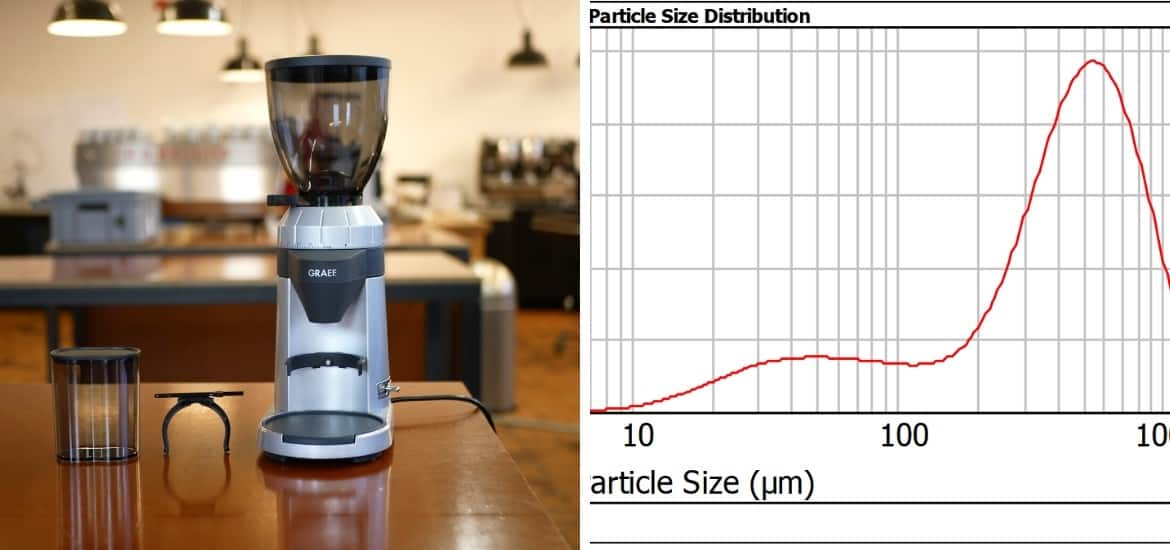

It has the reputation of being the entry-level grinder for the world of espresso. The Graef CM800 is often marketed as an affordable entry-level grinder, but how good is it really? What can you expect for 130 euros and is it really suitable for beginners? We tested the Graef thoroughly and were frustrated after the first few hours! The coffee didn't taste good. But we didn't give up on it; instead, we continued testing and tinkering to get something worthwhile out of the grinder. Our two-year journey with the Graef is summarized in this report.
Why we test the way we do and why we test at all?
Our goal is to bring you machines and tips that allow you to enjoy great coffee with simple means and a limited budget. That's why we, at Kaffeemacher:innen, operate our own coffee farm, a roastery and cafés, as well as a coffee academy.
When we recommend a machine, it's because we're convinced of it and know that you can make good coffee with it. If operating tips are needed for good results, you'll get them as well.
We don't earn anything from this grinder or our tips, so we can be completely honest from the ground up!
Overall impression Graef CM 800
The price and size are the major pluses of the Graef. At 13.5 cm deep, 23 cm wide, and 39 cm high, it fits into any kitchen. Its construction with 2.6 kg feels solid.
Another plus: It can produce espresso-fine coffee powder, unlike other grinders in the price range up to 200 €. So if you find the right setting for your beans, you can actually brew a proper espresso.
| Feature | Graef CM800 |
|---|---|
| Price | approx. 130 € |
| Dimensions (W × D × H) | 23 × 13.5 × 39 cm |
| Weight | 2.6 kg |
| Grind setting | Levels 0–40, for espresso additional internal adjustment needed |
| Dosing | On/Off button, no timer function |
| retention | approx. 8 g |
Our conclusion upfront on the Graef CM 800
So you can grind espresso-fine. But getting to the right grind setting is extremely difficult. Operating the grinder is not easy. You should even be comfortable handling a screwdriver to get everything out of the grinder. In our opinion, the Graef is suitable for sensory beginners and technically advanced users.
Grinding espresso fresh with the Graef CM800
Just 15 minutes after grinding, coffee loses flavor extremely rapidly. This is due to the large increase in surface area and the reaction of the powder with the oxygen in the air. Therefore, pre-ground coffee is always worse than freshly ground. Espresso grinders can grind finer than coffee grinders. This is necessary to build adequate resistance when preparing espresso. With powder that's ground too coarse, the espresso flows too quickly and the coffee isn't extracted enough (under-extraction), making it taste sour. So the Graef can make a big difference in taste – a quantum leap from pre-ground to freshly ground espresso.
Can something this cheap taste delicious?
We spent many hours with the Graef mastering the complex grind setting and brewing the perfect espresso. To ensure our negative points weren't related to the espresso machine, we pulled our espressos with a La Marzocco GS3, which is priced in the range of a small car.
Our espressos were bitter and at the same time had an aggressive acidity. Despite our usual brewing ratio (18 grams of coffee to 45 grams of espresso) and an optimal flow time of 25 seconds, the espresso didn't taste good.
To keep our perceived taste experience more objective, we applied the so-called triangle test. Three espressos are blind tasted. Two come from the same pull, one deviates from it. We asked the taster to also identify the worst espresso. With 6 sets, the Graef CM 800 was consistently identified as the worst espresso.

Particle distribution as a reason for poor espresso
During grinding, coffee beans are ground into pieces of somewhat varying sizes. This results in somewhat larger particles and somewhat smaller particles. This is called particle distribution. The greater the scatter of these particles, the more difficult it is to pull a balanced espresso. During extraction, large coffee particles are under-extracted and small ones are over-extracted. Thus, instead of a balanced cup, you get a mixture of bitter and sour notes. With the Graef, the particle distribution is too widely scattered. Using a laboratory sieve, we determined that out of 50 grams of espresso grounds, only 20 grams were ground to the perfect size. About 10 grams are too fine, about 20 grams too coarse.
Laboratory sieve analysis of 50 g espresso grounds from the Graef CM800.
Grind analysis using laser and image capture
With the help of Benjamin Schütz, roaster and coffee expert, and the company Sympatec, we were able to compare the grinding of different grinders. I set the grinders for perfect espresso (18 grams of grounds to 50 grams of beverage in 25 seconds). We tested the following grinders: Anfim Practica as a professional benchmark, Eureka Mignon Perfetto, Macap M2D, Sage Smart Grinder Pro, Sette 270Wi, and Graef CM800.
The Graef CM 800 showed the lowest peak. This means the grinding is scattered and has no truly uniform grind size. Also, the amount of coarse particles is higher than in the other grinders tested.
Lowest strength and extraction analysis for the Graef CM800
Furthermore, we tested the "strength" of the coffee, meaning the amount of dissolved coffee particles in the espresso. The Graef fell significantly behind the other grinders. There were only about 17.9% dissolved coffee particles in the cup. Other grinders achieved up to 21.5%. Taste-wise, this manifested itself in an espresso that tasted rather watery.
Grinder test 2022 – Graef CM800 under scrutiny again
The tests we conducted in 2022 also support the above results. In a fresh laboratory analysis, we again saw a very wide distribution of particles and a high coarse peak. It's simply difficult to precisely grind a specific size of coffee particles.
Operation and grind setting of the Graef CM800
The grind setting is the most important adjustment option for the coffee grinder. This is where you set how coarse or fine the powder needs to be to achieve the perfect flow rate during extraction.
The Graef has a setting range of 0–40. Unfortunately, even at the finest setting, the espresso shot through in just 12 seconds. So it was still too coarse. Therefore, instead of the external setting, we had to perform an internal adjustment of the grinding burrs.
For this, the grinder had to be opened and two small screws on the upper grinding burr loosened. Then you could make a coarse adjustment to get into the right range for espresso grinding. You can best see this in our Kaffeemacher:innen video.
This type of adjustment is possible, but very, very cumbersome and really a no-go. Especially beginners who are drawn to this inexpensive grinder will face quite a challenge here. There's a risk that instead of an introduction to the espresso world, you'll get a scare from the complexity.
Grinding is done via an on and off button. The amount of grounds must be weighed manually since there's no timer function.
You can find matching grinder cleaning powder here.
retention for coffee grounds
By retention we mean hidden spaces in the coffee grinder where old coffee grounds remain. The larger the retention, the more "old" ground coffee you get in your portafilter when grinding. The retention of the Graef is approx. 8 grams. That's quite a lot!
Conclusion on the Graef CM800 and who is this grinder suitable for?
The biggest pro is that the Graef is the only grinder in its price segment that manages to grind espresso-fine. However, precise adjustment is very cumbersome if a readjustment of the grinding burrs is necessary.
The particle distribution of the ground coffee is so widely scattered that the ground coffee is extracted incorrectly despite proper adjustment. There are then too many under- or over-extracted coffee particles.
Many beginners use the Graef together with the Delonghi Dedica EC 685. With both machines you can brew an espresso cheaply, but whether this then hits the taste remains questionable. Especially for beginners, it's important that your equipment works reliably so you can quickly identify setting errors. Therefore, we wouldn't really recommend the Graef. If you're not put off by wasted ground coffee and breaking a sweat over the settings, you can give the Graef a try.
This article is a short blog. For the detailed blog article, go here to our Swiss site.

