





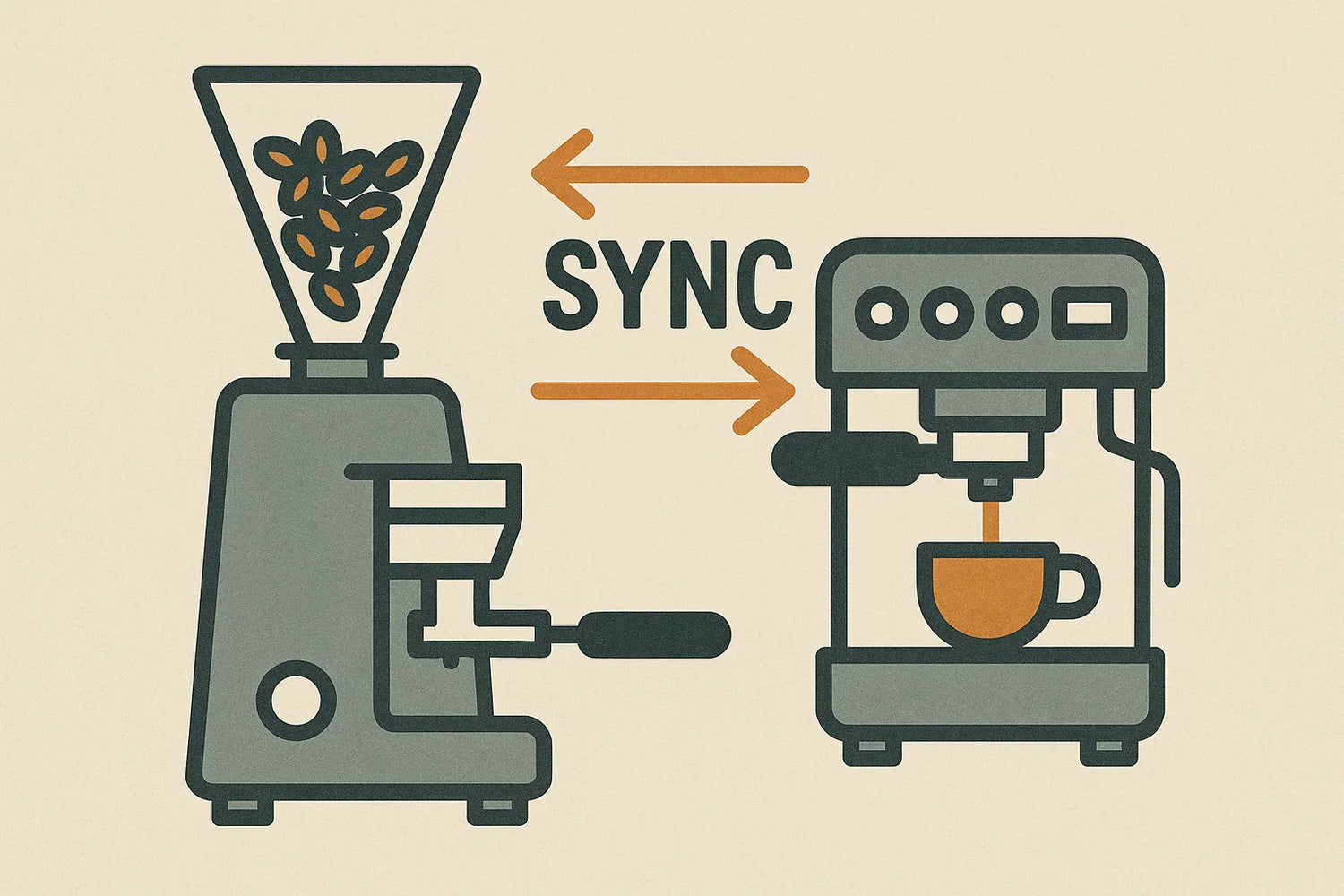

What is Grind-by-Sync? Espresso machines and grinders for home use that communicate with each other. The grinder-machine combination detects whether the espresso is running too fast or too slowly and adjusts the grinder accordingly. After 15 years of experience in gastronomy, the technology is now making its way into our homes. But let's be honest: do we really need this? Does the system work at home when we only brew a few espressos a day? Which machines and grinders have the potential to quickly and reliably brew espresso?
Or is the whole thing just marketing hype to lure coffee drinkers from fully automatic machines to portafilter machines without really convincing them of quality?
With this blog post, I'll examine the technology, evaluate it critically, and provide manufacturers with a requirements list of what I expect from a well-functioning espresso grinder and machine combination. And let me be clear about one thing: if a grinder consumes 100 grams to dial in an espresso, your system doesn't work!
The Promise: Never Adjust the Grind Size Again
"Wonderful, synchronization!", you might say. But it's not that simple. There are incredibly many pitfalls that we experienced when rolling out synchronization between grinders and espresso machines in gastro practice. The technology promises to automatically compensate for fluctuations caused by bean aging, moisture, or bean switching and to bring extraction "on target". But how much coffee is needed to dial in the grinder? Who actually makes enough coffee at home to provide the grinder with the necessary data and reference points for adjustment? And don't I still have to set the grinder's base setting myself?
How It Works – In Theory
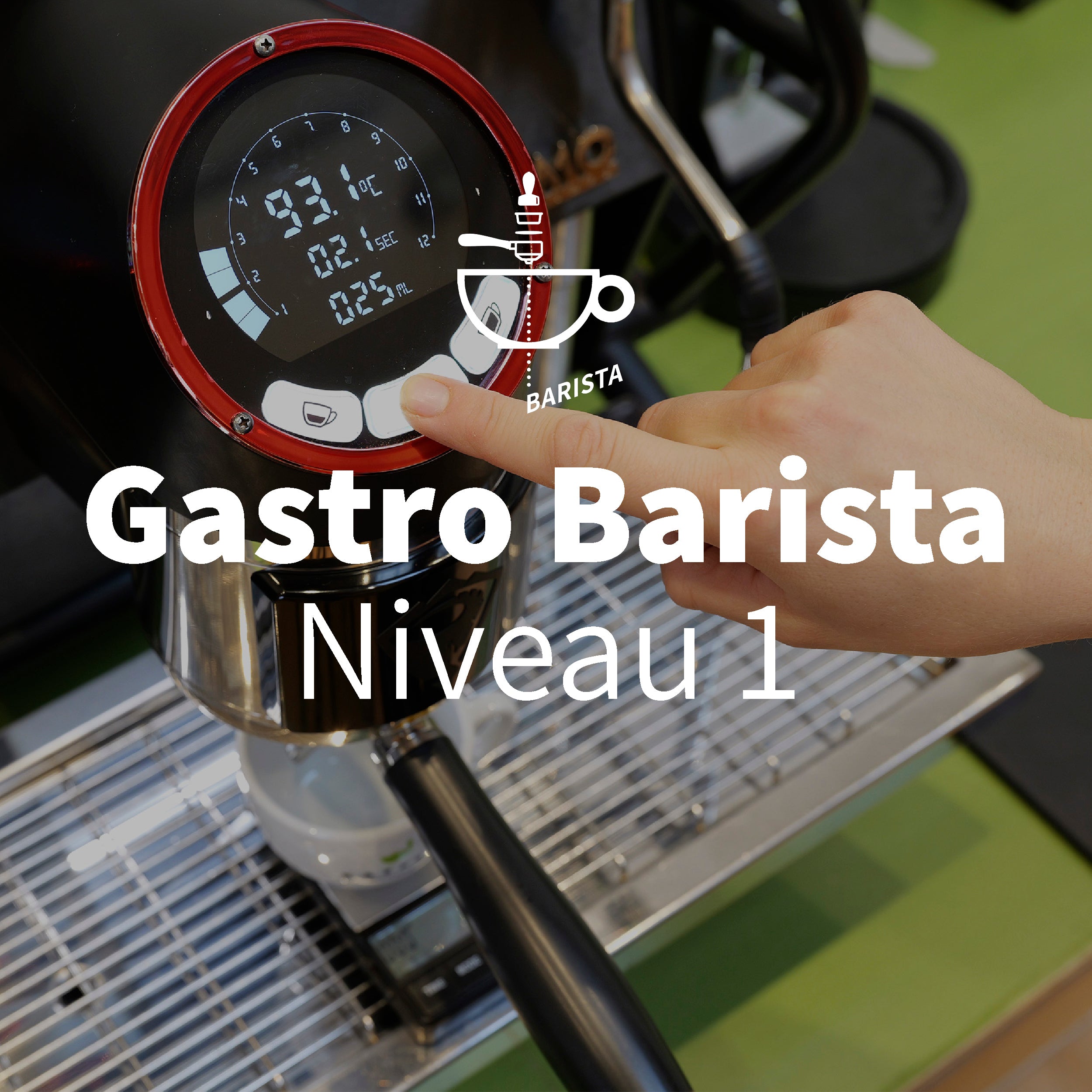
The espresso machine measures key parameters during extraction – flow rate, time, extraction behavior – and sends this data to the grinder. If the extraction deviates from the target values, the grinder automatically adjusts the grind size. For many machines, flow measurement is limited to the total volume rather than measuring milliliters per second.
The Technical Requirements for Grind-by-Sync to Work
For synchronization between grinder and machine to work, both must meet certain requirements. I distinguish between basic requirements and ideal criteria, which enable better synchronization and control of extraction.
What the Grinder Needs:
- Grind-by-Weight function (absolutely essential!)
- Electronically adjustable grind size
- Low retention!
- Communication interface to the machine (serial, WiFi, Bluetooth)
What the Machine Needs:
- Precise volumetrics (without good volumetrics, you get false signals to the grinder)
- Stable extraction parameters (pressure, temperature, flow)
- Ideally: sensors for flow rate and flow/pressure control
Why Grind-by-Weight is Essential
Without Grind-by-Weight, the system doesn't work properly. Why? When the grinder adjusts the grind size, the amount of coffee output from time-based grinders also changes. When ground finer, less coffee comes out. This distorts the brew ratio, and the extraction goes completely off course. You're adjusting two parameters simultaneously – a no-go for reproducible results.
Electronic grind size adjustment is of course also a requirement – but that goes without saying. Low retention is also a central requirement. Because a clean check of the adjustment only works if the next extraction also actually shows us the "new grind size" in the portafilter and not a few more grams of the old grind.
Current Systems Overview
Mahlkönig Xenia & E64 WS Home – The German Precision Approach
With the acquisition of Xenia, Mahlkönig has added not just a machine, but an entire platform to its portfolio. The Xenia remains technically an independent system with thoughtful details: two stainless steel boilers, actively heated brew group, and it's relatively quick to get running. In addition, it's able to control pressure profiles.
The E64 WS Home ("Weight & Sync") brings Grind-by-Weight from Mahlkönig to the home market for under 1,000 euros for the first time. The system is called "Grind-by-Sync" here: The Xenia measures during extraction and sends the data to the grinder, which then automatically adjusts the grind size.
Price: Mahlkönig Xenia 2,999 euros for the machine, E64 WS 999 euros. Market launch: The E64 WS will be available from dealers in November. Xenia production begins in December, with delivery at the end of December/beginning of January.
Quick Mill & Eureka Tio – The Italian Surprise
A partnership we didn't expect: Quick Mill and Eureka present with the Tio a cooperative system. Quick Mill has cleverly reworked the machine (1.4 liter steam boiler, thermoblock for the brew group): instead of the previous system with its own bayonet, there's now a classic dual bayonet. Finally, standard portafilters can be used – this makes the machine much more flexible in everyday use.
The Eureka grinder is based on the well-known Libra but has been further developed: larger burrs, integrated scale, and the Smart technology that has been providing feedback for some time. The system works with a "2–3 second rule": if extraction remains outside the target range three times for two to three seconds, the grinder adjusts the grind size.
Price: Approximately 2,600 euros for the machine and 800 euros for the grinder. Market launch: Q1 2026
The Other Players
Nunc: Probably the most technically mature. Bidirectional communication, large data storage with previous extractions, probably capable of learning with AI support. Plus: "nunc beans" can be used, which the machine naturally knows. This makes the base setup easier. Machine production reportedly started, but delivery continues to lag.
Sage/Breville Oracle Dual Boiler: The pioneer with integrated grinder. Responds with a delay and adjusts finer or coarser when the coffee is clearly outside the range.
Rocket: Already has the technology in use with Bentwood on gastro machines. Likely coming soon in combination with a volumetric machine like the Bicoca and the new home grinder.
Datum Coffee pursues the most open approach: no proprietary beans, no exclusive partners, platform for all roasters — Kickstarter end of 2026.
The Reality Check: What Manufacturers Don't Tell You
The 60-Gram Problem
Let's do the math: Most systems only react after two to three failed extractions. At 18–20 grams of coffee per extraction, that's quickly 60 grams before the grinder even reacts. With a 250g bag for 10–20 euros, that's frustrating. And then it's the grinder's turn to adjust – but does it nail the next shot? If not, 80 grams are already gone.
The Difference from Gastronomy
In gastronomy, we pull one espresso after another. The grinder adjusts gently throughout the day. It has a base setting, and when high humidity lengthens extraction times, it's gently fine-tuned.
At home? When do we actually make multiple extractions in a row? And how precisely does the system adjust then? How well is it able to make a sufficiently strong grind size adjustment? And what about grinders with retention? Is the old coffee that still remains from the last extraction at the old grind size in the chamber being ground out?
The Technology Only Works with Regular Use
This technology simply doesn't work if you "make three extractions in three days". If you really leave the coffee in the bean hopper for three days, none of these extractions will be consistently in range because you'll have to gently adjust the grinder anyway.
Base Setup Remains Manual
At this point in time, I assume you'll have to set up the base setting for all grinder-machine combinations yourself. I'm happy to be proven wrong. If coffee is then extracted regularly – yes, then the synchronized espresso grinder-machine combination plays to its strengths.
For Whom Does It Really Make Sense?
Suitable Use Cases:
- Households with multiple coffee drinkers – one sets it up, the others benefit
- Offices and shared apartments – many extractions, consistent quality
Less Suitable For:
- Beginners – you still have to learn the base setup
- Occasional drinkers – too few extractions for meaningful adjustment
- Purists – those who see the adjustment process as part of the ritual
The Test Protocol: How We'll Evaluate These Systems
- The Extreme Test: Completely adjust grind size (15 second flow time, target size 25 seconds)
- The Measurement: How many extractions / grams of coffee does the system need to reach the target range?
- The Daily Routine: One extraction in the morning, afternoon, and evening over several days
- The Consistency: How cleanly does the system maintain extraction under changing conditions like humidity or dry air (static electricity)?
Flow Profile Instead of Just Grind Size
The real potential lies in the interplay of good Grind-by-Weight grinders with very low retention and espresso machines with flow control. Classic espresso machines with static pump pressure can only influence the next grind and thus the next extraction. Machines with flow control have a huge advantage: A Roxy, Maro, Decent, or even the Xenia can't just say "okay, we'll adjust the grind size next time", they can react at the moment when the extraction is happening.
Extraction running too fast? The machine reduces the flow or pressure to bring the extraction into the target corridor anyway. On the Maro, this function is called "Smart Profiler".
Let's assume the perfect grind size gives us 100% extraction potential. With flow adjustment during extraction, we might get 75% – still significantly better than a ruined shot. If a shot goes badly when it shouldn't, i.e., clearly channels, too coarse grind and everything sprays, then the coffee is down the drain. With flow control, it looks better – and tastes better.
Conclusion: Evolution, Not Revolution
Grind-by-Sync is a logical development, but not a cure-all. The technology can help, but is unlikely to initially free anyone from manual adjustment. In households with many coffee drinkers or in offices, it makes sense. For the ambitious home barista who celebrates their morning espresso? Probably not.
What we'd like to see: open standards. If Eureka or Mahlkönig opened their interfaces, all machines could benefit and Roxy, Maro, Meticulous and Co. could simply dock on. These machines seem made for communicating with a grinder.
The technology exists, it works – in gastronomy for 15 years more or less. Whether it conquers the home market depends on whether manufacturers understand that three wasted shots in the morning makes nobody happy. We'll stay on it and test as soon as the devices are available.
We're curious to see what manufacturers will deliver next year. For now, we remain, as always, curious and open – but also a bit of the skeptical party poopers from Basel.
Your Benjamin Hohlmann