




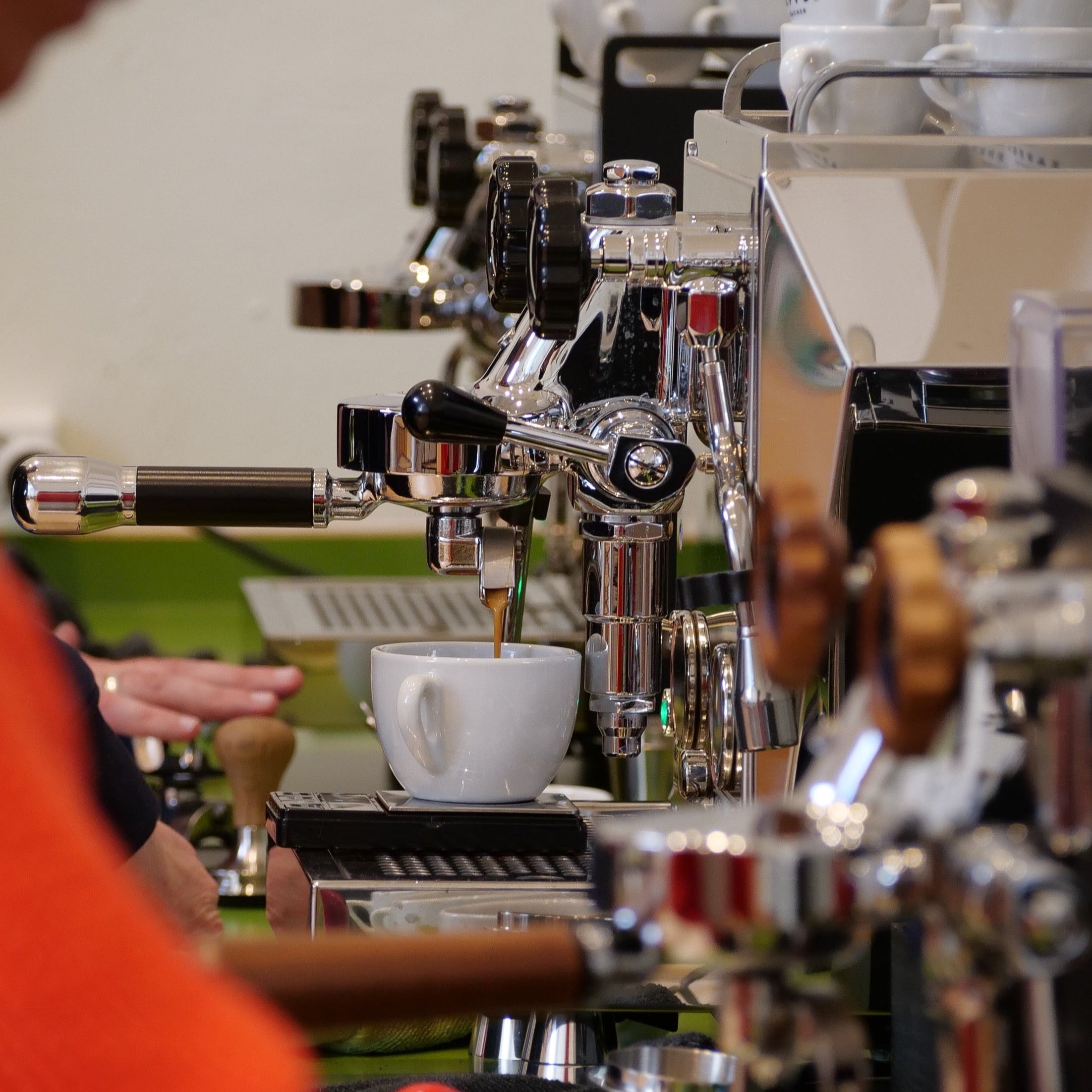

Coffee trade shows unfortunately often lack real news. New colors for tried-and-true espresso machines are hyped as innovations, gentle revisions from established manufacturers marketed as the latest trend. So it's all the more delightful when genuine innovations hide among the year-after-year repetitive booths at the World of Coffee — like Datum Coffee.
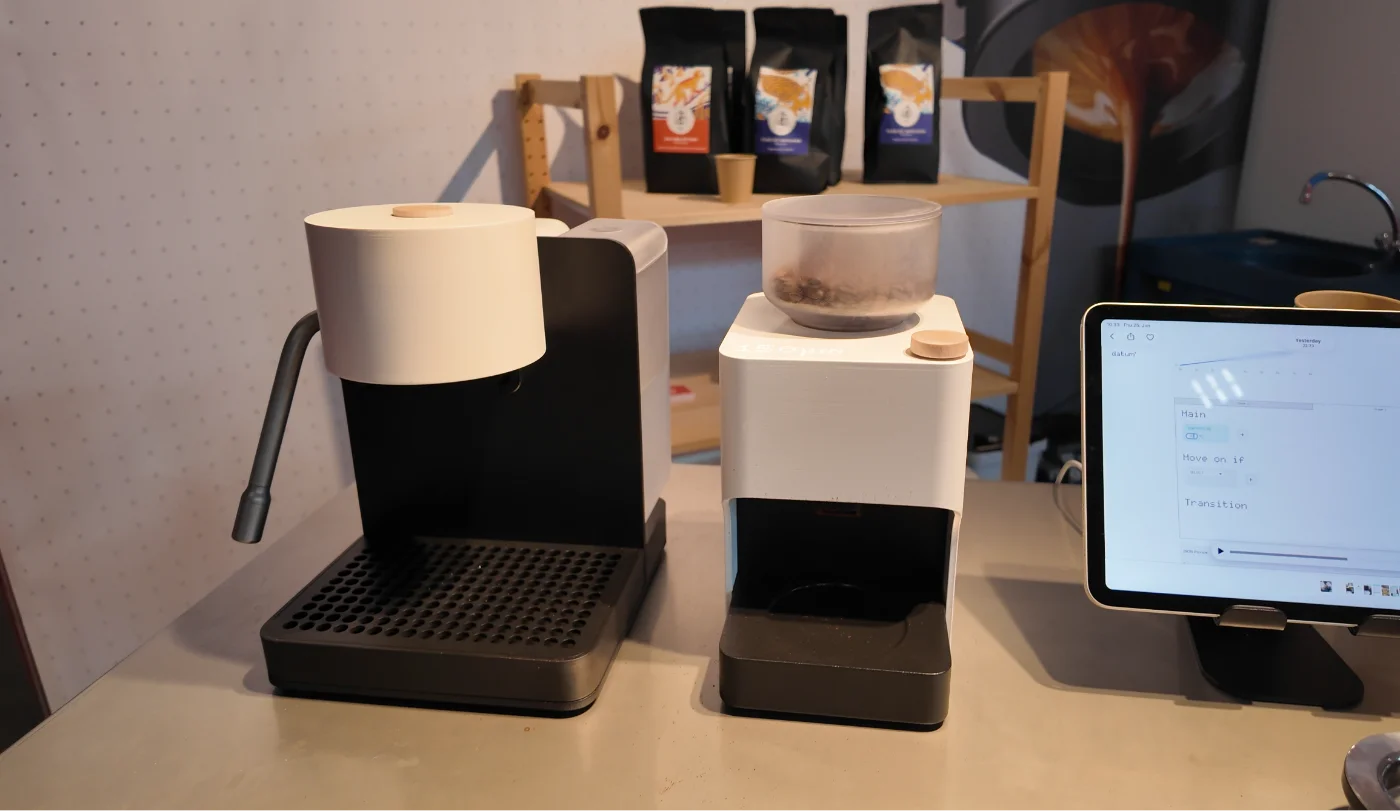
Datum Coffee is an Austrian espresso machine startup, founded by two 28-year-old mechanical engineering and design students Christoph Konheisner and Nikolaus Potapow. What have they developed? Two prototypes of an espresso machine and grinder that work together and produce espresso using the latest technology. The product isn't finished yet, but the concept is promising — and my personal highlight from the World of Coffee in Brussels.
This article is based on a trade show encounter with a prototype at the World of Coffee 2025 in Brussels. It is explicitly not a complete coffee maker test. All technical specifications come from conversations with the founders and the Datum website. We can only judge what the machine delivers in everyday use once we have a production machine in our hands and put it through our test protocol. We'll do that as soon as it becomes available.
Who's Behind Datum Coffee?
Chris and Nikolaus, mechanical engineering students from Lower Austria, based in Innsbruck. Over the course of around two and a half years, they developed the two presented prototypes, a concept, and the accompanying software, presenting them at the trade show in prototype 3D-printed housings.
The two founded it essentially using their own funds, without external investors, backed by government support. What drove them was a question many beginners ask: Why do people have to throw away several espressos until the grind size is right? In response, they're developing datum.coffee.
The Concept: Machine, Grinder, and Platform as System
Datum Coffee isn't a single device but a duo of espresso machine and grinder that work together connected and are coordinated via a platform. This sounds like marketing, but it's actually technically the core of the system: The two devices exchange data, adjust parameters to each other, and thus reduce manual setup effort.
The thinking behind this isn't new. We've described the principle behind such networked systems in detail in the article "Grind-by-Sync: Grinder and Machine in Dialog." What Datum Coffee does is take a consistent next step in this direction — with the difference that the platform here is intended from the start to be open to roasteries and potentially also to other machine manufacturers.
What the Machine Promises
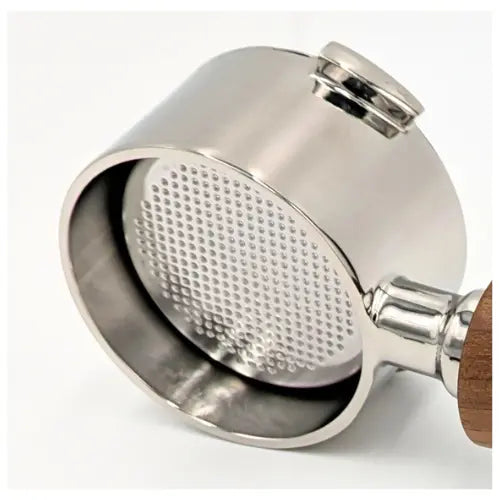
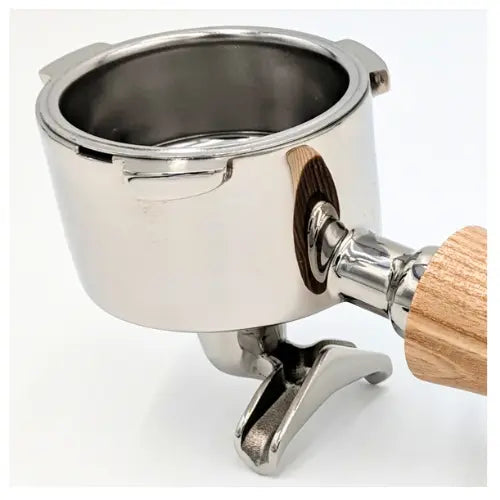
At first glance, the "58-mm portafilter" seems surprising: it forgoes the classic handle and instead consists of an oversized basket.
Heating is done with a thin-film heater. The heater heats while the grinder grinds — this takes about 10 seconds according to the founders. Whether and how preheating of the portafilter is planned beforehand remains open. This is not unknown technology: The Maro Model 1, one of the most technically advanced machines we've tested so far, also uses a thin-film heater (FTH) and achieves heat-up times of 4 minutes. The Roxy espresso machine, which also works with a thin-film heater, achieves similar speeds.
What Datum Coffee additionally brings: an automatic tamper, integrated directly into the brew group. A hydraulically controlled piston descends, tamps with adjustable pressure (the demo showed 20 kg), and then brews automatically. That means: insert portafilter, press start — the machine takes over. This is reminiscent of what Sage does with an integrated tamper on some devices, except that Datum's tamper sits not in the grinder but in the brew group. The portafilter can be removed and the coffee grounds distributed manually before the machine takes over.
According to the Datum team, a flow sensor, pressure sensor, and temperature sensor are installed. Flow and pressure profiling should be possible. Demos of a corresponding app or browser view show the programming of stages and exit conditions.
Two variants of the Datum espresso machine are planned: with and without a steam wand. According to the founders, the steam wand should also be smart, with a temperature sensor and automatic steam control. The water tank holds 0.8 liters and has an integrated water filter.
What the Grinder Offers
The grinder grinds with 64-mm flat burrs, brushless motor with adjustable speed, and integrated scale. Grind-by-Weight unlocks many smart functions of such a setup. This is complemented by electronic grind adjustment in micrometer increments. An LED display on the grinder shows the most essential information; more complex settings are made via app or browser.
The Grind-by-Sync principle is deeply integrated: When the machine notices during a shot that the flow is too fast or too slow, it sends a signal to the grinder, which adjusts the grind size for the next shot. We know this principle from other systems — the Mahlkönig Xenia with the E64 WS pursues a similar approach, as does the startup nunc. with its smart espresso machine. What Datum Coffee promises is an open version that doesn't rely on proprietary beans and exclusive partner roasteries from the start.
The Platform: Recipes via App, Open to All
When someone buys a new coffee bean package, they photograph the label once with the app. The platform recognizes the product, if it's listed, retrieves a recipe stored by the respective roastery, and sends grind size, shot parameters, and drink type directly to the grinder and machine. On the next shot, the grinder adjusts itself. Those who want can intervene manually — the Pro mode allows multi-stage brew profiles with free control of temperature, flow, and pressure.
For roasteries, registration on the platform is planned to be free. In the long term, the platform should also be opened to other machine manufacturers. Datum is thinking of a kind of open operating system for networked espresso devices. This sounds ambitious — and it remains to be seen how this actually can and will succeed. The value of a platform increases with the number of users, and an open platform has a better chance of remaining relevant than a closed ecosystem.
When Will the Machine Be Available?
Datum Coffee plans a Kickstarter campaign for late 2026. Those who want to pre-order can note it now. Delivery is planned for late 2027. What the machine will cost, the founders said candidly at the trade show: On the website, a price of €1,199 is visible for early buyers, regularly €1,499 later — and that's for machine and grinder together. For comparison: the Mahlkönig Xenia costs significantly more on its own. Whether Datum Coffee will actually hold this price remains to be seen. As a statement, it's remarkable.
Classification: What This Means
The direction Datum Coffee is thinking in isn't singular. Networked systems made of grinder and machine are becoming a real trend in the home segment. Mahlkönig shows with the Xenia and the E64 WS where established manufacturers are heading. nunc. has had a similar concept with NFC bean recognition for quite some time, but is still rolling out production. Maro is building a learning platform around their machine with the Smart Profiler and Maro Home shot database.
What distinguishes Datum Coffee from these systems: the automatic tamper as part of the brew group, the open platform idea, and the entry price, which — if it comes as suggested — is significantly below what comparable systems cost.
Whether all of this works in the production machine the way it was promised at the trade show remains to be seen. We'll test it when the time comes. Until then: a promising startup, a well-thought-out concept — and two machine builders from Innsbruck who know what they want to do.
We've committed to ordering a machine as soon as the Kickstarter goes live.
Conclusion
Datum Coffee is not yet a finished product but a prototype with a clear concept. Espresso machine and grinder as a networked duo, automatic tamping in the brew group, an open platform for roastery recipes. The direction is right, the team seems competent, the announced price would be, if it materializes, a real exclamation point. What the machine really delivers, we can only say after a complete test with our protocol. That will follow as soon as a production machine is available. Until then, we're keeping an eye on Datum Coffee — and we're excited to see what comes.
Kickstarter: planned late 2026 · Delivery: planned late 2027 · Price: €1,199 (early buyers) / €1,499 regular — machine + grinder as a set · More: datum.coffee