




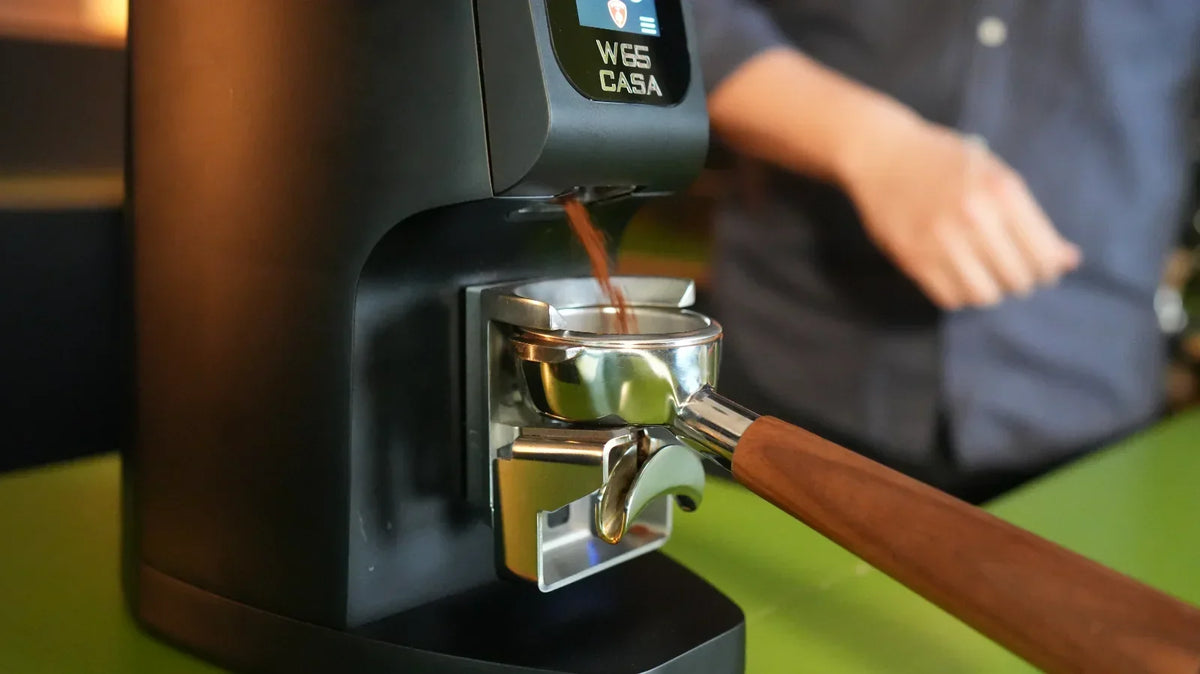

Eureka calls this grinder Casa, which means home. And the name does not, in our view, point to the grinder's strongest field of application. The W65 Casa is a grind-by-weight grinder with a 65-mm atom burr set. It's large, powerful, and fast, and at around 1,000 euros, it costs surprisingly little for what it can do. But in our opinion, it's not a living room grinder at all. We tested it according to our espresso grinder protocol, and a single value determines who it's right for: the retention. Michel and I didn't quite agree on this grinder, but let's take it one step at a time.
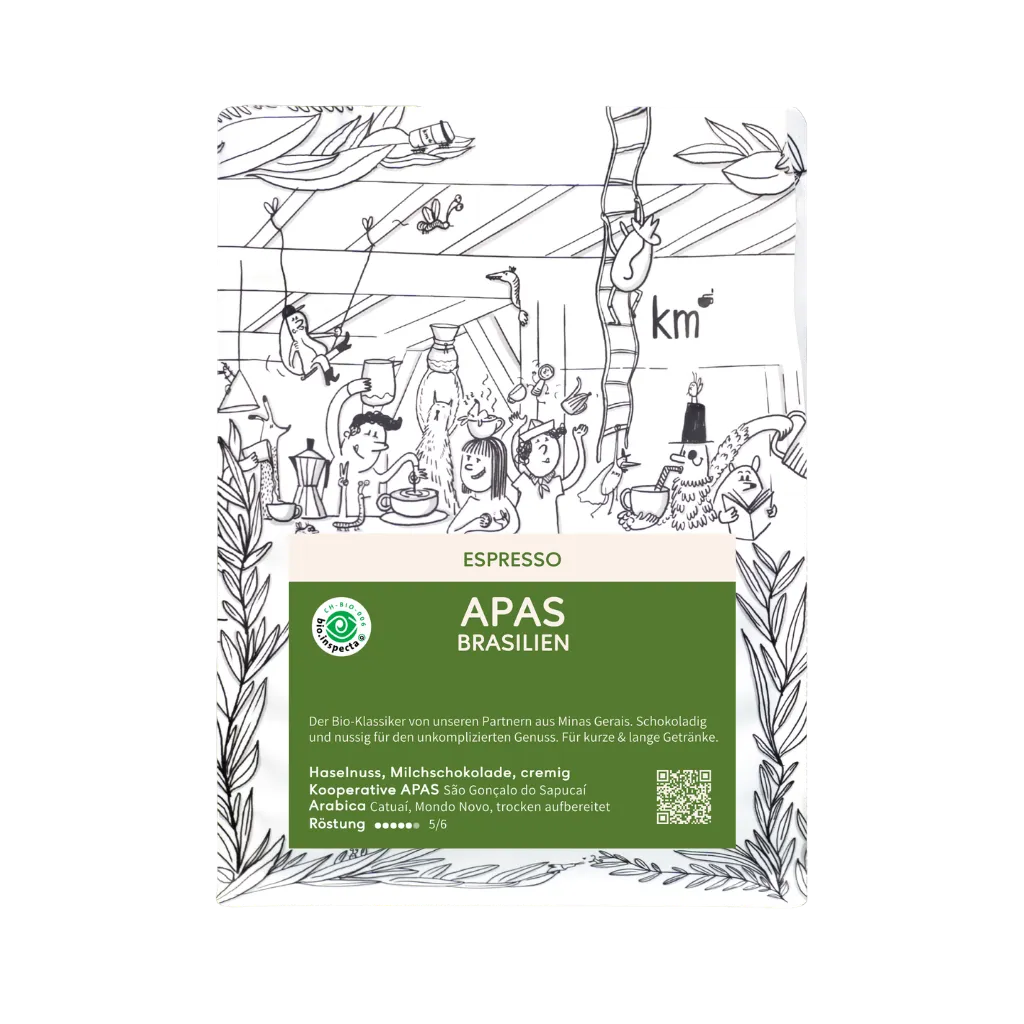
As always, we bought the grinder ourselves. All measurements come from our KM test protocol for espresso grinders. We tested and tasted with our Apas Espresso, the naturally processed coffee from Brazil from the APAS cooperative, which we know from countless tests.
A small atom in plastic housing
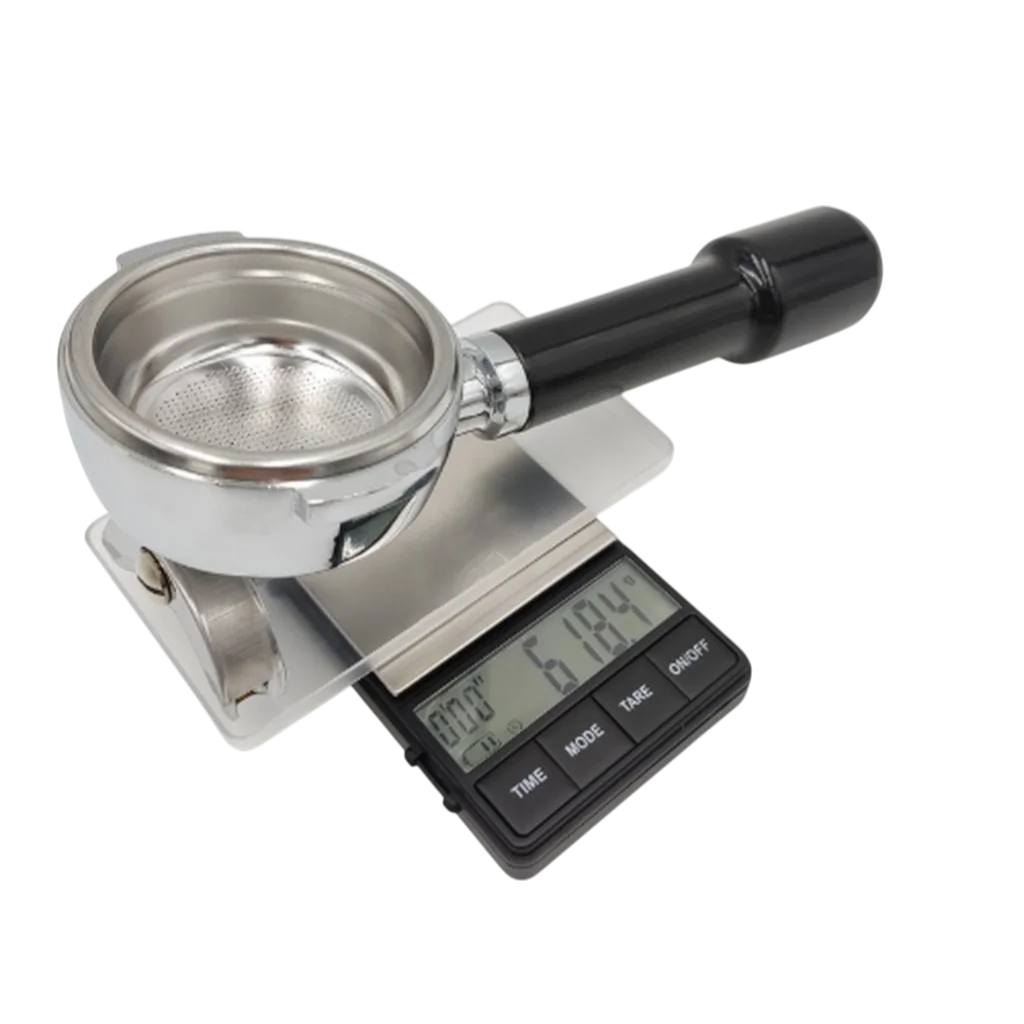
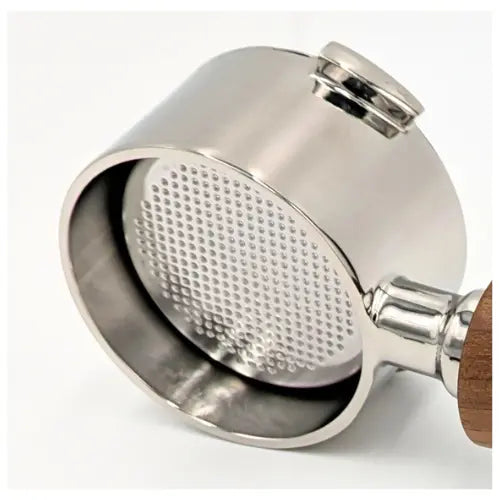
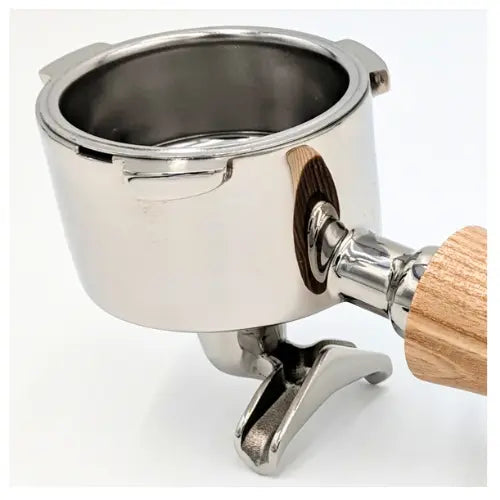
At its core, the W65 Casa is a Eureka Atom, just built a bit more simply. Costs are cut in the housing: the display attachment is made of plastic, and the included hopper is not the most expensive component either. Everything else is solidly and high-quality crafted. We particularly like the portafilter holder. It can be adjusted via two cross screws, and any portafilter really fits in there, even the tall, angled Maro, because the grinder has enough height. Where exactly Eureka has cut costs hardly matters in everyday use. For around 1,000 euros, you get a lot of grinder here.
It is large, however. With the small hopper, we measure 43 centimeters in height, plus 18 centimeters in width and 19 centimeters in depth. The power plug is on the side and doesn't extend the depth. If you put the large hopper on top, it grows noticeably taller. If you want to place it under a cupboard, you should measure first. The 10-kilogram weight ensures that nothing wobbles while grinding.
65-mm atom burr set and grind by weight
The heart of the grinder is a 65-mm flat burr made of hardened steel, the classic atom burr set. It's driven by a motor of around 280 watts, which is the smaller variant compared to the large Atom W 65 with 430 watts. This doesn't change much in grinding performance. For 18 grams, the grinder needs 10.5 seconds according to the protocol; with dark, brittle beans, it drops to seven to eight seconds in practice. In 10 seconds it dispenses 30 grams. A solid average that's already on the faster side.
The real attraction is grind by weight. In the portafilter fork sits a scale that weighs while grinding and stops the motor precisely at the target weight. You hang the portafilter in, the grinder tares and starts grinding until the programmed amount is in the basket. No button, no external scale, no guessing at time. Up to three portions can be stored, plus a manual mode. For commercial use, that's exactly what's worth its weight in gold, and we'll come back to that shortly.
As with the old Mignon Specialità, the adjustment wheel is small and difficult to fine-tune. One click changes the extraction in rather large steps, and there's a lot of play between the detent points. We've been asking Eureka for years for a larger wheel across their entire product line. That would be a bigger step forward than many new models. Clever modders are already printing 3D adapters for it.
Fast, quiet, and still cool
Despite its speed, the Casa remains quiet. We measure 79.6 decibels, making it one of the quieter grinders in the field. Speed and volume don't come at the expense of each other here, which isn't a given. Thermally, there's nothing to complain about either. The ground coffee remains at an average of around 29 degrees, below the threshold at which heat damages the coffee. Even under load, the grinder doesn't heat up. That's exemplary and one of the reasons it handles many shots in a row.
Consistency: a bit too much play for a GBW
This is where the first weakness shows, and it appears precisely where you wouldn't expect it with a GBW. Over 15 grindings, the standard deviation is 0.21 grams. We aim for 18 grams and sometimes land at 17.7, sometimes at 18.2. That's acceptable, but we'd expect more from a grinder with an integrated scale. Timed grinders with proper calibration are sometimes more precise.
Why grind by weight at all then? Because the advantage lies elsewhere. In a commercial environment, you constantly adjust the grind setting throughout the day because humidity and the bean change. With timed dosing, you'd have to adjust the time each time and reweigh. With GBW, there's only one variable: the grind setting. The grinder handles the amount. And then 17.7 or 18.2 grams isn't perfect, but still much closer to the target than if you suddenly find yourself at 17 grams with shifted timing.
The intermediate storage: 19 grams retention - TOO MUCH
Now to the point where everything decides for us. The absolute retention is 19.3 grams. Of that, only 0.9 grams is permanent; the bulk of 18.4 grams is temporary retention. This is ground coffee that remains in the burr set after grinding and waits to be dispensed next time. In other words: there's constantly a whole double espresso sitting in the grinder, a kind of emergency reserve. Switzerland had set up a coffee stockpile for times of crisis. Think of the W65 Casa as a small private version of that.
For operation, this means: if you want your first shot in the morning, you have to grind a good double portion first to empty the retention before fresh coffee comes out. If you've left the grinder sitting for a few hours, you'll otherwise grind old, oxidized coffee into the basket. At home, that's a real loss, every single day anew. In commercial use, the math changes. If coffee is running regularly, say at least one shot per hour, the temporary coffee is never in the grinder long enough to oxidize. Then the large retention is practically no issue.
The permanent portion of 0.9 grams, however, is pleasantly small. So coffee doesn't really accumulate permanently in the crevices. This also means: once you've ground through the temporary retention, you can do well with cleaning pellets afterward and don't have to take the grinder apart all the time.
So it's clear what the W65 Casa is not: a single-dosing grinder. If you load 18 grams of beans and grind them out, around 18 grams stay in the burr set. You're basically just swapping out the retention with single dosing. That's enough for a clean bean change, but not for gram-accurate single dosing. Eureka rates the grinder at a maximum of one kilo of coffee per day. We don't know why the manufacturer is so cautious, because the atom burr set otherwise sits in commercial grinders. We suspect it's more about differentiation from the more expensive models.
Because the Casa only opens with tools, there's hardly a way around cleaning granules for intermediate cleaning. You add it to the empty bean hopper, let it grind through, and then grind a portion of fresh beans after it—all without screws. Our Cafetto Grinder Clean is made from 100 percent natural ingredients, is certified organic, and costs 14.90 euros. This keeps the burrs and retention area free of old oils and residues, and the first coffee tastes fresh again.
Reliably returns after adjustment
If you adjust the grind setting frequently, you want to be able to trust returning to the same point afterward. In the adjustment test, we went from the espresso setting to ristretto, then to lungo, and back to espresso. The x50 value at the starting point is 167 micrometers and 175 micrometers after returning; the main peak shifts from 203 to 212 micrometers. These deviations are small. The grinder reliably returns to its setting.

Particle distribution and taste: plenty of body, little finesse
We measured and tasted using our standard recipe with the Apas Espresso.
In the cup, the Casa shows an espresso with notably lots of sweetness and body. It's powerful, soft, and balanced. What it lacks is some clarity. It doesn't show the last differentiation the coffee would actually be capable of.
We analyze the particle distribution in cooperation with the Coffee Excellence Center of ZHAW using the Retsch Camsizer X2. At espresso setting, the median (x50) is around 167 micrometers, the main peak at narrow 203 micrometers. So narrow that the grinder would theoretically also be suitable for light, complex coffees. At the same time, the fines content is very high at over 42 percent. Some of that is likely due to the large retention, because the coffee gets a lot of friction there and possibly gets ground twice.
This combination explains the taste. The high fines content pushes body and sweetness to the fore and covers the finer, clearer notes. The narrow main peak ensures that the many fines don't hurt the coffee. The espresso doesn't tip into bitterness despite some dustiness. In practice, this means: the W65 Casa is in its element with medium roasts that tend toward nutty chocolate without being overroasted. It also does well with darker roasts. With very dark coffees, we'd be careful—things can slip into harsh, scratchy bitterness. And for delicate, acid-forward coffees, it's not the first choice despite the narrow peak.
Casa versus gastro: the comparison with the Fiorenzato All Ground Sense
We pitted the W65 Casa directly against the Fiorenzato All Ground Sense, a GBW grinder with 64-mm burrs in the same league. We see both grinders more in the entry-level gastro, catering, or club segment than in the classic home kitchen.
The Fiorenzato is ahead on consistency, at around 0.1 grams deviation, roughly 0.1 grams more precise than the Eureka. The bigger difference is retention: where the Casa drags along 19.3 grams absolute, the Fiorenzato has just under 7 grams—less than half. The Fiorenzato also shows its strength when opening for cleaning. It basically opens without tools, while with the Eureka you need to reach for a tool.
The Eureka counters with volume and operation. At 79 to 84 decibels, it's noticeably quieter. And it starts grinding automatically as soon as the portafilter is in, without you pressing a button. The Fiorenzato requires an extra handgrip, and in a gastro setting, every handgrip counts. Neither gets hot, by the way—both stay around 30 degrees.
Taste-wise, the two are evenly matched; they just go in different directions. The Fiorenzato has the slightly narrower main peak and less fines, its espresso seems more structured and clearer, with less body. That works well with fruity and lighter coffees. The Eureka delivers more body and sweetness and feels most at home with medium roasts.
| Criterion | Eureka W65 Casa | Fiorenzato All Ground Sense |
|---|---|---|
| Burrs | 65 mm Flat | 64 mm Flat |
| Consistency (Std Dev) | 0.21 g | approx. 0.1 g |
| Absolute retention | 19.3 g | approx. 7 g |
| Volume | 79 dB | 84 dB |
| Operation | starts automatically | start button required |
| Opening / Cleaning | tool required | tool-free |
| Grind adjustment | stepped, small wheel | stepless, small range |
| Character in cup | Body, sweetness | Clarity, structure |
In the end, we didn't quite agree. Michel would reach for the Eureka, especially for lungo-heavy operations and when things are busy. He gets along well with the small adjustment wheel. I lean more toward the Fiorenzato. The detailed comparison will be available in the video soon.
Conclusion
The Eureka Atom W65 Casa is a high-quality, fast, and quiet grind-by-weight grinder at a fair price. The only problem is that it bears the wrong name. Casa stands for home, and we see it least of all there. The temporary retention of over 18 grams forces you at home every morning to waste a whole double portion. Nobody wants that.
The picture flips in commercial use. There, retention is no issue as long as coffee is running regularly, and then you get a package for around 1,000 euros that has no equal: 65-mm atom burrs, grind by weight, quiet, cool, and fast enough for up to two kilos a day, split across two grinders. For small cafés, catering, or the club, that's a lot of grinder for the money.
So who is it for? For commercial setups with steady throughput looking for an affordable GBW that run medium to darker roasts. Who is it not for? For the classic kitchen island at home, unless you really consume half a kilo to a full kilo a day or live in a shared flat with high coffee throughput. And anyone who loves delicate grind adjustment work will get frustrated with the small adjustment wheel. All told, a clear recommendation, but just not for the address on the nameplate.
Test Results: Eureka Atom W65 Casa
Rating according to the KM espresso grinder test protocol. All measurements taken by us. Permanent retention is green, temporary and absolute retention and single-dosing performance are red: the grinder holds back almost a full double portion when emptying, which is the core criticism for home use. The particle distribution deliberately does not factor into the rating because it depends on roast level.
Technical specifications at a glance
| Property | Value |
|---|---|
| Price | approx. 1,000 euros (as of August 2026) |
| Burr set | 65 mm flat burrs (Atom), hardened steel |
| Motor | approx. 280 W |
| Mode of operation | Dosing grinder with grind by weight (not a single-dosing grinder) |
| Grind adjustment | stepped, small adjustment wheel |
| Grinding speed | 30 g / 10 sec · 10.5 sec for 18 g (espresso) |
| Volume | 79.6 dB |
| Grinding temperature | on average approx. 29 °C (stays below critical threshold) |
| Absolute retention | 19.3 g (18.4 g temporary, 0.9 g permanent) |
| Single-dosing deviation | 18.4 g |
| Consistency (std dev) | 0.21 g (target value 18 g) |
| x50 (espresso setting) | approx. 167 µm |
| Fines content (< 100 µm) | approx. 42 % |
| Main peak (espresso) | approx. 203 µm |
| Recommended daily output (manufacturer) | max. 1 kg |
| Weight | 10 kg |
| Dimensions (W × D × H) | 18 × 19 × 43 cm (with small hopper) |
Further reading
To see how the W65 Casa stacks up against other grinders, check out our large espresso grinder comparison. We've also bundled all grinders with scales in our grind-by-weight comparison. And you can find the direct competitor in the test of the Fiorenzato All Ground Sense Plus.
As always, we bought this grinder ourselves. This test was not requested by Eureka.