




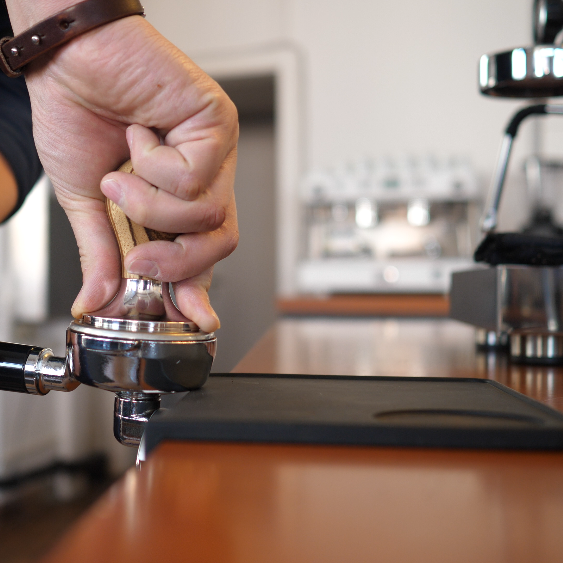
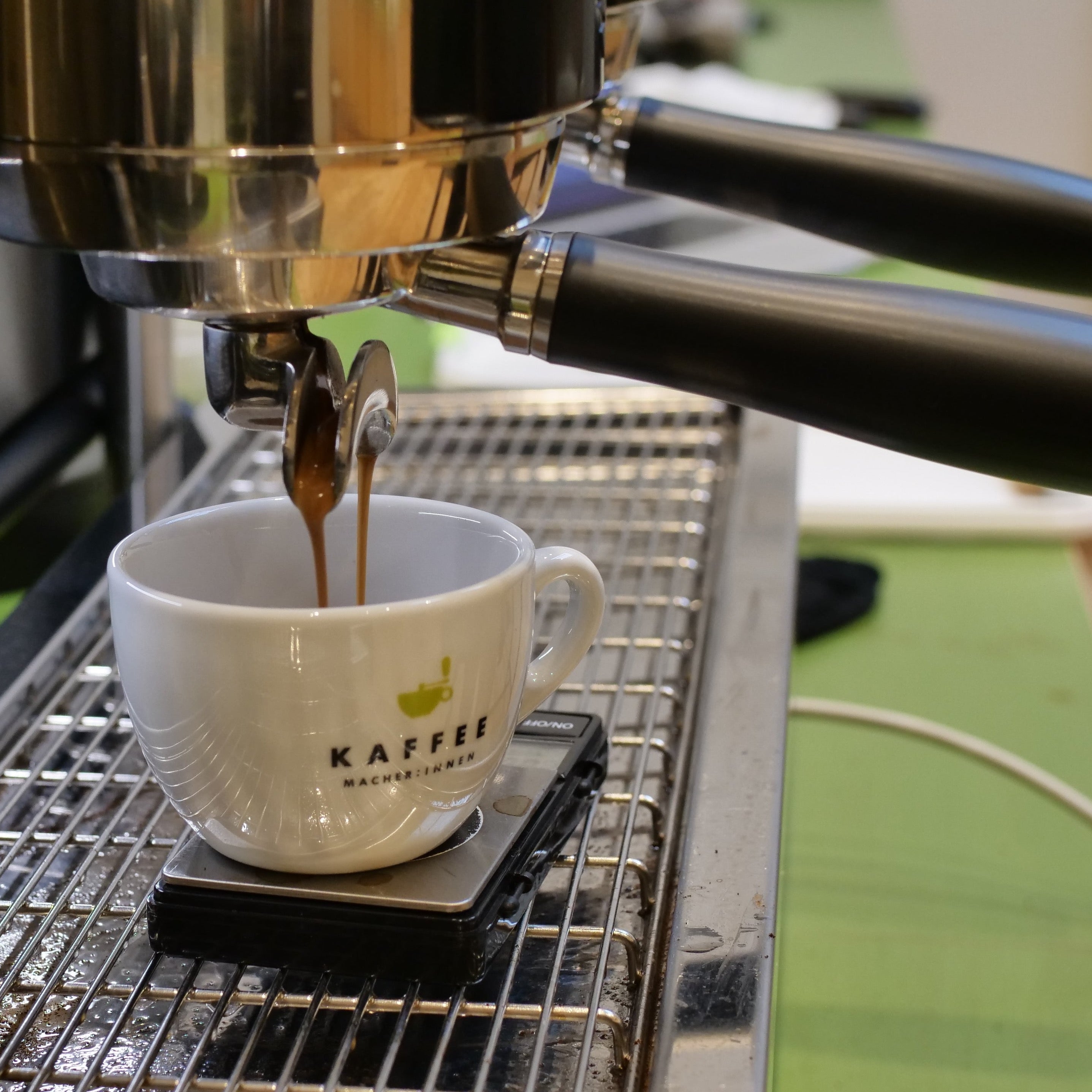
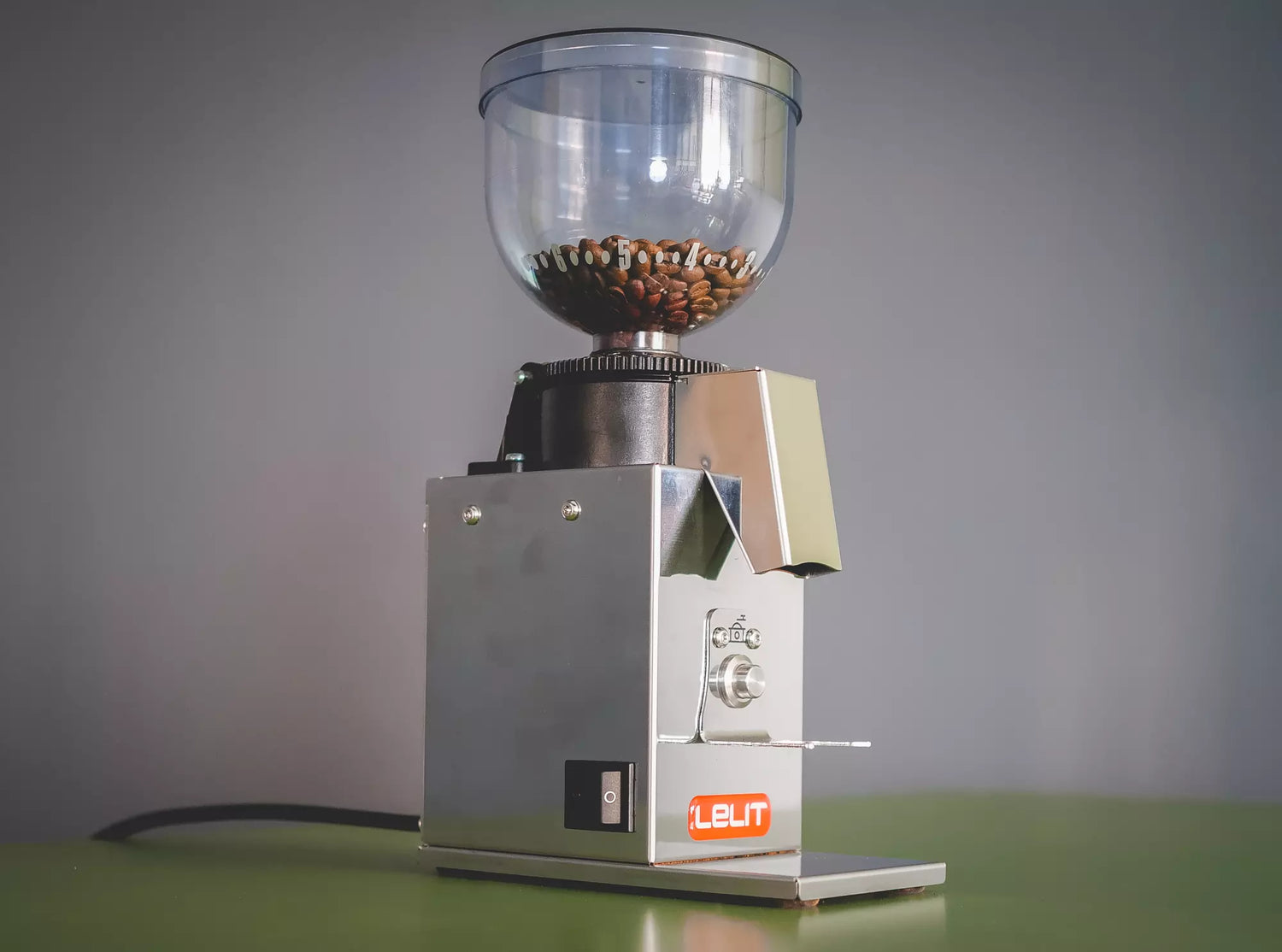

Two entry-level espresso grinders, both named Fred: the Lelit PL043MMI for around 185 euros and the Lelit PL044MMT for around 235 euros. We tested both thoroughly and, as always, purchased them ourselves. And both show the same result, just packaged differently.
The Freds ran in the most affordable comparison group of the first set of our espresso grinder test series in the range between 150 and 250 euros. Back then we compared 24 grinders directly against each other, in the meantime over 100 have gone through our lab. How we measure is explained in the espresso grinder test protocol. You can find all our Lelit tests bundled on the overview page Lelit at a glance.
What distinguishes the two Freds
Less than the price difference suggests. The grinding mechanism is the same conical burr in both grinders. The PL044MMT is larger and has programmable time dosing, with the PL043MMI the gearing is visibly exposed, with the larger one everything is enclosed.
Both are made from bent sheet metal, and you can tell. Lelit is a machine builder, not a grinder builder. If you bend chrome steel yourself, you take a grinding mechanism and wrap a chrome steel housing around it. That's not poor workmanship, but it's also not something that brings joy.
The bean hopper holds around 250 grams and has no slide. In theory you can remove it, in practice that means: grind it empty, empty it out, loosen a black protective cap, remove a screw. And then the problem: as soon as you rotate the hopper, the grind setting scale at the front no longer matches unless you marked where you were beforehand. These grinders are not built for daily bean changes.
Volume, speed, and a safety mechanism
88.9 decibels for the PL044MMT, 87.5 decibels for the PL043MMI. Both are loud. The motor actually sounds like a motorcycle when you adjust it.
They're also slow. 14.3 grams in 10 seconds for the PL044MMT, 15.1 grams for the PL043MMI. For 18 grams of espresso you need about twelve seconds. That's at the lower end of the test field.
And then there's a peculiarity that can be really annoying in everyday use. During our consistency measurement on the PL044MMT, we wanted to grind ten doses in a row. After the third one, nothing happened anymore. You press, the grinder doesn't grind. The instruction manual explains it: After about three grinding cycles of about 10 seconds each, the grinder needs 100 seconds to rest. We suspect a thermal protection because the grinder heats up during grinding.
For two espressos in the morning that's not an issue. But if you want to grind four or five portions in a row for guests, the grinder will eventually stop and won't give you any more coffee. Whoever grinds more than 18 grams at once will hit this lock faster.
The temperature is 38 degrees (PL044MMT) and 37.9 degrees (PL043MMI), with an increase of 0.8 and 0.7 degrees respectively over the measurement series. Both start off warm. We haven't found a sensorily clearly detectable influence of grinding material temperature in our measurement series so far.
Retention and dosing accuracy
4.5 grams retention with the PL044MMT, 5.0 grams with the PL043MMI. Before this grinder test we would have said: it's okay. Today we know there are grinders that are at 3 grams or less. 5 grams is a lot. That's old powder sitting in the grinding mechanism that you'll have to grind through eventually.
In single dosing the Freds lose 3.7 grams (PL044MMT) and 3.0 grams (PL043MMI). That's too much to make sense of switching between different coffees while grinding.
The dosing accuracy of the PL044MMT we measure with a standard deviation of 0.48 grams, which corresponds to a variation of around one gram. Combined with the high retention and programming that runs via blink signals, adjusting becomes a test of patience.
The espresso in the cup
This is where it gets unpleasant. Both grinders produce an espresso that is not balanced. The acidity stands out sharp and alone, the sweetness is missing, the bitterness has no counterpart. Michel Indelicato, Swiss Vice Barista Champion and course instructor with us, summarized it in the test like this: "It's not a unity."
However, the problem with the grinders is not the brewing recipe. Even with different recipes, the result in the cup doesn't achieve balance. The coffee has the body of a typical espresso, but it lacks the equilibrium. This becomes clearer as it cools down.
Sensorily the two Freds hardly differ from each other. One has a slightly softer texture and is more acidity-driven, the other is slightly less balanced. These are nuances within a result that doesn't convince in either case.
The particle distribution explains why
We did seven particle distribution measurements and evaluated four espresso grinds. The fines content is 20.1 percent (PL044MMT) and 21.7 percent (PL043MMI), so in the low range of our 2022 measurements and thus acceptable. Two other values are the problem.
First, the X50 value, the midpoint of all particles: 359 micrometers for the PL044MMT, 360 for the PL043MMI. That's clearly above 300 and thus in the upper range of the test field.
Second, and this is the actual finding: the width of the main peak. 336 micrometers for the PL044MMT, 349 for the PL043MMI. The best grinder in the test field at that time was at 180 micrometers. These two Lelits thus have the broadest particle distribution of the 24 directly compared grinders.

Particle distribution of the Lelit Fred PL044MMT

Particle distribution of the Lelit Fred PL043MMI
Why it tastes the way it tastes: extraction happens on every single particle. The more particles that have the same size, the more uniformly they extract. With a broad distribution, small particles are over-extracted while large ones aren't done yet. You get everything in the cup at the same time, and that's exactly what you taste as a lack of unity.
For comparison, we show the curve of a grinder with a narrower main peak. A narrower main peak typically leads to more balanced shots and more uniform extraction.

Comparison of the Lelit curves with the Eureka XL (X50 303 µm, fines content 21.6%, coarse peak 239 µm) with the espresso recipe 18 g in, 45 g out in 25 seconds.
What the Freds do well
Two things, and they're not nothing.
First, both grind espresso fine and even ristretto fine. That sounds banal, but with inexpensive espresso grinders it's a basic requirement that not every one meets. The Freds cover our entire espresso range.
Second, the grind setting reproducibility is good. Small changes to the dial change little, you need two or three full rotations for a noticeable difference. This makes it easy to find a setting again. Exactly where the Lelit William PL72 fails in the same category, the Freds are reliable.
And the extraction times are right: we consistently got precise shots between 23 and 27 seconds. If you want to learn how to dial in espresso, you can practice with these grinders.
Measured values in comparison
| Criterion | Lelit Fred PL044MMT | Lelit Fred PL043MMI |
|---|---|---|
| Price* | approx. 235 € | approx. 185 € |
| Volume | 88.9 dB | 87.5 dB |
| Retention | 4.5 g | 5.0 g |
| Speed | 14.3 g / 10 s | 15.1 g / 10 s |
| Temperature | 38.0 °C, increase 0.8 ° | 37.9 °C, increase 0.7 ° |
| Dosing consistency | Standard deviation 0.48 g | – |
| Single dosing | 3.7 g loss | 3.0 g loss |
| X50 (espresso) | 359 µm | 360 µm |
| Fines content | 20.1 % | 21.7 % |
| Width of main peak | 336 µm | 349 µm |
| Bean hopper | approx. 250 g, not removable | approx. 250 g, not removable |
| Time dosing programmable | yes | no |
* Prices at the time of testing, not current daily prices.

Summary of the Lelit Fred PL044MMT and PL043MMI
For the preparation of pure espresso we cannot recommend the two Freds. The particle distribution scatters too widely, and that directly shows up in the cup. We measured many grinders in this test, but none where the connection between measured data and taste was so clear.
If you primarily drink cappuccino, latte macchiato, or other milk-based drinks, the assessment changes. Milk is the great equalizer, it brings the sweetness that the espresso is missing. In this case, both Freds are usable entry-level grinders, and the PL043MMI at around 185 euros is the more honest purchase because the upcharge for programming on the PL044MMT brings little.
What you can't do with these grinders: develop yourself sensorily. If you want to find out how different coffees can taste, you will fail with these grinders and look for the error in yourself. That's exactly the experience that participants bring to our courses: did everything right, and it still doesn't taste good.
How the Freds performed against the rest of the test field and which grinder won in this price category can be found in our overview of the best espresso grinders for home, which now includes over 100 tested grinders. A classification of all Lelit devices can be found under Lelit: all tests and models. And if you want to work on recipe and grind setting: prepare espresso.
As always, we purchased both of these grinders ourselves. This test was not requested by Lelit.