










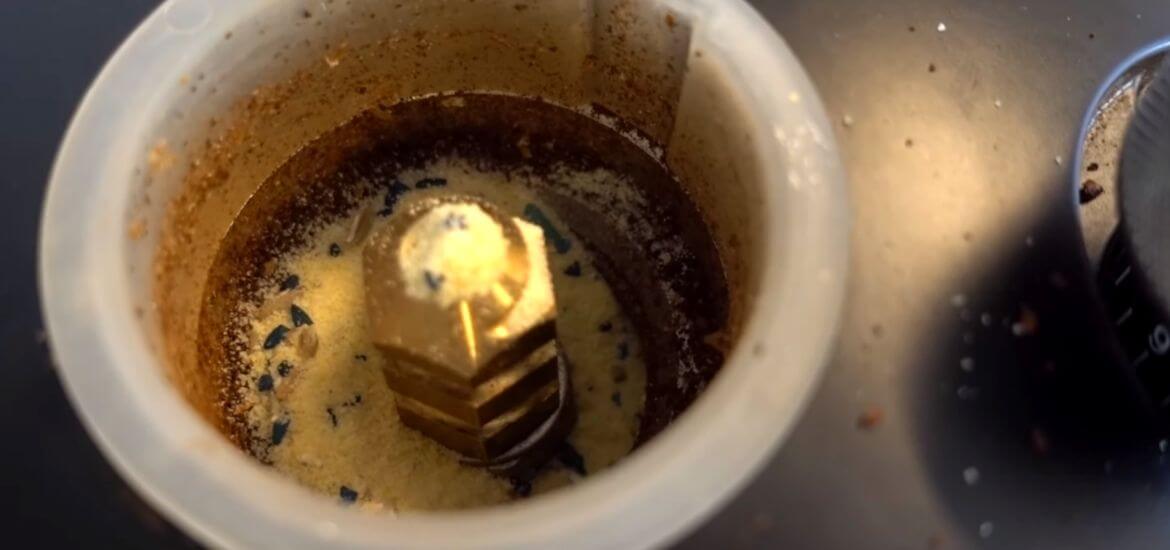

A clean coffee grinder is the prerequisite for good coffee. Cleaning it is even much faster than with the espresso machine. The grinder cleaning shown here can be applied to all types of coffee and espresso grinders. Nevertheless, the manufacturer's instructions should be followed. With cheaper espresso grinders, there are rarely other instructions in some cases.
In this text, we explain cleaning with cleaning powder. Good cleaning powder can also be purchased from us in the shop, or from many other roasteries or grinder shops.
The new cleaning video linked below also shows how you can directly and manually clean the grinding discs and the retention by opening the grinder with a cloth.
Remove deposits and coffee oils
As with the espresso machine, it is the coffee oils that settle unpleasantly. All the crevices of the grinder are popular, but also the bean hopper. The darker the coffee is roasted, the more oils remain behind. And oils become rancid under the influence of oxygen. The main goal of cleaning is to free the surfaces of the grinding discs and unwanted crevices from oils and deposits. After cleaning the grinder, the coffee tastes noticeably better, clearer and cleaner.

Retention
But it's not just the oils that are a problem. In many grinders there are gaps where old coffee gets stuck. These gaps are called retention. The English-speaking world refers to retention, which is the coffee powder that remains behind. The coffee is already ground, but then does not come out of the grinder. Typical places are, for example, the area in front of the flapper, in the discharge chute or around the grinding discs. The flapper is used to free the ground coffee from lumps, but it can also have a congesting effect.
We distinguish between permanent and temporary retention. Permanent retention is filled once with ground coffee powder, but then no longer exchanges with each grinding. So, if the grinder is not opened and cleaned from time to time, it becomes old in the grinder. In temporary retention there is coffee powder which is already carried out of the grinder during the next grinding.

Clogged coffee behind the flapper of a Quamar M80e.
Why is retention a problem in the first place?
The coffee is in ground form in the grinder. As a result, it is exposed to oxygen and oxidizes faster - in other words: it ages faster and tastes different after 30 minutes and noticeably worse after an hour. Unground, the coffee bean itself is like a protective layer for the coffee. Grinding increases the surface area, which also accelerates aging. Each small particle is exposed to interaction with oxygen (and possibly light).
The coffee in temporary retention is carried out with each new grinding. Whether this proportion of coffee beans has a clear or strong influence on the taste depends on the time of the last grinding and the size of the retention. In our large test of over 24 home espresso grinders, we therefore also investigated retention in particular.
For example: 2 grams of retention on a double espresso made with 18 grams of coffee play a lesser role. If retention holds 9 grams, then the espresso is made half with old coffee.
Permanent retention plays a different role. Although the settled powder is not released again with each extraction or has no direct influence on extraction, here there is coffee powder reacting with the environment, which ages in the grinder. This affects the hygiene in the grinder. Coffee powder normally does not mold, but it creates a rancid "atmosphere". The freshly ground coffee comes into contact with it and essentially rubs past the old coffee.
Does the coffee in permanent retention have a sensory influence? Yes, and quite significantly! You can do this test yourself. Extract 18 grams of coffee and then clean the grinder. Follow our video if you have a G-Iota/DF64 or Eureka Mignon. If you have a different grinder, then follow the manual, search for a guide on Youtube or write to us so we can make a video for you. After cleaning, extract 18 grams again. And now brew two double espressos. And then compare the results.
By the way: the size of the temporary retention often also influences the consistency of the espresso grinder or coffee grinder. With some extractions more powder remains behind and with the following ones more is then released.
The cleaning
- Remove and empty the bean hopper.
- Grind all remaining beans in the chute. If necessary, reattach the bean hopper because some grinders won't grind otherwise.
- Put a heaping tablespoon of cleaning powder into the bean chute. Yes, many manufacturers write about much more. But they also want to sell their cleaning powder. We think a tablespoon is fine. In the case of our cleaning powder, that's 10 to 15 grams.
- Grind the cleaning powder.
- Reattach the bean hopper.
- Grind a portion of coffee to remove all traces of the cleaning powder.
You can learn more about this in our coffee courses at www.kaffeemacher.ch/akademie
Frequently asked questions about cleaning coffee and espresso grinders
How often should a coffee grinder be cleaned?
We recommend cleaning with grinder cleaner every two weeks. If the grinder is used frequently in a shared apartment or office, the frequency should be increased. In gastronomy, we recommend adding grinder cleaning twice a week to the cleaning schedule.
Is cleaning with grinder cleaner necessary if I disassemble and clean the grinder?
Manual cleaning by opening the grinder and removing the coffee powder in the retention is more thorough than cleaning with grinder cleaner. So it can be done as an alternative.