




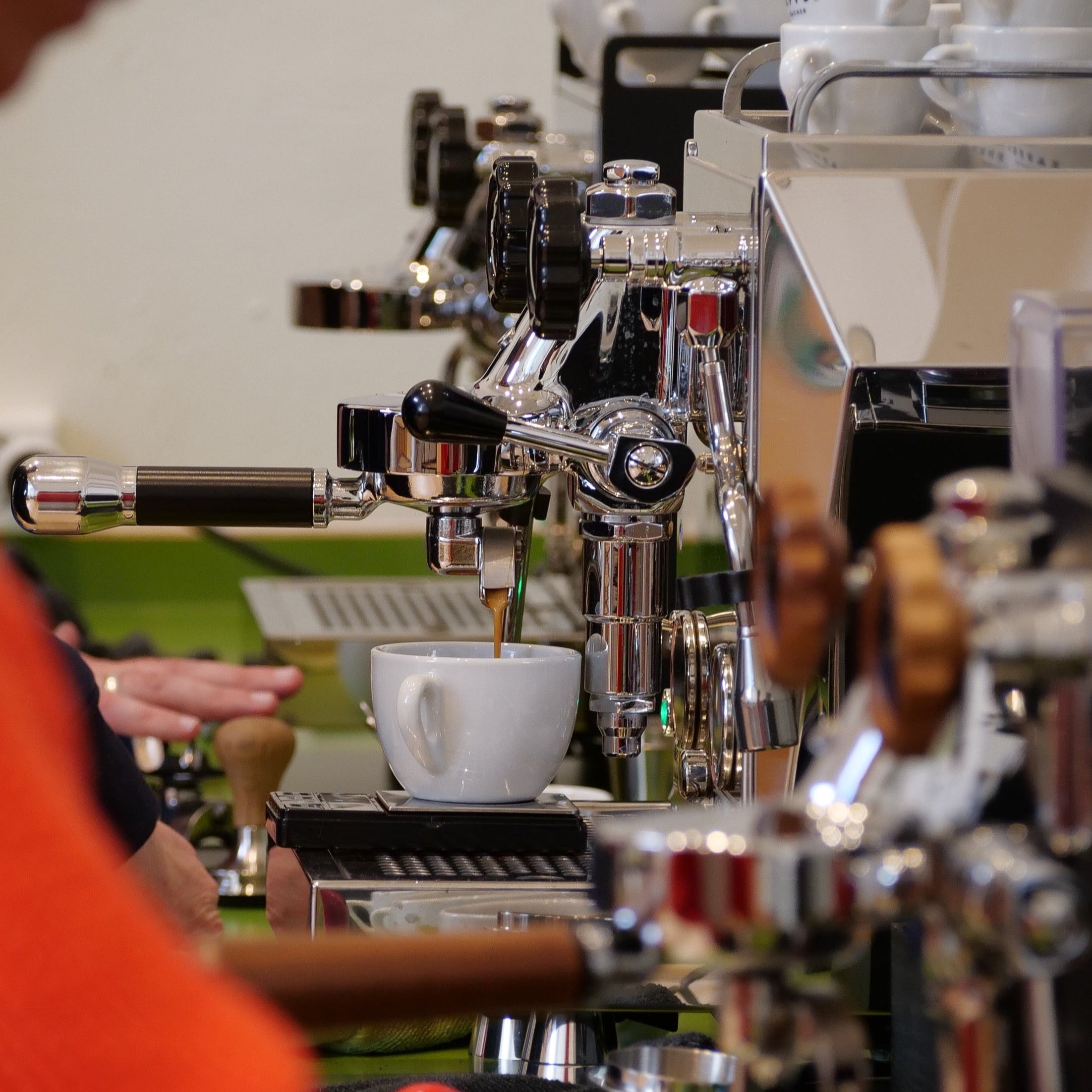
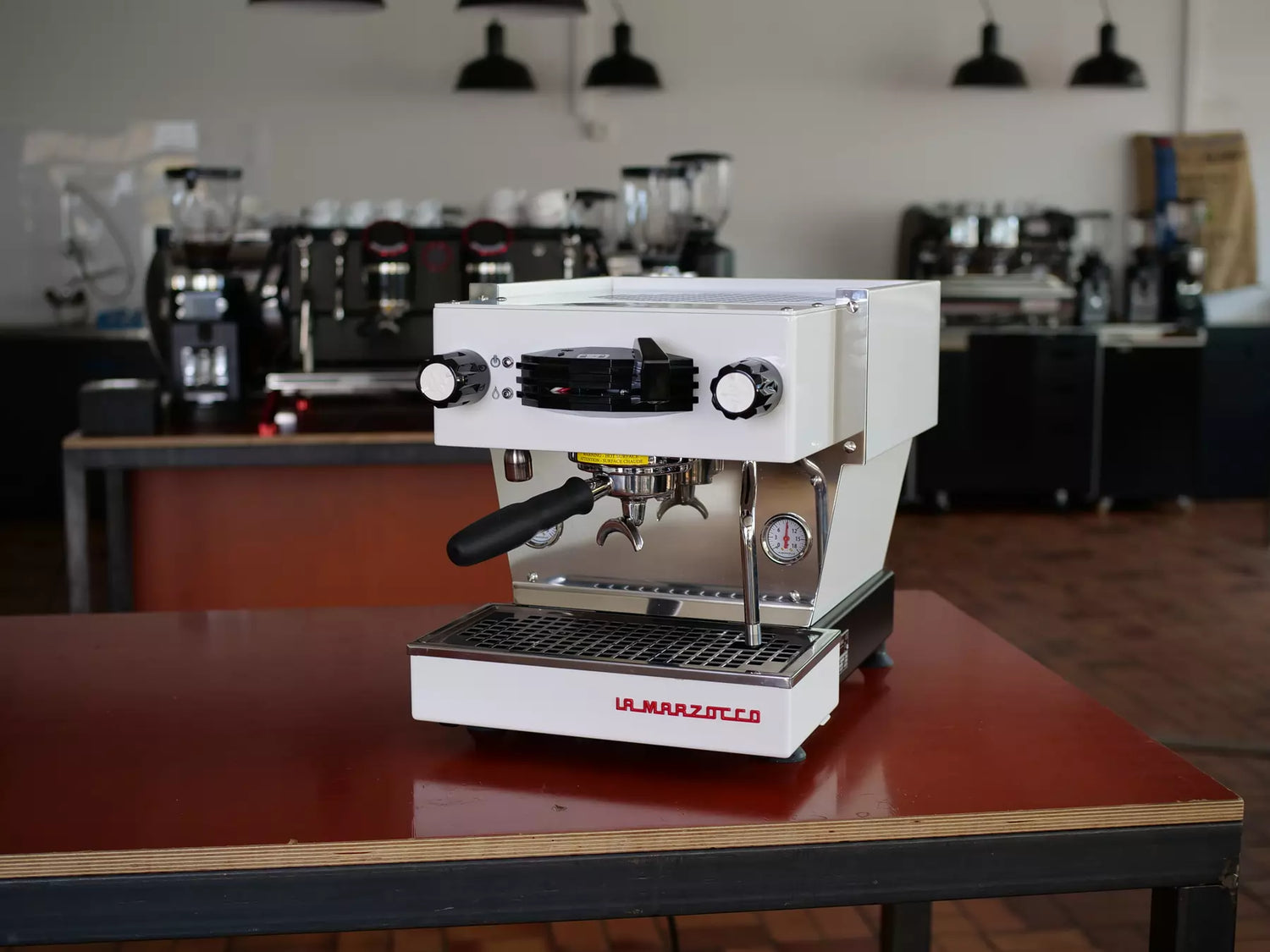

The La Marzocco Linea Mini is one of the best single-group espresso machines on the market. That much is certain. In terms of precision and power, no machine can hold a candle to this small dual boiler, which is modeled after the legendary Linea Classic. And yet the Linea Mini falls short in some areas to make it the perfect all-around machine.
This test report as well as a short and a detailed review summarize the findings of our two testers Michel Indelicato and Benjamin Hohlmann.
In the meantime, a test of the successor model, the Linea Mini-R has been published on our site. The Linea Mini-R replaces the previous Linea. The "R" stands for "Restyle".
Disclaimer: in Switzerland you can buy the Linea Mini from us. You should know that. Nevertheless, and we stay true to this, we work out the strengths and weaknesses of the machine without reservation.
Here to perform: Temperature performance par excellence
It's a joy! Lever on, machine off and the performance is right. The Linea Mini delivers temperature consistency both during extraction and from extraction to extraction. Because things went so well, our tester Michel Aeschbacher didn't want to stop and pulled one extraction after another. Following our classic temperature test protocol, the temperature consistency during extraction averaged 0.39 standard deviation. We based this on seconds 5 to 25 of the extraction.

Such small fluctuations over 6 extractions in a row is really good! This means every coffee can be brewed precisely. In our classic test protocol, we brew espresso every 60 seconds. After the Linea Mini performed so well, we wanted to know more and increased the frequency of extractions. But even with an extraction every 30 seconds, the machine's performance doesn't change. It remains constant.

Also good to know: the Linea Mini gets up to speed much faster than most dual boilers in our test series – though of course not as fast as a thermoblock. In about 15 minutes, the Linea Mini is essentially up to temperature.
Weight and dimensions of the La Marzocco Linea Mini
The Linea weighs a considerable 32 kg and combines this in 35.8 cm width, 45.3 in depth and 37.7 in height. The dual boiler can be connected to mains water, but must be prepared accordingly. The steam boiler holds 3.5 liters and the brew boiler 0.17 l. The water tank has a volume of 2.5 liters. The brew group is saturated. The boiler and housing are made of stainless steel.
In the first hour of espresso extraction, the Linea Mini consumes 0.47 kw/h of energy. That's quite a lot when you compare it to dual boiler espresso machines, which fluctuate around 0.3 kw/h, or a thermoblock, which comes in at sometimes under 0.1 kw/h.

The very good temperature consistency despite the small boiler has structural reasons. Temperature control only begins during extraction. The brew water is preheated by passing through the steam boiler. The target is a temperature of 85 degrees Celsius, which is subsequently achieved in the heat exchanger during longer standing times by adding cold water. At this temperature, the brew water enters the brew boiler, which sits directly above the brew group, and is brought up to temperature there.

Steam power for the masses
If 1000 guests were standing in front of me and I could only choose a single-group machine for frothing milk, the Linea Mini would be my machine. The steam power would probably not give way even with the last cappuccino. A 0.6 liter pitcher is frothed in just 15 seconds.
Since the steam power cannot simply be adjusted by the home barista, learning how to handle so much force is required. For a barista who is used to commercial machines, the Linea Mini will feel like daily business. For beginners, there is a learning curve to go through. But that's a curve to go through if a machine has too much power.
It's important not to form too much coarse foam when inserting the milk lance. Otherwise it's hard to get it under control. On the other hand, the powerful power of the cold touch steam wand is also suitable for performing a good rolling phase. This leaves nothing standing in the way of beautiful latte art.

Internet of Things and an anachronistic temperature wheel
La Marzocco has arrived in the present with its new espresso machines. This means "Internet of Things", WLAN connectable and control via smartphone. What is natively implemented in currently released machines seems like a compromise on the Linea Mini, to make an older machine future-proof without too much effort.
Don't get me wrong: temperature control via phone is a really good step that makes the Linea Mini better. Nevertheless, the concept is not fully realized. The old temperature control wheel on the side of the machine doesn't move when the temperature is adjusted digitally and therefore also indicates a different temperature than the phone. Accidentally turning the temperature wheel overwrites the digital setting. Adjusting the digital control overwrites the manual wheel.
Clearly two worlds are fighting each other here and it's not yet clear which direction it will go.
Very practical about the app is, for example, that the machine can be automatically switched on at certain times via a start control, or via remote control from bed.
Also, not all possibilities of the app are fully utilized, but more on that now. Important: unlike what was said in the video review, there is a shot timer in the app itself (not a shot control).
The missed opportunity – a machine for small gastronomy
Given the machine's remarkable precision, its great consistency even under load, both in brewing and frothing, the large work surface and overall performance, we want to shout: the Linea Mini is perfectly suited for small cafés or restaurants with low coffee turnover that still have quality demands. The Linea Mini can essentially keep up with its bigger brother, the La Marzocco GS3, and that for 2000 euros or francs less.
But… for that we would need water volume control and not an alibi lever.
Because no, the plastic lever on the front of the Linea Mini is not, like the lever on the GS3 MP or the Lelit Bianca, suitable for flow rate control or pressure profile control, but merely for on and off. Yes, it looks like it and feels like it should be – but it's nothing more than an on-off switch.
And the app doesn't even step in here and give us the option of controlling a specific amount. Not even a time control is provided.
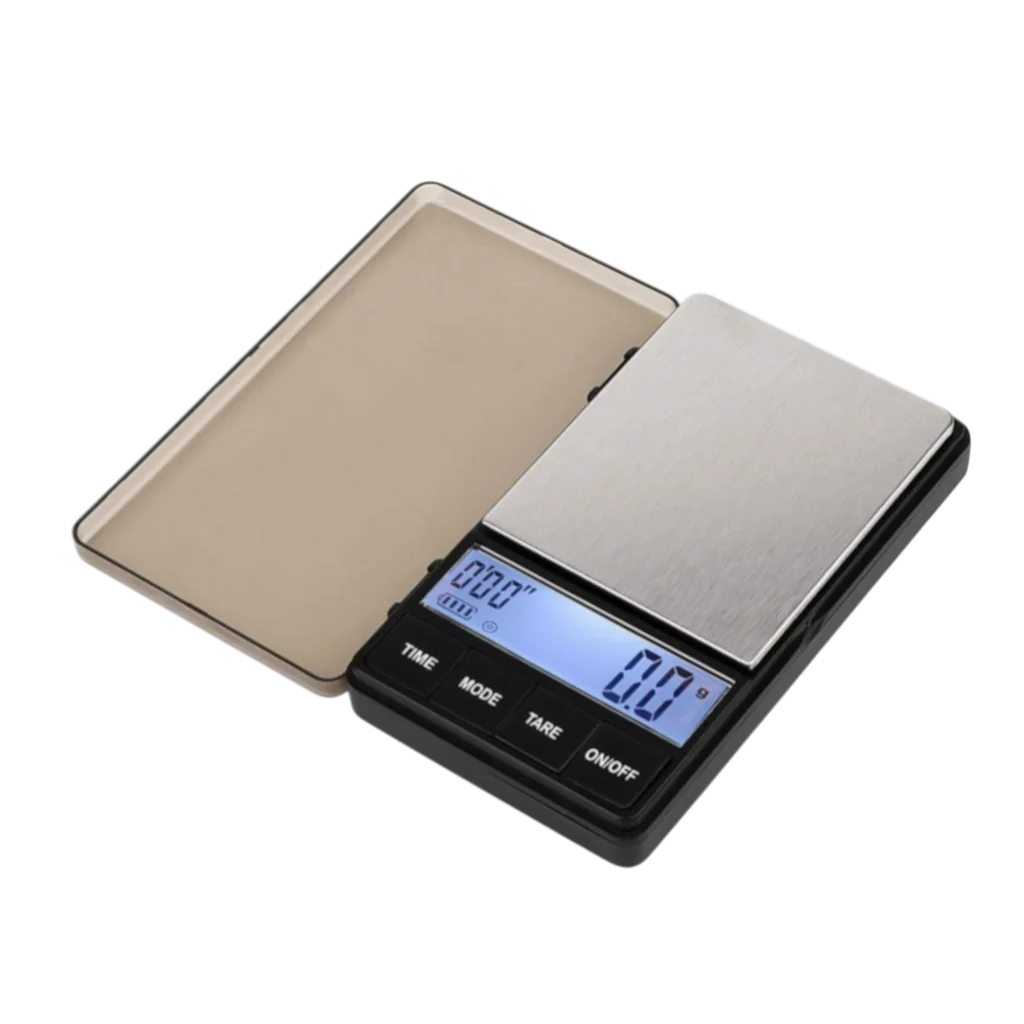
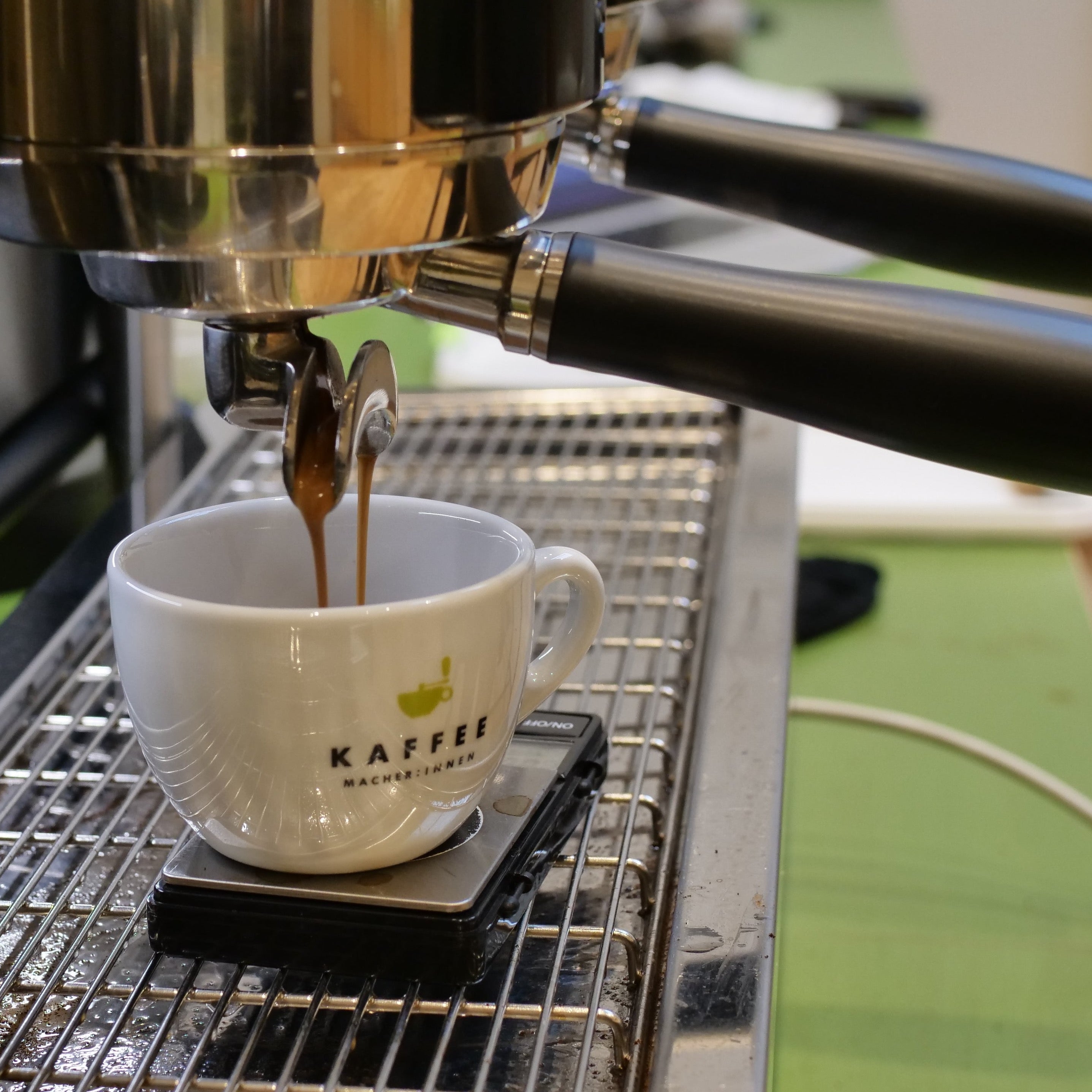
On the Linea Mini this happens by hand, via scale. That's enjoyable when we do it for ourselves. There's a certain ceremonial satisfaction in this manual nitty-gritty. But I really wish there was an optional control option that stops an extraction. One that simply turns off after second X. But it's not to be. And with that, the Linea Mini misses out on so much…
Conclusion
Testing the Linea Mini leaves me excited and frustrated. The Linea Mini is a magnificent espresso machine that can brew perfect coffee and offers frothing capabilities from another world. It has significantly improved through IoT, although the current version still leaves some potential untapped. It consumes too much electricity and due to its potential is an over-performer for home use.
At this point I'm almost a bit upset with La Marzocco. The Linea Mini performs so well in our test that it can stand directly next to the GS3 in terms of performance. Perhaps the GS3 has even more punch at frequency, even more endurance. But that's negligible. So for me, the big pro of the GS3 next to the Linea Mini remains the volumetric control of the water volume. And I have to say that I just find the price difference crazy!