






The amount of coffee powder to use per cup of coffee or per liter often causes confusion. However, there are clear rules that are easy to remember and universally applicable. In this article, you'll learn everything about the correct "dosage" and the appropriate brew ratio, the best measurement method, and the universal recipe.
Dosage is no accident
The amount of coffee used is the prerequisite for a balanced brew. Whether we're brewing a classic filter coffee, a French press or an espresso. The appropriate brew ratio, i.e., the amount of coffee powder used in relation to water, enables good extraction. Extraction means that water dissolves coffee particles from the coffee powder, which then create the coffee flavor in the cup.
The less coffee powder we use, the less water can dissolve from it. The grind size of the coffee also plays an important role in extraction capability, which we'll address elsewhere.
Little coffee powder, lots of water – over-extraction
When we add a lot of water to a small amount of coffee and extract for a long time, e.g., in a plunger pot (French press), the water dissolves a large portion of the soluble coffee particles from the coffee. The problem is that not all of these coffee particles taste good. The longer and more extensive an extraction, the more bitter a coffee becomes. The so-called over-extraction leaves a dry, puckering feeling in the mouth, which is called "astringent" in technical terms.
Due to the large amount of water, the coffee is also heavily diluted. Bitter, diluted, dry? Everyone knows that. Not tasty at all!
Lots of coffee powder, little water – under-extraction
If we add little water to a large amount of coffee, we get the opposite result. The small amount of water is not sufficient to dissolve the desired amount of coffee particles. We speak of under-extraction. Under-extraction is sour and aggressive. An under-extracted espresso can also have a salty note.
Due to the small amount of water used, the final drink also contains little water. While we've extracted too little from the coffee powder, it's still a lot compared to the water amount. So the coffee is rather strong due to the concentration of dissolved coffee particles. The concentrated strength means concentrated acidity in the taste due to under-extraction.
Both scenarios – too little coffee in relation and too much coffee in relation to water – have a common consequence: they are not balanced. Acidity and bitterness are not in balance. Why? Something crucial is missing: sweetness! The sweetness inherent in coffee is crucial for it to taste balanced and delicious.
Let's search for sweetness, or as it's nicely called, the sweet spot, in the Aeropress, the V60, and so many other brewing methods.
Brew ratio as the key to the sweet spot
Brewing coffee is neither rocket science nor voodoo. However, there are a few rules to follow when preparing coffee. One very important one is the brew ratio, which varies depending on the beverage type.
Brew ratio is the ratio between the amount of ground coffee used and water.
18 grams of coffee in relation to 300 ml of water gives a brew ratio of 1:16.66
In other words, we can also speak of 6 grams of coffee to 100 ml or 60 grams to one liter of water. To express the brew ratio, the water amount is divided by the amount of coffee used.
60 grams of coffee per liter is not a random example of a brew ratio, but the standard recipe for all filter coffee methods. Whether you brew classic Melitta filter or a modern Hario V60 filter, an automatic filter coffee machine or even a plunger pot – you'll do well with 60 grams/1 liter or 1:16.66.

How much coffee powder for filter coffee?
The dosage for filter coffee is no accident, but ultimately a combination of the preferred taste of the majority of people and mathematics. Those who drink filter coffee have a "perception expectation," arising from habit and taste.
When a coffee beverage has a certain strength, we perceive it as filter coffee. This strength can be quantified, measured, and calculated.
Filter coffee tastes like filter coffee when it contains a strength of 1.10% to 1.5% dissolved coffee particles. By the way, the rest is water, about 98%.
To brew this strength in a balanced way, we need at least a brew ratio of 1:20 and at most 1:14. Converted, this corresponds to a coffee amount ratio of between at least 50 grams and at most about 72 grams per liter. In the video above, I even mention a brew ratio of 1:12 as the strongest concentration. But then a bypass is needed to reduce the strength.
So how much coffee powder per 100 ml? Between 5 and 7.2 grams.
An average coffee cup holds 150 to 200 ml of liquid. The dosage should be calculated accordingly.
How much coffee powder for espresso?
Espresso is a small, strong beverage. Under pressure and with heat, a large amount of coffee particles are dissolved from a small amount of coffee powder.
Espresso also triggers a taste perception expectation in the coffee drinker. A classic espresso has a concentration of at least 7% dissolved coffee particles. So about 93% is water. Strong espressos reach double-digit concentrations of 10 or even 11% coffee particles.
To achieve a strength of at least 7%, a brew ratio of at most 1:3.5 is possible, for example 9 grams of coffee powder and 31.5 grams of liquid.
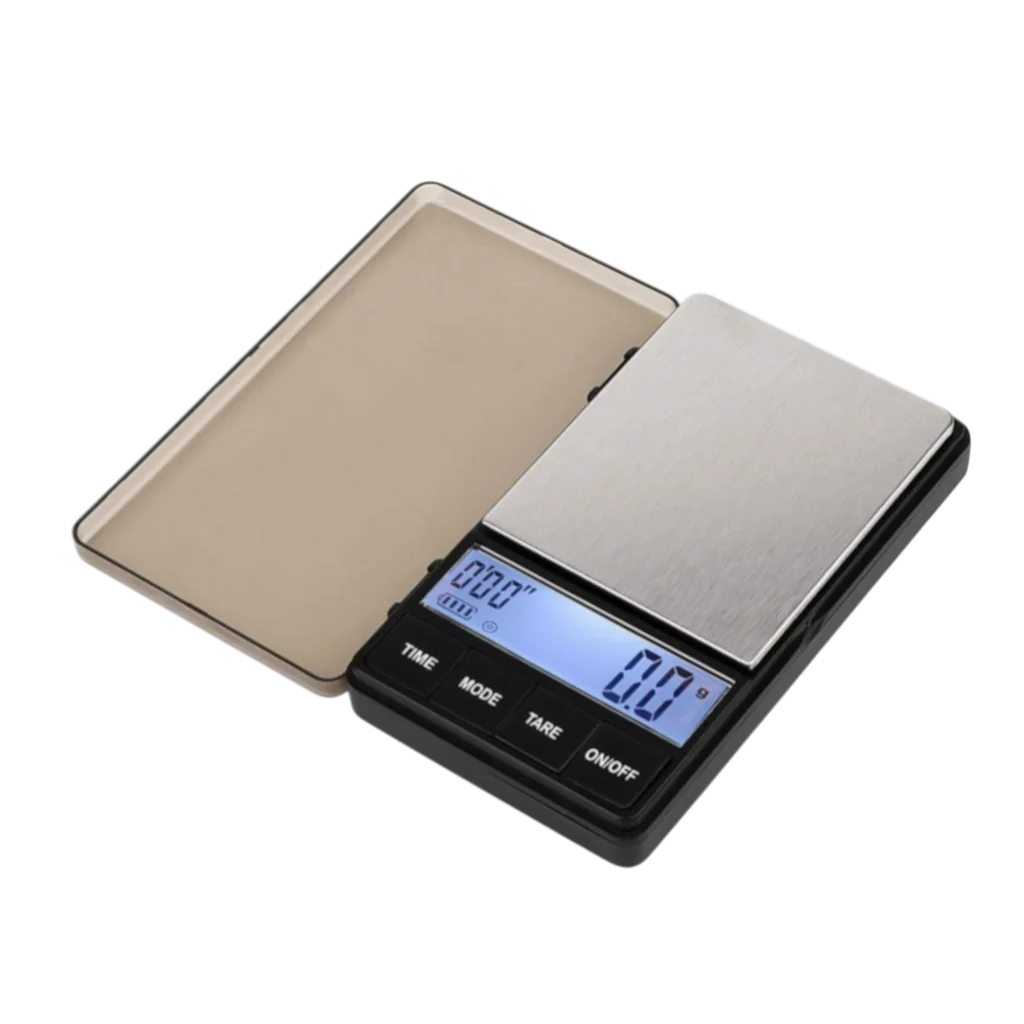
With espresso, the brew ratio is more difficult to measure than with filter coffee. With filter coffee, the water amount can be manually weighed and added. With a classic espresso machine, this is not possible because it's rinsed directly from the brew head over the espresso.
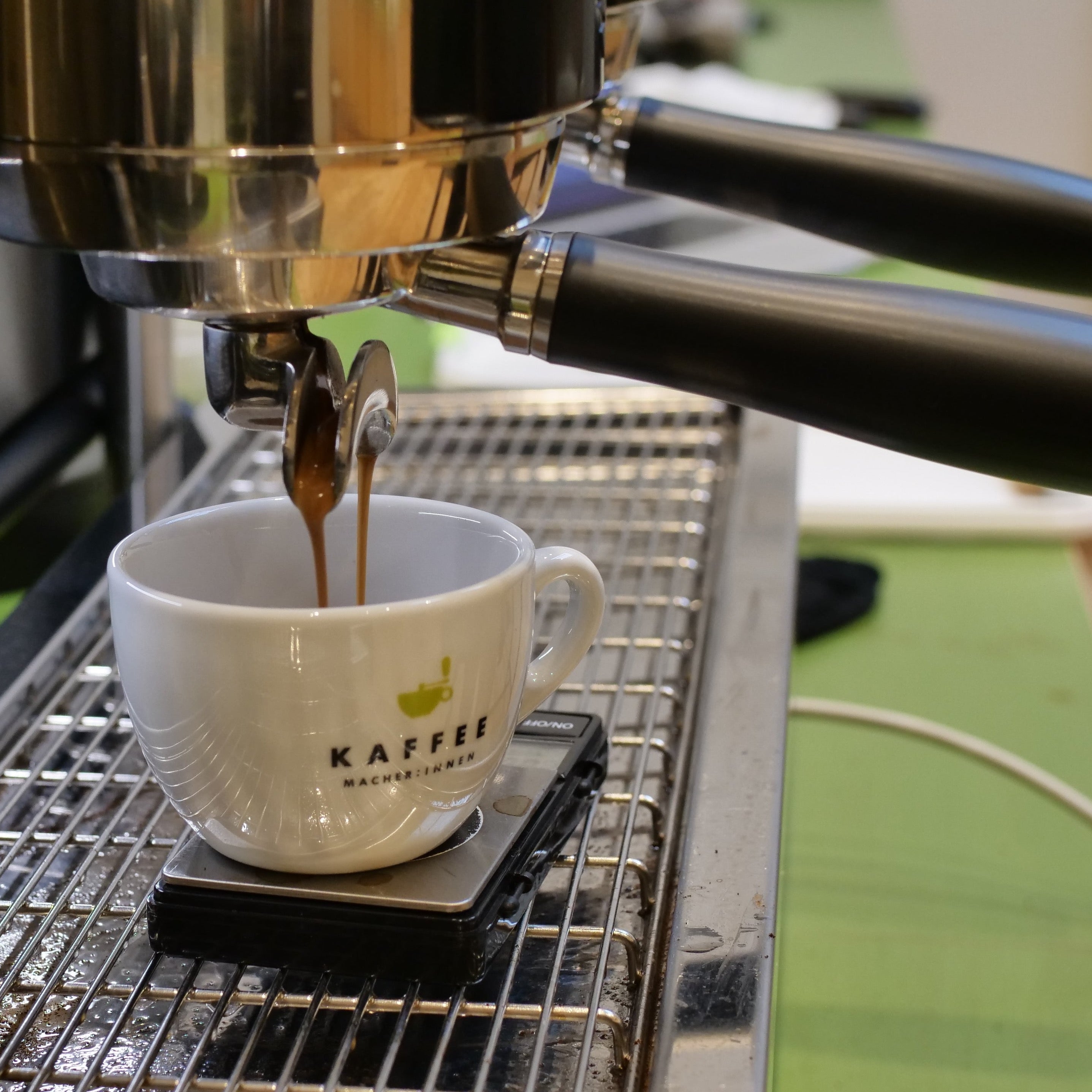
That's why espresso is measured by the volume of brewed espresso. The term for the ratio of brewed espresso to the amount of coffee used is beverage ratio.
Recommended ratio for a classic espresso:
1:2, which corresponds to, for example, 9 grams of coffee powder and an espresso weight of 18 grams
to
1:2.5, which corresponds to, for example, 9 grams of coffee powder and an espresso weight of 22.5 grams
Coffee machine inventions like the capsule machine or fully automatic coffee machine have watered down in the truest sense what we knew as classic, strong espresso. With these devices, brewing is done with different proportionality and the strength of the beverage changes accordingly. Nevertheless, both claim that they brew "espresso."
This has major effects on the taste expectation of what an espresso is. In coffee bars, more and more people are giving the barista feedback that the espresso is too strong for them. This is due to changed habits and taste expectations.
Strength and extraction – the basis of good brewing
In a detailed video, I've explained the relationships between strength and extraction. Here's a short summary. The proportionality of strength and extraction is the prerequisite for coffee to taste good.
Strength is the concentration of dissolved coffee particles. Each beverage has a very typical strength that is characteristic.

We achieve this concentration by extracting coffee. Not everything we can extract from the coffee bean is delicious and desirable in taste. It's a narrow corridor that we want to extract. The target corridor for extraction is 18–22%. Lower extraction leads to the sour taste of under-extraction, and higher extraction leads to the bitterness of over-extraction. The golden mean is balanced, sweet, and delicious. When we hit it exactly, we call that the sweet spot, where everything is in balance.
The extraction of all coffee beverages aims at the same value while strength differs. It makes sense because we only want to use the delicious parts of the coffee bean for all coffee beverages.
To achieve different strengths and thus different coffee beverages, adjusted dosage amounts are used.
Why a coffee spoon doesn't make sense
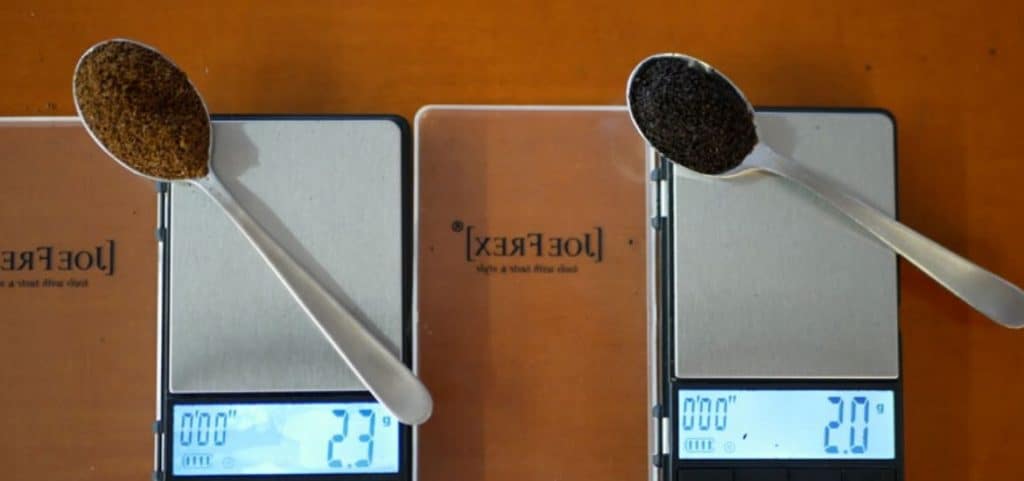
Unfortunately, it's impossible to fill a spoon the same way every time. A few grams of difference happen quickly and multiply with the number of spoons. If 9 grams instead of 7 grams of coffee per 100 ml are used for filter coffee, this inevitably leads to under-extraction and thus unpleasant acidity in taste.
Also, coffee weighs different amounts depending on the roast level and origin and has a different volume. A heaping teaspoon of coffee with a light roast is much heavier than a heaping teaspoon of dark coffee roast. Dark coffee has more volume but less density.
If you only orient yourself to the heap of a spoon, imprecise dosing is predetermined.
How large is a classic coffee cup?
A typical coffee cup holds about 150 to 200 milliliters. In gastronomy, such cups are often used for cappuccino as well. When guests are coming and a certain number of cups of coffee should be brewed, I recommend using 200 ml as the basis for calculation.
So we brew with the classic brew ratio of 6 grams of coffee to 100 ml of water. 4 cups of coffee should come out, so we brew 800 ml with 48 grams of coffee. Per gram of coffee used, 2 grams of water remain in the coffee cake. So we get a total of 800 grams minus 2 x 48 g of coffee, about 700 ml of coffee and thus about 175 ml per cup. Perfect!
The principle that 2 grams of water per gram of coffee used is absorbed in the coffee cake applies only to filter coffee methods without pressure. With espresso and also the Aeropress, different residues remain.
How many grams of coffee for the French press
When guests come for coffee, the French press is also a good option for brewing larger volumes of coffee. The French press is also called a plunger pot and belongs to alternative brewing methods. Water and coffee remain in contact throughout the entire brewing process. In technical terms, this is called "full immersion."
I like to brew the plunger pot with 7 grams per 100 ml. Although the coffee is in contact with the coffee for a long period of 3–5 minutes, there is little swirling after the first stir, which is why extraction proceeds more slowly than with classic filter drip methods.
By dosing in the higher range, I still get sufficient strength of the coffee beverage. At the same time, extraction is somewhat lower, which leads to a slightly more noticeable acidity.
With the plunger pot, the plunger with its metal mesh breaks the extraction and separates the coffee powder from the coffee beverage. Coffee oils and some sediments remain in the coffee beverage – unlike with a paper filter. The coffee oils and sediments create a less transparent coffee taste. Due to the lower extraction and associated acidity, the flavor is balanced. Stronger extraction would increase the bitterness of the plunger pot.
Conclusion on dosage
The amount of coffee powder to use for all beverage types is more or less predetermined by the extraction capability of the coffee. This is practical because it creates guardrails you can orient yourself by.
Anyone who wants to experiment with coffee and try different brewing methods has a huge playing field anyway. With our guide, you can first precisely determine the dosage amount and then focus on other factors like grind size or water temperature.