




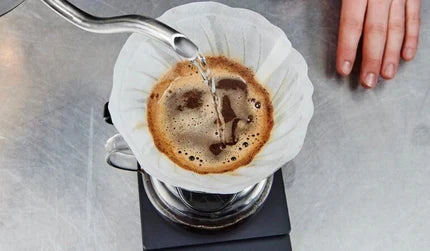

Every day starts for me with a filter coffee from a Hario V60 — and it has for many, many years. I brew my standard recipe by heart at this point. It's my entry into every coffee, the foundation from which I develop recipes further. The practical thing about it: I never adjust the grind size for my standard recipe. I extract the nuances through pouring technique, agitation, and brewing ratio.
For me, the V60 is not just one hand filter among many; it's the starting point for everything I know about filter coffee.
I've competed in the Brewers Cup many times — that's the filter coffee championship. In 2014, I became Swiss Filter Coffee Champion and placed 12th at the World Championship. Three runner-up titles in filter coffee round out my coffee journey. During that time, I've brewed with many different drippers, experimented, measured. The V60 has always been my starting point.
This article explains why the V60 is so popular, how to use it properly — and what the world's best brewers have gotten out of it.
What is the Hario V60?
Hario is a Japanese glassmaker that has existed since 1921. Hario brought the V60 to market in 2005. The name comes from the 60-degree angle of the inner wall. Characteristic are the spiral ribs running inside, which create air channels in the filter paper. In addition to the vertical water flow through the coffee bed, brewed coffee can also be diverted sideways.
The 60-degree angle, the side water drainage, and the large opening at the bottom support even extraction. The flow properties are designed so that the filter avoids errors: congestion is balanced by the side water flow along the air channels. The large opening also allows you to determine the flow rate very much yourself through the grind size.
Today, the V60 is the most-used hand filter worldwide. No other device has won more World Brewers Cup titles — between 2011 and 2021, the V60 was used by six world champions. At the same time, its design makes it very suitable for anyone who wants to start with a hand filter.
V60 in different materials
The V60 comes in different materials and sizes:
| Variant | Material | Size | Specialty | Ideal for |
|---|---|---|---|---|
| V60 Plastic | PP plastic | 01 / 02 | Light, affordable, durable | Beginners, travel |
| V60 Glass | Borosilicate glass | 02 | Beautiful to look at, neutral | Home, gift |
| V60 Ceramic | Porcelain | 01 / 02 | Good heat retention, stable | Daily use |
| V60 Copper | Copper | 02 | Very high heat retention | Professionals, enthusiasts |
Size 02 is the most sensible for home use — really for almost all contexts.
I use the ceramic version. It retains heat better than plastic, stays stable on the cup, and simply has a nice feel to it. If you're just starting out: the plastic version is an excellent choice. Affordable, light, indestructible. When I travel, I prefer to take the plastic version with me.

What do you need for the V60?
Equipment requirements are minimal. What's really necessary:
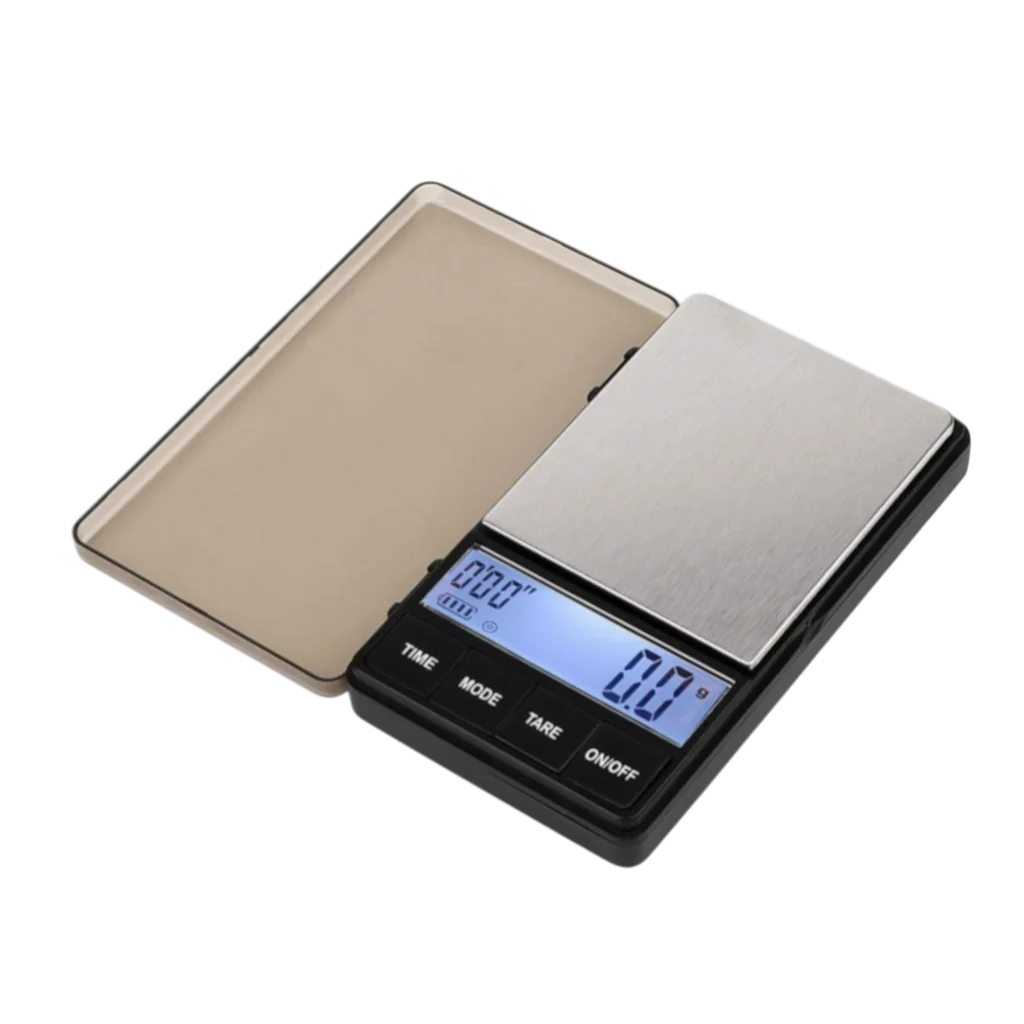
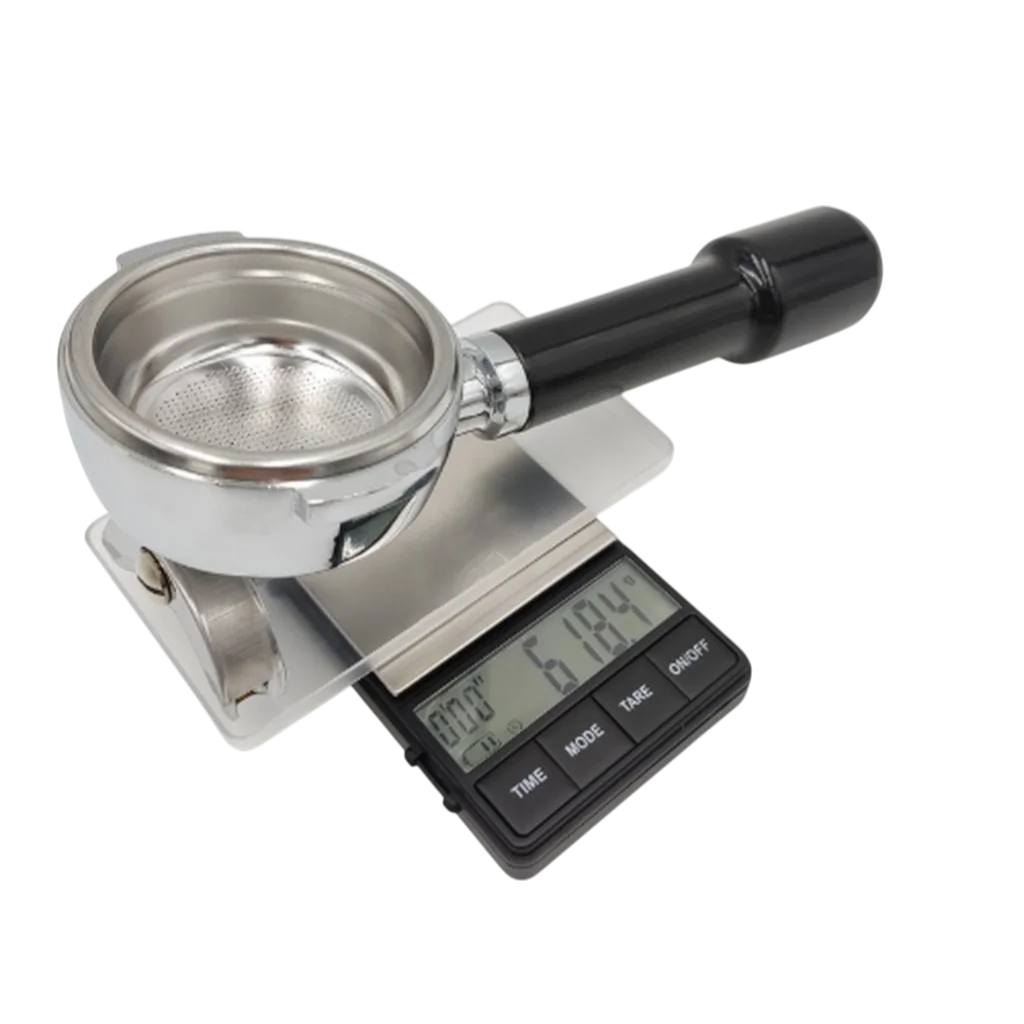
Without a scale, you won't brew reproducible coffee. Any kitchen scale works. Coffee scales with a stopwatch are handy, but not necessary. What matters is gram accuracy, not the model.

My standard recipe for the Hario V60
I've used this recipe as a foundation for years. It's the same one we also describe in the filter coffee preparation article, now V60-specific and with all the steps.
The coffee should feel like fine polenta. If the V60 runs through faster than 2:30 min: grind a bit finer. If it takes longer: grind a bit coarser. Grind size is the most important lever.
Reference values for our hand grinders from zero point (burrs just touching):
| Grinder | Setting for Hand Filter / Pour-Over |
|---|---|
| Comandante C40 MK4 | 20–25 clicks |
| Timemore C5 ESP Pro | 1.5–2.0 turns |
| Timemore C3 ESP Pro | 20–30 clicks |
| Timemore Slim 3 | approx. 33–53 clicks |
| Kinu M47 Classic | approx. 4.0–5.0 turns |
All values are starting points. Comandante values from our own measurements, C5 from kaffeemacher.ch; Slim 3 and Kinu are approximations. Dial in depending on bean and roast.
Important: There is no single right recipe. This one is a proven starting point. Lighter coffees benefit from slightly higher temperatures, for example 94 to 96 degrees. Darker roasted coffee tolerates more like 88 to 92 degrees. At the World Championship, I brewed a light-roasted Kenyan coffee at 98 degrees and the balance was excellent.
Famous recipes from the Brewers Cup
The Brewers Cup is the world's filter coffee championship. No device has been used there more often than the V60. Two recipes have particularly spread through the scene.
Tetsu Kasuya won the 2016 World Championship with a concept he called the 4:6 method. The idea: The brew water is divided in a ratio of 40 to 60. The first 40 percent determines the balance between acidity and sweetness, the last 60 percent the strength of the coffee.
Matt Winton won the 2021 World Championship with a simpler approach: five equally-sized, aggressive pours. No waiting for water to run through, but the next pour comes as soon as the previous one is almost gone. This gives even extraction with a clear, clean profile.
In the office, we drink filter coffee brewed with the V60 all day long. Usually 250 to 300 ml, which is then distributed to everyone in the office. This way we taste many different coffees throughout the day.
The right filter paper for the V60
The V60 requires conical filter papers with a 60-degree angle. Hario sells them in sizes 01 and 02. For the size-02 version, which is most sensible for home use, use the V60 filter paper 02.
White or natural brown? The difference in cup profile is minimal. I always rinse the paper, regardless of color. That's the more important point: Unrinsed filter paper imparts paper taste, which you can clearly taste. First run 100 ml hot water through the inserted filter, discard rinse water, then add coffee.
Try tasting the rinse water sometime. You'll immediately understand why this step is not optional. Paper taste has no place in your cup.
Common mistakes with the V60
Not pre-rinsing the filter paper. Paper taste in the coffee. Also, the paper often doesn't sit cleanly on the filter, which slightly disrupts extraction. So it's better to always rinse.
Wrong grind size. Too coarse: the coffee runs through in under 1:30 minutes, is thin and sour. Too fine: it barely runs through, is bitter and dry. The recipe stays the same, the grind size adjusts.
Water too cold. Below 90 degrees, coffee becomes sour and flat. Without a temperature-controlled kettle: boil and wait two minutes.
Pouring too fast. Too much water at once pushes coffee particles upward. They remain "high and dry," don't get extracted — the result is thin and unbalanced.
No scale. Without a scale, the brewing ratio varies from brew to brew. With a scale, it's reproducible.
V60 vs. other brewing methods
| Method | Body | Clarity | Time investment | Complicated? | For whom |
|---|---|---|---|---|---|
| Hario V60 | Light to medium | Very high | approx. 4 min | Forgiving, accessible brewing method | Anyone who wants clear, complex filter coffee |
| Chemex | Medium to heavy | Medium | approx. 5–6 min | Grind size very important. Practical: filter and carafe in one | Aesthetic enthusiasts |
| AeroPress | Medium | Medium | approx. 2–3 min | Easy to use, steep learning curve | Quick, robust, on the go |
| French Press | Strong | Low | approx. 4 min | Very easy to use | Strong, more body. Honest coffee |
Brewing a lot of coffee with the V60
Up to about 500 ml and 30 grams of coffee, the V60 produces solid results. Beyond that, the coffee-to-water ratio no longer matches the brewer and quality drops rapidly. Anyone wanting to brew a liter of coffee is better off making two brews in succession.
The sweet spot of the V60 02 is between 200 and 350 ml of water with corresponding coffee amount. Less is possible, but requires very careful brewing. Generally speaking, with filter coffee methods: more coffee and water lead to more uniform results.
For very large target amounts, I recommend bypass brewing. A concentrate is brewed, which is then adjusted with water to the right strength.

V60 for cold brew and flash iced coffee
The V60 is not just for hot filter coffee. For the flash iced method — where coffee is brewed directly over ice — the V60 is one of the best options. The concentrate is brewed hot through the filter onto ice cubes, cools instantly, and retains the aromatics better than cold brew with a long extraction time. Sounds simple, but produces surprisingly clear, aromatic iced coffee.
We describe exactly how that works in the cold brew article.
You can get the V60 from us in plastic, glass, and ceramic. Plus matching filter papers. If you want to dive deeper: In our filter coffee course level 1, we go through the basics step by step.
Conclusion
The Hario V60 is, for good reason, the reference among hand filters. It is precise, flexible, and forgiving in terms of flavor. Yet it also shows you what you're doing wrong — and rewards you with exceptional coffee when you get it right.
I use it daily as a foundation, as a calibration point for all other recipes. Anyone who wants to understand filter coffee starts with the V60. Not because it's simple, but because it's the most honest mirror of the coffee and the technique.
The recipe by Tetsu Kasuya, the 5-pour method by Matt Winton, my own standard recipe: they all work. The V60 gives you the space to experiment. Try the different recipes and see what tastes best to you.