




Cupping: How to Taste Coffee Like a Pro at Home

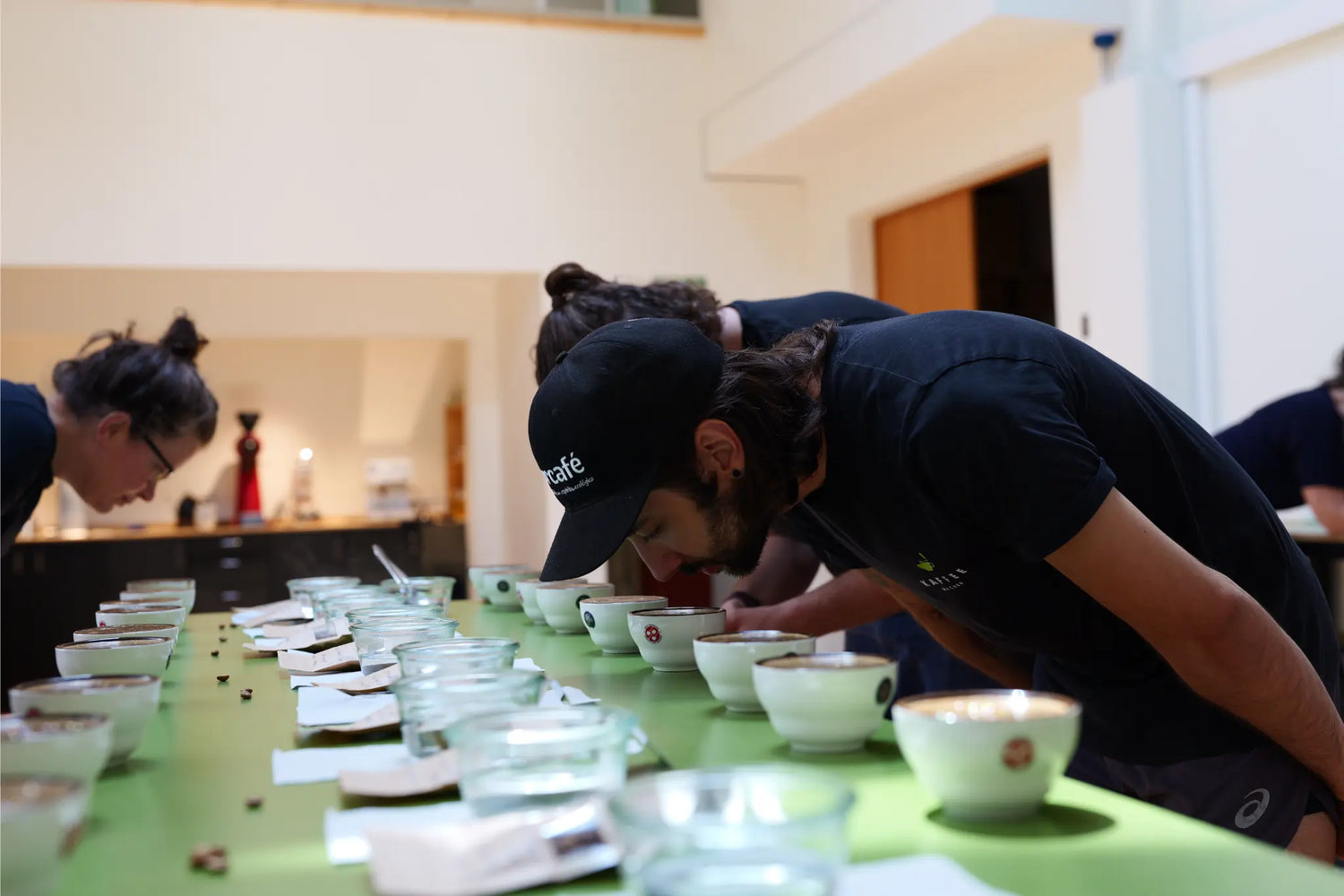
Tasting coffee, or cupping as it's called, plays an important role in the world of coffee. In the countries of origin (exporting countries), where coffee is grown, quality control of the produced product is carried out this way. In importing countries, among us consumers, buyers use cupping to verify that the delivered quality matches the order. Roasteries use cupping to define which type of beverage they want to roast the coffee for. And we at home can find out whether we like the coffee.
This article explains how you can taste coffee at home and puts the significance and use case of cupping into context. What is a cupping?
What is a Cupping?
A cupping is the method used for tasting green coffee. For this, a coffee sample is roasted according to a preset standard, ground, and tasted by slurping the coffee. The standardized process makes it possible to evaluate and compare coffee objectively.
Under scrutiny are 10 different attributes, each of which can achieve a score of up to 10 points - a total of 100 points. In addition to aroma and flavor, acidity, body, aftertaste, balance, and overall impression are also rated. Sweetness, uniformity, and cleanliness round out the attributes to be evaluated.
Starting in October 2025, a new evaluation form will be introduced. The Coffee Value Assessment, or CVA for short, we have discussed and analyzed in detail here.

Simple Step-by-Step Cupping Guide
Short and sweet, for home or in the workplace, here's the basics of cupping. Taste coffee with ease like the professionals do. Tip: Read through the entire guide once before you start.
Your Preparation
Foreign odors impair sensory perception.
If you want to sensorily analyze coffee (or wine and beer), make sure there are no foreign odors in the room. After all, the scent of roses, linden blossoms, and jasmine should come from your coffee and not from your perfume.
What You Need:
- 1x grinder
- 1x cupping spoon or tablespoon
- 1x cup or glass 200ml (if smaller or larger, maintain brew ratio)
- 1x cup or glass to rinse the spoon (size doesn't matter)
- 1x kettle
- 200ml soft water (for example Volvic, Black Forest)
- 12gr coffee (or brew ratio 1:16.66 = 6 g coffee per 100 g water)
- Paper and pen
- Stopwatch
The Basics of Cupping - Short and Sweet
- Grind coffee polenta-fine (700-1000 microns)
- Smell the dry grounds
- Heat water to 93-96°
- Start the stopwatch and pour water to the brim over the coffee, making sure to wet all grounds
- Smell the crust
- After 4 minutes, break the crust
- Skim off particles floating on the surface without stirring up the sunken coffee
- Taste the coffee (see below)
- Record your impressions - why do I recognize this coffee again?
- Cleaning: don't pour coffee grounds down the drain; instead pour them through a fine sieve and enjoy the rest. Use coffee grounds as fertilizer for plants.
Between each step, always rinse the spoon with water.
The Individual Cupping Steps Explained in Detail
Notes
In a cupping, it's essential to record your tasting with notes. This can be done using an official SCA score sheet, in a personal notebook, or a cupping app. What's important is that through your notes, you can recognize the coffee again. On a professional level, the whole thing is done on an objective basis. At home, you're welcome to let your subjectivity flow in, after all it's about whether you like the coffee or not. But also note here what you particularly like about the coffee.

SCA Arabica Cupping Form
Number of Cups
For a professional tasting, 5 cups of coffee are individually brewed. The coffee is weighed and ground individually into each cup. This makes it possible to identify and name any potential errors or defects in the coffee. The uniformity of the coffee is examined. If only one cup were poured, you wouldn't know whether the perceived off-flavor is actually one, or whether all the coffee smells like that and perhaps has inferior quality.
Brew Ratio
For 12gr coffee we use 200ml water. If you use a smaller or larger cup or glass, make sure to maintain the brew ratio. For 150ml water you take 9gr coffee (1:16.6). By the way: our brew ratio does not match the specifications and standards of the Specialty Coffee Association. They recommend a brew ratio of 8.25gr per 150ml, or 1:18. We prefer to taste a bit stronger, as this brings out the attributes better for us, and our preferred brew ratio for filter coffee is also 1:16.66.
Grinding
Grind your coffee polenta-fine (700-1000 microns). You can also use your hand grinder beautifully for this. Clean the grinder with a few coffee beans to eliminate any residue in the grinder before you grind the 12gr for the cup.
Dry Grounds
Place the ground coffee in your vessel. Smell the dry grounds and note your impressions. What aromas can you detect?
Water
On our Youtube channel we published a detailed video on perfect coffee water. We recommend a water hardness of 2 - 3 total hardness in German degrees and a corresponding alkalinity of 1 - 2 German degrees. Not sure if your water is suitable? Here you can see how to test your water at home.
Heat the water to 93-96°. Pour the water over the ground coffee and start the stopwatch. Fill to the brim and make sure all particles are wetted.
Smell the Crust
Smell the crust that forms. Do your initial impressions confirm themselves? Do you find additional aromas?
Break the Crust
After 4 minutes, slowly break the crust with your spoon by pushing the particles from front to back. Don't stir, just push back. Repeat this 3 times. As the crust breaks, volatile aromas unfold. These dissipate quickly, which is why the aroma assessment must be done immediately.
Skimming
With your spoon, you can now skim off the particles floating on the surface. They affect tactile sensation and are also bitter.
Slurping
After another 4-5 minutes, you slurp the first sip. As with wine tasting, in cupping we also try to add air so that we can also perceive the retronasal aromas. This gives us the full bouquet and the complete taste profile.
With the first sip we analyze the flavor and get a first impression of body and acidity. During the second slurp, we focus on the aftertaste, the balance, which means the balance between the other attributes. The third time we slurp, we pay attention to the persistence of the coffee (did it improve/worsen/become more intense as it cooled?) and we evaluate the overall impression.
Why Do We Taste Coffee?
Cupping is the method for sensorially analyzing green coffee and evaluating its potential as roasted coffee. Depending on the growing region, variety, harvest process, post-harvest process, and the producer's interests, the coffee tastes completely different. So various parties along the value chain have different reasons for testing the green coffee thoroughly.
The Producers
Through cupping, producers verify their work. Just as a winemaker repeatedly checks the quality of his wines during aging, coffee producers do the same - but only at the end of the entire process. At the end of a long journey from flowering through processing to green coffee stands cupping - and it decides between success or failure. All the work on the coffee farm is reflected in a few cups and a single sip, showing the producer whether their efforts will pay off. Based on the cupping and the sensory impression gained, the producer can now bring her coffee to market. And already knows for next year in which steps she might optimize or whether the adjustments made this year have already paid off.
Note: many coffee producers don't taste their coffee. In particular, small producers have often never drunk their coffee the way traders, roasters, or consumers taste it. There is a lack of access to training and equipment. As a result, many coffee producers lack important prerequisites to know the value of their coffee and to offer it accordingly on the market.
The Traders
Traders or dealers trade in green coffee. They are the hub of the coffee industry, whether on a small or large scale. However, more and more roasteries and producers are trying to bypass the intermediaries and buy or sell their green coffees as directly as possible. However, this is not as simple as it appears at first glance. Whoever buys green coffee is in many cases the intermediary between producers and roasters. The interest in tasting lies in selling buyers the desired flavor profile and quality. With modern traders, it's long been not just about quality, but also about sustainability aspects related to people and animals that are tied to coffee production. Because coffee brings a lot of baggage from earlier times as well as current times.
The Roasteries
Roasteries lay the decisive foundation with their profile for whether their customers, in addition to their philosophy, also share taste preferences and whether, depending on their personal standards, they shop with them for exactly that reason. Through cupping, the roastery decides which coffees it wants to use for its end products and how the characteristics of the individual roasted coffees should be. If an elegant espresso with delicate acidity, notes of honey, caramel, and citrus fruits is desired, the team looks for a corresponding green coffee. Finding the green coffees that match both in taste and ideologically is probably one of the bigger challenges for a modern roastery.
The Consumers
Ideally, we drink coffee that knocks our socks off. But how do you find out which coffee you like best? Whether you prefer subtle aromas or funky flavors? Which post-harvest process convinces you the most? Which flavor profile you want to enjoy at which time? Whether you can even tell the difference between different varieties and countries by smell, taste, and feel? One thing upfront: yes, you will. So consumers can also use cupping to find out what flavor profile is theirs.
Q-Grader - the Licensed Coffee Taster
A Q-Grader is a person who has successfully passed 21 sensory tests and thus receives a 3-year license as a certified coffee taster. What is only familiar to few of us is an respected profession in certain coffee-producing countries such as Honduras - with far more pay than, for example, a teacher. After 3 years, this license must be renewed. The license is obtained for Arabica or Robusta.
Further information about the Q-Grader including a video from Michel and Philipp can be found here. Among us coffee makers, David, Michel, Benjamin, Philipp, and Nadja are trained as Q-Graders, of which Benjamin and Nadja have both the Q-Grader Arabica and Robusta.
Want to Participate in Our Next Online Cupping?
Sign up here if you want to be informed about future cuppings.
More Topics on Sensory
Learn more about cupping and tasting: Sensory Course
Test kits for water hardness determination buy in CH
Test kits for water hardness determination buy in DE
The influence of coffee processing methods on taste