

















Why does coffee taste the way it does? Growing conditions and varieties are part of the answer. The other part is the role of fermentation in flavor development. How do washed coffees differ in taste from honeys, naturals, and experimental fermentations? We clarify the terminology and explain where coffee aromas can come from.
"This coffee shows notes of cherries and milk chocolate." Anyone who engages with coffee eventually encounters increasingly precise descriptions of how the coffee might taste. What used to be more of a specialty roastery's favorite discipline is now also cultivated by traditional and major roasteries.
A precise sensory description is meant to help consumers form a good impression of the coffee and to sharpen their senses before the first sip, to discover something new or previously overlooked in the coffee. It should be noted, however, that every sensory impression is individual and shaped by one's own biography.

When something tastes like an apple, we immediately have a picture in our mind's eye. But whether the apple is yellow, red, or green depends on our own experiences.
In coffee sensory evaluation, we like to talk about a vocabulary that helps us express our impressions precisely. We find this vocabulary, for example, in the Flavor Wheel of the SCAA, which was created in 1995 and renewed in 2016.

2016 version of the SCA Flavor Wheel

The 1995 version
Additionally, in early 2025, the first study on a Canephora Flavor Wheel was published.
The collection of descriptive words is diverse. The Flavor Wheel first groups aroma categories before differentiating from the large groups. While fruity and nutty notes are positively connotated, notes like petrol or medicinal can interfere with enjoyment.
The aroma wheel gives us a selection of aromas that can be tasted more or less frequently in coffee, regardless of whether they are positive or negative. But where do these aromas actually come from? And how do they get into the coffee?
This article consists of two parts.
Coffee processing / post-harvest process - terminology and influence on coffee taste
If we imagine coffee as a puzzle, we notice countless small particles needed to make everything fit together perfectly. This applies both to a perfectly brewed espresso and to green coffee.
Before sowing a coffee variety, it must be considered whether the soil provides the nutrients it needs. Likewise, whether the chosen variety gets the degree of sun or shade it needs for balanced growth. And when coffee cherries are on the tree, the producer decides exactly when to pick them - because red is not always the same red.
Like a traffic light, the color of the coffee cherry shows whether it is ripe.
There are large differences in the shade of red, which can affect the taste of the coffee.

From the moment a cherry is picked, we speak of the post-harvest process or processing. Once the cherry is separated from the stem, a small wound opens in the so-called exocarp.
Bacteria and yeasts can now react and activate the metabolism, the fruit comes into contact with oxygen, and the opening attracts insects with its sweet aromas, which in turn carry bacteria and yeasts with them. Each stage the coffee cherry is now in potentially has an influence on the quality and thus the final taste of the coffee.

The post-harvest process does not begin with the drying of the cherry, pulping, or fermentation, but precisely when the cherry is separated from the stem.
What matters now so that all the positive properties contained in the coffee cherry result in good taste is clarified in the following sections.
Step 1: from tree to further processing
The following points should be observed when cherries are separated from the stem
clean storage location
- where do the picked cherries go? Usually, workers pick the cherries and put them in a cloth, a plastic bag tied around their waist, or a woven container, etc.
- when this is full, they put the cherries in a larger plastic bag. These bags quickly become a melting pot of insects, bacteria, sugars, and yeasts, which can trigger unwanted fermentation
- the longer coffee cherries lie in the bags, the greater the risk that unwanted or off-flavors form even in the first step after picking
- the bags must either be replaced or always washed well

Plastic bags with depulped and washed coffee are placed on a tarp and not directly on the ground.
not too much weight, not too large bags
- if you've ever been to a grape harvest, you might have seen that particularly valuable grapes are transported in only one layer in small, multi-level containers. This reduces the weight pressing on the grapes and prevents them from being crushed
- coffee cherries are considerably harder than grapes, but it can happen that the bottom cherries in the transport bag are already crushed
- these cherries should be sorted out before further processing for the highest quality standards
time until the next step
- The time until the next processing step is crucial
- strategies and opinions on this vary widely
- it is still recommended in globally applicable literature to pulp coffee cherries as quickly as possible to avoid "risking" fermentation - which makes it clear that for many, fermentation is unwanted and a source of danger rather than an opportunity for more aroma
- in fact, the time of intermediate storage of the cherries before the next processing step is decisive, depending on what is being pursued
-
often coffees that are mechanically demucilaged or depulped before water treatment are processed very quickly (the same day)
-
especially from Colombia we know that producers treat coffee cherries with ozone to eliminate yeasts and bacteria on the surface. In further processing steps, they now work with the microorganisms inside the cherry, or add starter cultures
-
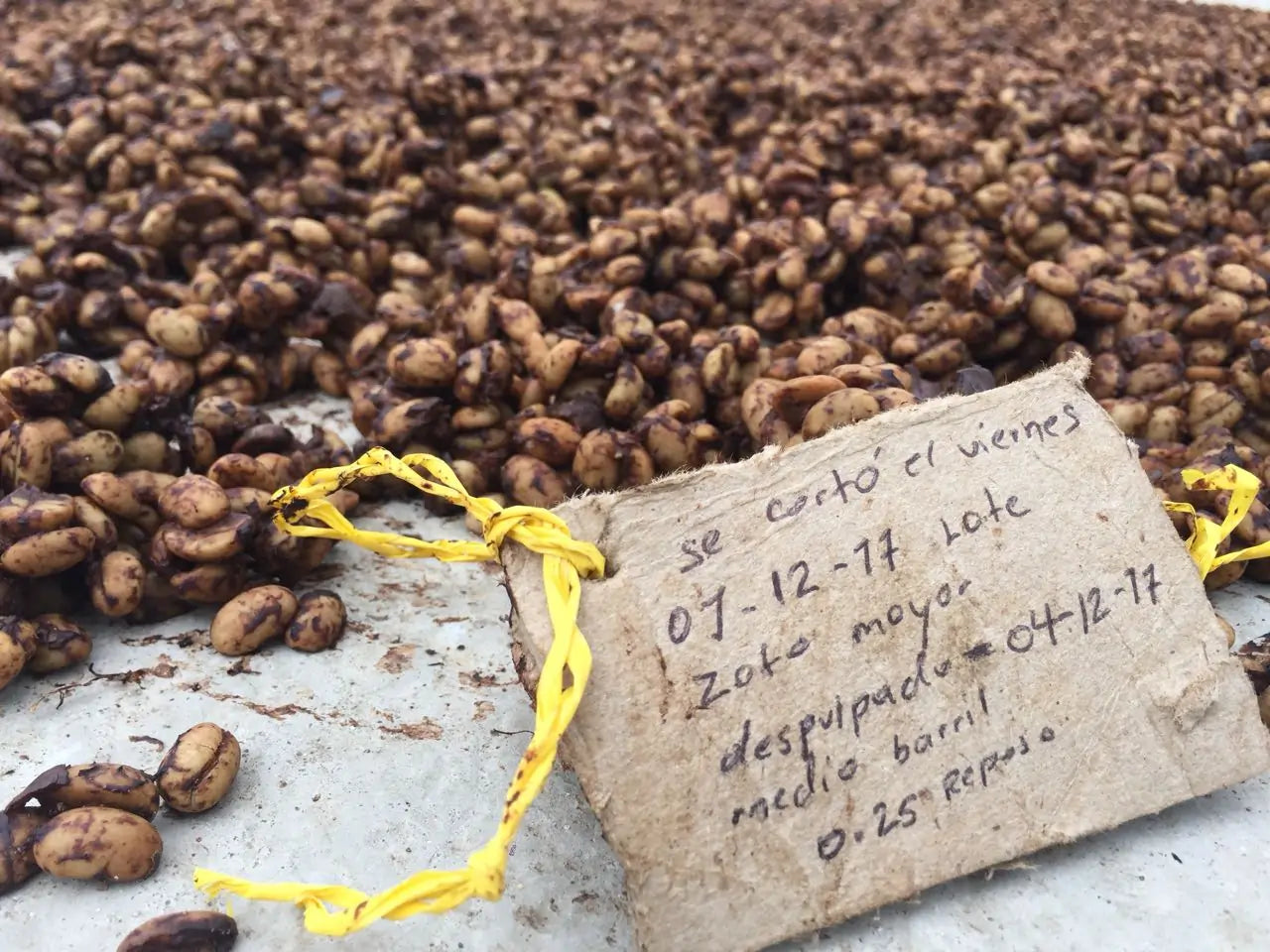
in large parts of Central America, the tradition of reposa exists, a storage of coffee cherries for several hours before they are processed further
-
in Nicaragua, for example, we use a 16-hour pause of the cherries before further processing. In contrast to the control sample, which is processed immediately, we observe slightly more sweetness and acidity in the roasted coffee
-
we had this scientifically accompanied by the ZHaW: you'll find the work further below
Step 2: the dilemma of choice - pulp or not pulp?
Whether the coffee underwent a reposa or whether the cherries were processed shortly after picking has no influence on the following steps. The decision must now be made about what happens to the coffee cherries: is the pulp pressed away or does it remain intact?
The picked and sorted quality plays a large role here. If mostly under-ripe cherries were picked, direct drying of the coffee cherries (so-called natural) is hardly intended. The cherries bring too little sugar, which could provide new aromas in intensive fermentation. If the cherries are very ripe and uniformly sorted, all further processing steps are suitable.
With all further steps, aroma can now be added to the coffee that was not present before.
Targeted fermentation creates aroma precursors, which are then converted into aromas during roasting.
A fundamental decision: remove pulp or not?
Is the coffee cherry dried as an intact cherry, or is the pulp (so-called mesocarp) removed? This decision not only defines the further procedure but also the intention of which aroma should be promoted.
1. Remove all pulp: mechanical demucilagination
- here machines called demucilaginators or eco-pulpers are used
- large machines that not only expose the seed but use friction and high-pressure water jets to remove all mucilage
- this prevents fermentation from occurring
- the coffee beans come out as wet parchment after a few minutes and go into drying as quickly as possible

*especially at peak harvest, when most coffee cherries are delivered for processing in a short time, the demucilaginadores are the most reliable and efficient tool for processing the cherries
**no fermentation occurs in this processing, so no new aromas are created that are not already present in the coffee seed as so-called aroma precursors. Depending on sensory standards, these coffees often seem somewhat austere. High-quality coffees often have a delicate, clean acidity. The texture depends on the ripeness of the cherries, as does the type of aroma. But since this often involves volume coffees, less uniform cherries end up in processing, which limits the aromatic complexity of the coffee.
Many options with demucilaginators
Due to their high efficiency and low water consumption, demucilaginators are now used worldwide. Newer generations of the machines allow the amount of mucilage that should remain on the coffee seed to be precisely adjusted. Especially in Costa Rica, producers refined this technique in the 2000s and invented various types of honeys.
2. Partially remove pulp: depulping
- here either a despulpadora is used, a pulping machine operated manually or mechanically - often with gasoline
- cherries fall into a hopper and are pressed by a rotating drum against a front plate, where the pulp is separated from the seed
- depending on cherry size and pulp thickness, adjustments must be made to the front plates so the beans are pressed out of the cherries without damage
- most of the slime (mucilage) remains on the seed

Despulpadoras are not designed to remove all pulp and thus the slime, which is why the process of fermenting as a biological process (= loosening the slime) and washing developed - more on that later.
3. Keep the cherry intact - the pulp stays on - Natural
- the oldest method of further processing coffee after picking is drying in the coffee cherry
- the method is also known as natural processing
- in the most rudimentary version of this processing, the coffee cherry is laid out in a dry place until the seed inside has a residual moisture of about 12%
- in the meanwhile highly refined methods, technical and biological aids are used to create ever more aromas that were not previously present
- natural processing produces both the best and worst coffees I have ever tasted

The coffee world between the poles - all other types of processing
Until around the turn of the millennium, the burning question in post-harvest processing was: washed or not washed - naturals were for decades the way coffees were dried, but we're talking about a different level of precision in how this is handled today. With increasing efficiency in processing and new market demands, there was a steep increase in wet mills or beneficios starting in the 1970s, central stations where coffee cherries were depulped and washed.
The ability to depulp and wash coffee was a major step toward consistency for many processors. Processes could be better controlled, and general coffee quality increased as a result, which also helped shape mass taste.
With the emergence of specialty coffee, the search for ever new taste notes, the research into microorganisms in the cherry, and a holistic understanding of fermentation as a tool for creating new aromas, the motivation and experimental spirit of producers increased.
Since the 2000s, we have seen a steep increase in post-harvest processes that fall between the poles of depulped and non-depulped coffees.

New markets with new taste preferences have sparked creativity in post-harvest processes as much as pragmatic considerations:
how can more water be saved in the processes?
How can a lot of coffee be processed in little space?
And how can complex aromas be created with simple means?
We regularly receive coffees that have been processed with new technologies, sequences, or bacteria. The field for experimentation is open - and when it tastes good, these coffees find a market. Yet these coffees also regularly perplex us. I expressed myself on this a few years ago here.
Fact sheet on post-harvest processes
Over the years, there have been repeated efforts to break down the now steadily growing number of post-harvest processes in a graphic.
We are currently working on our own graphic, which we will also publish here. We would like to share two graphics with you though. One is by Tim Willems from 2019, who manages our farm in Nicaragua. The other is by Chris Kornman of Royal Coffee.
Both graphics are very precise. While Tim focuses on the sequence, Chris names the individual work steps that do or do not occur for a given post-harvest process.
Chris Kornman, Royal Coffee, 2020


Naming, taste preferences, and possibilities
So far, the focus in our article has been on the mechanical processing steps, namely whether the coffee pulp is removed or not. The explanation in processing steps will always be more precise than naming the fermentation method - or who knows what a koji fermentation is? Those in the know might be familiar with this post-harvest process. The name implies that koji fungi were used, but not how, when, at what temperature, how long, and at what intensity. Even with a koji fermentation, there are countless possible combinations of processes.
The more we discuss the work steps and less the melodious names, the better we come to understand what exactly is meant by which coffee fermentation.
The choice of method for how coffee is further processed after picking depends on various factors. And just as there is no best coffee, there is no best processing method for coffee. The post-harvest processes always depend on
- the volume of cherries to be processed
- space constraints
- access to know-how
- access to tools
- access to capital
- target market - mass market or niche market
- etc.
On many farms today I see rain barrels that, since the beginning of the 2010s especially in Costa Rica have been used for so-called anaerobic fermentations before this approach spread worldwide. These barrels are cheap and stable.
The more capital-intensive variant involves working with steel tanks, as is done in wine production. The basic effects are the same, however, even more pressure can be applied in steel tanks, analogous to maceration carbonique in Beaujolais wine.
This method first became established in a small circle of coffee producers and is still found in many places today. Those who conduct this process in a cooler environment prolong the fermentation and create yet another new taste profile. For this purpose, specially climate-controlled rooms are created where the coffee ferments.
It seems that today every new idea for a modified fermentation protocol is received with great curiosity, applied, refined, and further developed. However, by a very small circle of coffee producers who bring the know-how, technical infrastructure, and a potential buyer network.
This harbors opportunities and risks, but above all it accelerates knowledge growth on the production side. The sensory diversity of these coffees can hardly be compared to a "traditionally" washed coffee.
Part 2: How do coffees from various processing methods taste?
Through various processing methods, aromas can be added to a coffee that it did not previously have. Depending on which post-harvest process is chosen, other attributes such as aromas, flavor notes, acidity, and texture can be influenced.
Graphic

From our experience, texture is the least changed by the type of fermentation. New aroma, on the other hand, arises relatively quickly from the process.
The prerequisite for a soft and round texture is a high and uniform ripeness.
If this is not present, fermentation cannot produce "softness" - except, and I have tasted such coffees for the first time a few years ago from La Palma y el Tucán, when lactic acid bacteria are added, which often have a positive effect on texture. Similarly, a reposa, which we do as standard in Nicaragua, can somewhat increase the perceived texture - but only if the cherries are already well ripe and uniform. You need good raw material to achieve a good or even better fermentation result.
Excursus on coffee fermentation: from risk to opportunity

How does coffee taste when depulped in a demucilaginador (eco-pulper)?
Coffees depulped and demucilaged in a water-saving demucilaginador come closest to what is called washed coffees. Before demucilaginators existed, fermentation helped remove mucilage as a mechanical process before the coffee was washed.
Today, using demucilaginators is becoming standard practice at medium to large beneficios. No fermentation occurs in this process because the seeds are pressed out of the cherry and demucilaged in minutes.

Ecopulper / Demucilaginator at Finca La Bastilla in Nicaragua, 2017
Sensory remarks
- this efficient type of washed coffee often shows the pure character of the green coffee.
- The ripeness level and uniformity become clear - high ripeness favors soft texture, high uniformity makes for a balanced cup
- since no fermentation occurs, no new aromas are added to the coffee
- the acidity is often very present, complex aromas play a secondary role
- these coffees show what the base can offer in a region

Mucilage, honey, slime, Finca La Bastilla, Nicaragua, 2017
What does a reposa, a pause before depulping, achieve?
When picked coffee cherries are not depulped immediately, but first rest for several hours in a controlled environment, it is called a reposa - a pause - in large parts of Central America.
I first encountered this years ago in Nicaragua, when I saw a full collection hopper for coffee cherries late in the evening. I asked my companion if the cherries didn't need to be depulped immediately? "No," he said - the reposa in a cooler environment (due to nighttime temperatures) slowed down fermentation, "not much could happen".
The next morning the coffee was depulped, fermented under water, and washed. Today this process is our standard process at Finca Santa Rita in Nicaragua. We wanted to understand what exactly happens and conducted a research project with the ZHaW. A sample was processed with the reposa, and the control sample was processed without reposa.

Barbara Beck (photo above) examined and documented the development of yeasts, bacteria, and acids in this paper.
Sensory remarks
We rated coffees with a reposa about 1 point higher, e.g., 83 instead of 82. Reposa coffees often show more sweetness, more texture, but especially better integrated acidity. Sometimes we encounter reposa coffees that bring a light fruitiness with them.

How does coffee taste that has been depulped on a despulpadora?
Especially on smaller farms or in smaller, centralized beneficios, coffee is separated from pulp with despulpadoras. Since most of the slime remains stuck to the seed, the producer faces only the decision of whether to dry the coffee with the mucilage on the seed (honey) or whether to remove the mucilage through fermentation as a biological process. This fermentation can be done in the open air, in a closed container, or under water. The time for hydrolysis, the breaking down of the pectin that holds the slime together, varies depending on the chosen method and potentially affects the taste.

Despulpadora on Mil Variedades, our farm in Nicaragua
Sensory remarks
Depulped coffees often bring the taste of a washed-demucilaged coffee that can display further facets.
- often the aromas are more intense and go beyond the basic coffee flavor
- the acidity often gains in complexity
- depulped coffees in parchment that ferment under water often gain a bright, clear, and fresh acidity
- depulped coffees in parchment that ferment without water often gain more fruity notes.
- Depending on whether the coffee is fermented in even layering or an uneven pile, the coffees show more evenness/unevenness
How do honey processed coffees taste?
Coffees depulped on a despulpadora are - as described above - fermented to loosen the slime. The slime, or mucilage, is often called miel in Spanish, meaning honey. In back-translation to English, miel becomes honey, and so we talk about the honey process when we mean depulped coffee dried with the mucilage layer.
The proportion of slime layer and the length of drying, as well as the thickness of the stacked layers and the prevailing temperature. Less honey on the seed promotes faster drying of the seed to about 12% residual moisture, more honey requires longer drying.

A honey-processed coffee dries in Ocotal, Nicaragua
Particularly in Costa Rica, different residual amounts of honeys are used. Less honey on the parchment, e.g., 25%, allows faster drying. This type is often called white or yellow honey, because the little miel on the parchment turns yellowish. With 50% or more honey, the coffee in parchment dries slower and the color of the honey turns reddish, with so-called black honey even dark brown. The variation in drying time in combination with the proportion of honey on the parchment knows no limits.

A black honey, Ocotal, Nicaragua
Sensory remarks
- white honeys often remind of washed, and/or under water fermented, depulped coffees. They show a balanced coffee, often with pronounced acidity
- yellow honeys often bring a bit more perceived texture and slightly fruity nuances to the cup
- red honeys already show distinctly fruitier notes obtained through fermentation on the seed. Often the acidity recedes into the background with this type
- black honey coffees are often accompanied by dark fruity, to chocolatey, or also lush fruity notes
-
generally more intensive honey processes can add a new layer of complexity to the coffee, often a pronounced texture
however, we also encounter many honeys where the clarity of aromas and acidity is obscured. This often has to do with the fact that fermentation on the parchment cannot be controlled very well - unlike, for example, intact cherries
How do naturals taste?
"Naturals," or "coffee seeds dried in the cherry," were in earlier times the opposite of "classically washed coffee." Today it remains true that coffee seeds dry inside the cherry before the dried pulp is rubbed off. However, especially in the last ten years, new types of fermentation and drying protocols for naturals have become established.
"Back then," it was said that naturals had more sweetness and less acidity. Today, the saying goes that basically nothing applies anymore.
We had naturals that were as lean as washed coffees. Then we had naturals that were lushly fruity, and then we had naturals that had much more (vinegary) acidity than their washed counterparts.
Many nutty-chocolatey coffees from Brazil are naturals, but not fruity (bubble far left in the diagram). The white arrows do not mean that all coffees that dry-ferment develop sensorially that way. Certain coffees are naturally fruity and can become even fruitier through targeted fermentation. Other coffees, such as those from Brazil, are more nutty-chocolatey. These coffees may not be given a tropical note if the green coffee does not naturally allow it.
The degree and duration of fermentation define the aromas that can be created through drying in the cherry.

Over recent years, we have conducted numerous fermentation experiments on our farm in Nicaragua. Many experiments failed or were labor-intensive but showed no massive sensory gain.
There are now no limits to creativity in how coffee can be fermented. This offers many opportunities but also carries risks.
How do heavily fermented coffees taste?
Heavily fermented coffees add notes to the coffee that would otherwise not be present. We often use terminology that we would not use for more classically processed coffees. It is important to open up to something new. Often the learned vocabulary is not sufficient to do justice to these coffees. It is similar to when we taste natural wine, where we also draw on different vocabulary.
Aromas that we repeatedly discover in heavily fermented coffees, we have collected in the graphic.

What does a cool room achieve?
A cool room, or cold room, are spaces that are cooled down with air conditioning to a maximum of 16 degrees. Coffee is usually first put in barrels and then brought to the cold room, where fermentation slows down or resumes.

Cold room in Nicaragua with nitrogen bottles to expel oxygen from the barrels.
The cooler temperatures slow down fermentation, so cold room fermentations can sometimes take 40 days or even longer. This can lead to super lush notes that are very intense. Our experience is that coffees from this fermentation often take longer to stabilize properly.
In 2018, we had a sample from Nicaragua for the first time that - to put it mildly - displeased us. We kept 1kg of the coffee and roasted it a year later. The coffee was suddenly balanced, no longer sharp and very sweet.
How do coffees taste with the addition of microorganisms?
By adding microorganisms during the fermentation process, which takes place in a controlled environment (e.g., tanks), new reactions between yeasts, bacteria, and sugars can be induced. This inoculation of the ferment, the substance to be fermented, only works if the microorganisms are still intact. For this, they must be cooled. This process requires not only a lot of precision but also high hygienic standards and a well-equipped laboratory. These are criteria that very few coffee farms can meet.
One farm that works creatively with bacteria and yeasts is Finca el Paraíso by Diego Bermudez in Colombia. These coffees often have lushly perfumed and fruity notes with strong intensity and an aroma spectrum not found in un-fermented coffees.
How do coffees processed with yeast taste?
Since the mid-2010s, coffees have been offered, first without comment, and later heavily commented on, to which isolated yeast strains were added during fermentation. I have written about the process and its derivation here.
Lucia Solis and Oleneska Cespedes are two engineers who make the subject precise and accessible to understanding. With Lucia Solis, I was involved in a project in Honduras where we scaled laboratory experiments with yeast fermentations to several tons.

Taste-wise, yeast fermentation - similar to wine - can be controlled with different yeasts. Lallemand were the first to launch a special yeast for coffee cherry fermentation almost a decade ago. We have also worked with various strains like Intenso or Cima in Nicaragua.
Intenso makes, as the name says, the coffee somewhat more intense, here fruitier. Cima somewhat lifts the texture and the finish of the coffee. Yeast cannot work miracles, but can amplify what is already there.
Coffee yeast is like an amplifier. Good may become better, bad becomes worse.
Again, it depends on how high the quality of the raw material, in this case the coffee cherries, is. Ripe cherries inherently bring a high degree of sugar, yeasts, and bacteria, the starting position is good, and added yeast can amplify or accelerate the metabolism.
Precision is required here: water temperature for mixing the yeast, the amount, and the retention time in a tank massively influence success or failure.

Cloak and dagger action with Lucia Solis and coffee yeast, 2018
How do coffees fermented with koji fungi taste?
Christopher Feran spent several years establishing a process with koji fungi, which in 2021 made big waves in the specialty world. Koji is widespread in Asia and is used to make sake, miso, and other umami-rich products.
The major advantage of koji is that the fungus's own enzymes convert starches into readily available sugars, which then form new compounds with existing bacteria and yeasts in fermentation.
Christopher's blog article on this reads like a mixture of history, science fiction, and recipe that makes you want to taste such coffees.
The coffees we have been able to taste so far are as fruity and sweet as the best yeast-fermented coffees are. Coffee Circle recently had a koji-fermented coffee in its assortment.
But here too: any inoculated fungal or yeast strains can only work as well as the raw material allows. The cherries must be of high quality for the process to produce desirable aromas.

Koji growing on coffee cherries. Source: Christopher Feran's blog