













Coffees are tasting increasingly complex. Experimental fermentation practices are bringing forth new flavors that we haven't previously found in coffee. We humans are getting involved and adding something to the coffee that wouldn't otherwise be there. Where is this journey heading for producers, roasters, and consumers?
Part 1: Challenges
Sensory evaluation: How do we assess these coffees?
Developments on the coffee production side are sometimes rapid. We hear about Anaerobic Fermentations and Double Barrel Fermentations and Carbonic Macerations. What all sounds interesting are designations that are heavily borrowed from wine production. Sometimes these names also sound very artistic. Here there seems to be an opportunity for producers to make a name for themselves with an original name. We clarify what fermentation in coffee actually is in this detailed article.
This entire development is certainly very interesting from a sensory perspective – suddenly we find flavors of cherry liqueur, violets; these are heavy, boozy coffees, heavily fermented, without drifting into vinegary territory. These are new flavor profiles that are just emerging. A few years ago I tasted a coffee where the official cupping score sheet simply no longer seemed appropriate to me.
The coffee offered far more than I could have expressed through a rating sheet. The aromas were so diverse, I had never encountered such a coffee before. It was a multi-dimensional coffee that I couldn't match against anything in my sensory repertoire.

I rated it at 93 points. But here I clearly distinguish between a professional and a subjective assessment – I rated it highly to the best of my knowledge and conscience and based on my cupping experience.
My subjective assessment, however, was quite different – did I like the coffee? No. I wouldn't want to drink it again. There was simply too much flavor in too little space. But I'm convinced there is a market for these coffees. Only I don't think they're widespread in Europe.
Roasting: How do we roast these coffees?
Coffee roasters are increasingly coming into contact with these coffees. Us too. On our own farm in Nicaragua, we conduct numerous fermentation experiments and monitor them scientifically. The flavor notes we can create this way are sometimes truly absurd. In the positive sense.
However, we've also noticed that we need to roast these coffees somewhat differently. These are sometimes coffees that are absolutely bursting with aromaticity. It would be a shame to drown these in a more developed, darker roast. We almost always opt for filter coffees with this type of green coffee.
Roasting these coffees requires a lot of finesse to find the right roast profile. The aromaticity is intense, and that should be preserved, but the acidity is often also very intense, so it needs a bit more balance without jeopardizing the aromas. I'd also like to encourage all other roasters to try something new here, perhaps even to leave the familiar path of roasting and try something different.
The advances on the production and fermentation side are enormous. On the roasting side, I don't see that as much yet. I also wonder if our way of roasting is the right one to do justice to such coffees at all?
Enjoyment. Are these coffees a pleasure or an expansion of horizons?
I have the feeling that I'm becoming something – if you'll forgive me – a bit old and set in my ways. I notice how these coffees interest me technically and challenge me sensorily, but gustatorily they leave me somewhat cold.
Recently a friend, who at his age is certainly already a bit old and set in his ways, said it seemed to him like the American Chardonnays in the 90s.
A lot of texture, a lot of aromaticity, a lot of everything, but little characteristic flavor.
a friend old and set in his ways about coffee
He finds it hard to take pleasure in them. He's into lean wines, elegant, distinctive. I understand him. That's how I understand coffee. I personally prefer elegant coffees, often tea-like, with limited complexity but high clarity. Those are coffees I can enjoy wonderfully. The «new-style coffees» (oh dear, I really am getting old) challenge me anew each time. I can't enjoy them yet, perhaps that will come.
2. Opportunities
Anyone who has been able to taste such coffees needs to show some openness, because they taste different. One could simply be dismissive about it and enjoy the coffee that tastes more familiar. One can dismiss this as «gimmicky», as «newfangled stuff» or as a «trend» – I've heard all of that in recent months. Or, we show a bit more openness and look more closely at who is making these coffees.
A post from a renowned cupper from Costa Rica irritated me recently. He was dismissive, as described above, about these
«trendy cinnamon fruit bombs», that's no longer coffee. He preferred the crystal-clear, juicy and naturally fruity coffees from Tarrazú – which is one of the highest altitude growing regions in Costa Rica.
Cupper from Costa Rica
And here lies the problem. Not all producers have a finca at nearly 2000 m elevation. The majority don't. The majority are well below that and producing coffee for a market that often can't cover production costs. A different market channel could help. One that seeks extreme flavors.

With extreme fermentations we create extreme flavors – and that also at 800 m elevation. Of course, not just any raw material can be used; only well-sorted, ideally very ripe cherries result in great green coffee in the end. But the altitude at which coffee is grown could suddenly become relative.
And that is a huge opportunity for all producers who didn't draw the big prize of a finca at altitude, but like the vast majority of coffee farmers still sit in the sensory middle ground.
3. Risks
"For they know (not) what they do"
Heavily fermented and delicious coffees don't just happen. They are not a random product, but the result of a precise, controlled and intentional post-harvest process.
We often hear of «over-fermentation» when something tastes heavily fermented. We disagree with that. Either something is controlled fermentation, or it isn't. Lucia Solis recently made the comparison in a podcast to a pregnant woman – either a woman is pregnant, or not. But she is not a little bit pregnant, or too pregnant. Either she is, or she isn't. Just like coffee that was fermented, or not.
«Over-fermented» carries a clear subjective note and historically stems from the fact that uncontrolled fermented coffees were often called that. Coffees that smell and taste of vinegar, leather, rotten fruit, etc. Those are defects. And they are the product of uncontrolled fermentation, not over-fermentation.
These «modern» flavor profiles tend toward strong, lush fruit notes, often with heavy floral aromas. They remind me of old ladies' perfume.

Creating such a profile requires a lot of knowledge. The know-how must be present, otherwise it won't turn out well and the coffee ferments uncontrolled. Producers who know what they're doing always go to extreme lengths and create even more intense flavor profiles
Producers who've heard about it and now want to try something take on quite a high risk of doing many things not quite correctly. This can result in uncontrolled fermentations.
The pH value, the temperature, the available sugar, the presence of air, the headspace in a sealed container, the agitation, the temperature development, etc. – all of these are factors that must be taken into account in such a fermentation. Otherwise it quickly becomes leathery, vinegary and stinky.
Copy-paste. Will soon all coffees taste the same?
We are fortunate that we get to taste a lot of different coffees. If we don't order samples ourselves, we have them sent to us. Often including such intensely fermented coffees. That expands the sensory horizon.
The problem here, however, is that I remember much more a general flavor profile than unique, distinctive characteristics.

A coffee from Flores, Indonesia, recently stood on the table next to a coffee from Colombia, and both tasted suspiciously similar. The post-harvest process was such that the cherries first spent 6 days in a barrel without air before being dried as Natural for more than 25 days.
This intensive process created such similar notes in both coffees that I almost confused them. The Colombian tasted like the Indonesian.
«Is that tragic now?» some may ask. Perhaps that's just the way things go. Others, meanwhile, see here a «loss of retention» and might long for profiles that were standard twenty years ago, but today are giving way due to socio-economic, botanical, and climatic conditions.
I am neither a terroirist, someone who seeks «retention» in coffee. Those who know me better know how much I'm at odds with this term. Nor am I someone who blindly chases after new developments. I see myself as a bystander in this discussion, because:
Is it up to us roasters to decide what coffee producers should produce and ferment?
Would someone dictate to a winemaker which profile to expand and which to leave alone?
I don't think so.
I rather believe that here for once the «free market» of sensory preferences will decide. What resonates, that's decided by coffee drinkers, and that's roasters and coffee drinkers equally. We should simply refrain from dismissing these new developments under a «trend» – that would probably be too simplistic.
Are these coffees hygienically sound?
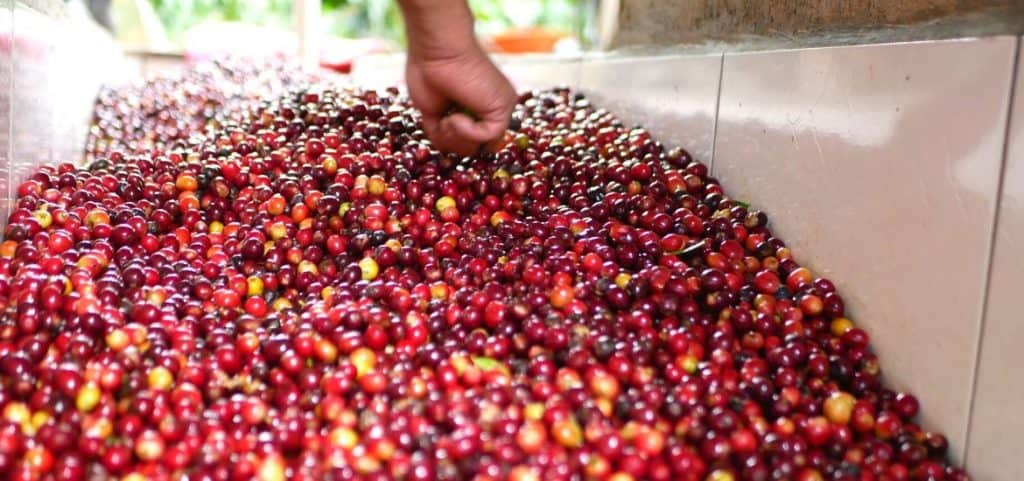
Intense fermentation notes stem from intensive fermentation. Countless microbes and yeasts degrade sugar, cause acids to rise and pH to drop. Yeasts eventually withdraw and bacteria take over. In some cases, mold envelops the half-dried cherry before it is dried in the shade for over 30 days.
It is a collection of life.

I am neither a biologist nor a health expert. And precisely for that reason I must ask this question – are these coffees hygienically sound? If so, are there studies on this?
Roasting kills harmful bacteria in coffee. Should coffees be affected by mold, however, the risk increases – aflatoxins, mycotoxins found in mold fungi, cannot be completely eliminated even by roasting and remain potentially carcinogenic.
Who can help here? Who knows someone who knows whether intensely fermented coffees can pose a potential health risk?
Conclusion
For me, it's far too early for a conclusion. We're only just at the beginning of this new era, where coffees from Colombia taste like Flores, where coffees in aromaticity remind us of heavy old-ladies' perfume, where we need to realign our sensory standards once again.
What are your experiences with these coffees? We're curious about your feedback and open to learning much more.